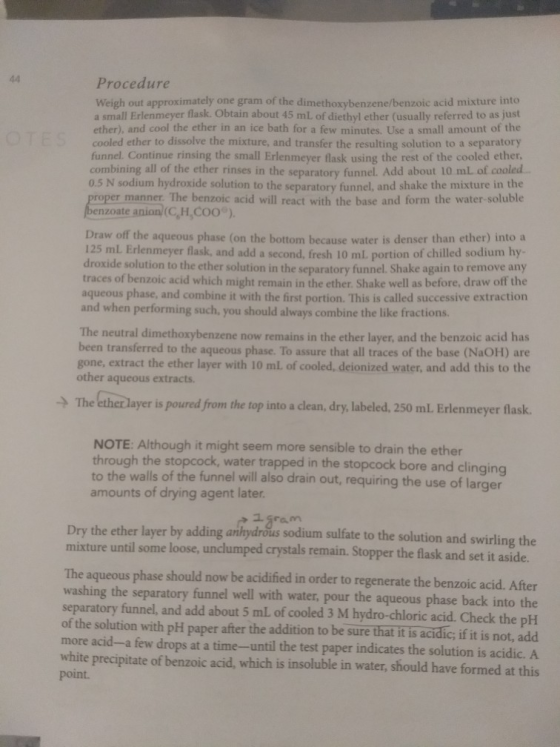
Procedure Weigh out approximately one gram of the dimethoxybenzene/benzoic acid mixture into a small Erlenmeyer flask. Obtain about 45 mL of diethyl ether (usually referred to as just ether), and cool the ether in an ice bath for a few minutes. Use a small amount of the cooled ether to dissolve the mixture, and transfer the resulting solution to a separatory funnel. Continue rinsing the small Erlenmeyer flask using the rest of the cooled ether. combining all of the ether rinses in the separatory funnel. Add about 10 mL of cooled 0.5 N sodium hydroxide solution to the separatory funnel, and shake the mixture in the rmanner. The benzoic acid will react with the base and form the water-soluble nzoate anion C H.COO°) Draw off the aqueous phase (on the bottom because water is denser than ether) into a 125 ml Erlenmeyer flask, and add a second, fresh 10 ml. portion of chilled sodium hy- droxide solution to the ether solution in the separatory funnel. Shake again to remove any traces of benzoic acid which might remain in the ether. Shake well as before, draw off the aqueous phase, and combine it with the first portion. This is called successive extraction and when performing such, you should always combine the like fractions. The neutral dimethoxybenzene now remains in the ether layer, and the benzoic acid has been transferred to the aqueous phase. To asure that all traces of the base (NaOH) are gone, extract the ether layer with 10 ml of cooled, deionized water, and add this to the other aqueous extracts The ether layer is poured from the top into a dlean, dry labeled. 250 ml. Erlenmeyer fask NOTE: Although it might seem more sensible to drain the ether through the stopcock, water trapped in the stopcock bore and clinging to the walls of the funnel will also drain out, requiring the use of larger amounts of drying agent later Dry the ether layer by ading anbydrois sodium sulfate to the solution and swirling the Dry mixture until some loose, unclumped crystals remain. Stopper the flask and set it aside. The aqueous phase should now be acidified in order to regenerate the benzoic acid. After washing the separatory funnel well with water, pour the aqueous phase separatory funnel, and add about 5 mL of cooled 3 M hydro-chloric acid. Check the pH of the solution with pH paper after the addition to be sure that it is acidic; if it is not, add more acid-a few drops at a time-until the test paper indicates the solution is acidic. A white precipitate of benzoic acid, which is insoluble in water, should have formed at this back into the point
Homework Answers
Dichloromethylne layer would be below aqueous layer.
Dichloromethylne (CH2Cl2) or methylene chloride is also called as DCM (organic layer). It has density of 1.33 g/cm3 and the density of water is 1gm/cm3. In separatory funnel when both organic (DCM) and aqueous layers (water) are combined, being denser Dichloromethylne layer would sink to the bottom or below the aqueous layer. The aqueous layer would be at top because of lower in density.
Add Answer to:
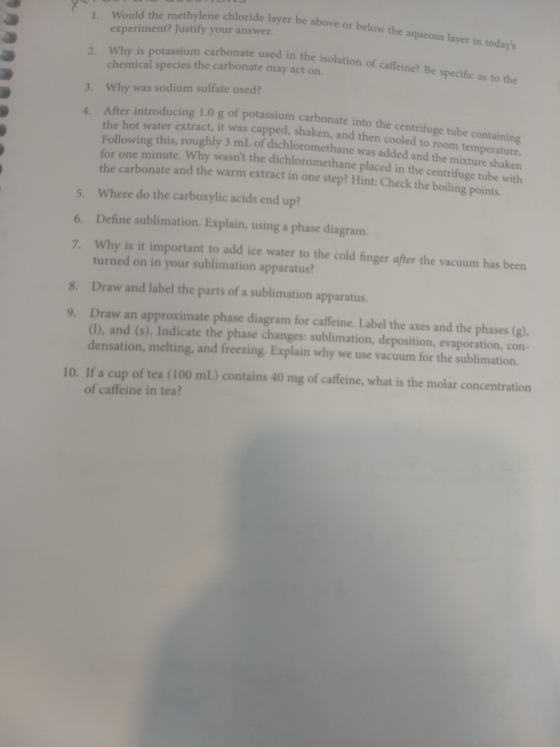
Would the methylene chloride layer be above or below the experiment? Justify your answer. 1. aqueous layer in today...
Experiment: A mixture of equal proportions of benzoic acid, ethyl 4-aminobenzoate, and 1,4-dimethoxybenzene are to be...
Experiment: A mixture of equal proportions of benzoic acid, ethyl 4-aminobenzoate, and 1,4-dimethoxybenzene are to be separated by extraction using the solvent diethyl ether. Day 1: Part A. Isolation of the basic component: In a small beaker, dissolve 3 g of the mixture (benzoic acid, ethyl 4-aminobenzoate, and 1,4-dimethoxybenzene) in 30 mL of diethyl ether and transfer the mixture to a 125- mL separatory funnel (see Fig. 1) using a little diethyl ether to complete the transfer. Add 10 mL...
Draw an extraction flow chart for the Extraction experiment you completed. experiment below Separation of a...
Draw an extraction flow chart for the Extraction experiment you completed. experiment below Separation of a Benzoic Acid/Biphenyl Mixture by Acid-Base Extraction Prepare the solution to be extracted by dissolving 2.5 g of a 1:1 mixture of benzoic acid/ biphenyl in 25 mL of tert-butyl methyl ether (MTBE) . Using a 125 mL separatory funnel extract the ether solution with a mixture containing 10 mL of distilled water and 15 mL of saturated NaHCO3 . Repeat After removing the aqueous...
Attached below are the pages from this lab report to help give context to the questions....
 Attached below are the pages from this lab report to help give
context to the questions. Please be as detailed as possible when
answering the questions and include any relevant information about
intermolecular forces at play. Thank you for your help!
Here are the questions which I need answered. Thank you in
advance for your help! :) Please be as detailed as possible and
discuss any intermolecular forces in detail if they are relevant to
the question. Thanks!
PARTA. SEPARATION...
Attached below are the pages from this lab report to help give
context to the questions. Please be as detailed as possible when
answering the questions and include any relevant information about
intermolecular forces at play. Thank you for your help!
Here are the questions which I need answered. Thank you in
advance for your help! :) Please be as detailed as possible and
discuss any intermolecular forces in detail if they are relevant to
the question. Thanks!
PARTA. SEPARATION...
Extraction of solids: Experiment outlined below Draw a “roadmap” of the experiment, containing chemical structures and...
 Extraction of solids: Experiment outlined below
Draw a “roadmap” of the experiment, containing chemical
structures and “layers” (organic and aqueous). This should contain
the individual reactions occurring in each step, and show which
layer the various components are present. Make sure you think about
whether the acetaminophen, caffeine and aspirin are neutral,
protonated or deprotonated.
Preliminary separation obtain a sample (1.0g) of the mixture. weigh the sample and record it. this sample should consist of a 2:1:1 mixture (by mass)...
Extraction of solids: Experiment outlined below
Draw a “roadmap” of the experiment, containing chemical
structures and “layers” (organic and aqueous). This should contain
the individual reactions occurring in each step, and show which
layer the various components are present. Make sure you think about
whether the acetaminophen, caffeine and aspirin are neutral,
protonated or deprotonated.
Preliminary separation obtain a sample (1.0g) of the mixture. weigh the sample and record it. this sample should consist of a 2:1:1 mixture (by mass)...
Why did you wash the ether solution with sodium bicarbonate? Write chemical equations for the rea...
 Why did you wash the ether solution with sodium bicarbonate? Write chemical equations for the reactions that took place. b. At which purification steps was the unreacted methanol removed in the reaction? Some of it may have been removed in more than one place. c. Three-Step Synthesis of Methyl Anisate (Step 3) 0 CHOH. Н.so, cat.) Wear gloves. Methanol is poisonous. Ether is an anesthetic, so don't breathe it. Sulfuric acid is a strong corrosive acid. Wash any you spill...
SYNTHESIS OF T-PENTYL CHLORIDE LAB Provide a stoichiometry table for the reaction being performed in this...
 SYNTHESIS OF T-PENTYL CHLORIDE LAB
Provide a stoichiometry table for the reaction being performed
in this lab.
PROCEDURE Preparation oft-Pentyl Chloride In a 125-mL separatory funnel, place 10.0 mL of tert-pentyl alcohol (2-methyl-2- butanol, MW = 88.2, d = 0.805 g/mL) and 25 mL of concentrated hydrochloric acid (d 1.18 g/mL). Do not stopper the funnel. Gently swirl the mixture in the separa- tory funnel for about 1 minute. After this period of swirling, stopper the separatory funnel and carefully...
SYNTHESIS OF T-PENTYL CHLORIDE LAB
Provide a stoichiometry table for the reaction being performed
in this lab.
PROCEDURE Preparation oft-Pentyl Chloride In a 125-mL separatory funnel, place 10.0 mL of tert-pentyl alcohol (2-methyl-2- butanol, MW = 88.2, d = 0.805 g/mL) and 25 mL of concentrated hydrochloric acid (d 1.18 g/mL). Do not stopper the funnel. Gently swirl the mixture in the separa- tory funnel for about 1 minute. After this period of swirling, stopper the separatory funnel and carefully...
The alcohol could easily be converted to a tosylate, a good leaving group, and a conventional sub...
 The alcohol could easily be converted to a tosylate, a good
leaving group, and a conventional substitution reaction could have
been performed instead of the nucleophilic aromatic substitution
(NAS) reaction. Why was the NAS reaction the preferred method?
(Hint : Look up the nucleophiles of both reactions on chemical
manufacturing site.)
Part A: Synthesis of (t)-N,N-dimethyl-3-phenyl-3-(4- trifluoromethylphenoxy)propanamine 1. To the 250-mL round-bottom flask (RBF) containing (t)-3-(dimethylamino)-1-phenylpropanol (product from Lab 6) and a magnetic stir bar, add 4 mL of 4-...
The alcohol could easily be converted to a tosylate, a good
leaving group, and a conventional substitution reaction could have
been performed instead of the nucleophilic aromatic substitution
(NAS) reaction. Why was the NAS reaction the preferred method?
(Hint : Look up the nucleophiles of both reactions on chemical
manufacturing site.)
Part A: Synthesis of (t)-N,N-dimethyl-3-phenyl-3-(4- trifluoromethylphenoxy)propanamine 1. To the 250-mL round-bottom flask (RBF) containing (t)-3-(dimethylamino)-1-phenylpropanol (product from Lab 6) and a magnetic stir bar, add 4 mL of 4-...
What is the purpose of shaking the ether layer with a saturated NaCl solution? What is...
What is the purpose of shaking the ether layer with a saturated NaCl solution? What is the purpose of adding CaCl2 to the ether layer? In this experiment you separated a mixture of benzoic acid, 4-t-butylphenol, and 1,4-dimethoxybenzene. You were instructed to dissolve the mixture in tert-butyl ether and extract with sodium bicarbonate first. Why can’t you extract with sodium hydroxide first? Explain. A mixture of lactic acid (pKa 3.86) and ascorbic acid (pKa 11.80) are dissolved in an organic...
The alcohol could easily be converted to a tosylate, a good leaving group, and a conventional...
 The alcohol could easily be converted to a tosylate, a good
leaving group, and a conventional substitution reaction could have
been performed instead of the nucleophilic aromatic substitution
(NAS) reaction. Why was the NAS reaction the preferred method?
(Hint : Look up the nucleophiles of both reactions on chemical
manufacturing site.)
Part A: Synthesis of (t)-N,N-dimethyl-3-phenyl-3-(4- trifluoromethylphenoxy)propanamine 1. To the 250-mL round-bottom flask (RBF) containing (t)-3-(dimethylamino)-1-phenylpropanol (product from Lab 6) and a magnetic stir bar, add 4 mL of 4-...
The alcohol could easily be converted to a tosylate, a good
leaving group, and a conventional substitution reaction could have
been performed instead of the nucleophilic aromatic substitution
(NAS) reaction. Why was the NAS reaction the preferred method?
(Hint : Look up the nucleophiles of both reactions on chemical
manufacturing site.)
Part A: Synthesis of (t)-N,N-dimethyl-3-phenyl-3-(4- trifluoromethylphenoxy)propanamine 1. To the 250-mL round-bottom flask (RBF) containing (t)-3-(dimethylamino)-1-phenylpropanol (product from Lab 6) and a magnetic stir bar, add 4 mL of 4-...
How can the NMP oxalate salt be converted back to NMP? Here is the procedure: PROCEDURES...
How can the NMP oxalate salt be converted back to NMP? Here is the procedure: PROCEDURES Part A: Synthesis of (±)-N,N-dimethyl-3-phenyl-3-(4-trifluoromethylphenoxy)propanamine To the 250-mL round-bottom flask (RBF) containing (±)-3-(dimethylamino)-1-phenylpropanol (product from Lab 6) and a magnetic stir bar, add 4 mL of 4-chlorobenzotrifluoride and 30 mL of dimethylacetamide (DMA). With stirring, add to this mixture 30 mL of 1.0 M potassium tert-butoxide (caustic alkali!) in tert-butyl alcohol using a syringe. Using a simple distillation apparatus, distill the mixture slowly, with...
 Attached below are the pages from this lab report to help give
context to the questions. Please be as detailed as possible when
answering the questions and include any relevant information about
intermolecular forces at play. Thank you for your help!
Here are the questions which I need answered. Thank you in
advance for your help! :) Please be as detailed as possible and
discuss any intermolecular forces in detail if they are relevant to
the question. Thanks!
PARTA. SEPARATION...
Attached below are the pages from this lab report to help give
context to the questions. Please be as detailed as possible when
answering the questions and include any relevant information about
intermolecular forces at play. Thank you for your help!
Here are the questions which I need answered. Thank you in
advance for your help! :) Please be as detailed as possible and
discuss any intermolecular forces in detail if they are relevant to
the question. Thanks!
PARTA. SEPARATION...
 Extraction of solids: Experiment outlined below
Draw a “roadmap” of the experiment, containing chemical
structures and “layers” (organic and aqueous). This should contain
the individual reactions occurring in each step, and show which
layer the various components are present. Make sure you think about
whether the acetaminophen, caffeine and aspirin are neutral,
protonated or deprotonated.
Preliminary separation obtain a sample (1.0g) of the mixture. weigh the sample and record it. this sample should consist of a 2:1:1 mixture (by mass)...
Extraction of solids: Experiment outlined below
Draw a “roadmap” of the experiment, containing chemical
structures and “layers” (organic and aqueous). This should contain
the individual reactions occurring in each step, and show which
layer the various components are present. Make sure you think about
whether the acetaminophen, caffeine and aspirin are neutral,
protonated or deprotonated.
Preliminary separation obtain a sample (1.0g) of the mixture. weigh the sample and record it. this sample should consist of a 2:1:1 mixture (by mass)...
 Why did you wash the ether solution with sodium bicarbonate? Write chemical equations for the reactions that took place. b. At which purification steps was the unreacted methanol removed in the reaction? Some of it may have been removed in more than one place. c. Three-Step Synthesis of Methyl Anisate (Step 3) 0 CHOH. Н.so, cat.) Wear gloves. Methanol is poisonous. Ether is an anesthetic, so don't breathe it. Sulfuric acid is a strong corrosive acid. Wash any you spill...
 SYNTHESIS OF T-PENTYL CHLORIDE LAB
Provide a stoichiometry table for the reaction being performed
in this lab.
PROCEDURE Preparation oft-Pentyl Chloride In a 125-mL separatory funnel, place 10.0 mL of tert-pentyl alcohol (2-methyl-2- butanol, MW = 88.2, d = 0.805 g/mL) and 25 mL of concentrated hydrochloric acid (d 1.18 g/mL). Do not stopper the funnel. Gently swirl the mixture in the separa- tory funnel for about 1 minute. After this period of swirling, stopper the separatory funnel and carefully...
SYNTHESIS OF T-PENTYL CHLORIDE LAB
Provide a stoichiometry table for the reaction being performed
in this lab.
PROCEDURE Preparation oft-Pentyl Chloride In a 125-mL separatory funnel, place 10.0 mL of tert-pentyl alcohol (2-methyl-2- butanol, MW = 88.2, d = 0.805 g/mL) and 25 mL of concentrated hydrochloric acid (d 1.18 g/mL). Do not stopper the funnel. Gently swirl the mixture in the separa- tory funnel for about 1 minute. After this period of swirling, stopper the separatory funnel and carefully...
 The alcohol could easily be converted to a tosylate, a good
leaving group, and a conventional substitution reaction could have
been performed instead of the nucleophilic aromatic substitution
(NAS) reaction. Why was the NAS reaction the preferred method?
(Hint : Look up the nucleophiles of both reactions on chemical
manufacturing site.)
Part A: Synthesis of (t)-N,N-dimethyl-3-phenyl-3-(4- trifluoromethylphenoxy)propanamine 1. To the 250-mL round-bottom flask (RBF) containing (t)-3-(dimethylamino)-1-phenylpropanol (product from Lab 6) and a magnetic stir bar, add 4 mL of 4-...
The alcohol could easily be converted to a tosylate, a good
leaving group, and a conventional substitution reaction could have
been performed instead of the nucleophilic aromatic substitution
(NAS) reaction. Why was the NAS reaction the preferred method?
(Hint : Look up the nucleophiles of both reactions on chemical
manufacturing site.)
Part A: Synthesis of (t)-N,N-dimethyl-3-phenyl-3-(4- trifluoromethylphenoxy)propanamine 1. To the 250-mL round-bottom flask (RBF) containing (t)-3-(dimethylamino)-1-phenylpropanol (product from Lab 6) and a magnetic stir bar, add 4 mL of 4-...
 The alcohol could easily be converted to a tosylate, a good
leaving group, and a conventional substitution reaction could have
been performed instead of the nucleophilic aromatic substitution
(NAS) reaction. Why was the NAS reaction the preferred method?
(Hint : Look up the nucleophiles of both reactions on chemical
manufacturing site.)
Part A: Synthesis of (t)-N,N-dimethyl-3-phenyl-3-(4- trifluoromethylphenoxy)propanamine 1. To the 250-mL round-bottom flask (RBF) containing (t)-3-(dimethylamino)-1-phenylpropanol (product from Lab 6) and a magnetic stir bar, add 4 mL of 4-...
The alcohol could easily be converted to a tosylate, a good
leaving group, and a conventional substitution reaction could have
been performed instead of the nucleophilic aromatic substitution
(NAS) reaction. Why was the NAS reaction the preferred method?
(Hint : Look up the nucleophiles of both reactions on chemical
manufacturing site.)
Part A: Synthesis of (t)-N,N-dimethyl-3-phenyl-3-(4- trifluoromethylphenoxy)propanamine 1. To the 250-mL round-bottom flask (RBF) containing (t)-3-(dimethylamino)-1-phenylpropanol (product from Lab 6) and a magnetic stir bar, add 4 mL of 4-...
Most questions answered within 3 hours.
-
Where is the error in this code sequence?
String s1 = "Hello";
String s2 = "ello";...
asked 10 months ago -
Financial data for Joel de Paris, Inc., for last year
follow:
Joel de Paris, Inc.
Balance...
asked 10 months ago -
Consider this reaction:
Al2(SO4)3 (aq)+ BaCl3
(aq) Al2Cl6 (aq)- +
3BaSO4(s) . What is the...
asked 10 months ago -
Suppose that Savneet is considering increasing her
recent random sample from 20 car rentals to 40...
asked 10 months ago -
Trucks arrive at an unloading terminal at an average rate of 120
per hour.
Trucks arrive...
asked 10 months ago -
Why are methanol and ethanol completely soluble in water while
octanol is not very little soluble....
asked 10 months ago -
A facilities manager at a university reads in a research report
that the mean amount of...
asked 10 months ago -
When the CuSO4 is rehydrated by adding water to the anhydrous
compound, is this an endothermic...
asked 10 months ago -
A ray of sunlight is passing from diamond into crown glass; the
angle of incidence is...
asked 10 months ago -
A block of mass 0.249 kg is placed on top of a light, vertical
spring of...
asked 10 months ago -
how do the kidneys compensate in the presences of acidosis
a) trigger hyperventilate
b) reserve acid...
asked 10 months ago -
Question 501 pts
The rental rate of capital to the firm increases. Which of the
following...
asked 10 months ago