

weight of cylinder 10.48g
weight of cylinder with of isopentyl alcohol 14.55g
weight of collecting flask 56.77 g
weight of collecting flask with product 60.42g
I need help getting theoretical yield and % yield.
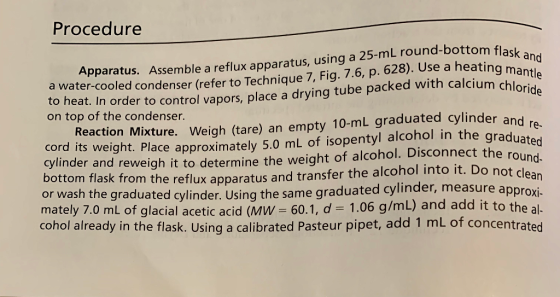
Procedure Apparatus. Assemble a reflux apparatus, using a 25-mL round-bottom flask and a water-cooled condenser (refer to Technique 7, Fig. 7.6, p. 628). Use a heating mantle to heat. In order to control vapors, place a drying tube packed with calcium chloride on top of the condenser. Reaction Mixture. Weigh (tare) an empty 10-mL graduated cylinder and re- cord its weight. Place approximately 5.0 mL of isopentyl alcohol in the graduated cylinder and reweigh it to determine the weight of alcohol. Disconnect the round bottom flask from the reflux apparatus and transfer the alcohol into it. Do not clean or wash the graduated cylinder. Using the same graduated cylinder, measure approxi- mately 7.0 mL of glacial acetic acid (MW = 60.1, d = 1.06 g/mL) and add it to the al- cohol already in the flask. Using a calibrated Pasteur pipet, add 1 mL of concentrated
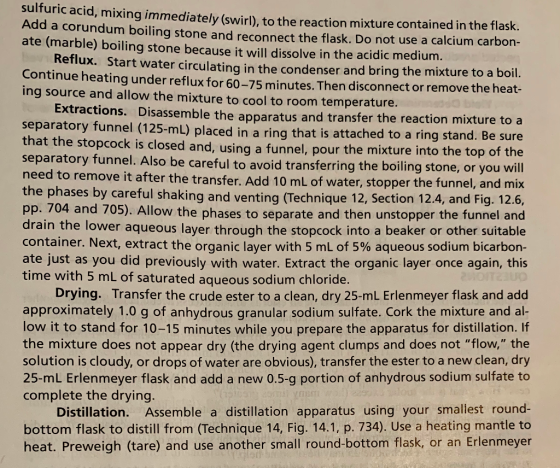
sulfuric acid, mixing immediately (swirl), to the reaction mixture contained in the flask. Add a corundum boiling stone and reconnect the flask. Do not use a calcium carbon- ate (marble) boiling stone because it will dissolve in the acidic medium. Reflux. Start water circulating in the condenser and bring the mixture to a boil. Continue heating under reflux for 60-75 minutes. Then disconnect or remove the heat- ing source and allow the mixture to cool to room temperature. Extractions. Disassemble the apparatus and transfer the reaction mixture to a separatory funnel (125-m L) placed in a ring that is attached to a ring stand. Be sure that the stopcock is closed and, usina a funnel, pour the mixture into the top of the separatory funnel. Also be careful to avoid transferring the boiling stone, or you will need to remove it after the transfer. Add 10 mL of water, stopper the funnel, and mix the phases by careful shaking and venting (Technique 12, Section 12.4, and Fig. 12.6, pp. 704 and 705). Allow the phases to separate and then unstopper the funnel and drain the lower aqueous layer through the stopcock into a beaker or other suitable container. Next, extract the organic laver with 5 mL of 5% aqueous sodium bicarbon- ate just time with 5 mL of saturated aqueous sodium chloride. as you did previously with water. Extract the organic layer once again, this 250IT2 U0 Drying. Transfer the crude ester to a clean, dry 25-mL Erlenmeyer flask and add approximately 1.0 g of anhydrous granular sodium sulfate. Cork the mixture and al- low it to stand for 10-15 minutes while you prepare the apparatus for distillation. If the mixture does not appear dry (the drying agent clumps and does not "flow," the solution is cloudy, clean, dry or drops of water are obvious), transfer the ester to a new 25-mL Erlenmeyer flask and add a new 0.5-g portion of anhydrous sodium sulfate to complete the drying. 20BTVOSO Distillation. Assemble a distillation apparatus using your smallest round- bottom flask to distill from (Technique 14, Fig. 14.1, p. 734). Use a heating mantle to heat. Preweigh (tare) and use another small round-bottom flask, or an Erlenmeyer 7.1e
96 Introduction to Basic Part One flask, to collect the product. Immerse the collection flask in a beaker of ice to ensure condensation and to reduce odors. You should look up the boiling point of your ex- pected product in a handbook so you will know what to expect. Continue distillation drops of liquid remain in the distilling flask. Record the observed noD until only one or two boiling point range in your notebook. Yield Determination. Weigh the product and calculate the percentage yield of the ester. At the option of your instructor, determine the boiling point using the methods described in Technique 13, Sections 13.2 and 13.3, pages 724 and 727. )Spectroscopy. At your instructor's option, obtain an infrared spectrum using salt plates (Technique 25, Section 25.2, p. 875). Compare your spectrum with the one re- produced in the text. Interpret the spectrum and include it in your report to the in- structor. You may also be required to determine and interpret the proton and carbon- 13 NMR spectra (Technique 26, Part A, pp. 911-916, and Technique 27, Section 27.1, p. 947). Submit your sample in a properly labeled vial with your report. one of b
Homework Answers
Mass of isopentyl alcohol = 14.55-10.48 = 4.07 g
Mass of product collected = 60.42-56.77 = 3.65 g
1 mole isopentyl alcohol give 1 mole product
88.148 g isopentyl alcohol give 130.19 g product.
4.07 g isopentyl alcohol give 130.19×4.07/88.148 g product
= 6.01 g product
Theoretical yield = 6.01 g
% yield = 3.65×100/6.01 = 60.73%
Add Answer to:
weight of cylinder 10.48g weight of cylinder with of isopentyl alcohol 14.55g weight of collecting flask...
Give a detailed mechanism for this reaction and give a separation scheme NUCLEOPHILIC ACYL SUBSTITUTION: Synthesis...
 Give a detailed mechanism for this reaction and give a separation
scheme
NUCLEOPHILIC ACYL SUBSTITUTION: Synthesis of an Ester Isoamyl acetate (Banana Oil) Purpose This experiment demonstrat and alcohol. The technique of refluxing the reaction mixture is introduced. es the procedure for the synthesis of an ester from a carboxylic acid Esters are an important functional group in organic chemistry, and esters are found widely distributed in nature. Many lower molecular weight esters are associated with natural fuit flavors and...
Give a detailed mechanism for this reaction and give a separation
scheme
NUCLEOPHILIC ACYL SUBSTITUTION: Synthesis of an Ester Isoamyl acetate (Banana Oil) Purpose This experiment demonstrat and alcohol. The technique of refluxing the reaction mixture is introduced. es the procedure for the synthesis of an ester from a carboxylic acid Esters are an important functional group in organic chemistry, and esters are found widely distributed in nature. Many lower molecular weight esters are associated with natural fuit flavors and...
Help with PreLab questions 1-4 Procedure Esterification Each group will be assigned an unknown alcohol by...
 Help with PreLab questions 1-4
Procedure Esterification Each group will be assigned an unknown alcohol by the instructor. Record the unknown number and then add the contents of the vial (25 mmol of alcohol) to a 50 mL round bottom flask with a stir bar Then add 2.75 mL (approx. 50 mmol) of acetic acid followed by 0.25 mL of concentrated sulfuric acid Add a reflux condenser then reflux the mixture in a sand bath with stirring for one hour....
Help with PreLab questions 1-4
Procedure Esterification Each group will be assigned an unknown alcohol by the instructor. Record the unknown number and then add the contents of the vial (25 mmol of alcohol) to a 50 mL round bottom flask with a stir bar Then add 2.75 mL (approx. 50 mmol) of acetic acid followed by 0.25 mL of concentrated sulfuric acid Add a reflux condenser then reflux the mixture in a sand bath with stirring for one hour....
In today’s experiment, we will react isopentyl alcohol with acetic acid to produce isopentyl acetate. Isopentyl...
In today’s experiment, we will react isopentyl alcohol with acetic acid to produce isopentyl acetate. Isopentyl acetate smells like bananas: CH3 O CH3 O + H3COH H3C -H2O H3C O CH3 Isopentyl Acetate However, instead of using conventional heating, we will use microwave energy to promote the reaction and we will use an acidic resin, Dowex-50, in place of the mineral acid to catalyze the process. Questions 1. The three standards have different retention times on the Mini-GC. What physical...
In the experiment of synthesizing isopentyl acetate by reacting an excess of acetic acid with Isopentyl...
In the experiment of synthesizing isopentyl acetate by reacting an excess of acetic acid with Isopentyl alcohol and using sulfuric acid as the catalyst, what was the purpose of doing a distillation after heating under reflux for an hour?
5.0 ml of 2-methylcyclohexanol was placed in a 50 ml round bottom flask. Phosphoric acid (85%,...
5.0 ml of 2-methylcyclohexanol was placed in a 50 ml round bottom flask. Phosphoric acid (85%, 5 ml) was added cautiously, and the mixture swirled. Boiling stones were added to prevent bumping during heating. The mixture was heated to reflux temperature and refluxed for 15 minutes. The products were collected between 85-90 ˚C, in a small round bottom flask, cooled in ice water. Isolation Procedure The distillate was washed with 2 x 5 ml saturated sodium chloride solution in a...
Experiment: In the experiment: Mix together 74 g. (92 ml.) of n-butyl alcohol and 120 g....
Experiment: In the experiment: Mix together 74 g. (92 ml.) of n-butyl alcohol and 120 g. (120 ml.) of glacial acetic acid in a 500 ml. round-bottomed flask, and add cautiously 10 ml. of concentrated sulphuric acid (use a small measuring cylinder or a burette or a calibrated dropper pipette). Attach a reflux condenser and reflux the mixture on a wire gauze for 3-6 hours. Pour the mixture into about 500 ml of water in a separatory funnel, remove the...
Thumbs up for good answer. Why does the liquid in the round bottom flask turn light...
 Thumbs up for good answer. Why does the liquid in the round
bottom flask turn light pink?, please explain (This happened
during/after step 2). This is the procedure and the experiment is
called Synthesis of Artificial Flavorings by Fischer
Esterification.
Thank you!
SAMPLE PROCEDURES: 1. Isoanvl acetate (banana) + H2O OH HO 1. Mix 6 mL of isoamyl alcohol (0.809 g/mL, 88.148 g/mol) and 10 ml ofglacial acetic acid (1.05 g/ml 60.05 g/mol) in a 100 mL round bottom flask....
Thumbs up for good answer. Why does the liquid in the round
bottom flask turn light pink?, please explain (This happened
during/after step 2). This is the procedure and the experiment is
called Synthesis of Artificial Flavorings by Fischer
Esterification.
Thank you!
SAMPLE PROCEDURES: 1. Isoanvl acetate (banana) + H2O OH HO 1. Mix 6 mL of isoamyl alcohol (0.809 g/mL, 88.148 g/mol) and 10 ml ofglacial acetic acid (1.05 g/ml 60.05 g/mol) in a 100 mL round bottom flask....
Assume you are doing an experiment on the esterification of isopentyl acetate using 1mL of isopentyl...
Assume you are doing an experiment on the esterification of isopentyl acetate using 1mL of isopentyl alcohol and 1.5mL of acetic acid. Assuming complete reaction, calculate the amount of acetic acid left in the post-reaction mixture at the end of reflux Calculate the amount of 5% aq sodium bicarbonate needed to neutralize the unreacted acetic acid
SYNTHESIS OF T-PENTYL CHLORIDE LAB Provide a stoichiometry table for the reaction being performed in this...
 SYNTHESIS OF T-PENTYL CHLORIDE LAB
Provide a stoichiometry table for the reaction being performed
in this lab.
PROCEDURE Preparation oft-Pentyl Chloride In a 125-mL separatory funnel, place 10.0 mL of tert-pentyl alcohol (2-methyl-2- butanol, MW = 88.2, d = 0.805 g/mL) and 25 mL of concentrated hydrochloric acid (d 1.18 g/mL). Do not stopper the funnel. Gently swirl the mixture in the separa- tory funnel for about 1 minute. After this period of swirling, stopper the separatory funnel and carefully...
SYNTHESIS OF T-PENTYL CHLORIDE LAB
Provide a stoichiometry table for the reaction being performed
in this lab.
PROCEDURE Preparation oft-Pentyl Chloride In a 125-mL separatory funnel, place 10.0 mL of tert-pentyl alcohol (2-methyl-2- butanol, MW = 88.2, d = 0.805 g/mL) and 25 mL of concentrated hydrochloric acid (d 1.18 g/mL). Do not stopper the funnel. Gently swirl the mixture in the separa- tory funnel for about 1 minute. After this period of swirling, stopper the separatory funnel and carefully...
Why did you wash the ether solution with sodium bicarbonate? Write chemical equations for the rea...
 Why did you wash the ether solution with sodium bicarbonate? Write chemical equations for the reactions that took place. b. At which purification steps was the unreacted methanol removed in the reaction? Some of it may have been removed in more than one place. c. Three-Step Synthesis of Methyl Anisate (Step 3) 0 CHOH. Н.so, cat.) Wear gloves. Methanol is poisonous. Ether is an anesthetic, so don't breathe it. Sulfuric acid is a strong corrosive acid. Wash any you spill...
 Give a detailed mechanism for this reaction and give a separation
scheme
NUCLEOPHILIC ACYL SUBSTITUTION: Synthesis of an Ester Isoamyl acetate (Banana Oil) Purpose This experiment demonstrat and alcohol. The technique of refluxing the reaction mixture is introduced. es the procedure for the synthesis of an ester from a carboxylic acid Esters are an important functional group in organic chemistry, and esters are found widely distributed in nature. Many lower molecular weight esters are associated with natural fuit flavors and...
Give a detailed mechanism for this reaction and give a separation
scheme
NUCLEOPHILIC ACYL SUBSTITUTION: Synthesis of an Ester Isoamyl acetate (Banana Oil) Purpose This experiment demonstrat and alcohol. The technique of refluxing the reaction mixture is introduced. es the procedure for the synthesis of an ester from a carboxylic acid Esters are an important functional group in organic chemistry, and esters are found widely distributed in nature. Many lower molecular weight esters are associated with natural fuit flavors and...
 Help with PreLab questions 1-4
Procedure Esterification Each group will be assigned an unknown alcohol by the instructor. Record the unknown number and then add the contents of the vial (25 mmol of alcohol) to a 50 mL round bottom flask with a stir bar Then add 2.75 mL (approx. 50 mmol) of acetic acid followed by 0.25 mL of concentrated sulfuric acid Add a reflux condenser then reflux the mixture in a sand bath with stirring for one hour....
Help with PreLab questions 1-4
Procedure Esterification Each group will be assigned an unknown alcohol by the instructor. Record the unknown number and then add the contents of the vial (25 mmol of alcohol) to a 50 mL round bottom flask with a stir bar Then add 2.75 mL (approx. 50 mmol) of acetic acid followed by 0.25 mL of concentrated sulfuric acid Add a reflux condenser then reflux the mixture in a sand bath with stirring for one hour....
 Thumbs up for good answer. Why does the liquid in the round
bottom flask turn light pink?, please explain (This happened
during/after step 2). This is the procedure and the experiment is
called Synthesis of Artificial Flavorings by Fischer
Esterification.
Thank you!
SAMPLE PROCEDURES: 1. Isoanvl acetate (banana) + H2O OH HO 1. Mix 6 mL of isoamyl alcohol (0.809 g/mL, 88.148 g/mol) and 10 ml ofglacial acetic acid (1.05 g/ml 60.05 g/mol) in a 100 mL round bottom flask....
Thumbs up for good answer. Why does the liquid in the round
bottom flask turn light pink?, please explain (This happened
during/after step 2). This is the procedure and the experiment is
called Synthesis of Artificial Flavorings by Fischer
Esterification.
Thank you!
SAMPLE PROCEDURES: 1. Isoanvl acetate (banana) + H2O OH HO 1. Mix 6 mL of isoamyl alcohol (0.809 g/mL, 88.148 g/mol) and 10 ml ofglacial acetic acid (1.05 g/ml 60.05 g/mol) in a 100 mL round bottom flask....
 SYNTHESIS OF T-PENTYL CHLORIDE LAB
Provide a stoichiometry table for the reaction being performed
in this lab.
PROCEDURE Preparation oft-Pentyl Chloride In a 125-mL separatory funnel, place 10.0 mL of tert-pentyl alcohol (2-methyl-2- butanol, MW = 88.2, d = 0.805 g/mL) and 25 mL of concentrated hydrochloric acid (d 1.18 g/mL). Do not stopper the funnel. Gently swirl the mixture in the separa- tory funnel for about 1 minute. After this period of swirling, stopper the separatory funnel and carefully...
SYNTHESIS OF T-PENTYL CHLORIDE LAB
Provide a stoichiometry table for the reaction being performed
in this lab.
PROCEDURE Preparation oft-Pentyl Chloride In a 125-mL separatory funnel, place 10.0 mL of tert-pentyl alcohol (2-methyl-2- butanol, MW = 88.2, d = 0.805 g/mL) and 25 mL of concentrated hydrochloric acid (d 1.18 g/mL). Do not stopper the funnel. Gently swirl the mixture in the separa- tory funnel for about 1 minute. After this period of swirling, stopper the separatory funnel and carefully...
 Why did you wash the ether solution with sodium bicarbonate? Write chemical equations for the reactions that took place. b. At which purification steps was the unreacted methanol removed in the reaction? Some of it may have been removed in more than one place. c. Three-Step Synthesis of Methyl Anisate (Step 3) 0 CHOH. Н.so, cat.) Wear gloves. Methanol is poisonous. Ether is an anesthetic, so don't breathe it. Sulfuric acid is a strong corrosive acid. Wash any you spill...
Most questions answered within 3 hours.
-
Where is the error in this code sequence?
String s1 = "Hello";
String s2 = "ello";...
asked 11 months ago -
Financial data for Joel de Paris, Inc., for last year
follow:
Joel de Paris, Inc.
Balance...
asked 11 months ago -
Consider this reaction:
Al2(SO4)3 (aq)+ BaCl3
(aq) Al2Cl6 (aq)- +
3BaSO4(s) . What is the...
asked 11 months ago -
Suppose that Savneet is considering increasing her
recent random sample from 20 car rentals to 40...
asked 11 months ago -
Trucks arrive at an unloading terminal at an average rate of 120
per hour.
Trucks arrive...
asked 11 months ago -
Why are methanol and ethanol completely soluble in water while
octanol is not very little soluble....
asked 11 months ago -
A facilities manager at a university reads in a research report
that the mean amount of...
asked 11 months ago -
When the CuSO4 is rehydrated by adding water to the anhydrous
compound, is this an endothermic...
asked 11 months ago -
A ray of sunlight is passing from diamond into crown glass; the
angle of incidence is...
asked 11 months ago -
A block of mass 0.249 kg is placed on top of a light, vertical
spring of...
asked 11 months ago -
how do the kidneys compensate in the presences of acidosis
a) trigger hyperventilate
b) reserve acid...
asked 11 months ago -
Question 501 pts
The rental rate of capital to the firm increases. Which of the
following...
asked 11 months ago