we have 1.5 g final product for following experiment. how can I draw acid- base curve...
we have 1.5 g final product for following experiment. how can I draw acid- base curve for following experiment?
Experimental procedure Weigh approximately 2.5 gof benzoic acid contaminated withtable salt (NaCl) as precisely as possible (record the exact quantity). Transfer the solid to a 100 mL separatory funnel and add 30 mL of ethyl acetate. In a 50 mL beaker, add 20 mL of water and 1.0 mL of 3 M hydrochloric acid. Transferthe mixtureto the separatory funnel. The solid crystals will dissolve in their suitable solvents: NaCl will dissolve in water and the benzoic acid in the ethyl acetate.Insert the glass stopper of the separatory funnel and holding it tightly in its place with your thumb turn the separatory funnel upside down twice. When the tip of the separatory funnel is pointing up, open the stopcock and release the pressure. Repeat this step several times until there is no more gas escaping (“no hissing” sound).Clamp the separatory funnel from a stand and observe these paration of the two phases.The organic phase is on top and the aqueous phase is at the bottom of the separatory funnel.Carefully drain the lower, water (aqueous) phase into a beaker. Add another10 mL of water to the separatory funnel and repeat the extraction (“wash”) .
Report:At this point, where is our product and in what ionization state is it? Where is the NaCl?
Add 20 mL of 2 N NaOH solution to the separatory funnel and repeat the extraction. Allow the layers to separate and carefully drain the aqueous phase into a clean 100mL beaker. Be careful not to allow any ethyl acetate from the upper organic phase to drip in to the beaker.The NaOH solution neutralises the benzoic acid from the organic phase and converts it into benzoate ion, negatively charged, that issoluble in the aqueous phase.Measure 10 mL of 3 N HCl solution and slowly add it to the aqueous extract while stirring it with a glass rod. The sodium benzoate is converted back into benzoic acid. Check the pH with pH paper to insure that the final solution has a pH of 2.0. If not, add additional hydrochloride solution drop wise until a pH of 2.0is attained
Cool the solution to below 10°C by placing the beaker in a larger vessel containing ice and water. A white solid should precipitate out. Separate the product by vacuum filtration, using pure, ice cold water (no more than 10 mL) to transfer any solid which remains in the beaker and to wash the solid on the filter. Air-dry the solid and then dry it in a drying oven.Once dry, transfer your product to a pre-weighed (tared) vial. Record the weight of the solid.Report:What is the purpose of pH 2.0? What is in each phase produced through the course of the procedure?What is the % yield of the experiment?
Homework Answers
- At this point, the Benzoic Acid is absolutely Neutral in Ethyl Acetate, it isn't ionised. NaCl is in the Aqueous layer.
- The purpose of pH=2 is to ensure the Complete precipitation of Benzoic Acid, otherwise some Benzoic Acid still may be present as Sodium Benzoate.
- After addition of NaOH, Benzoic Acid forms the Sodium Benzoate Salt and goes into Water. After seperating the Aqueous layer from ethyl Acetate, Sodium Benzoate is again converted to Benzoic Acid, on attainment of pH 2. This Benzoic Acid is insoluble in Water and thus precipitates out from the Aqueous phase as solid.
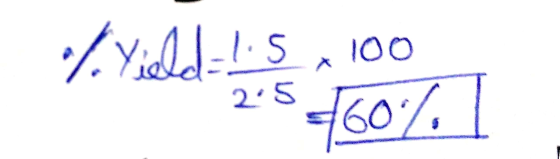
Add Answer to:
we have 1.5 g final product for following experiment.
how can I draw acid- base curve...
Need help on providing reactions that describe the acid-base extraction and neutralization processes used in this exper...
 Need help on providing reactions that describe the acid-base
extraction and neutralization processes used in this experiment.
Provide a statement of solubility of each starting material and
product.
The experiment to be performed this week involves liquid-liquid extraction using a separatory funnel. Read chapter 15 in Zubrick to familiarize yourself with the use of the glassware for extraction and washing. Acid/Base Extraction Liquid-liquid extraction is a technique that can be used to physically separate two substances that have varying solubility...
Need help on providing reactions that describe the acid-base
extraction and neutralization processes used in this experiment.
Provide a statement of solubility of each starting material and
product.
The experiment to be performed this week involves liquid-liquid extraction using a separatory funnel. Read chapter 15 in Zubrick to familiarize yourself with the use of the glassware for extraction and washing. Acid/Base Extraction Liquid-liquid extraction is a technique that can be used to physically separate two substances that have varying solubility...
Acid/Base Extraction Liquid-liquid extraction is a technique that can be used to physically separate two substancesthat...
Acid/Base Extraction Liquid-liquid extraction is a technique that can be used to physically separate two substancesthat have varying solubility properties. Typically an aqueous solution can be extracted with anorganic solvent to isolate a compound or vice-versa. The specialized piece of glassware that isemployed for these types of separations is called a separatory funnel.In this experiment a mixture of benzoic acid and naphthalene will be purified using liquid-liquidextraction, more specifically an acid-base extraction. Since both compounds are soluble inethyl acetate (an...
Draw an extraction flow chart for the Extraction experiment you completed. experiment below Separation of a...
Draw an extraction flow chart for the Extraction experiment you completed. experiment below Separation of a Benzoic Acid/Biphenyl Mixture by Acid-Base Extraction Prepare the solution to be extracted by dissolving 2.5 g of a 1:1 mixture of benzoic acid/ biphenyl in 25 mL of tert-butyl methyl ether (MTBE) . Using a 125 mL separatory funnel extract the ether solution with a mixture containing 10 mL of distilled water and 15 mL of saturated NaHCO3 . Repeat After removing the aqueous...
Experiment: A mixture of equal proportions of benzoic acid, ethyl 4-aminobenzoate, and 1,4-dimethoxybenzene are to be...
Experiment: A mixture of equal proportions of benzoic acid, ethyl 4-aminobenzoate, and 1,4-dimethoxybenzene are to be separated by extraction using the solvent diethyl ether. Day 1: Part A. Isolation of the basic component: In a small beaker, dissolve 3 g of the mixture (benzoic acid, ethyl 4-aminobenzoate, and 1,4-dimethoxybenzene) in 30 mL of diethyl ether and transfer the mixture to a 125- mL separatory funnel (see Fig. 1) using a little diethyl ether to complete the transfer. Add 10 mL...
QUESTION: Write a flow scheme for the work-up. THE WORK UP:
 QUESTION:
Write a flow scheme for the work-up.
THE WORK UP:
C. Work-up (save all layers) and Isolation of Product MgBrCl Benzoic acid Transfer the mixture into a test tube. Rinse the beaker with about 3 mL of regular (not anhydrous) diethyl ether and pour the washings into the test tube. There should be two distinct layers in the test tube Remove the aqueous layer (to be discarded) and shake the ether layer with about 2 mL of 3 M...
QUESTION:
Write a flow scheme for the work-up.
THE WORK UP:
C. Work-up (save all layers) and Isolation of Product MgBrCl Benzoic acid Transfer the mixture into a test tube. Rinse the beaker with about 3 mL of regular (not anhydrous) diethyl ether and pour the washings into the test tube. There should be two distinct layers in the test tube Remove the aqueous layer (to be discarded) and shake the ether layer with about 2 mL of 3 M...
how to get %recovery? here recovered benzoic acid is 0.14 g. Part 1 - ExtracHon of...
 how to get %recovery? here recovered benzoic acid is 0.14 g.
Part 1 - ExtracHon of an Acidic Organic Compound 1. Secure a small, clean separatory funnel to a ring stand with a clamp. 2. Label three small flask (25 or 50 mL) with one of the following: "benzoic acid", "ethyl-4- aminobenzoate" and "organic layer". 3. Obtain exactly 10.0 mL of a solution containing benzoic acid and ethyl-4-aminobenzonate in ethyl acetate. 4. Extract the solution containing the two compounds with...
how to get %recovery? here recovered benzoic acid is 0.14 g.
Part 1 - ExtracHon of an Acidic Organic Compound 1. Secure a small, clean separatory funnel to a ring stand with a clamp. 2. Label three small flask (25 or 50 mL) with one of the following: "benzoic acid", "ethyl-4- aminobenzoate" and "organic layer". 3. Obtain exactly 10.0 mL of a solution containing benzoic acid and ethyl-4-aminobenzonate in ethyl acetate. 4. Extract the solution containing the two compounds with...
Would the methylene chloride layer be above or below the experiment? Justify your answer. 1. aqueous layer in today...
 Would the methylene chloride layer be above or below the experiment? Justify your answer. 1. aqueous layer in today's ium carbonate used in the isolation of caffeine? Be specific as to the 2. Why is potass chemical species the carbonate may act on. Why was sodium sulfate used? 3. 4. After introducing 1.0 g of potassium carbonate into the centri hot water extract, it was capped, shaken, and then cooled to room temperature. Following this, roug minute. Why wasn't the...
what is the purpose of each of the extractions (washings) the crude product? In other word,...
what is the purpose of each of the extractions (washings) the crude product? In other word, what is removed upon washing with (a) water (b) sodium bicarbonate and finally (c) ammonium chloride. The experiment I did is amide synthesis from carboxylic acid and amine and using EDCl with catalyst DMAP and DMF. By doing the extraction. I dilute my reaction mixture with 40 ml of water, pour the contents into separatory funnel. Then add approximately 20 mL of ethyl acetate...
How can the NMP oxalate salt be converted back to NMP? Here is the procedure: PROCEDURES...
How can the NMP oxalate salt be converted back to NMP? Here is the procedure: PROCEDURES Part A: Synthesis of (±)-N,N-dimethyl-3-phenyl-3-(4-trifluoromethylphenoxy)propanamine To the 250-mL round-bottom flask (RBF) containing (±)-3-(dimethylamino)-1-phenylpropanol (product from Lab 6) and a magnetic stir bar, add 4 mL of 4-chlorobenzotrifluoride and 30 mL of dimethylacetamide (DMA). With stirring, add to this mixture 30 mL of 1.0 M potassium tert-butoxide (caustic alkali!) in tert-butyl alcohol using a syringe. Using a simple distillation apparatus, distill the mixture slowly, with...
Attached below are the pages from this lab report to help give context to the questions....
 Attached below are the pages from this lab report to help give
context to the questions. Please be as detailed as possible when
answering the questions and include any relevant information about
intermolecular forces at play. Thank you for your help!
Here are the questions which I need answered. Thank you in
advance for your help! :) Please be as detailed as possible and
discuss any intermolecular forces in detail if they are relevant to
the question. Thanks!
PARTA. SEPARATION...
Attached below are the pages from this lab report to help give
context to the questions. Please be as detailed as possible when
answering the questions and include any relevant information about
intermolecular forces at play. Thank you for your help!
Here are the questions which I need answered. Thank you in
advance for your help! :) Please be as detailed as possible and
discuss any intermolecular forces in detail if they are relevant to
the question. Thanks!
PARTA. SEPARATION...
 Need help on providing reactions that describe the acid-base
extraction and neutralization processes used in this experiment.
Provide a statement of solubility of each starting material and
product.
The experiment to be performed this week involves liquid-liquid extraction using a separatory funnel. Read chapter 15 in Zubrick to familiarize yourself with the use of the glassware for extraction and washing. Acid/Base Extraction Liquid-liquid extraction is a technique that can be used to physically separate two substances that have varying solubility...
Need help on providing reactions that describe the acid-base
extraction and neutralization processes used in this experiment.
Provide a statement of solubility of each starting material and
product.
The experiment to be performed this week involves liquid-liquid extraction using a separatory funnel. Read chapter 15 in Zubrick to familiarize yourself with the use of the glassware for extraction and washing. Acid/Base Extraction Liquid-liquid extraction is a technique that can be used to physically separate two substances that have varying solubility...
 QUESTION:
Write a flow scheme for the work-up.
THE WORK UP:
C. Work-up (save all layers) and Isolation of Product MgBrCl Benzoic acid Transfer the mixture into a test tube. Rinse the beaker with about 3 mL of regular (not anhydrous) diethyl ether and pour the washings into the test tube. There should be two distinct layers in the test tube Remove the aqueous layer (to be discarded) and shake the ether layer with about 2 mL of 3 M...
QUESTION:
Write a flow scheme for the work-up.
THE WORK UP:
C. Work-up (save all layers) and Isolation of Product MgBrCl Benzoic acid Transfer the mixture into a test tube. Rinse the beaker with about 3 mL of regular (not anhydrous) diethyl ether and pour the washings into the test tube. There should be two distinct layers in the test tube Remove the aqueous layer (to be discarded) and shake the ether layer with about 2 mL of 3 M...
 how to get %recovery? here recovered benzoic acid is 0.14 g.
Part 1 - ExtracHon of an Acidic Organic Compound 1. Secure a small, clean separatory funnel to a ring stand with a clamp. 2. Label three small flask (25 or 50 mL) with one of the following: "benzoic acid", "ethyl-4- aminobenzoate" and "organic layer". 3. Obtain exactly 10.0 mL of a solution containing benzoic acid and ethyl-4-aminobenzonate in ethyl acetate. 4. Extract the solution containing the two compounds with...
how to get %recovery? here recovered benzoic acid is 0.14 g.
Part 1 - ExtracHon of an Acidic Organic Compound 1. Secure a small, clean separatory funnel to a ring stand with a clamp. 2. Label three small flask (25 or 50 mL) with one of the following: "benzoic acid", "ethyl-4- aminobenzoate" and "organic layer". 3. Obtain exactly 10.0 mL of a solution containing benzoic acid and ethyl-4-aminobenzonate in ethyl acetate. 4. Extract the solution containing the two compounds with...
 Would the methylene chloride layer be above or below the experiment? Justify your answer. 1. aqueous layer in today's ium carbonate used in the isolation of caffeine? Be specific as to the 2. Why is potass chemical species the carbonate may act on. Why was sodium sulfate used? 3. 4. After introducing 1.0 g of potassium carbonate into the centri hot water extract, it was capped, shaken, and then cooled to room temperature. Following this, roug minute. Why wasn't the...
 Attached below are the pages from this lab report to help give
context to the questions. Please be as detailed as possible when
answering the questions and include any relevant information about
intermolecular forces at play. Thank you for your help!
Here are the questions which I need answered. Thank you in
advance for your help! :) Please be as detailed as possible and
discuss any intermolecular forces in detail if they are relevant to
the question. Thanks!
PARTA. SEPARATION...
Attached below are the pages from this lab report to help give
context to the questions. Please be as detailed as possible when
answering the questions and include any relevant information about
intermolecular forces at play. Thank you for your help!
Here are the questions which I need answered. Thank you in
advance for your help! :) Please be as detailed as possible and
discuss any intermolecular forces in detail if they are relevant to
the question. Thanks!
PARTA. SEPARATION...
Most questions answered within 3 hours.
-
Where is the error in this code sequence?
String s1 = "Hello";
String s2 = "ello";...
asked 11 months ago -
Financial data for Joel de Paris, Inc., for last year
follow:
Joel de Paris, Inc.
Balance...
asked 11 months ago -
Consider this reaction:
Al2(SO4)3 (aq)+ BaCl3
(aq) Al2Cl6 (aq)- +
3BaSO4(s) . What is the...
asked 11 months ago -
Suppose that Savneet is considering increasing her
recent random sample from 20 car rentals to 40...
asked 11 months ago -
Trucks arrive at an unloading terminal at an average rate of 120
per hour.
Trucks arrive...
asked 11 months ago -
Why are methanol and ethanol completely soluble in water while
octanol is not very little soluble....
asked 11 months ago -
A facilities manager at a university reads in a research report
that the mean amount of...
asked 11 months ago -
When the CuSO4 is rehydrated by adding water to the anhydrous
compound, is this an endothermic...
asked 11 months ago -
A ray of sunlight is passing from diamond into crown glass; the
angle of incidence is...
asked 11 months ago -
A block of mass 0.249 kg is placed on top of a light, vertical
spring of...
asked 11 months ago -
how do the kidneys compensate in the presences of acidosis
a) trigger hyperventilate
b) reserve acid...
asked 11 months ago -
Question 501 pts
The rental rate of capital to the firm increases. Which of the
following...
asked 11 months ago