Acid/Base Extraction Liquid-liquid extraction is a technique that can be used to physically separate two substancesthat...
Acid/Base Extraction
Liquid-liquid extraction is a technique that can be used to
physically separate two substancesthat have varying solubility
properties. Typically an aqueous solution can be extracted with
anorganic solvent to isolate a compound or vice-versa. The
specialized piece of glassware that isemployed for these types of
separations is called a separatory funnel.In this experiment a
mixture of benzoic acid and naphthalene will be purified using
liquid-liquidextraction, more specifically an acid-base extraction.
Since both compounds are soluble inethyl acetate (an organic
solvent), and benzoic acid is reactive toward aqueous bases, we
canextract the benzoic acid out of the organic solvent into the
aqueous solvent and physicallyseparate them. Neutralization of the
aqueous solution will yield the purified benzoic acidproduct that
can be characterized using melting point determination.
Benzoic acid and Naphthalene
Experimental Obtain a separatory funnel with stopper from the
stockroom. Add 20 mL of ethyl acetate to theseparatory funnel
followed by 2 g of the organic compound mixture. Swirl the contents
of theseparatory funnel to dissolve the solids. If any residual
compound mixture is stuck to the neck(the ground glass joint) of
the separatory funnel wash it down into the funnel using a
fewmilliliters of ethyl acetate.To the separatory funnel add 20 mL
of 5% NaOH solution. Insert the stopper into theseparatory funnel
and invert. Be sure to place the stopper into the funnel correctly.
The groundglass joints form a water tight seal so that the
solutions cannot escape during extraction. Pointthe drain away from
others and immediately vent the separatory funnel by opening
thestopcock. After relieving the pressure, close the stopcock and
shake the contents to ensureefficient mixing. Vent periodically to
relieve built up pressure. Place the separatory funnel onthe ring
stand, remove the stopper and allow the solvents to separate. Drain
the aqueous layerinto a 125 mL Erlenmeyer flask, label as flask A
and set aside. Be sure to drain only the lowerlayer. Leave a small
amount of the lower layer behind if necessary. Repeat the process
ofadding sodium hydroxide solution and extracting two additional
times. Combine all of theaqueous extracts into the same flask.
Prepare an ice bath in a 400 mL beaker. Place flask A into the ice bath and allow it to cool for3 minutes. Add 6M HCl solution portionwise (a pipette at a time) until the solution is stronglyacidic (pH<1). Test the pH by removing a drop of the solution using a glass stirring rod andplacing it on the pH paper. A white precipitate should form during the acidification. Isolate thesolid using vacuum filtration with a Buchner funnel and a filter paper. Wash the solid withplenty of water to remove residual acid. Place the solid in an open, labeled Petri dish and allowto dry over the course of a week. After allowing the sample to dry completely, identify the solidusing melting point analysis and obtain the mass and record the data in the laboratorynotebook.
Provide reactions that describe the acid-base extraction and neutralization processes used in this experiment. Provide a statement of solubility of each starting material and product
Homework Answers
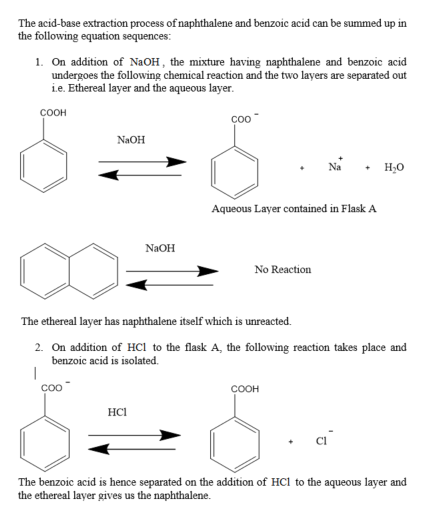
Solubility explaination:
On addition of sodium hydroxide, the benzoic acid is soluble in it and the reaction 1 occurs.
Napthalene gets separated in this way.

a statement of solubility of each starting material and product
first benzoic acid is soluble in ethyl acetate but naphthalene is insoluble so benzoic acid gets separated by filtration .
Then again NaOH is added to get sodium benzoate which is insoluble and can be collected in ppt form
Add Answer to:
Acid/Base Extraction
Liquid-liquid extraction is a technique that can be used to
physically separate two substancesthat...
Need help on providing reactions that describe the acid-base extraction and neutralization processes used in this exper...
 Need help on providing reactions that describe the acid-base
extraction and neutralization processes used in this experiment.
Provide a statement of solubility of each starting material and
product.
The experiment to be performed this week involves liquid-liquid extraction using a separatory funnel. Read chapter 15 in Zubrick to familiarize yourself with the use of the glassware for extraction and washing. Acid/Base Extraction Liquid-liquid extraction is a technique that can be used to physically separate two substances that have varying solubility...
Need help on providing reactions that describe the acid-base
extraction and neutralization processes used in this experiment.
Provide a statement of solubility of each starting material and
product.
The experiment to be performed this week involves liquid-liquid extraction using a separatory funnel. Read chapter 15 in Zubrick to familiarize yourself with the use of the glassware for extraction and washing. Acid/Base Extraction Liquid-liquid extraction is a technique that can be used to physically separate two substances that have varying solubility...
how to get %recovery? here recovered benzoic acid is 0.14 g. Part 1 - ExtracHon of...
 how to get %recovery? here recovered benzoic acid is 0.14 g.
Part 1 - ExtracHon of an Acidic Organic Compound 1. Secure a small, clean separatory funnel to a ring stand with a clamp. 2. Label three small flask (25 or 50 mL) with one of the following: "benzoic acid", "ethyl-4- aminobenzoate" and "organic layer". 3. Obtain exactly 10.0 mL of a solution containing benzoic acid and ethyl-4-aminobenzonate in ethyl acetate. 4. Extract the solution containing the two compounds with...
how to get %recovery? here recovered benzoic acid is 0.14 g.
Part 1 - ExtracHon of an Acidic Organic Compound 1. Secure a small, clean separatory funnel to a ring stand with a clamp. 2. Label three small flask (25 or 50 mL) with one of the following: "benzoic acid", "ethyl-4- aminobenzoate" and "organic layer". 3. Obtain exactly 10.0 mL of a solution containing benzoic acid and ethyl-4-aminobenzonate in ethyl acetate. 4. Extract the solution containing the two compounds with...
Write a small introduction in words and a conclusion for this lab report Experiment 9 Acid-Base Extraction Liquid-liquid extraction utilizes the contrast solubilities of solutes in two immiscible...
 Write a small introduction in words and a conclusion for this
lab report
Experiment 9 Acid-Base Extraction Liquid-liquid extraction utilizes the contrast solubilities of solutes in two immiscible solvents the separation of a mixture. An extracting solvent can be reactive that changes the character of solute. Consider a mixture of organic acid, organic base, and neutral substance, for example, benzoic acid, aniline, biphenyl, nd phenol. They sodium benzoate. Sodium hydroxide changes phenol to sodium phenoxide. Hydrochloric acid changes aniline to...
Write a small introduction in words and a conclusion for this
lab report
Experiment 9 Acid-Base Extraction Liquid-liquid extraction utilizes the contrast solubilities of solutes in two immiscible solvents the separation of a mixture. An extracting solvent can be reactive that changes the character of solute. Consider a mixture of organic acid, organic base, and neutral substance, for example, benzoic acid, aniline, biphenyl, nd phenol. They sodium benzoate. Sodium hydroxide changes phenol to sodium phenoxide. Hydrochloric acid changes aniline to...
we have 1.5 g final product for following experiment. how can I draw acid- base curve...
we have 1.5 g final product for following experiment. how can I draw acid- base curve for following experiment? Experimental procedure Weigh approximately 2.5 gof benzoic acid contaminated withtable salt (NaCl) as precisely as possible (record the exact quantity). Transfer the solid to a 100 mL separatory funnel and add 30 mL of ethyl acetate. In a 50 mL beaker, add 20 mL of water and 1.0 mL of 3 M hydrochloric acid. Transferthe mixtureto the separatory funnel. The solid...
Draw an extraction flow chart for the Extraction experiment you completed. experiment below Separation of a...
Draw an extraction flow chart for the Extraction experiment you completed. experiment below Separation of a Benzoic Acid/Biphenyl Mixture by Acid-Base Extraction Prepare the solution to be extracted by dissolving 2.5 g of a 1:1 mixture of benzoic acid/ biphenyl in 25 mL of tert-butyl methyl ether (MTBE) . Using a 125 mL separatory funnel extract the ether solution with a mixture containing 10 mL of distilled water and 15 mL of saturated NaHCO3 . Repeat After removing the aqueous...
Experiment: A mixture of equal proportions of benzoic acid, ethyl 4-aminobenzoate, and 1,4-dimethoxybenzene are to be...
Experiment: A mixture of equal proportions of benzoic acid, ethyl 4-aminobenzoate, and 1,4-dimethoxybenzene are to be separated by extraction using the solvent diethyl ether. Day 1: Part A. Isolation of the basic component: In a small beaker, dissolve 3 g of the mixture (benzoic acid, ethyl 4-aminobenzoate, and 1,4-dimethoxybenzene) in 30 mL of diethyl ether and transfer the mixture to a 125- mL separatory funnel (see Fig. 1) using a little diethyl ether to complete the transfer. Add 10 mL...
HW.4 & 5 Liquid-Liquid Extraction HW4. A student wishes to separate a mixture of the two...
 HW.4 & 5
Liquid-Liquid Extraction HW4. A student wishes to separate a mixture of the two compounds shown below. They intend to use liquid-liquid extraction to do so. NH Aniline Naphthalene A) Aniline has an amine functionality and naphthalene is purely a hydrocarbon compound. An amine functional group is acidic, basic, or neutral? asic B) Given your answer to A, fill in the missing portions of the diagram that describe the process of the separation for aniline and naphthalene. Aqueous...
HW.4 & 5
Liquid-Liquid Extraction HW4. A student wishes to separate a mixture of the two compounds shown below. They intend to use liquid-liquid extraction to do so. NH Aniline Naphthalene A) Aniline has an amine functionality and naphthalene is purely a hydrocarbon compound. An amine functional group is acidic, basic, or neutral? asic B) Given your answer to A, fill in the missing portions of the diagram that describe the process of the separation for aniline and naphthalene. Aqueous...
In the acid/base extraction lab, a carboxylic acid was separated from fluorene by extracting the carboxylic...
 In the acid/base extraction lab, a carboxylic acid was separated
from fluorene by extracting the carboxylic acid into the aqueous
layer using NaOH solution (a review of this experiment before lab
will be helpful). Phenols (aromatic alcohols) can also be separated
using this method. In a mixture of a phenol and a non-reacting
organic compound, the phenol may be selectively removed from an
organic solvent by extracting with a dilute NaOH solution. After
separating the organic and aqueous layers, the...
In the acid/base extraction lab, a carboxylic acid was separated
from fluorene by extracting the carboxylic acid into the aqueous
layer using NaOH solution (a review of this experiment before lab
will be helpful). Phenols (aromatic alcohols) can also be separated
using this method. In a mixture of a phenol and a non-reacting
organic compound, the phenol may be selectively removed from an
organic solvent by extracting with a dilute NaOH solution. After
separating the organic and aqueous layers, the...
Acid/Base Extraction 1. Provide a flow chart detailing the acid/base extraction/separation of the compounds shown below....
 Acid/Base Extraction
1. Provide a flow chart detailing the acid/base
extraction/separation of the compounds shown below. Your answer
must employ the following reagents: methylene chloride,
hydrochloric acid (1M & 6M), sodium hydroxide (1M & 6M),
10% sodium bicarbonate (aq). Clearly indicate the product(s) and
layers formed following each step of your separation scheme.
IMPORTANT: p-cresol is soluble in sodium hydroxide solution but
insoluble in neutral water or sodium bicarbonate solution. 2-
ethylbenzoic acid is soluble in both sodium hydroxide and...
Acid/Base Extraction
1. Provide a flow chart detailing the acid/base
extraction/separation of the compounds shown below. Your answer
must employ the following reagents: methylene chloride,
hydrochloric acid (1M & 6M), sodium hydroxide (1M & 6M),
10% sodium bicarbonate (aq). Clearly indicate the product(s) and
layers formed following each step of your separation scheme.
IMPORTANT: p-cresol is soluble in sodium hydroxide solution but
insoluble in neutral water or sodium bicarbonate solution. 2-
ethylbenzoic acid is soluble in both sodium hydroxide and...
Attached below are the pages from this lab report to help give context to the questions....
 Attached below are the pages from this lab report to help give
context to the questions. Please be as detailed as possible when
answering the questions and include any relevant information about
intermolecular forces at play. Thank you for your help!
Here are the questions which I need answered. Thank you in
advance for your help! :) Please be as detailed as possible and
discuss any intermolecular forces in detail if they are relevant to
the question. Thanks!
PARTA. SEPARATION...
Attached below are the pages from this lab report to help give
context to the questions. Please be as detailed as possible when
answering the questions and include any relevant information about
intermolecular forces at play. Thank you for your help!
Here are the questions which I need answered. Thank you in
advance for your help! :) Please be as detailed as possible and
discuss any intermolecular forces in detail if they are relevant to
the question. Thanks!
PARTA. SEPARATION...
 Need help on providing reactions that describe the acid-base
extraction and neutralization processes used in this experiment.
Provide a statement of solubility of each starting material and
product.
The experiment to be performed this week involves liquid-liquid extraction using a separatory funnel. Read chapter 15 in Zubrick to familiarize yourself with the use of the glassware for extraction and washing. Acid/Base Extraction Liquid-liquid extraction is a technique that can be used to physically separate two substances that have varying solubility...
Need help on providing reactions that describe the acid-base
extraction and neutralization processes used in this experiment.
Provide a statement of solubility of each starting material and
product.
The experiment to be performed this week involves liquid-liquid extraction using a separatory funnel. Read chapter 15 in Zubrick to familiarize yourself with the use of the glassware for extraction and washing. Acid/Base Extraction Liquid-liquid extraction is a technique that can be used to physically separate two substances that have varying solubility...
 how to get %recovery? here recovered benzoic acid is 0.14 g.
Part 1 - ExtracHon of an Acidic Organic Compound 1. Secure a small, clean separatory funnel to a ring stand with a clamp. 2. Label three small flask (25 or 50 mL) with one of the following: "benzoic acid", "ethyl-4- aminobenzoate" and "organic layer". 3. Obtain exactly 10.0 mL of a solution containing benzoic acid and ethyl-4-aminobenzonate in ethyl acetate. 4. Extract the solution containing the two compounds with...
how to get %recovery? here recovered benzoic acid is 0.14 g.
Part 1 - ExtracHon of an Acidic Organic Compound 1. Secure a small, clean separatory funnel to a ring stand with a clamp. 2. Label three small flask (25 or 50 mL) with one of the following: "benzoic acid", "ethyl-4- aminobenzoate" and "organic layer". 3. Obtain exactly 10.0 mL of a solution containing benzoic acid and ethyl-4-aminobenzonate in ethyl acetate. 4. Extract the solution containing the two compounds with...
 Write a small introduction in words and a conclusion for this
lab report
Experiment 9 Acid-Base Extraction Liquid-liquid extraction utilizes the contrast solubilities of solutes in two immiscible solvents the separation of a mixture. An extracting solvent can be reactive that changes the character of solute. Consider a mixture of organic acid, organic base, and neutral substance, for example, benzoic acid, aniline, biphenyl, nd phenol. They sodium benzoate. Sodium hydroxide changes phenol to sodium phenoxide. Hydrochloric acid changes aniline to...
Write a small introduction in words and a conclusion for this
lab report
Experiment 9 Acid-Base Extraction Liquid-liquid extraction utilizes the contrast solubilities of solutes in two immiscible solvents the separation of a mixture. An extracting solvent can be reactive that changes the character of solute. Consider a mixture of organic acid, organic base, and neutral substance, for example, benzoic acid, aniline, biphenyl, nd phenol. They sodium benzoate. Sodium hydroxide changes phenol to sodium phenoxide. Hydrochloric acid changes aniline to...
 HW.4 & 5
Liquid-Liquid Extraction HW4. A student wishes to separate a mixture of the two compounds shown below. They intend to use liquid-liquid extraction to do so. NH Aniline Naphthalene A) Aniline has an amine functionality and naphthalene is purely a hydrocarbon compound. An amine functional group is acidic, basic, or neutral? asic B) Given your answer to A, fill in the missing portions of the diagram that describe the process of the separation for aniline and naphthalene. Aqueous...
HW.4 & 5
Liquid-Liquid Extraction HW4. A student wishes to separate a mixture of the two compounds shown below. They intend to use liquid-liquid extraction to do so. NH Aniline Naphthalene A) Aniline has an amine functionality and naphthalene is purely a hydrocarbon compound. An amine functional group is acidic, basic, or neutral? asic B) Given your answer to A, fill in the missing portions of the diagram that describe the process of the separation for aniline and naphthalene. Aqueous...
 In the acid/base extraction lab, a carboxylic acid was separated
from fluorene by extracting the carboxylic acid into the aqueous
layer using NaOH solution (a review of this experiment before lab
will be helpful). Phenols (aromatic alcohols) can also be separated
using this method. In a mixture of a phenol and a non-reacting
organic compound, the phenol may be selectively removed from an
organic solvent by extracting with a dilute NaOH solution. After
separating the organic and aqueous layers, the...
In the acid/base extraction lab, a carboxylic acid was separated
from fluorene by extracting the carboxylic acid into the aqueous
layer using NaOH solution (a review of this experiment before lab
will be helpful). Phenols (aromatic alcohols) can also be separated
using this method. In a mixture of a phenol and a non-reacting
organic compound, the phenol may be selectively removed from an
organic solvent by extracting with a dilute NaOH solution. After
separating the organic and aqueous layers, the...
 Acid/Base Extraction
1. Provide a flow chart detailing the acid/base
extraction/separation of the compounds shown below. Your answer
must employ the following reagents: methylene chloride,
hydrochloric acid (1M & 6M), sodium hydroxide (1M & 6M),
10% sodium bicarbonate (aq). Clearly indicate the product(s) and
layers formed following each step of your separation scheme.
IMPORTANT: p-cresol is soluble in sodium hydroxide solution but
insoluble in neutral water or sodium bicarbonate solution. 2-
ethylbenzoic acid is soluble in both sodium hydroxide and...
Acid/Base Extraction
1. Provide a flow chart detailing the acid/base
extraction/separation of the compounds shown below. Your answer
must employ the following reagents: methylene chloride,
hydrochloric acid (1M & 6M), sodium hydroxide (1M & 6M),
10% sodium bicarbonate (aq). Clearly indicate the product(s) and
layers formed following each step of your separation scheme.
IMPORTANT: p-cresol is soluble in sodium hydroxide solution but
insoluble in neutral water or sodium bicarbonate solution. 2-
ethylbenzoic acid is soluble in both sodium hydroxide and...
 Attached below are the pages from this lab report to help give
context to the questions. Please be as detailed as possible when
answering the questions and include any relevant information about
intermolecular forces at play. Thank you for your help!
Here are the questions which I need answered. Thank you in
advance for your help! :) Please be as detailed as possible and
discuss any intermolecular forces in detail if they are relevant to
the question. Thanks!
PARTA. SEPARATION...
Attached below are the pages from this lab report to help give
context to the questions. Please be as detailed as possible when
answering the questions and include any relevant information about
intermolecular forces at play. Thank you for your help!
Here are the questions which I need answered. Thank you in
advance for your help! :) Please be as detailed as possible and
discuss any intermolecular forces in detail if they are relevant to
the question. Thanks!
PARTA. SEPARATION...
Most questions answered within 3 hours.
-
Where is the error in this code sequence?
String s1 = "Hello";
String s2 = "ello";...
asked 11 months ago -
Financial data for Joel de Paris, Inc., for last year
follow:
Joel de Paris, Inc.
Balance...
asked 11 months ago -
Consider this reaction:
Al2(SO4)3 (aq)+ BaCl3
(aq) Al2Cl6 (aq)- +
3BaSO4(s) . What is the...
asked 11 months ago -
Suppose that Savneet is considering increasing her
recent random sample from 20 car rentals to 40...
asked 11 months ago -
Trucks arrive at an unloading terminal at an average rate of 120
per hour.
Trucks arrive...
asked 11 months ago -
Why are methanol and ethanol completely soluble in water while
octanol is not very little soluble....
asked 11 months ago -
A facilities manager at a university reads in a research report
that the mean amount of...
asked 11 months ago -
When the CuSO4 is rehydrated by adding water to the anhydrous
compound, is this an endothermic...
asked 11 months ago -
A ray of sunlight is passing from diamond into crown glass; the
angle of incidence is...
asked 11 months ago -
A block of mass 0.249 kg is placed on top of a light, vertical
spring of...
asked 11 months ago -
how do the kidneys compensate in the presences of acidosis
a) trigger hyperventilate
b) reserve acid...
asked 11 months ago -
Question 501 pts
The rental rate of capital to the firm increases. Which of the
following...
asked 11 months ago