Homework Answers
Answer:
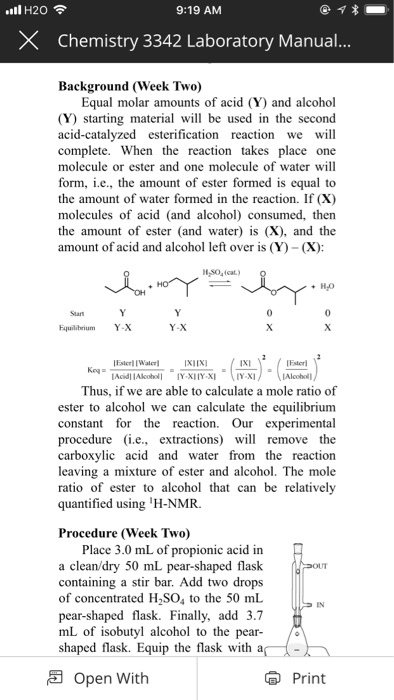
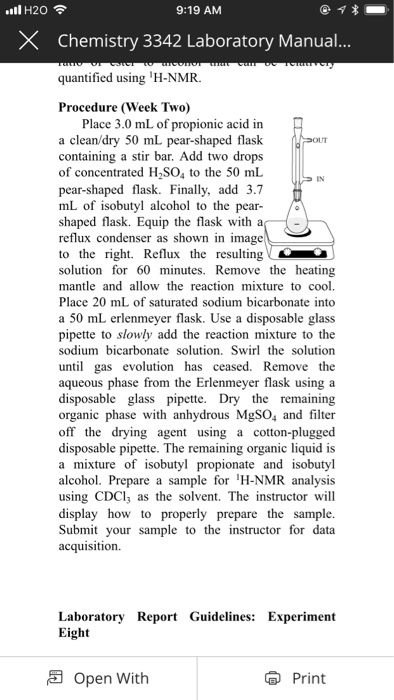
Reaction scheme [mixture of]
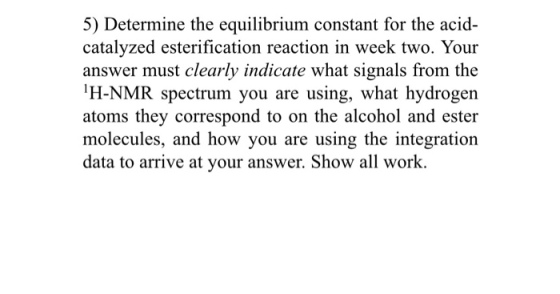
NMR Assignment:
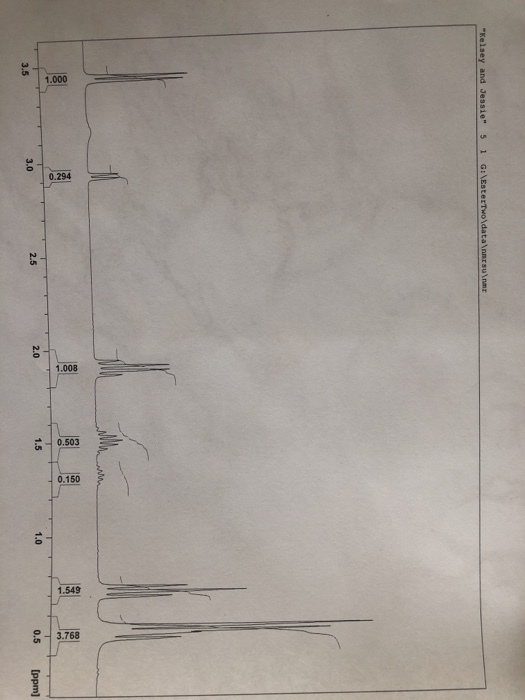
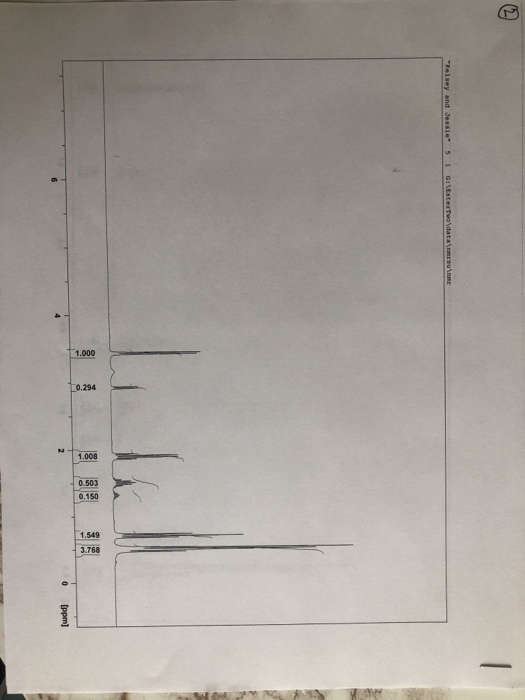
Proton (d)ppm Integration calc. Identity of proton(s) Comments
Ha: 3.4 1.00/2 = 0.50 CH2 of ester part, doublet
Hb: 1.5 0.503/1 = 0.50 CH of ester part multiplet
Hc: 0.5 3.76/ CH3 of ester part of molecule Refer Hf calculation
And alcohol parts
Alcohol correspond 0.147*6= 0.882
Ester + Total – alcohol
3.76-0.882=2.78
2.78/6= 0.46 (close to 0.50)
Hd: 1.9 1.00/2 =0.50 CH2 of acid part quartet
He: 0.75 1.540/3= 0.51 CH3 of acid part, triplet
Hf: 2.8 0.294/2 =0.147 CH2 of unreacted alcohol
Hg: 1.3 0.150/1=0.15 CH of unreacted alcohol
Equilibrium:
([Product]/[Unreacted])2 = ([Ester] /[Alcohol])2 ([0.50]/[0.147])2
=1.913* 10-3
Add Answer to:
I need help with the lab’s question below and H-NMR ASAP.
Please explain and show all...
need help analyzing nmr (calculations and structure) (TOH) as catalyst. Check your organic textbook for the...
 need help analyzing nmr (calculations and structure) (TOH) as catalyst. Check your organic textbook for the mechanism-acid-catalyzed addition of alcohol to aldehydes or ketones to form acetals or ketals. The ketone carbonyl, significantly more reactive than the ester Carbonyl, will react more rapidly with the ethylene glycol Formation of the ketal involves an equilibrium in which water is one of the products. The equilibrium can be shifted to favor the product by removing the water as it is formed (Le...
I need help with questions 5, 6, & 7. The FTIR and NMR is provided. I...
 I need help with questions 5, 6, & 7. The FTIR and NMR is
provided. I also need help creating a reaction mechanism using the
following:
Starting material: 1,7-Dimethyl-heptanedioate
Solvent: Diethyl ether
Reagent: sodium methoxide
Product: 3-oxo-cyclohexane carboxylic acid methyl ester
THANK YOU!!!!!
Ö 11-11: Dieckmann Reaction For this assignment, the target compound that you should synthesize is 2-oxo-cyclohexane carboxylic acid methyl ester.This is an intramolecular carbonyl addition variation. Examine the product and determine which ester is the nucleophile and...
I need help with questions 5, 6, & 7. The FTIR and NMR is
provided. I also need help creating a reaction mechanism using the
following:
Starting material: 1,7-Dimethyl-heptanedioate
Solvent: Diethyl ether
Reagent: sodium methoxide
Product: 3-oxo-cyclohexane carboxylic acid methyl ester
THANK YOU!!!!!
Ö 11-11: Dieckmann Reaction For this assignment, the target compound that you should synthesize is 2-oxo-cyclohexane carboxylic acid methyl ester.This is an intramolecular carbonyl addition variation. Examine the product and determine which ester is the nucleophile and...
IM HAVING DIFFICULTIES TO IDENTIFY NMR, can you please explain in details this answer and whats t...
 IM HAVING DIFFICULTIES TO IDENTIFY NMR, can you please explain
in details this answer and whats the easiest way to read it
The reaction is worked up and compared to the starting material by NMR Staring material (methyl (S 2-methy-4-cxobutanoate) Product зн 러 зн H 24 3H 2H 10 PPM 2 PPM Question #14: Does it appear that the correct product has formed? Examine your reasoning type your text here For example, if you had an alcohol and an aldehyde...
IM HAVING DIFFICULTIES TO IDENTIFY NMR, can you please explain
in details this answer and whats the easiest way to read it
The reaction is worked up and compared to the starting material by NMR Staring material (methyl (S 2-methy-4-cxobutanoate) Product зн 러 зн H 24 3H 2H 10 PPM 2 PPM Question #14: Does it appear that the correct product has formed? Examine your reasoning type your text here For example, if you had an alcohol and an aldehyde...
I need help with this post lab from Orgo. Anyone please help me. I have included...
 I need help with this post lab from Orgo. Anyone please help
me. I have included the procedure from experiment, but let me know
if there is anything to add on this. Thank you
1. Write the overall balanced chemical equation (not the mechanism) for the reaction you carried out in this experiment. Equation must be charge and mass balanced. Use structures not molecular formula. (3 pts) Part A Table 2: Complete this table (15 pts) 2-methyl cyclohexanol cycloalkene Molecular...
I need help with this post lab from Orgo. Anyone please help
me. I have included the procedure from experiment, but let me know
if there is anything to add on this. Thank you
1. Write the overall balanced chemical equation (not the mechanism) for the reaction you carried out in this experiment. Equation must be charge and mass balanced. Use structures not molecular formula. (3 pts) Part A Table 2: Complete this table (15 pts) 2-methyl cyclohexanol cycloalkene Molecular...
The proton nmr and the infrared spectra of DCC, DMAP, DCU, the product and the nmrs...
 The proton nmr and the infrared spectra of DCC, DMAP, DCU, the
product and the nmrs of the starting materials and products are
shown. These are labeled Compounds A, B and C. a.Which nmr is the
product?
b. Which is the nmr of the starting material?
c. What is the mixture of compounds shown as compound C?
tert-Butyl Ethyl Fumarate DCC, DMAP, CHCI OH Chemical Formula: C,H,O Chemical Formula: CH 0 Molecular Weight: 144.13 Molecular Weight: 74.12 Chemical Formula: CH...
The proton nmr and the infrared spectra of DCC, DMAP, DCU, the
product and the nmrs of the starting materials and products are
shown. These are labeled Compounds A, B and C. a.Which nmr is the
product?
b. Which is the nmr of the starting material?
c. What is the mixture of compounds shown as compound C?
tert-Butyl Ethyl Fumarate DCC, DMAP, CHCI OH Chemical Formula: C,H,O Chemical Formula: CH 0 Molecular Weight: 144.13 Molecular Weight: 74.12 Chemical Formula: CH...
Please help! For the reaction in step 2, how do i find the theoretical yield of...
 Please help! For the reaction
in step 2, how do i find the theoretical yield of the product for
this reaction? 0.07 moles of the reactant (ethyl acetoacetate
ethylene ketal) was used. What is that keto alcohol product
(circled) called? what is the molar mass of that circled product??
thank you!!
(TsOH) as catalyst. . Check your organic textbook for the mechanism- acid-catalvzed addition of alcohol to aldehydes or ketones to form acetals or ketals. The ketone carbonyl, significantly more...
Please help! For the reaction
in step 2, how do i find the theoretical yield of the product for
this reaction? 0.07 moles of the reactant (ethyl acetoacetate
ethylene ketal) was used. What is that keto alcohol product
(circled) called? what is the molar mass of that circled product??
thank you!!
(TsOH) as catalyst. . Check your organic textbook for the mechanism- acid-catalvzed addition of alcohol to aldehydes or ketones to form acetals or ketals. The ketone carbonyl, significantly more...
Give a detailed mechanism for this reaction and give a separation scheme NUCLEOPHILIC ACYL SUBSTITUTION: Synthesis...
 Give a detailed mechanism for this reaction and give a separation
scheme
NUCLEOPHILIC ACYL SUBSTITUTION: Synthesis of an Ester Isoamyl acetate (Banana Oil) Purpose This experiment demonstrat and alcohol. The technique of refluxing the reaction mixture is introduced. es the procedure for the synthesis of an ester from a carboxylic acid Esters are an important functional group in organic chemistry, and esters are found widely distributed in nature. Many lower molecular weight esters are associated with natural fuit flavors and...
Give a detailed mechanism for this reaction and give a separation
scheme
NUCLEOPHILIC ACYL SUBSTITUTION: Synthesis of an Ester Isoamyl acetate (Banana Oil) Purpose This experiment demonstrat and alcohol. The technique of refluxing the reaction mixture is introduced. es the procedure for the synthesis of an ester from a carboxylic acid Esters are an important functional group in organic chemistry, and esters are found widely distributed in nature. Many lower molecular weight esters are associated with natural fuit flavors and...
i need help with #3 please! SAFETY NOTES: Bromobenene and acetophenone are irritants. Wear gloves and...
 i need help with #3 please!
SAFETY NOTES: Bromobenene and acetophenone are irritants. Wear gloves and avoid contact with skin, eyes, and clothing • MHC) is dritating to the skin avoid contact with the skin, eyes, and clothing Diethyl ether, usually referred to simply as "ether", is volatile and flammable. Keep a safe distance from hot electrical devices WASTE DISPOSAL *** A itrate is the liquid that passed through the Hirsch funnel, ending up in the bottom of the sidearm...
i need help with #3 please!
SAFETY NOTES: Bromobenene and acetophenone are irritants. Wear gloves and avoid contact with skin, eyes, and clothing • MHC) is dritating to the skin avoid contact with the skin, eyes, and clothing Diethyl ether, usually referred to simply as "ether", is volatile and flammable. Keep a safe distance from hot electrical devices WASTE DISPOSAL *** A itrate is the liquid that passed through the Hirsch funnel, ending up in the bottom of the sidearm...
complete the stoichiometry table for the process above Experimental Notes 4, H ОН NaBH4 NaOH OH...
 complete the stoichiometry table for the process above
Experimental Notes 4, H ОН NaBH4 NaOH OH H2O OH Step 1: Procedure for the Sodium Borohydride Reduction of 3-Ethoxy-4-hydroxybenzaldehyde: Dissolve 1.62 g of 3-ethoxy-4-hydroxybenzaldehyde in 10 mL of 1.0 M NaOH in a 125 mL Erlenmeyer flask with a magnetic stir bar. Cool the flask in a cold-water bath, and then add, in small portions, 0.30 g of NaBH, over five minutes. Remove the cold-water bath and allow the reaction flask...
complete the stoichiometry table for the process above
Experimental Notes 4, H ОН NaBH4 NaOH OH H2O OH Step 1: Procedure for the Sodium Borohydride Reduction of 3-Ethoxy-4-hydroxybenzaldehyde: Dissolve 1.62 g of 3-ethoxy-4-hydroxybenzaldehyde in 10 mL of 1.0 M NaOH in a 125 mL Erlenmeyer flask with a magnetic stir bar. Cool the flask in a cold-water bath, and then add, in small portions, 0.30 g of NaBH, over five minutes. Remove the cold-water bath and allow the reaction flask...
I need it right now, please help me?? PROCEDURE PART I: DILUTING THE VINEGAR SOLUTION The...
 I
need it right now, please help me??
PROCEDURE PART I: DILUTING THE VINEGAR SOLUTION The vinegar solution must be diluted by a factor of 5 to be suitable for titration. 1. Obtain - 20 ml of the stock vinegar solution from the fume hood. 2. Using the 10-ml. pipet, pipet" 10 mL of the stock solution to a 50-ml volumetric flask. 3. Fill the volumetric flask to the calibration line with distilled water. Be sure not to go over...
I
need it right now, please help me??
PROCEDURE PART I: DILUTING THE VINEGAR SOLUTION The vinegar solution must be diluted by a factor of 5 to be suitable for titration. 1. Obtain - 20 ml of the stock vinegar solution from the fume hood. 2. Using the 10-ml. pipet, pipet" 10 mL of the stock solution to a 50-ml volumetric flask. 3. Fill the volumetric flask to the calibration line with distilled water. Be sure not to go over...
 need help analyzing nmr (calculations and structure) (TOH) as catalyst. Check your organic textbook for the mechanism-acid-catalyzed addition of alcohol to aldehydes or ketones to form acetals or ketals. The ketone carbonyl, significantly more reactive than the ester Carbonyl, will react more rapidly with the ethylene glycol Formation of the ketal involves an equilibrium in which water is one of the products. The equilibrium can be shifted to favor the product by removing the water as it is formed (Le...
 I need help with questions 5, 6, & 7. The FTIR and NMR is
provided. I also need help creating a reaction mechanism using the
following:
Starting material: 1,7-Dimethyl-heptanedioate
Solvent: Diethyl ether
Reagent: sodium methoxide
Product: 3-oxo-cyclohexane carboxylic acid methyl ester
THANK YOU!!!!!
Ö 11-11: Dieckmann Reaction For this assignment, the target compound that you should synthesize is 2-oxo-cyclohexane carboxylic acid methyl ester.This is an intramolecular carbonyl addition variation. Examine the product and determine which ester is the nucleophile and...
I need help with questions 5, 6, & 7. The FTIR and NMR is
provided. I also need help creating a reaction mechanism using the
following:
Starting material: 1,7-Dimethyl-heptanedioate
Solvent: Diethyl ether
Reagent: sodium methoxide
Product: 3-oxo-cyclohexane carboxylic acid methyl ester
THANK YOU!!!!!
Ö 11-11: Dieckmann Reaction For this assignment, the target compound that you should synthesize is 2-oxo-cyclohexane carboxylic acid methyl ester.This is an intramolecular carbonyl addition variation. Examine the product and determine which ester is the nucleophile and...
 IM HAVING DIFFICULTIES TO IDENTIFY NMR, can you please explain
in details this answer and whats the easiest way to read it
The reaction is worked up and compared to the starting material by NMR Staring material (methyl (S 2-methy-4-cxobutanoate) Product зн 러 зн H 24 3H 2H 10 PPM 2 PPM Question #14: Does it appear that the correct product has formed? Examine your reasoning type your text here For example, if you had an alcohol and an aldehyde...
IM HAVING DIFFICULTIES TO IDENTIFY NMR, can you please explain
in details this answer and whats the easiest way to read it
The reaction is worked up and compared to the starting material by NMR Staring material (methyl (S 2-methy-4-cxobutanoate) Product зн 러 зн H 24 3H 2H 10 PPM 2 PPM Question #14: Does it appear that the correct product has formed? Examine your reasoning type your text here For example, if you had an alcohol and an aldehyde...
 I need help with this post lab from Orgo. Anyone please help
me. I have included the procedure from experiment, but let me know
if there is anything to add on this. Thank you
1. Write the overall balanced chemical equation (not the mechanism) for the reaction you carried out in this experiment. Equation must be charge and mass balanced. Use structures not molecular formula. (3 pts) Part A Table 2: Complete this table (15 pts) 2-methyl cyclohexanol cycloalkene Molecular...
I need help with this post lab from Orgo. Anyone please help
me. I have included the procedure from experiment, but let me know
if there is anything to add on this. Thank you
1. Write the overall balanced chemical equation (not the mechanism) for the reaction you carried out in this experiment. Equation must be charge and mass balanced. Use structures not molecular formula. (3 pts) Part A Table 2: Complete this table (15 pts) 2-methyl cyclohexanol cycloalkene Molecular...
 The proton nmr and the infrared spectra of DCC, DMAP, DCU, the
product and the nmrs of the starting materials and products are
shown. These are labeled Compounds A, B and C. a.Which nmr is the
product?
b. Which is the nmr of the starting material?
c. What is the mixture of compounds shown as compound C?
tert-Butyl Ethyl Fumarate DCC, DMAP, CHCI OH Chemical Formula: C,H,O Chemical Formula: CH 0 Molecular Weight: 144.13 Molecular Weight: 74.12 Chemical Formula: CH...
The proton nmr and the infrared spectra of DCC, DMAP, DCU, the
product and the nmrs of the starting materials and products are
shown. These are labeled Compounds A, B and C. a.Which nmr is the
product?
b. Which is the nmr of the starting material?
c. What is the mixture of compounds shown as compound C?
tert-Butyl Ethyl Fumarate DCC, DMAP, CHCI OH Chemical Formula: C,H,O Chemical Formula: CH 0 Molecular Weight: 144.13 Molecular Weight: 74.12 Chemical Formula: CH...
 Please help! For the reaction
in step 2, how do i find the theoretical yield of the product for
this reaction? 0.07 moles of the reactant (ethyl acetoacetate
ethylene ketal) was used. What is that keto alcohol product
(circled) called? what is the molar mass of that circled product??
thank you!!
(TsOH) as catalyst. . Check your organic textbook for the mechanism- acid-catalvzed addition of alcohol to aldehydes or ketones to form acetals or ketals. The ketone carbonyl, significantly more...
Please help! For the reaction
in step 2, how do i find the theoretical yield of the product for
this reaction? 0.07 moles of the reactant (ethyl acetoacetate
ethylene ketal) was used. What is that keto alcohol product
(circled) called? what is the molar mass of that circled product??
thank you!!
(TsOH) as catalyst. . Check your organic textbook for the mechanism- acid-catalvzed addition of alcohol to aldehydes or ketones to form acetals or ketals. The ketone carbonyl, significantly more...
 Give a detailed mechanism for this reaction and give a separation
scheme
NUCLEOPHILIC ACYL SUBSTITUTION: Synthesis of an Ester Isoamyl acetate (Banana Oil) Purpose This experiment demonstrat and alcohol. The technique of refluxing the reaction mixture is introduced. es the procedure for the synthesis of an ester from a carboxylic acid Esters are an important functional group in organic chemistry, and esters are found widely distributed in nature. Many lower molecular weight esters are associated with natural fuit flavors and...
Give a detailed mechanism for this reaction and give a separation
scheme
NUCLEOPHILIC ACYL SUBSTITUTION: Synthesis of an Ester Isoamyl acetate (Banana Oil) Purpose This experiment demonstrat and alcohol. The technique of refluxing the reaction mixture is introduced. es the procedure for the synthesis of an ester from a carboxylic acid Esters are an important functional group in organic chemistry, and esters are found widely distributed in nature. Many lower molecular weight esters are associated with natural fuit flavors and...
 i need help with #3 please!
SAFETY NOTES: Bromobenene and acetophenone are irritants. Wear gloves and avoid contact with skin, eyes, and clothing • MHC) is dritating to the skin avoid contact with the skin, eyes, and clothing Diethyl ether, usually referred to simply as "ether", is volatile and flammable. Keep a safe distance from hot electrical devices WASTE DISPOSAL *** A itrate is the liquid that passed through the Hirsch funnel, ending up in the bottom of the sidearm...
i need help with #3 please!
SAFETY NOTES: Bromobenene and acetophenone are irritants. Wear gloves and avoid contact with skin, eyes, and clothing • MHC) is dritating to the skin avoid contact with the skin, eyes, and clothing Diethyl ether, usually referred to simply as "ether", is volatile and flammable. Keep a safe distance from hot electrical devices WASTE DISPOSAL *** A itrate is the liquid that passed through the Hirsch funnel, ending up in the bottom of the sidearm...
 complete the stoichiometry table for the process above
Experimental Notes 4, H ОН NaBH4 NaOH OH H2O OH Step 1: Procedure for the Sodium Borohydride Reduction of 3-Ethoxy-4-hydroxybenzaldehyde: Dissolve 1.62 g of 3-ethoxy-4-hydroxybenzaldehyde in 10 mL of 1.0 M NaOH in a 125 mL Erlenmeyer flask with a magnetic stir bar. Cool the flask in a cold-water bath, and then add, in small portions, 0.30 g of NaBH, over five minutes. Remove the cold-water bath and allow the reaction flask...
complete the stoichiometry table for the process above
Experimental Notes 4, H ОН NaBH4 NaOH OH H2O OH Step 1: Procedure for the Sodium Borohydride Reduction of 3-Ethoxy-4-hydroxybenzaldehyde: Dissolve 1.62 g of 3-ethoxy-4-hydroxybenzaldehyde in 10 mL of 1.0 M NaOH in a 125 mL Erlenmeyer flask with a magnetic stir bar. Cool the flask in a cold-water bath, and then add, in small portions, 0.30 g of NaBH, over five minutes. Remove the cold-water bath and allow the reaction flask...
 I
need it right now, please help me??
PROCEDURE PART I: DILUTING THE VINEGAR SOLUTION The vinegar solution must be diluted by a factor of 5 to be suitable for titration. 1. Obtain - 20 ml of the stock vinegar solution from the fume hood. 2. Using the 10-ml. pipet, pipet" 10 mL of the stock solution to a 50-ml volumetric flask. 3. Fill the volumetric flask to the calibration line with distilled water. Be sure not to go over...
I
need it right now, please help me??
PROCEDURE PART I: DILUTING THE VINEGAR SOLUTION The vinegar solution must be diluted by a factor of 5 to be suitable for titration. 1. Obtain - 20 ml of the stock vinegar solution from the fume hood. 2. Using the 10-ml. pipet, pipet" 10 mL of the stock solution to a 50-ml volumetric flask. 3. Fill the volumetric flask to the calibration line with distilled water. Be sure not to go over...
Most questions answered within 3 hours.
-
Where is the error in this code sequence?
String s1 = "Hello";
String s2 = "ello";...
asked 10 months ago -
Financial data for Joel de Paris, Inc., for last year
follow:
Joel de Paris, Inc.
Balance...
asked 10 months ago -
Consider this reaction:
Al2(SO4)3 (aq)+ BaCl3
(aq) Al2Cl6 (aq)- +
3BaSO4(s) . What is the...
asked 10 months ago -
Suppose that Savneet is considering increasing her
recent random sample from 20 car rentals to 40...
asked 10 months ago -
Trucks arrive at an unloading terminal at an average rate of 120
per hour.
Trucks arrive...
asked 10 months ago -
Why are methanol and ethanol completely soluble in water while
octanol is not very little soluble....
asked 10 months ago -
A facilities manager at a university reads in a research report
that the mean amount of...
asked 10 months ago -
When the CuSO4 is rehydrated by adding water to the anhydrous
compound, is this an endothermic...
asked 10 months ago -
A ray of sunlight is passing from diamond into crown glass; the
angle of incidence is...
asked 10 months ago -
A block of mass 0.249 kg is placed on top of a light, vertical
spring of...
asked 10 months ago -
how do the kidneys compensate in the presences of acidosis
a) trigger hyperventilate
b) reserve acid...
asked 10 months ago -
Question 501 pts
The rental rate of capital to the firm increases. Which of the
following...
asked 10 months ago