

Homework Answers
The type of mutations shown below fig 12.3 are known as Homeotic mutation
Homeotic mutations affect normal development of the imaginal disks that produce cuticular structures (antennae, wings, halteres, legs, etc.)
From the evolution the Homeotic mutation would likely to be selectively neutral
Add Answer to:
The type of mutations shown below (Fig. 12.3) are known as mutations (a) Wild-type fly (b)...
For a cross between the tan body female fly and the wild-type male fly, is the...
For a cross between the tan body female fly and the wild-type male fly, is the phenotypic ratio of the F2 offspring for sex linked the same as the Mendelian ratio for a normal non-sex-linked dominant/recessive trait. Select one: True False?
2. Three genes and their mutations are found on the third chromosome in fruit fly Drosophila...
 2. Three genes and their mutations are found on the third chromosome in fruit fly Drosophila melanogaster. Of these three genes, scarlet eyes (st) are recessive to red eyes (st"), cbony body color (eb) is recessive to gray body color (eb"), and spineless (ss), the st presence of small bristles, is recessive to normal bristles (ss). You eb SS were given a heterozygous fly (st'st eb'eb ss'ss) and were asked to eb ss design an experiment to map the distance...
Two dominant mutations that are linked on the third chromosome and each is homozyogus recessive lethal:...
 Two dominant mutations that are linked on the third chromosome
and each is homozyogus recessive lethal: Tubby (Tb) in the Tb+ gene
results in short/fat “tubby“ bodies. Another dominant mutation
serrate (Ser) in the Ser+ gene results in serrated wings. Tb flies
with normal wings were crossed to Ser flies with normal body.
Assuming no recombination, the expected progeny and their
proportions are:
+ Consider two dominant mutations that are linked on the third chromosome and each is homozyogus recessive...
Two dominant mutations that are linked on the third chromosome
and each is homozyogus recessive lethal: Tubby (Tb) in the Tb+ gene
results in short/fat “tubby“ bodies. Another dominant mutation
serrate (Ser) in the Ser+ gene results in serrated wings. Tb flies
with normal wings were crossed to Ser flies with normal body.
Assuming no recombination, the expected progeny and their
proportions are:
+ Consider two dominant mutations that are linked on the third chromosome and each is homozyogus recessive...
3-3. In the fruit fly, Dichaete (D) is a dominant autosomal mutation that affects wing shape;...
 3-3. In the fruit fly, Dichaete (D) is a dominant autosomal mutation that affects wing shape; it is lethal when homozygous. Ebony body, e, and rose eye, r, are recessive mutations also located on the same chromosome. Dichaete flies were crossed to pure-breeding ebony, rose flies. Among the F1 were Dichaete progeny with normal body and eye color. Female Dichaete F1 were test-crossed to ebony, rose males, with the results listed below. (Show your work!) A. Write the genotypes of...
You are interested in mouse eye development and conduct a genetic screen for mutations that result...
You are interested in mouse eye development and conduct a genetic screen for mutations that result in strong eye defects. After treating a male mouse with ENU (a chemical mutagen that induces base-pair changes and small deletions), you identify four mouse mutants 1-4, each with defective eyes. You cross each of the four mutant mice with eye defects to homozygous wild type mice and examine the progeny from each cross. What type of information can you get from observing the...
Assume that a true breeding fly with vermillion eyes is mated to a true breeding fly...
Assume that a true breeding fly with vermillion eyes is mated to a true breeding fly that is crossveiless and has torn wings. The genes in question are located on an autosome and are recessive mutants. The resulting female is mated to a fly that has vermillion eyes and crossveinless and torn wings. The number of offspring and the resulting phenotypes are provided. Use the below designations to show your work. V = wild type, v = vermillion eyes; C...
Shown below are the amino acid sequences of the wild-type and three mutant forms of a...
 Shown below are the amino acid sequences of the wild-type and three mutant forms of a short protein. Each mutation results from a single nucleotide change (transition/transversion / insertion / deletion). Use this information to answer the following questions. Hint: First, reconstruct as much as you can of the wild-type RNA sequence and then reference that sequence when analyzing the mutations. Wild type: met - gin-ala - ser-val - arg - phe Mutant 1: met - gln - pro-ser -...
Shown below are the amino acid sequences of the wild-type and three mutant forms of a...
Shown below are the amino acid sequences of the wild-type and three mutant forms of a short protein. Each mutation results from a single nucleotide change (transition / transversion / insertion / deletion). Use this information to answer the following questions. Hint: First, reconstruct as much as you can of the wild-type RNA sequence and then reference that sequence when analyzing the mutations. Wild type: met – gln – ala – ser – val – arg – phe Mutant 1:...
Can you please help me with this problem: 3. A dominant wild-type allele D produces full...
 Can you please help me with this problem:
3. A dominant wild-type allele D produces full enzyme function, but a recessive alleled, produces no functional enzymatic action, and a recessive allele da produces reduced enzyme function. Western blot analysis of the proteins produced by organisms with different genotypes for this gene gives the results shown. Note, proteins separate out in a gel by size similar to DNA fragments with smaller polypeptides traveling farther. Genotype DD Dd, Dd, dod, dd₂ d₂d₂...
Can you please help me with this problem:
3. A dominant wild-type allele D produces full enzyme function, but a recessive alleled, produces no functional enzymatic action, and a recessive allele da produces reduced enzyme function. Western blot analysis of the proteins produced by organisms with different genotypes for this gene gives the results shown. Note, proteins separate out in a gel by size similar to DNA fragments with smaller polypeptides traveling farther. Genotype DD Dd, Dd, dod, dd₂ d₂d₂...
13. The promoter mutations, lacP A. Are recessive B. Are cis dominant C. Cannot be complemented...
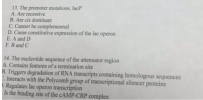 13. The promoter mutations, lacP A. Are recessive B. Are cis dominant C. Cannot be complemented D. Cause constitutive expression of the lac operon E. A and D F. B and C 14. The nucleotide sequence of the attenuator region A. Contains features of a termination site 8. Triggers degradation of RNA transcripts containing homologous sequences Interacts with the Polycomb group of transcriptional silencer proteins . Regulates lac operon transcription Is the binding site of the cAMP-CRP complex
 2. Three genes and their mutations are found on the third chromosome in fruit fly Drosophila melanogaster. Of these three genes, scarlet eyes (st) are recessive to red eyes (st"), cbony body color (eb) is recessive to gray body color (eb"), and spineless (ss), the st presence of small bristles, is recessive to normal bristles (ss). You eb SS were given a heterozygous fly (st'st eb'eb ss'ss) and were asked to eb ss design an experiment to map the distance...
 Two dominant mutations that are linked on the third chromosome
and each is homozyogus recessive lethal: Tubby (Tb) in the Tb+ gene
results in short/fat “tubby“ bodies. Another dominant mutation
serrate (Ser) in the Ser+ gene results in serrated wings. Tb flies
with normal wings were crossed to Ser flies with normal body.
Assuming no recombination, the expected progeny and their
proportions are:
+ Consider two dominant mutations that are linked on the third chromosome and each is homozyogus recessive...
Two dominant mutations that are linked on the third chromosome
and each is homozyogus recessive lethal: Tubby (Tb) in the Tb+ gene
results in short/fat “tubby“ bodies. Another dominant mutation
serrate (Ser) in the Ser+ gene results in serrated wings. Tb flies
with normal wings were crossed to Ser flies with normal body.
Assuming no recombination, the expected progeny and their
proportions are:
+ Consider two dominant mutations that are linked on the third chromosome and each is homozyogus recessive...
 3-3. In the fruit fly, Dichaete (D) is a dominant autosomal mutation that affects wing shape; it is lethal when homozygous. Ebony body, e, and rose eye, r, are recessive mutations also located on the same chromosome. Dichaete flies were crossed to pure-breeding ebony, rose flies. Among the F1 were Dichaete progeny with normal body and eye color. Female Dichaete F1 were test-crossed to ebony, rose males, with the results listed below. (Show your work!) A. Write the genotypes of...
 Shown below are the amino acid sequences of the wild-type and three mutant forms of a short protein. Each mutation results from a single nucleotide change (transition/transversion / insertion / deletion). Use this information to answer the following questions. Hint: First, reconstruct as much as you can of the wild-type RNA sequence and then reference that sequence when analyzing the mutations. Wild type: met - gin-ala - ser-val - arg - phe Mutant 1: met - gln - pro-ser -...
 Can you please help me with this problem:
3. A dominant wild-type allele D produces full enzyme function, but a recessive alleled, produces no functional enzymatic action, and a recessive allele da produces reduced enzyme function. Western blot analysis of the proteins produced by organisms with different genotypes for this gene gives the results shown. Note, proteins separate out in a gel by size similar to DNA fragments with smaller polypeptides traveling farther. Genotype DD Dd, Dd, dod, dd₂ d₂d₂...
Can you please help me with this problem:
3. A dominant wild-type allele D produces full enzyme function, but a recessive alleled, produces no functional enzymatic action, and a recessive allele da produces reduced enzyme function. Western blot analysis of the proteins produced by organisms with different genotypes for this gene gives the results shown. Note, proteins separate out in a gel by size similar to DNA fragments with smaller polypeptides traveling farther. Genotype DD Dd, Dd, dod, dd₂ d₂d₂...
 13. The promoter mutations, lacP A. Are recessive B. Are cis dominant C. Cannot be complemented D. Cause constitutive expression of the lac operon E. A and D F. B and C 14. The nucleotide sequence of the attenuator region A. Contains features of a termination site 8. Triggers degradation of RNA transcripts containing homologous sequences Interacts with the Polycomb group of transcriptional silencer proteins . Regulates lac operon transcription Is the binding site of the cAMP-CRP complex
Most questions answered within 3 hours.
-
Where is the error in this code sequence?
String s1 = "Hello";
String s2 = "ello";...
asked 10 months ago -
Financial data for Joel de Paris, Inc., for last year
follow:
Joel de Paris, Inc.
Balance...
asked 10 months ago -
Consider this reaction:
Al2(SO4)3 (aq)+ BaCl3
(aq) Al2Cl6 (aq)- +
3BaSO4(s) . What is the...
asked 10 months ago -
Suppose that Savneet is considering increasing her
recent random sample from 20 car rentals to 40...
asked 10 months ago -
Trucks arrive at an unloading terminal at an average rate of 120
per hour.
Trucks arrive...
asked 10 months ago -
Why are methanol and ethanol completely soluble in water while
octanol is not very little soluble....
asked 10 months ago -
A facilities manager at a university reads in a research report
that the mean amount of...
asked 10 months ago -
When the CuSO4 is rehydrated by adding water to the anhydrous
compound, is this an endothermic...
asked 10 months ago -
A ray of sunlight is passing from diamond into crown glass; the
angle of incidence is...
asked 10 months ago -
A block of mass 0.249 kg is placed on top of a light, vertical
spring of...
asked 10 months ago -
how do the kidneys compensate in the presences of acidosis
a) trigger hyperventilate
b) reserve acid...
asked 10 months ago -
Question 501 pts
The rental rate of capital to the firm increases. Which of the
following...
asked 10 months ago