
Homework Answers
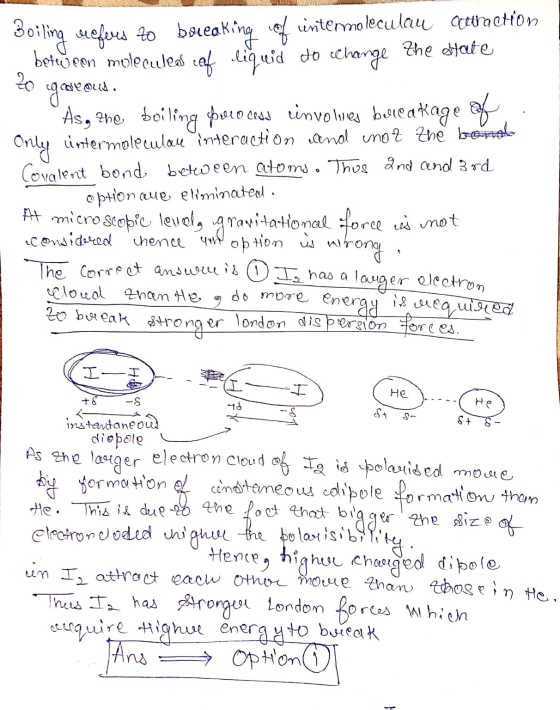
Correct answer is first option and explanation is given below
Add Answer to:
The boiling point of iodine (12) is much higher than the boiling point of helium (He)....
C The boiling point of H,O is much higher than the boiling point of HS. H2O...
 C The boiling point of H,O is much higher than the boiling point of HS. H2O is a molecular compound, while HS is an ionic compound. H2O is a polar molecule, so the attractions between the molecules are stronger than those between nonpolar H2S molecules. H2O has strong hydrogen bonds between its molecules, and HS molecules cannot form hydrogen bonds. The dispersion forces between the H2O molecules are much stronger. d The boiling point of CH,O is much higher than...
1.Which of the following is expected to have the higher boiling point? fluorine gas chlorine gas...
1.Which of the following is expected to have the higher boiling point? fluorine gas chlorine gas bromine gas iodine gas 2.Which of the following statements are true about Intermolecular Forces (IMFs)? (Select all that apply.) Hydrogen bonds occur between hydrogens on two neighboring molecules. All molecules exhibit Dipole-Dipole forces. Hydrogen bonds are generally stronger than London Dispersion Forces. Intermolecular forces are weaker than bonds. Intermolecular forces are attractive forces between two atoms in the same molecule. Only polar molecules exhibit...
h of the following statements is NOT true? London dispersion forces are present in all substances but are the only significant intermolecular forces in nonpolar substances. ) The density of the l...
 h of the following statements is NOT true? London dispersion forces are present in all substances but are the only significant intermolecular forces in nonpolar substances. ) The density of the liquid state of a substance is greater than the density of its gaseous state. The thermal energy in a liquid allows the atoms within molecules to completely overcome the attractions between them so they flow. Most liquids can be converted to a gas by reducing pressure and/or heating. The...
Select the statement(s) which account for the differences in boiling point? A) PH3 is ionic, and...
Select the statement(s) which account for the differences in boiling point? A) PH3 is ionic, and NH3 is covalent. B) NH3 forms hydrogen bonds, and PH3 does not. C) PH3 forms stronger dipole-dipole interactions than NH3. D) PH3 forms weaker dispersion forces than NH3. E) PH3 forms dispersion forces, and NH3 does not.
2. Identify the strongest type of intermolecular forces in acetone, ethanol, water and hexane. (Structures listed...
 2. Identify the strongest type of intermolecular forces in acetone, ethanol, water and hexane. (Structures listed on page 15.) Experiment 2 Intermolecular Forces There are three general types of intermolecular forces. All substances exhibit London Dispersion Forces (LDF), and they are generally the weakest of the three types. These London forces are due to the attractions between small, temporary dipoles that arise from the constant, random movement of the electrons in a substance. As molar mass increases, the size of...
(b) Why is the magnitude of this value so much larger than the heat of vaporization...
 (b) Why is the magnitude of this value so much larger than the heat of vaporization of water (AH°vap = 41 kJ/mol)? * Choose one: A. Less energy is needed to form attractive forces between water molecules than to break H-H and O-O bonds and form H-O bonds. O B. More energy is needed to form attractive forces between water molecules than to break H-Hand O-O bonds and form H-O bonds. o C. Less energy is needed to break attractive...
1. Why is the boiling point of 1-butene higher than the boiling point of 1-propene? Group...
1. Why is the boiling point of 1-butene higher than the boiling point of 1-propene? Group of answer choices Because 1-butene has a different (and stronger) type of atom-to-atom intermolecular interaction than does 1-propene. Because 1-butene forms H bonds and 1-propene does not. As a larger compound, 1-butene can form more atom/atom intermolecular interactions than can 1-propene. None of the above reasons is correct. 2. An ethene molecule contains 4 H atoms. How many H bonds could ethane participate in...
Why does benzene have a much higher boiling point (80。c) than hexane (69。c), even though they...
Why does benzene have a much higher boiling point (80。c) than hexane (69。c), even though they have the same number of carbons? A) Benzene is much more polar than hexane which enhances the attractive forces between molecules and raises the boiling point. B) Benzene has fewer hydrogens than hexane. C) Benzene is planar and has delocalized electron density which increases the attractive forces between molecules and raises the boiling point. D) Benzene can covalently bond to another benzene molecule which...
Part A H,0 (100°C) has a higher boiling point than CH, OH (65°C). There are more...
 Part A H,0 (100°C) has a higher boiling point than CH, OH (65°C). There are more hydrogen bonds between water molecules than between alcohol molecules. There are less hydrogen bonds between water molecules than between alcohol molecules. CH, OH has the higher molecular mass than H,O. There are no hydrogen bonds between alcohol molecules while there are plenty of them between water molecules. O Submit Previous Answers Request Answer X Incorrect; Try Again; 2 attempts remaining Part B H,O (100°C)...
My answers: Not sure if they are correct. 1. a. London dispersion b. H-bonding, dipole-dipole,...
 My answers: Not sure if they are correct.
1. a. London dispersion
b. H-bonding, dipole-dipole, london dispersion
c. London dispersion
d. Ionic, london disperson
2. The second one because not a lot of H+ and less acidic. Need
help understanding the meaning of the question.
3. Diethyl cannot h-bond because it does not provide intermolecular
bonding engery while 1-b. can form h-bond making strong
intermolecular bonds to take up greater engery to break
molecules.
4. Not sure...
My answers: Not sure if they are correct.
1. a. London dispersion
b. H-bonding, dipole-dipole, london dispersion
c. London dispersion
d. Ionic, london disperson
2. The second one because not a lot of H+ and less acidic. Need
help understanding the meaning of the question.
3. Diethyl cannot h-bond because it does not provide intermolecular
bonding engery while 1-b. can form h-bond making strong
intermolecular bonds to take up greater engery to break
molecules.
4. Not sure...
 C The boiling point of H,O is much higher than the boiling point of HS. H2O is a molecular compound, while HS is an ionic compound. H2O is a polar molecule, so the attractions between the molecules are stronger than those between nonpolar H2S molecules. H2O has strong hydrogen bonds between its molecules, and HS molecules cannot form hydrogen bonds. The dispersion forces between the H2O molecules are much stronger. d The boiling point of CH,O is much higher than...
 h of the following statements is NOT true? London dispersion forces are present in all substances but are the only significant intermolecular forces in nonpolar substances. ) The density of the liquid state of a substance is greater than the density of its gaseous state. The thermal energy in a liquid allows the atoms within molecules to completely overcome the attractions between them so they flow. Most liquids can be converted to a gas by reducing pressure and/or heating. The...
 2. Identify the strongest type of intermolecular forces in acetone, ethanol, water and hexane. (Structures listed on page 15.) Experiment 2 Intermolecular Forces There are three general types of intermolecular forces. All substances exhibit London Dispersion Forces (LDF), and they are generally the weakest of the three types. These London forces are due to the attractions between small, temporary dipoles that arise from the constant, random movement of the electrons in a substance. As molar mass increases, the size of...
 (b) Why is the magnitude of this value so much larger than the heat of vaporization of water (AH°vap = 41 kJ/mol)? * Choose one: A. Less energy is needed to form attractive forces between water molecules than to break H-H and O-O bonds and form H-O bonds. O B. More energy is needed to form attractive forces between water molecules than to break H-Hand O-O bonds and form H-O bonds. o C. Less energy is needed to break attractive...
 Part A H,0 (100°C) has a higher boiling point than CH, OH (65°C). There are more hydrogen bonds between water molecules than between alcohol molecules. There are less hydrogen bonds between water molecules than between alcohol molecules. CH, OH has the higher molecular mass than H,O. There are no hydrogen bonds between alcohol molecules while there are plenty of them between water molecules. O Submit Previous Answers Request Answer X Incorrect; Try Again; 2 attempts remaining Part B H,O (100°C)...
 My answers: Not sure if they are correct.
1. a. London dispersion
b. H-bonding, dipole-dipole, london dispersion
c. London dispersion
d. Ionic, london disperson
2. The second one because not a lot of H+ and less acidic. Need
help understanding the meaning of the question.
3. Diethyl cannot h-bond because it does not provide intermolecular
bonding engery while 1-b. can form h-bond making strong
intermolecular bonds to take up greater engery to break
molecules.
4. Not sure...
My answers: Not sure if they are correct.
1. a. London dispersion
b. H-bonding, dipole-dipole, london dispersion
c. London dispersion
d. Ionic, london disperson
2. The second one because not a lot of H+ and less acidic. Need
help understanding the meaning of the question.
3. Diethyl cannot h-bond because it does not provide intermolecular
bonding engery while 1-b. can form h-bond making strong
intermolecular bonds to take up greater engery to break
molecules.
4. Not sure...
Most questions answered within 3 hours.
-
Where is the error in this code sequence?
String s1 = "Hello";
String s2 = "ello";...
asked 11 months ago -
Financial data for Joel de Paris, Inc., for last year
follow:
Joel de Paris, Inc.
Balance...
asked 11 months ago -
Consider this reaction:
Al2(SO4)3 (aq)+ BaCl3
(aq) Al2Cl6 (aq)- +
3BaSO4(s) . What is the...
asked 11 months ago -
Suppose that Savneet is considering increasing her
recent random sample from 20 car rentals to 40...
asked 11 months ago -
Trucks arrive at an unloading terminal at an average rate of 120
per hour.
Trucks arrive...
asked 11 months ago -
Why are methanol and ethanol completely soluble in water while
octanol is not very little soluble....
asked 11 months ago -
A facilities manager at a university reads in a research report
that the mean amount of...
asked 11 months ago -
When the CuSO4 is rehydrated by adding water to the anhydrous
compound, is this an endothermic...
asked 11 months ago -
A ray of sunlight is passing from diamond into crown glass; the
angle of incidence is...
asked 11 months ago -
A block of mass 0.249 kg is placed on top of a light, vertical
spring of...
asked 11 months ago -
how do the kidneys compensate in the presences of acidosis
a) trigger hyperventilate
b) reserve acid...
asked 11 months ago -
Question 501 pts
The rental rate of capital to the firm increases. Which of the
following...
asked 11 months ago