1.Which of the following is expected to have the higher boiling point? fluorine gas chlorine gas...
1.Which of the following is expected to have the higher boiling point?
- fluorine gas
- chlorine gas
- bromine gas
- iodine gas
2.Which of the following statements are true about Intermolecular Forces (IMFs)? (Select all that apply.)
- Hydrogen bonds occur between hydrogens on two neighboring molecules.
- All molecules exhibit Dipole-Dipole forces.
- Hydrogen bonds are generally stronger than London Dispersion Forces.
- Intermolecular forces are weaker than bonds.
- Intermolecular forces are attractive forces between two atoms in the same molecule.
- Only polar molecules exhibit London Dispersion Forces.
Homework Answers
Request Answer!
We need at least 10 more requests to produce the answer.
0 / 10 have requested this problem solution
The more requests, the faster the answer.
Add Answer to:
1.Which of the following is expected to have the higher boiling
point?
fluorine gas
chlorine gas...
2. Identify the strongest type of intermolecular forces in acetone, ethanol, water and hexane. (Structures listed...
 2. Identify the strongest type of intermolecular forces in acetone, ethanol, water and hexane. (Structures listed on page 15.) Experiment 2 Intermolecular Forces There are three general types of intermolecular forces. All substances exhibit London Dispersion Forces (LDF), and they are generally the weakest of the three types. These London forces are due to the attractions between small, temporary dipoles that arise from the constant, random movement of the electrons in a substance. As molar mass increases, the size of...
C The boiling point of H,O is much higher than the boiling point of HS. H2O...
 C The boiling point of H,O is much higher than the boiling point of HS. H2O is a molecular compound, while HS is an ionic compound. H2O is a polar molecule, so the attractions between the molecules are stronger than those between nonpolar H2S molecules. H2O has strong hydrogen bonds between its molecules, and HS molecules cannot form hydrogen bonds. The dispersion forces between the H2O molecules are much stronger. d The boiling point of CH,O is much higher than...
Arrange the compounds in order from highest to lowest boiling point.
 Arrange the compounds in order from highest to lowest boiling point. Consider how noncovalent interactions would affect the boiling point rather than looking up actual boiling points. Highest boiling point Lowest boiling point Identify the three true statements. Stronger intermolecular forces usually correlate with higher boiling points. Boiling point generally increases with molecular weight due to increased strength of dispersion forces. Hydrocarbons exhibit only dispersion forces. Dipolo-dipole interactions are stronger than dispersion forces and hydrogen bonds. Hydrogen bonds require carbon, hydrogen, and a halogen.
The boiling point of iodine (12) is much higher than the boiling point of helium (He)....
 The boiling point of iodine (12) is much higher than the boiling point of helium (He). Why? O 12 has a larger electron cloud than He, so more energy is required to overcome the stronger London Dispersion Forces. O It requires more energy to break the covalent bonds in 12 than to overcome the London Dispersion Forces between He atoms. The bonds between iodine atoms are stronger than the bonds between helium atoms and therefore harder to break. O 12...
QUESTION 1 Identify the most important type of intermolecular force that would exist between neighboring molecules...
 QUESTION 1 Identify the most important type of intermolecular force that would exist between neighboring molecules in CH3CH2COOH A. London dispersion forces B. Dipole-dipole forces OC. Hydrogen bonding QUESTION 2 Identify the most important type of intermolecular force that would exist between neighboring molecules in NF3 O A. London dispersion forces B. Dipole-dipole forces OC. Hydrogen bonding QUESTION 3 Identify the most important type of intermolecular force that would exist between neighboring molecules in SO3 A. London dispersion forces B....
Question 14 Which of the following is or are true? Molecules which have hydrogen bonded to...
 Question 14 Which of the following is or are true? Molecules which have hydrogen bonded to F, 0, or N can undergo hydrogen-bonding London dispersion forces are the result of permanent dipoles in atoms or molecules. Bonding forces are much stronger than intermolecular forces. An intermolecular force is an attractive force that operates between molecules. London dispersion forces occur in all atoms and molecules.
Use the References to access important values if needed for this question. List the following substances...
 Use the References to access important values if needed for this question. List the following substances in order of increasing normal boiling points Tb, and explain your reasoning: He, HCI, HF, Nal Boiling point substance1-lowest Reason 4-highest Is an ionic compound: forces are stronger than forces between neutral molecules. Has hydrogen bonds: stronger than other dipole-dipole interactions Is polar: dipole-dipole forces are stronger than dispersion forces Is nonpolar: dispersion forces are weaker than dipole-dipole forces. HCI HF Nal Submit Answer...
The gases CO,(9) and NH, (9) can be liquefied at 20°C by compressing them to sufficiently...
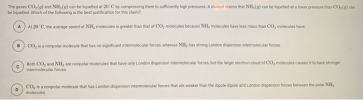 The gases CO,(9) and NH, (9) can be liquefied at 20°C by compressing them to sufficiently high pressures. A student claims that NH,) can be liquefied at a lower pressure than C0,G) can be liquefied. Which of the following is the best justification for this claim? A) At 20°C, the average speed of NH3 molecules is greater than that of CO, molecules because NH, molecules have less mass than Co, molecules have. (B) Co, is a nonpolar molecule that has...
Which of the following compounds will only have London dispersion intermolecular attractions? {Hint: look for non-polar...
 Which of the following compounds will only have London dispersion intermolecular attractions? {Hint: look for non-polar molecules). O CO2 O CH3F O CH3OH O OCI2 O Naci QUESTION 4 What is the strongest (most attractive) intermolecular force in CH3F? O hydrogen bonding O London dispersion forces O ion-dipole attraction O jonic bonding O dipole-dipole attraction
Select the statement(s) which account for the differences in boiling point? A) PH3 is ionic, and...
Select the statement(s) which account for the differences in boiling point? A) PH3 is ionic, and NH3 is covalent. B) NH3 forms hydrogen bonds, and PH3 does not. C) PH3 forms stronger dipole-dipole interactions than NH3. D) PH3 forms weaker dispersion forces than NH3. E) PH3 forms dispersion forces, and NH3 does not.
 2. Identify the strongest type of intermolecular forces in acetone, ethanol, water and hexane. (Structures listed on page 15.) Experiment 2 Intermolecular Forces There are three general types of intermolecular forces. All substances exhibit London Dispersion Forces (LDF), and they are generally the weakest of the three types. These London forces are due to the attractions between small, temporary dipoles that arise from the constant, random movement of the electrons in a substance. As molar mass increases, the size of...
 C The boiling point of H,O is much higher than the boiling point of HS. H2O is a molecular compound, while HS is an ionic compound. H2O is a polar molecule, so the attractions between the molecules are stronger than those between nonpolar H2S molecules. H2O has strong hydrogen bonds between its molecules, and HS molecules cannot form hydrogen bonds. The dispersion forces between the H2O molecules are much stronger. d The boiling point of CH,O is much higher than...
 The boiling point of iodine (12) is much higher than the boiling point of helium (He). Why? O 12 has a larger electron cloud than He, so more energy is required to overcome the stronger London Dispersion Forces. O It requires more energy to break the covalent bonds in 12 than to overcome the London Dispersion Forces between He atoms. The bonds between iodine atoms are stronger than the bonds between helium atoms and therefore harder to break. O 12...
 QUESTION 1 Identify the most important type of intermolecular force that would exist between neighboring molecules in CH3CH2COOH A. London dispersion forces B. Dipole-dipole forces OC. Hydrogen bonding QUESTION 2 Identify the most important type of intermolecular force that would exist between neighboring molecules in NF3 O A. London dispersion forces B. Dipole-dipole forces OC. Hydrogen bonding QUESTION 3 Identify the most important type of intermolecular force that would exist between neighboring molecules in SO3 A. London dispersion forces B....
 Question 14 Which of the following is or are true? Molecules which have hydrogen bonded to F, 0, or N can undergo hydrogen-bonding London dispersion forces are the result of permanent dipoles in atoms or molecules. Bonding forces are much stronger than intermolecular forces. An intermolecular force is an attractive force that operates between molecules. London dispersion forces occur in all atoms and molecules.
 Use the References to access important values if needed for this question. List the following substances in order of increasing normal boiling points Tb, and explain your reasoning: He, HCI, HF, Nal Boiling point substance1-lowest Reason 4-highest Is an ionic compound: forces are stronger than forces between neutral molecules. Has hydrogen bonds: stronger than other dipole-dipole interactions Is polar: dipole-dipole forces are stronger than dispersion forces Is nonpolar: dispersion forces are weaker than dipole-dipole forces. HCI HF Nal Submit Answer...
 The gases CO,(9) and NH, (9) can be liquefied at 20°C by compressing them to sufficiently high pressures. A student claims that NH,) can be liquefied at a lower pressure than C0,G) can be liquefied. Which of the following is the best justification for this claim? A) At 20°C, the average speed of NH3 molecules is greater than that of CO, molecules because NH, molecules have less mass than Co, molecules have. (B) Co, is a nonpolar molecule that has...
 Which of the following compounds will only have London dispersion intermolecular attractions? {Hint: look for non-polar molecules). O CO2 O CH3F O CH3OH O OCI2 O Naci QUESTION 4 What is the strongest (most attractive) intermolecular force in CH3F? O hydrogen bonding O London dispersion forces O ion-dipole attraction O jonic bonding O dipole-dipole attraction
Most questions answered within 3 hours.
-
Where is the error in this code sequence?
String s1 = "Hello";
String s2 = "ello";...
asked 11 months ago -
Financial data for Joel de Paris, Inc., for last year
follow:
Joel de Paris, Inc.
Balance...
asked 11 months ago -
Consider this reaction:
Al2(SO4)3 (aq)+ BaCl3
(aq) Al2Cl6 (aq)- +
3BaSO4(s) . What is the...
asked 11 months ago -
Suppose that Savneet is considering increasing her
recent random sample from 20 car rentals to 40...
asked 11 months ago -
Trucks arrive at an unloading terminal at an average rate of 120
per hour.
Trucks arrive...
asked 11 months ago -
Why are methanol and ethanol completely soluble in water while
octanol is not very little soluble....
asked 11 months ago -
A facilities manager at a university reads in a research report
that the mean amount of...
asked 11 months ago -
When the CuSO4 is rehydrated by adding water to the anhydrous
compound, is this an endothermic...
asked 11 months ago -
A ray of sunlight is passing from diamond into crown glass; the
angle of incidence is...
asked 11 months ago -
A block of mass 0.249 kg is placed on top of a light, vertical
spring of...
asked 11 months ago -
how do the kidneys compensate in the presences of acidosis
a) trigger hyperventilate
b) reserve acid...
asked 11 months ago -
Question 501 pts
The rental rate of capital to the firm increases. Which of the
following...
asked 11 months ago