
Homework Answers
Add Answer to:
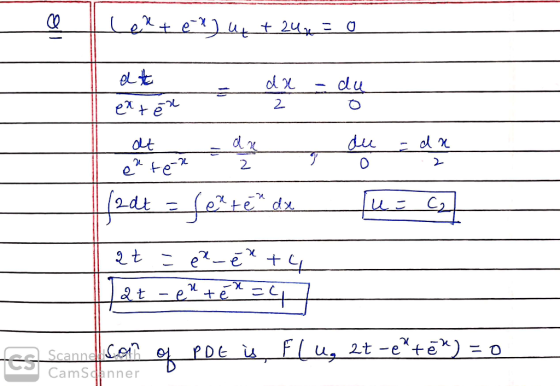
Solve the PDE (e* + e-*)ut +2ux = 0, and sketch a few of the characteristic...
clear writing please and thank you Problem 2. Given the PDE ut + uy = u?...
 clear writing please and thank you
Problem 2. Given the PDE ut + uy = u? u(3,0) = g(x) for IER, >0, for ER. (a) Sketch the characteristic curve that passes through P(2,3) in the xt-plane. Find u(2,3) without using the exact solution ulit, t). (b) Use the method of characteristics to find the solution u(, t).
clear writing please and thank you
Problem 2. Given the PDE ut + uy = u? u(3,0) = g(x) for IER, >0, for ER. (a) Sketch the characteristic curve that passes through P(2,3) in the xt-plane. Find u(2,3) without using the exact solution ulit, t). (b) Use the method of characteristics to find the solution u(, t).
5. For the transport equation PDE Uz-ut + u = 0 IC u(z,0) cos z (a) What is the associated ODE af...
 5. For the transport equation PDE Uz-ut + u = 0 IC u(z,0) cos z (a) What is the associated ODE after applying the method of characteristics? (b) Solve the associated ODE to find u(s,T) c)Find u(x, t)
5. For the transport equation PDE Uz-ut + u = 0 IC u(z,0) cos z (a) What is the associated ODE after applying the method of characteristics? (b) Solve the associated ODE to find u(s,T) c)Find u(x, t)
5. For the transport equation PDE Uz-ut + u = 0 IC u(z,0) cos z (a) What is the associated ODE after applying the method of characteristics? (b) Solve the associated ODE to find u(s,T) c)Find u(x, t)
PDE Question thank you 0 0, t 4. Solve for ρ(x, t) on x Hint: Sketch the characteristics and consider how they relat...
 PDE Question thank you
0 0, t 4. Solve for ρ(x, t) on x Hint: Sketch the characteristics and consider how they relate to the initial data
0 0, t 4. Solve for ρ(x, t) on x Hint: Sketch the characteristics and consider how they relate to the initial data
PDE Question thank you
0 0, t 4. Solve for ρ(x, t) on x Hint: Sketch the characteristics and consider how they relate to the initial data
0 0, t 4. Solve for ρ(x, t) on x Hint: Sketch the characteristics and consider how they relate to the initial data
PDE: Ut = Uxx, -00 < x < 0, t> 0 IC: u(x,0) = 38(x) +...
 PDE: Ut = Uxx, -00 < x < 0, t> 0 IC: u(x,0) = 38(x) + 28(x – 6) where is the Dirac delta function (impulse). u(x, t) =
Problem # 3 [20 Points] Solve PDE: ut = uxx - u, 0 < x < 1, 0 < t < ∞ BCs: u(0, t)=0 u(1, t)=0 0 < t < ∞ IC: u(x, 0) = sin(πx), 0 ≤ x ≤ 1 directly by separation of variabl...
Problem # 3 [20 Points] Solve PDE: ut = uxx - u, 0 < x < 1, 0 < t < ∞ BCs: u(0, t)=0 u(1, t)=0 0 < t < ∞ IC: u(x, 0) = sin(πx), 0 ≤ x ≤ 1 directly by separation of variables without making any preliminary trans- formation. Does your solution agree with the solution you would obtain if transformation u(x, t)= e(caret)(-t) w(x, t) were made in advance?
PDE question Consider the one dimensional wave equation on the half line: Ut(x,0) = g(x) Utt...
 PDE
question
Consider the one dimensional wave equation on the half line: Ut(x,0) = g(x) Utt - Uzx= 0 0 < < u(0,t) = 0 u(x,0) = f(x) (a) What is the solution? (b) For the particular initial conditions 12 - 2 25254 f(x) = { 6- 4<r<6 otherwise g(x) = 0 sketch the solution u(x, t) for t = 0, 2, 4, 6.
PDE
question
Consider the one dimensional wave equation on the half line: Ut(x,0) = g(x) Utt - Uzx= 0 0 < < u(0,t) = 0 u(x,0) = f(x) (a) What is the solution? (b) For the particular initial conditions 12 - 2 25254 f(x) = { 6- 4<r<6 otherwise g(x) = 0 sketch the solution u(x, t) for t = 0, 2, 4, 6.
Assignment 0220 Marks) Solve the following IVBP: PDE : Uxx = (1/25) utt ICs: u (x,0)...
 Assignment 0220 Marks) Solve the following IVBP: PDE : Uxx = (1/25) utt ICs: u (x,0) = x2 (nt - x), ut (x,0) = sin(x) BCs: u(0,t) = 0, u(nt,t) = 0 for 0<x<, t> 0. for 0<x<T. for t>0.
MATH2018 Quiz The PDE ar2 can be solved using D'Alembert method. That is, it has a solution of the form u(x, t) = φ(x + ct) + ψ(x-ct). where c 6 Solve the PDE with the initial conditions u(x, 0)...
 MATH2018 Quiz The PDE ar2 can be solved using D'Alembert method. That is, it has a solution of the form u(x, t) = φ(x + ct) + ψ(x-ct). where c 6 Solve the PDE with the initial conditions u(x, 0) 6 sin (x), ut (x, 0) 3 er Enter the expression for u(x, t) in the box below using Maple syntax. Note: the expression should be in terms of x andt, but not c
MATH2018 Quiz The PDE ar2 can...
MATH2018 Quiz The PDE ar2 can be solved using D'Alembert method. That is, it has a solution of the form u(x, t) = φ(x + ct) + ψ(x-ct). where c 6 Solve the PDE with the initial conditions u(x, 0) 6 sin (x), ut (x, 0) 3 er Enter the expression for u(x, t) in the box below using Maple syntax. Note: the expression should be in terms of x andt, but not c
MATH2018 Quiz The PDE ar2 can...
Solve the circularly symmetric vibrating membrane PDE given as u_tt = ∇^2*u BC : u(1, θ,...
 Solve the circularly symmetric vibrating membrane PDE given
as
u_tt = ∇^2*u
BC : u(1, θ, 0) = 0, 0 < t < ∞
ICs :
u(r, θ, 0) = J_0*(2.4r) − 0.25*J_0*(14.93r), 0 ≤ r ≤ 1
u_t(r, θ, 0) = 0
Solve the circularly symmetric vibrating membrane PDE given as Utt = Dau BC : u(1,0,0) = 0, 0<t< oo ICs : u(r,0,0) = J.(2.4r) – 0.25J(14.93r), 0 <r <1 Ut(r,0,0) = 0
Solve the circularly symmetric vibrating membrane PDE given
as
u_tt = ∇^2*u
BC : u(1, θ, 0) = 0, 0 < t < ∞
ICs :
u(r, θ, 0) = J_0*(2.4r) − 0.25*J_0*(14.93r), 0 ≤ r ≤ 1
u_t(r, θ, 0) = 0
Solve the circularly symmetric vibrating membrane PDE given as Utt = Dau BC : u(1,0,0) = 0, 0<t< oo ICs : u(r,0,0) = J.(2.4r) – 0.25J(14.93r), 0 <r <1 Ut(r,0,0) = 0
Problem # 1 [15 Points] Consider the following PDE which describes a typical heat-flow problem PDE: ut = ↵2uxx, 0 < x < 1, 0 < t < 1 BCs: ux(0, t)=0 ux(1, t)=0 0 < t < 1 IC...
Problem # 1 [15 Points] Consider the following PDE which describes a typical heat-flow problem PDE: ut = ↵2uxx, 0 < x < 1, 0 < t < 1 BCs: ux(0, t)=0 ux(1, t)=0 0 < t < 1 IC: u(x, 0) = sin(⇡x), 0 x 1 (a) What is your physical interpretation of the above problem? (b) Can you draw rough sketches of the solution for various values of time? (c) What about the steady-state temperature?
 clear writing please and thank you
Problem 2. Given the PDE ut + uy = u? u(3,0) = g(x) for IER, >0, for ER. (a) Sketch the characteristic curve that passes through P(2,3) in the xt-plane. Find u(2,3) without using the exact solution ulit, t). (b) Use the method of characteristics to find the solution u(, t).
clear writing please and thank you
Problem 2. Given the PDE ut + uy = u? u(3,0) = g(x) for IER, >0, for ER. (a) Sketch the characteristic curve that passes through P(2,3) in the xt-plane. Find u(2,3) without using the exact solution ulit, t). (b) Use the method of characteristics to find the solution u(, t).
 5. For the transport equation PDE Uz-ut + u = 0 IC u(z,0) cos z (a) What is the associated ODE after applying the method of characteristics? (b) Solve the associated ODE to find u(s,T) c)Find u(x, t)
5. For the transport equation PDE Uz-ut + u = 0 IC u(z,0) cos z (a) What is the associated ODE after applying the method of characteristics? (b) Solve the associated ODE to find u(s,T) c)Find u(x, t)
5. For the transport equation PDE Uz-ut + u = 0 IC u(z,0) cos z (a) What is the associated ODE after applying the method of characteristics? (b) Solve the associated ODE to find u(s,T) c)Find u(x, t)
 PDE Question thank you
0 0, t 4. Solve for ρ(x, t) on x Hint: Sketch the characteristics and consider how they relate to the initial data
0 0, t 4. Solve for ρ(x, t) on x Hint: Sketch the characteristics and consider how they relate to the initial data
PDE Question thank you
0 0, t 4. Solve for ρ(x, t) on x Hint: Sketch the characteristics and consider how they relate to the initial data
0 0, t 4. Solve for ρ(x, t) on x Hint: Sketch the characteristics and consider how they relate to the initial data
 PDE: Ut = Uxx, -00 < x < 0, t> 0 IC: u(x,0) = 38(x) + 28(x – 6) where is the Dirac delta function (impulse). u(x, t) =
 PDE
question
Consider the one dimensional wave equation on the half line: Ut(x,0) = g(x) Utt - Uzx= 0 0 < < u(0,t) = 0 u(x,0) = f(x) (a) What is the solution? (b) For the particular initial conditions 12 - 2 25254 f(x) = { 6- 4<r<6 otherwise g(x) = 0 sketch the solution u(x, t) for t = 0, 2, 4, 6.
PDE
question
Consider the one dimensional wave equation on the half line: Ut(x,0) = g(x) Utt - Uzx= 0 0 < < u(0,t) = 0 u(x,0) = f(x) (a) What is the solution? (b) For the particular initial conditions 12 - 2 25254 f(x) = { 6- 4<r<6 otherwise g(x) = 0 sketch the solution u(x, t) for t = 0, 2, 4, 6.
 Assignment 0220 Marks) Solve the following IVBP: PDE : Uxx = (1/25) utt ICs: u (x,0) = x2 (nt - x), ut (x,0) = sin(x) BCs: u(0,t) = 0, u(nt,t) = 0 for 0<x<, t> 0. for 0<x<T. for t>0.
 MATH2018 Quiz The PDE ar2 can be solved using D'Alembert method. That is, it has a solution of the form u(x, t) = φ(x + ct) + ψ(x-ct). where c 6 Solve the PDE with the initial conditions u(x, 0) 6 sin (x), ut (x, 0) 3 er Enter the expression for u(x, t) in the box below using Maple syntax. Note: the expression should be in terms of x andt, but not c
MATH2018 Quiz The PDE ar2 can...
MATH2018 Quiz The PDE ar2 can be solved using D'Alembert method. That is, it has a solution of the form u(x, t) = φ(x + ct) + ψ(x-ct). where c 6 Solve the PDE with the initial conditions u(x, 0) 6 sin (x), ut (x, 0) 3 er Enter the expression for u(x, t) in the box below using Maple syntax. Note: the expression should be in terms of x andt, but not c
MATH2018 Quiz The PDE ar2 can...
 Solve the circularly symmetric vibrating membrane PDE given
as
u_tt = ∇^2*u
BC : u(1, θ, 0) = 0, 0 < t < ∞
ICs :
u(r, θ, 0) = J_0*(2.4r) − 0.25*J_0*(14.93r), 0 ≤ r ≤ 1
u_t(r, θ, 0) = 0
Solve the circularly symmetric vibrating membrane PDE given as Utt = Dau BC : u(1,0,0) = 0, 0<t< oo ICs : u(r,0,0) = J.(2.4r) – 0.25J(14.93r), 0 <r <1 Ut(r,0,0) = 0
Solve the circularly symmetric vibrating membrane PDE given
as
u_tt = ∇^2*u
BC : u(1, θ, 0) = 0, 0 < t < ∞
ICs :
u(r, θ, 0) = J_0*(2.4r) − 0.25*J_0*(14.93r), 0 ≤ r ≤ 1
u_t(r, θ, 0) = 0
Solve the circularly symmetric vibrating membrane PDE given as Utt = Dau BC : u(1,0,0) = 0, 0<t< oo ICs : u(r,0,0) = J.(2.4r) – 0.25J(14.93r), 0 <r <1 Ut(r,0,0) = 0
Most questions answered within 3 hours.
-
Where is the error in this code sequence?
String s1 = "Hello";
String s2 = "ello";...
asked 10 months ago -
Financial data for Joel de Paris, Inc., for last year
follow:
Joel de Paris, Inc.
Balance...
asked 10 months ago -
Consider this reaction:
Al2(SO4)3 (aq)+ BaCl3
(aq) Al2Cl6 (aq)- +
3BaSO4(s) . What is the...
asked 10 months ago -
Suppose that Savneet is considering increasing her
recent random sample from 20 car rentals to 40...
asked 10 months ago -
Trucks arrive at an unloading terminal at an average rate of 120
per hour.
Trucks arrive...
asked 10 months ago -
Why are methanol and ethanol completely soluble in water while
octanol is not very little soluble....
asked 10 months ago -
A facilities manager at a university reads in a research report
that the mean amount of...
asked 10 months ago -
When the CuSO4 is rehydrated by adding water to the anhydrous
compound, is this an endothermic...
asked 10 months ago -
A ray of sunlight is passing from diamond into crown glass; the
angle of incidence is...
asked 10 months ago -
A block of mass 0.249 kg is placed on top of a light, vertical
spring of...
asked 10 months ago -
how do the kidneys compensate in the presences of acidosis
a) trigger hyperventilate
b) reserve acid...
asked 10 months ago -
Question 501 pts
The rental rate of capital to the firm increases. Which of the
following...
asked 10 months ago