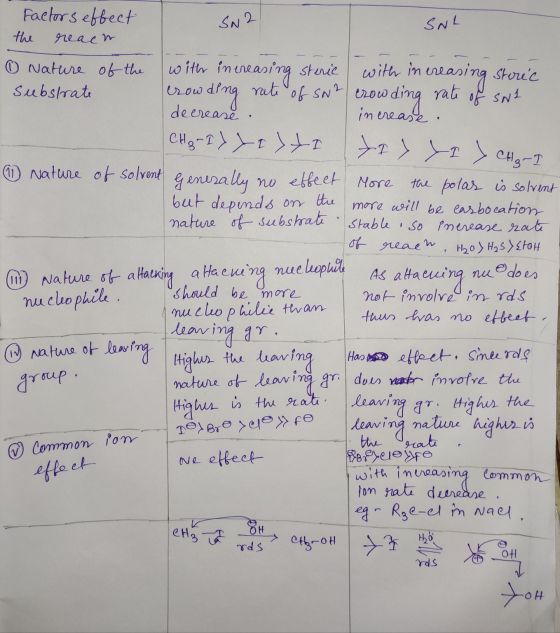
Create a table and label the left column, “SN2” and the right column, “SN1”. Provide 5...
Create a table and label the left column, “SN2” and the right column, “SN1”. Provide 5 factors that affect nucleophilic substitution reactions. Provide a specific example for each and thoroughly explain each factor.
Homework Answers
Add Answer to:
Create a table and label the left column, “SN2” and the right
column, “SN1”. Provide 5...
4. Give reaction conditions for the following reactions. Under each arrow label SN1 or SN2. Lai...
 4. Give reaction conditions for the following reactions. Under each arrow label SN1 or SN2. Lai < 5. Draw the mechanism for each of the reactions in problem 4.
5. For each transformation below, name each mechanism as SN1, SN2, E1, or E2. Label your...
 5. For each transformation below,
name each mechanism as SN1, SN2, E1, or E2. Label your answers in
correspondence to the reactions a) to d).
5. For each transformation below, name each mechanism as Syl, SN2, E1, or E2. Label your answers in correspondence to the reactions a) to d). [1.3 Marks a) .H H -СН3 Y CH3 + H2O+ b) + ROH + CI- "Como lag for "&- 16.5 for + Br + Br- + Br
5. For each transformation below,
name each mechanism as SN1, SN2, E1, or E2. Label your answers in
correspondence to the reactions a) to d).
5. For each transformation below, name each mechanism as Syl, SN2, E1, or E2. Label your answers in correspondence to the reactions a) to d). [1.3 Marks a) .H H -СН3 Y CH3 + H2O+ b) + ROH + CI- "Como lag for "&- 16.5 for + Br + Br- + Br
4. (5 pts) Complete the table comparing SN2 and SN1 reactions. SN2 SN1 rate k[R-XINuc] rate...
 4. (5 pts) Complete the table comparing SN2 and SN1 reactions. SN2 SN1 rate k[R-XINuc] rate rate substrate reactivity methyl 1> 2 >> 3° polar, aprotic fastest stronger nucleophiles react faster solvent nucleophile inversion stereochemistry
Nucleophilic Substitution Reactions Lab (SN1 and SN2 reaction mechanisms) Below are my lab results for SN1...
Nucleophilic Substitution Reactions Lab (SN1 and SN2 reaction mechanisms) Below are my lab results for SN1 and SN2 reactions. This first column of the chart gives the ten starting material halides used in this experiment. The second column gives the reaction time for SN1 mechanisms with silver nitratate in ethanol solution. The third column gives the reaction time for SN2 mechanisms with sodium iodide. In theory, primary alkyl halides are expected to react faster in SN2 mechanisms, and tertiary alkyl...
1-) What is the difference between SN1 and SN2 reactions? Please list at least three different...
1-) What is the difference between SN1 and SN2 reactions? Please list at least three different factors for each reaction type. Also provide an example for each type with detailed arrow-pushing mechanism. 2-) Ethanol is not usually a solvent used for SN2 reactions – why not? Describe an undesirable side reaction that might occur using ethanol as a solvent that would not occur if THF was used as the solvent.
2. List the trend of relative reactivity of compounds in: SN2 & SN1. Indicate which favors...
 2. List the trend of relative reactivity of compounds in: SN2 & SN1. Indicate which favors 1°, 2° or 3° carbon. 3. What makes a good leaving group, or poor leaving group in a substitution reaction? List examples. 4. What makes a good nucleophile or poor nucleophile group in a substitution reaction? List examples. Be able to identify the nucleophile in a reaction. 5. What makes a good solvent for an SN2 reaction? List examples. Assign R & S to...
HWS 5: Due 10/30/2019 15 points total SN1, SN2, Elimination pt 1 1. (10 pts) For...
 HWS 5: Due 10/30/2019 15 points total SN1, SN2, Elimination pt 1 1. (10 pts) For the following reactions: a. Label the Nucleophile (Nu) and whether it is strong or weak b. Label the Electrophile (E) and whether it is primary, secondary, or tertiary and circle the leaving group C. Label the Solvent and whether it is polar protic or polar aprotic d. Categorize each as preferring SN1, Preferring SN2, or could do either e. Draw the product of the...
For the following factors, create a table with columns labeled “right-side heart failure” and “left-side heart...
For the following factors, create a table with columns labeled “right-side heart failure” and “left-side heart failure” and slot each factor under the type of heart failure for which it is more commonly associated. o Pulmonary edema, hepatomegaly, ankle edema, pulmonary crackles, orthopnea, JVD, cor pulmonale, decreased blood pressure, LVH
For letters h & i : For each of the following reactions, predict the major mechanistic pathway (SN1/SN2/E1/E2...
 For
letters h & i :
For each of the following reactions, predict the major
mechanistic pathway (SN1/SN2/E1/E2) and the major organic
products
1. (cont.) (h) НСОН CHB -CHBr HCOH - (0) CH,CH,CH,CH,Br- NH 2. For each of the following indicate which reaction will occur faster. Explain your reasoning. (No credit will be given for guesses) (a) The reaction of (CH),CBr with 0.001M aqueous NaOH or 0.10M aqueous NaOH (b) The reaction of 2-bromobutane with NaOH in DMSO or NaSH...
For
letters h & i :
For each of the following reactions, predict the major
mechanistic pathway (SN1/SN2/E1/E2) and the major organic
products
1. (cont.) (h) НСОН CHB -CHBr HCOH - (0) CH,CH,CH,CH,Br- NH 2. For each of the following indicate which reaction will occur faster. Explain your reasoning. (No credit will be given for guesses) (a) The reaction of (CH),CBr with 0.001M aqueous NaOH or 0.10M aqueous NaOH (b) The reaction of 2-bromobutane with NaOH in DMSO or NaSH...
please help with #5 (sn2) and #6 (sn1) 52 Reaction Rates 1. Pace drops of the...
 please help with #5 (sn2) and #6 (sn1)
52 Reaction Rates 1. Pace drops of the compounds in the 9.1 in separate labeled test tubes Table 9.11 FE for Relative Reaction Rates is Sy Reactions Halide Halide S hare -Chord CECH.CH.CH.CH 1-Broomoburane Нr CHCHCHCH typ=77-78°C b.100-101 C oboti CH CH CH.CH 2-Chloro-2-methylbute CH C CH CH, tip-85.86 C 2-r by CI-CH:CHCH, 1-Chloro2- methylpropane Lp68-69°C 2-Bromo-2-methylbutane pr1073H CHỤC CHÍCH, CH CICH.C-CH, H-Chloro-2.2- dimethylpropane -84-85' Browobenzene bp-156 Benzyl Bromide bo198199 2. Recording...
please help with #5 (sn2) and #6 (sn1)
52 Reaction Rates 1. Pace drops of the compounds in the 9.1 in separate labeled test tubes Table 9.11 FE for Relative Reaction Rates is Sy Reactions Halide Halide S hare -Chord CECH.CH.CH.CH 1-Broomoburane Нr CHCHCHCH typ=77-78°C b.100-101 C oboti CH CH CH.CH 2-Chloro-2-methylbute CH C CH CH, tip-85.86 C 2-r by CI-CH:CHCH, 1-Chloro2- methylpropane Lp68-69°C 2-Bromo-2-methylbutane pr1073H CHỤC CHÍCH, CH CICH.C-CH, H-Chloro-2.2- dimethylpropane -84-85' Browobenzene bp-156 Benzyl Bromide bo198199 2. Recording...
 4. Give reaction conditions for the following reactions. Under each arrow label SN1 or SN2. Lai < 5. Draw the mechanism for each of the reactions in problem 4.
 5. For each transformation below,
name each mechanism as SN1, SN2, E1, or E2. Label your answers in
correspondence to the reactions a) to d).
5. For each transformation below, name each mechanism as Syl, SN2, E1, or E2. Label your answers in correspondence to the reactions a) to d). [1.3 Marks a) .H H -СН3 Y CH3 + H2O+ b) + ROH + CI- "Como lag for "&- 16.5 for + Br + Br- + Br
5. For each transformation below,
name each mechanism as SN1, SN2, E1, or E2. Label your answers in
correspondence to the reactions a) to d).
5. For each transformation below, name each mechanism as Syl, SN2, E1, or E2. Label your answers in correspondence to the reactions a) to d). [1.3 Marks a) .H H -СН3 Y CH3 + H2O+ b) + ROH + CI- "Como lag for "&- 16.5 for + Br + Br- + Br
 4. (5 pts) Complete the table comparing SN2 and SN1 reactions. SN2 SN1 rate k[R-XINuc] rate rate substrate reactivity methyl 1> 2 >> 3° polar, aprotic fastest stronger nucleophiles react faster solvent nucleophile inversion stereochemistry
 2. List the trend of relative reactivity of compounds in: SN2 & SN1. Indicate which favors 1°, 2° or 3° carbon. 3. What makes a good leaving group, or poor leaving group in a substitution reaction? List examples. 4. What makes a good nucleophile or poor nucleophile group in a substitution reaction? List examples. Be able to identify the nucleophile in a reaction. 5. What makes a good solvent for an SN2 reaction? List examples. Assign R & S to...
 HWS 5: Due 10/30/2019 15 points total SN1, SN2, Elimination pt 1 1. (10 pts) For the following reactions: a. Label the Nucleophile (Nu) and whether it is strong or weak b. Label the Electrophile (E) and whether it is primary, secondary, or tertiary and circle the leaving group C. Label the Solvent and whether it is polar protic or polar aprotic d. Categorize each as preferring SN1, Preferring SN2, or could do either e. Draw the product of the...
 For
letters h & i :
For each of the following reactions, predict the major
mechanistic pathway (SN1/SN2/E1/E2) and the major organic
products
1. (cont.) (h) НСОН CHB -CHBr HCOH - (0) CH,CH,CH,CH,Br- NH 2. For each of the following indicate which reaction will occur faster. Explain your reasoning. (No credit will be given for guesses) (a) The reaction of (CH),CBr with 0.001M aqueous NaOH or 0.10M aqueous NaOH (b) The reaction of 2-bromobutane with NaOH in DMSO or NaSH...
For
letters h & i :
For each of the following reactions, predict the major
mechanistic pathway (SN1/SN2/E1/E2) and the major organic
products
1. (cont.) (h) НСОН CHB -CHBr HCOH - (0) CH,CH,CH,CH,Br- NH 2. For each of the following indicate which reaction will occur faster. Explain your reasoning. (No credit will be given for guesses) (a) The reaction of (CH),CBr with 0.001M aqueous NaOH or 0.10M aqueous NaOH (b) The reaction of 2-bromobutane with NaOH in DMSO or NaSH...
 please help with #5 (sn2) and #6 (sn1)
52 Reaction Rates 1. Pace drops of the compounds in the 9.1 in separate labeled test tubes Table 9.11 FE for Relative Reaction Rates is Sy Reactions Halide Halide S hare -Chord CECH.CH.CH.CH 1-Broomoburane Нr CHCHCHCH typ=77-78°C b.100-101 C oboti CH CH CH.CH 2-Chloro-2-methylbute CH C CH CH, tip-85.86 C 2-r by CI-CH:CHCH, 1-Chloro2- methylpropane Lp68-69°C 2-Bromo-2-methylbutane pr1073H CHỤC CHÍCH, CH CICH.C-CH, H-Chloro-2.2- dimethylpropane -84-85' Browobenzene bp-156 Benzyl Bromide bo198199 2. Recording...
please help with #5 (sn2) and #6 (sn1)
52 Reaction Rates 1. Pace drops of the compounds in the 9.1 in separate labeled test tubes Table 9.11 FE for Relative Reaction Rates is Sy Reactions Halide Halide S hare -Chord CECH.CH.CH.CH 1-Broomoburane Нr CHCHCHCH typ=77-78°C b.100-101 C oboti CH CH CH.CH 2-Chloro-2-methylbute CH C CH CH, tip-85.86 C 2-r by CI-CH:CHCH, 1-Chloro2- methylpropane Lp68-69°C 2-Bromo-2-methylbutane pr1073H CHỤC CHÍCH, CH CICH.C-CH, H-Chloro-2.2- dimethylpropane -84-85' Browobenzene bp-156 Benzyl Bromide bo198199 2. Recording...
Most questions answered within 3 hours.
-
Where is the error in this code sequence?
String s1 = "Hello";
String s2 = "ello";...
asked 10 months ago -
Financial data for Joel de Paris, Inc., for last year
follow:
Joel de Paris, Inc.
Balance...
asked 10 months ago -
Consider this reaction:
Al2(SO4)3 (aq)+ BaCl3
(aq) Al2Cl6 (aq)- +
3BaSO4(s) . What is the...
asked 10 months ago -
Suppose that Savneet is considering increasing her
recent random sample from 20 car rentals to 40...
asked 10 months ago -
Trucks arrive at an unloading terminal at an average rate of 120
per hour.
Trucks arrive...
asked 10 months ago -
Why are methanol and ethanol completely soluble in water while
octanol is not very little soluble....
asked 10 months ago -
A facilities manager at a university reads in a research report
that the mean amount of...
asked 10 months ago -
When the CuSO4 is rehydrated by adding water to the anhydrous
compound, is this an endothermic...
asked 10 months ago -
A ray of sunlight is passing from diamond into crown glass; the
angle of incidence is...
asked 10 months ago -
A block of mass 0.249 kg is placed on top of a light, vertical
spring of...
asked 10 months ago -
how do the kidneys compensate in the presences of acidosis
a) trigger hyperventilate
b) reserve acid...
asked 10 months ago -
Question 501 pts
The rental rate of capital to the firm increases. Which of the
following...
asked 10 months ago