
Homework Answers
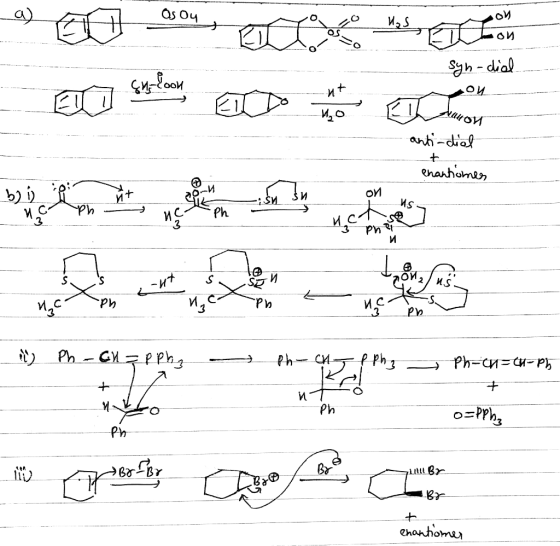
Add Answer to:
Answer all parts of the questions
Wower all parts. (a) 1,4-dihydroxynaphthalene can be converted to either...
3. When 1,4-dimethylcylopent-1-ene is treated with bromine in water, one of the depicted stereoisomers and its...
 3. When 1,4-dimethylcylopent-1-ene is treated with bromine in water, one of the depicted stereoisomers and its enantiomer are formed. Circle the correct product and write the steps in the mechanism that show how this reaction occurs. Be sure to show the following: (1) all necessary curved arrows (2) the structure of any intermediates that are formed during the mechanism, including stereochemistry (3), what if anything is added or lost during each step of the mechanism, (4) any nonzero formal charges....
Please answer all parts, I’ll give you a thumbs up! What is a stereoselective reaction? What...
 Please answer all parts, I’ll give you a thumbs up!
What is a stereoselective reaction? What is a chiral center? What are R and S? What physical property allows us to distinguish between diastereomers but not enantiomers? What are syn and anti addition? How do they add? What product results from each? Provide the R and S configurations for both possible products. What is the addition that is most likely to occur? Why?
Please answer all parts, I’ll give you a thumbs up!
What is a stereoselective reaction? What is a chiral center? What are R and S? What physical property allows us to distinguish between diastereomers but not enantiomers? What are syn and anti addition? How do they add? What product results from each? Provide the R and S configurations for both possible products. What is the addition that is most likely to occur? Why?
can anyone help me with these 3 questions 4. Do All parts: a. Provide the reagents...
 can anyone help me with these 3 questions
4. Do All parts: a. Provide the reagents necessary to carry out the following conversion (5 points) b. Provide the reagents necessary to carry out the following conversion. (5 points) c. Indicate all the acidic protons on the following structures: (4 points) COME! FO H ON-CH2-C-CH3 d. With reason say which one is most acidic i. for each compound (4 points) ii. for all compounds (2 points)
can anyone help me with these 3 questions
4. Do All parts: a. Provide the reagents necessary to carry out the following conversion (5 points) b. Provide the reagents necessary to carry out the following conversion. (5 points) c. Indicate all the acidic protons on the following structures: (4 points) COME! FO H ON-CH2-C-CH3 d. With reason say which one is most acidic i. for each compound (4 points) ii. for all compounds (2 points)
pls bix the answers 13 Report problem Be sure to answer all parts. How can 2-pentanone...
 pls bix the answers
13 Report problem Be sure to answer all parts. How can 2-pentanone be converted into the following compound? 8 00:16:28 Draw the starting material and all three reaction intermediates, and select the single best set of reagents for each step below. draw structure PCC 11,0, che (Illr NOCH CHI, CHICH OH ME PCC ОН,0, С, ОСН Br NaOCH2CH3, CH3CH2OH draw structure OH,SO4 Н., Рас о mCPBA О CH3Br draw structure ... ООО Н., Рас NaOCH,CH, CH3CH,он...
pls bix the answers
13 Report problem Be sure to answer all parts. How can 2-pentanone be converted into the following compound? 8 00:16:28 Draw the starting material and all three reaction intermediates, and select the single best set of reagents for each step below. draw structure PCC 11,0, che (Illr NOCH CHI, CHICH OH ME PCC ОН,0, С, ОСН Br NaOCH2CH3, CH3CH2OH draw structure OH,SO4 Н., Рас о mCPBA О CH3Br draw structure ... ООО Н., Рас NaOCH,CH, CH3CH,он...
Please answer all parts for good rating! The following reaction will not result in complete conversion...
 Please answer all parts for good rating!
The following reaction will not result in complete conversion to the amide compound. Suggest all of the products (the main organic products as well as any by-products) and indicate the number of moles of each product formed and the approximate number of moles of each reagent remaining. The reaction takes place in an inert (non-reactive) solvent. NH u. CI 1.0 mol 1.0 mol Suggest the reagents and steps needed to synthesize the following...
Please answer all parts for good rating!
The following reaction will not result in complete conversion to the amide compound. Suggest all of the products (the main organic products as well as any by-products) and indicate the number of moles of each product formed and the approximate number of moles of each reagent remaining. The reaction takes place in an inert (non-reactive) solvent. NH u. CI 1.0 mol 1.0 mol Suggest the reagents and steps needed to synthesize the following...
ANSWER ALL QUESTIONS AND ALL PARTS FULLY! 1. Provide the reagent needed to convert 2-pentanol to...
 ANSWER ALL QUESTIONS AND ALL PARTS FULLY!
1. Provide the reagent needed to convert 2-pentanol to 2-bromopentane (3 points). 2. Provide the reagent needed to complete the reaction below (1 point) De - Di 3. Give the products for the following reactions (6 points). нс он HCI HC on here a. OH O mot 1. NaH 2. CH CH CH(CH3)CH2CI 1, CHICAS COLGA SOCI Pyridine HBr 4. For each molecule, give the electrophile and the nucleophile that formed the compound...
ANSWER ALL QUESTIONS AND ALL PARTS FULLY!
1. Provide the reagent needed to convert 2-pentanol to 2-bromopentane (3 points). 2. Provide the reagent needed to complete the reaction below (1 point) De - Di 3. Give the products for the following reactions (6 points). нс он HCI HC on here a. OH O mot 1. NaH 2. CH CH CH(CH3)CH2CI 1, CHICAS COLGA SOCI Pyridine HBr 4. For each molecule, give the electrophile and the nucleophile that formed the compound...
please answer all parts of question 16. thanks! Additional Questions: (16. (a) Use curved arrows to...
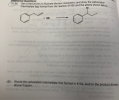 please answer all parts of question 16. thanks!
Additional Questions: (16. (a) Use curved arrows to illustrate electron movement, and draw the carbocation intermediate first formed from the reaction of HBr and the alkene shown below B obol brott + HBr homme biznos a A Z orts dizza n bo ubongow Abnuomo o bobbs How sot basDH Mont Habib nodar EDS ano b) sot bbs Hobib noch olibo w E s trossos ou 10 W hold on n o bolo...
please answer all parts of question 16. thanks!
Additional Questions: (16. (a) Use curved arrows to illustrate electron movement, and draw the carbocation intermediate first formed from the reaction of HBr and the alkene shown below B obol brott + HBr homme biznos a A Z orts dizza n bo ubongow Abnuomo o bobbs How sot basDH Mont Habib nodar EDS ano b) sot bbs Hobib noch olibo w E s trossos ou 10 W hold on n o bolo...
Please answer ALL questions and all parts. Will give a good rating, thanks! 12.34 Starting with...
 Please answer ALL questions and all parts. Will give a good
rating, thanks!
12.34 Starting with 1-butanol, show the reagents you would use to prepare each of the following compounds: o OH (a) H (b) ОН (c) OH (d) (e) 13.38 Propose a plausible mechanism for each of the following transformations: OH 1) EtMgBr 2) H2O (a) OH 1) NaH 2) Et OET (b) HO e 1) H-CEC: 2) H2O Na (c) OH of [H, 50 MeSH (d) MeS NaH...
Please answer ALL questions and all parts. Will give a good
rating, thanks!
12.34 Starting with 1-butanol, show the reagents you would use to prepare each of the following compounds: o OH (a) H (b) ОН (c) OH (d) (e) 13.38 Propose a plausible mechanism for each of the following transformations: OH 1) EtMgBr 2) H2O (a) OH 1) NaH 2) Et OET (b) HO e 1) H-CEC: 2) H2O Na (c) OH of [H, 50 MeSH (d) MeS NaH...
Be sure to answer all parts. A person inhales air richer in O2 and exhales air...
Be sure to answer all parts. A person inhales air richer in O2 and exhales air richer in CO2 and water vapor. During each hour of sleep, a person exhales a total of about 300. L of this CO2−enriched and H2O-enriched air. (a) If the partial pressures of CO2 and H2O in exhaled air are each 29.1 torr at 37.0°C, calculate the masses of CO2 and of H2O exhaled in 1 h of sleep. _____g CO2 _____ g H2O (b)...
please answee all 3 pages! they are multiple choice 3. Answer the following questions. Clearly mark...
 please answee all 3 pages! they are multiple choice
3. Answer the following questions. Clearly mark your answer. (1 point each: 25 points total) a. Circle the substrate that will give 4 different products when reacted fully under hydroboration-oxidation conditions. b. Circle the substrate that will not result in a tertiary alkyl chloride when treated with HCI. C. Circle the alkene that can be most easily formed under unimolecular elimination d. Circle the alkene that will react fastest with m-chloroperoxybenzoic...
please answee all 3 pages! they are multiple choice
3. Answer the following questions. Clearly mark your answer. (1 point each: 25 points total) a. Circle the substrate that will give 4 different products when reacted fully under hydroboration-oxidation conditions. b. Circle the substrate that will not result in a tertiary alkyl chloride when treated with HCI. C. Circle the alkene that can be most easily formed under unimolecular elimination d. Circle the alkene that will react fastest with m-chloroperoxybenzoic...
 3. When 1,4-dimethylcylopent-1-ene is treated with bromine in water, one of the depicted stereoisomers and its enantiomer are formed. Circle the correct product and write the steps in the mechanism that show how this reaction occurs. Be sure to show the following: (1) all necessary curved arrows (2) the structure of any intermediates that are formed during the mechanism, including stereochemistry (3), what if anything is added or lost during each step of the mechanism, (4) any nonzero formal charges....
 Please answer all parts, I’ll give you a thumbs up!
What is a stereoselective reaction? What is a chiral center? What are R and S? What physical property allows us to distinguish between diastereomers but not enantiomers? What are syn and anti addition? How do they add? What product results from each? Provide the R and S configurations for both possible products. What is the addition that is most likely to occur? Why?
Please answer all parts, I’ll give you a thumbs up!
What is a stereoselective reaction? What is a chiral center? What are R and S? What physical property allows us to distinguish between diastereomers but not enantiomers? What are syn and anti addition? How do they add? What product results from each? Provide the R and S configurations for both possible products. What is the addition that is most likely to occur? Why?
 can anyone help me with these 3 questions
4. Do All parts: a. Provide the reagents necessary to carry out the following conversion (5 points) b. Provide the reagents necessary to carry out the following conversion. (5 points) c. Indicate all the acidic protons on the following structures: (4 points) COME! FO H ON-CH2-C-CH3 d. With reason say which one is most acidic i. for each compound (4 points) ii. for all compounds (2 points)
can anyone help me with these 3 questions
4. Do All parts: a. Provide the reagents necessary to carry out the following conversion (5 points) b. Provide the reagents necessary to carry out the following conversion. (5 points) c. Indicate all the acidic protons on the following structures: (4 points) COME! FO H ON-CH2-C-CH3 d. With reason say which one is most acidic i. for each compound (4 points) ii. for all compounds (2 points)
 pls bix the answers
13 Report problem Be sure to answer all parts. How can 2-pentanone be converted into the following compound? 8 00:16:28 Draw the starting material and all three reaction intermediates, and select the single best set of reagents for each step below. draw structure PCC 11,0, che (Illr NOCH CHI, CHICH OH ME PCC ОН,0, С, ОСН Br NaOCH2CH3, CH3CH2OH draw structure OH,SO4 Н., Рас о mCPBA О CH3Br draw structure ... ООО Н., Рас NaOCH,CH, CH3CH,он...
pls bix the answers
13 Report problem Be sure to answer all parts. How can 2-pentanone be converted into the following compound? 8 00:16:28 Draw the starting material and all three reaction intermediates, and select the single best set of reagents for each step below. draw structure PCC 11,0, che (Illr NOCH CHI, CHICH OH ME PCC ОН,0, С, ОСН Br NaOCH2CH3, CH3CH2OH draw structure OH,SO4 Н., Рас о mCPBA О CH3Br draw structure ... ООО Н., Рас NaOCH,CH, CH3CH,он...
 Please answer all parts for good rating!
The following reaction will not result in complete conversion to the amide compound. Suggest all of the products (the main organic products as well as any by-products) and indicate the number of moles of each product formed and the approximate number of moles of each reagent remaining. The reaction takes place in an inert (non-reactive) solvent. NH u. CI 1.0 mol 1.0 mol Suggest the reagents and steps needed to synthesize the following...
Please answer all parts for good rating!
The following reaction will not result in complete conversion to the amide compound. Suggest all of the products (the main organic products as well as any by-products) and indicate the number of moles of each product formed and the approximate number of moles of each reagent remaining. The reaction takes place in an inert (non-reactive) solvent. NH u. CI 1.0 mol 1.0 mol Suggest the reagents and steps needed to synthesize the following...
 ANSWER ALL QUESTIONS AND ALL PARTS FULLY!
1. Provide the reagent needed to convert 2-pentanol to 2-bromopentane (3 points). 2. Provide the reagent needed to complete the reaction below (1 point) De - Di 3. Give the products for the following reactions (6 points). нс он HCI HC on here a. OH O mot 1. NaH 2. CH CH CH(CH3)CH2CI 1, CHICAS COLGA SOCI Pyridine HBr 4. For each molecule, give the electrophile and the nucleophile that formed the compound...
ANSWER ALL QUESTIONS AND ALL PARTS FULLY!
1. Provide the reagent needed to convert 2-pentanol to 2-bromopentane (3 points). 2. Provide the reagent needed to complete the reaction below (1 point) De - Di 3. Give the products for the following reactions (6 points). нс он HCI HC on here a. OH O mot 1. NaH 2. CH CH CH(CH3)CH2CI 1, CHICAS COLGA SOCI Pyridine HBr 4. For each molecule, give the electrophile and the nucleophile that formed the compound...
 please answer all parts of question 16. thanks!
Additional Questions: (16. (a) Use curved arrows to illustrate electron movement, and draw the carbocation intermediate first formed from the reaction of HBr and the alkene shown below B obol brott + HBr homme biznos a A Z orts dizza n bo ubongow Abnuomo o bobbs How sot basDH Mont Habib nodar EDS ano b) sot bbs Hobib noch olibo w E s trossos ou 10 W hold on n o bolo...
please answer all parts of question 16. thanks!
Additional Questions: (16. (a) Use curved arrows to illustrate electron movement, and draw the carbocation intermediate first formed from the reaction of HBr and the alkene shown below B obol brott + HBr homme biznos a A Z orts dizza n bo ubongow Abnuomo o bobbs How sot basDH Mont Habib nodar EDS ano b) sot bbs Hobib noch olibo w E s trossos ou 10 W hold on n o bolo...
 Please answer ALL questions and all parts. Will give a good
rating, thanks!
12.34 Starting with 1-butanol, show the reagents you would use to prepare each of the following compounds: o OH (a) H (b) ОН (c) OH (d) (e) 13.38 Propose a plausible mechanism for each of the following transformations: OH 1) EtMgBr 2) H2O (a) OH 1) NaH 2) Et OET (b) HO e 1) H-CEC: 2) H2O Na (c) OH of [H, 50 MeSH (d) MeS NaH...
Please answer ALL questions and all parts. Will give a good
rating, thanks!
12.34 Starting with 1-butanol, show the reagents you would use to prepare each of the following compounds: o OH (a) H (b) ОН (c) OH (d) (e) 13.38 Propose a plausible mechanism for each of the following transformations: OH 1) EtMgBr 2) H2O (a) OH 1) NaH 2) Et OET (b) HO e 1) H-CEC: 2) H2O Na (c) OH of [H, 50 MeSH (d) MeS NaH...
 please answee all 3 pages! they are multiple choice
3. Answer the following questions. Clearly mark your answer. (1 point each: 25 points total) a. Circle the substrate that will give 4 different products when reacted fully under hydroboration-oxidation conditions. b. Circle the substrate that will not result in a tertiary alkyl chloride when treated with HCI. C. Circle the alkene that can be most easily formed under unimolecular elimination d. Circle the alkene that will react fastest with m-chloroperoxybenzoic...
please answee all 3 pages! they are multiple choice
3. Answer the following questions. Clearly mark your answer. (1 point each: 25 points total) a. Circle the substrate that will give 4 different products when reacted fully under hydroboration-oxidation conditions. b. Circle the substrate that will not result in a tertiary alkyl chloride when treated with HCI. C. Circle the alkene that can be most easily formed under unimolecular elimination d. Circle the alkene that will react fastest with m-chloroperoxybenzoic...
Most questions answered within 3 hours.
-
Where is the error in this code sequence?
String s1 = "Hello";
String s2 = "ello";...
asked 11 months ago -
Financial data for Joel de Paris, Inc., for last year
follow:
Joel de Paris, Inc.
Balance...
asked 11 months ago -
Consider this reaction:
Al2(SO4)3 (aq)+ BaCl3
(aq) Al2Cl6 (aq)- +
3BaSO4(s) . What is the...
asked 11 months ago -
Suppose that Savneet is considering increasing her
recent random sample from 20 car rentals to 40...
asked 11 months ago -
Trucks arrive at an unloading terminal at an average rate of 120
per hour.
Trucks arrive...
asked 11 months ago -
Why are methanol and ethanol completely soluble in water while
octanol is not very little soluble....
asked 11 months ago -
A facilities manager at a university reads in a research report
that the mean amount of...
asked 11 months ago -
When the CuSO4 is rehydrated by adding water to the anhydrous
compound, is this an endothermic...
asked 11 months ago -
A ray of sunlight is passing from diamond into crown glass; the
angle of incidence is...
asked 11 months ago -
A block of mass 0.249 kg is placed on top of a light, vertical
spring of...
asked 11 months ago -
how do the kidneys compensate in the presences of acidosis
a) trigger hyperventilate
b) reserve acid...
asked 11 months ago -
Question 501 pts
The rental rate of capital to the firm increases. Which of the
following...
asked 11 months ago