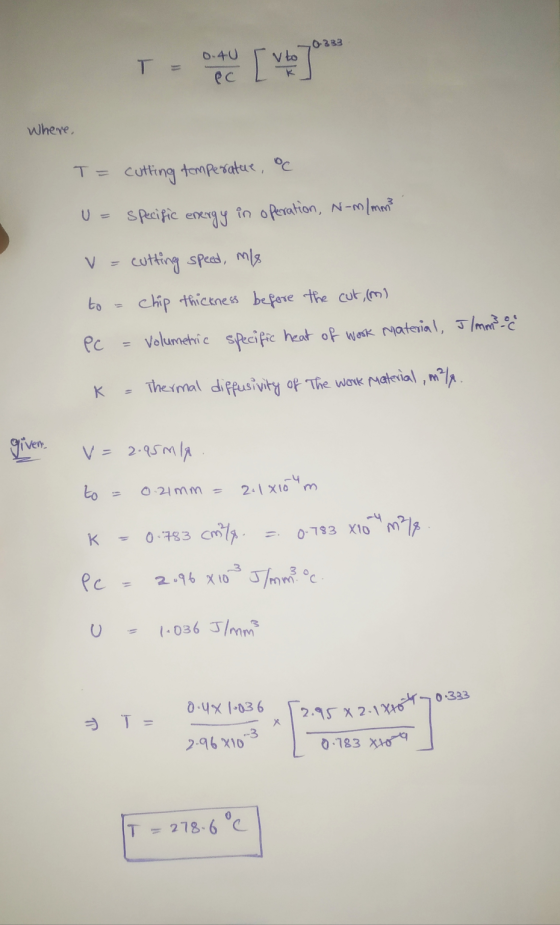
During the turning operation, the cutting speed = 2.95 m/s, the feed f = 0.40 mm/rev,...
Homework Answers
Add Answer to:
During the turning operation, the cutting speed = 2.95 m/s, the
feed f = 0.40 mm/rev,...
In a turning operation, cutting speed = 1.8 m/s, feed = 0.30 mm/rev, and depth of...
In a turning operation, cutting speed = 1.8 m/s, feed = 0.30 mm/rev, and depth of cut = 2.6 mm. Rake angle = 8°. After the cut, the deformed chip thickness = 0.56 mm and before the cut, the chip thickness = 0.26 mm. Determine (a) shear plane angle, (b) shear strain, and (c) material removal rate. Use the orthogonal cutting model as an approximation of turning
In an orthogonal metal cutting test in a turning operation, the following conditions were recorded cutting...
 In an orthogonal metal cutting test in a turning operation, the following conditions were recorded cutting speed = 160 m/min, feed = 0.28 mm/rev, width of cut-2.4 mm, rake angle-70. After the cut, the deformed chip thickness 0.45 mm, cutting force-950 N and thrust 400 N. Determine (a) shear plane angle, (b) The friction angle, (c) The specific energy of workpiece material, (d) The shear stress on shear plane (e) The friction force (f) The shear strain during the deformation...
a) A workpiece (φ-75 mm, 1 275 mm) is machined using turning at a feed rate of 0.25 mm/rev. At a cutting speed- 3.5 m/s, the turning tool is ineffective after machining 3 parts, and at a cutting s...
 a) A workpiece (φ-75 mm, 1 275 mm) is machined using turning at a feed rate of 0.25 mm/rev. At a cutting speed- 3.5 m/s, the turning tool is ineffective after machining 3 parts, and at a cutting speed = 2.5 m/s, the turning tool is effective for producing 20 parts. Calculate the Cutting Speed that will allow 30 parts to be machined between tool changes [20 marks] b) An aluminium alloy workpiece (tensile strength - 325 N/mm2 and yield...
1. The cutting conditions in a turning operation are v=2m/s f=. 25 mm. and d 3.0...
1. The cutting conditions in a turning operation are v=2m/s f=. 25 mm. and d 3.0 mm. The tool rake angle 10 degrees, which produces a deformed chip thickness t c = 0.54 mm. Determine (a) shear plane angle, (b) shear strain. and (c) material removal rate. Use the orthogonal cutting model as an approximation of the turning process. 3. The cutting force and thrust force have been measured in an orthogonal cutting operation: Fc = 300 lb and Fc...
Chapter 15: 1. Shear plane angle and shear strain: In an orthogonal cutting operation, the tool...
Chapter 15: 1. Shear plane angle and shear strain: In an orthogonal cutting operation, the tool has a rake angle = 16°. The chip thickness before the cut = 0.32 mm and the cut yields a deformed chip thickness = 0.72 mm. Calculate (a) the shear plane angle and (b) the shear strain for the operation. 2. Shear strength: The cutting force and thrust force have been measured in an orthogonal cutting operation to be 301 lb and 291 lb,...
I. (SI units) Low-carbon steel with tensile strength-300 MPa, shear strength-220 MPa, and Brinell hardness of...
 I. (SI units) Low-carbon steel with tensile strength-300 MPa, shear strength-220 MPa, and Brinell hardness of 225 HB is turned at a cutting speed-2.5 m/s. Feed-0.20 mm/rev and depth of cut- 3.0 mm. Rake angle - 5° in the direction of chip flow. The resulting chip ratio 0.45. Using the orthogonal model to approximate turning, determine (a) cutting force, (b) feed force, and (c) compute the required power, if mechanical efficiency-80%. (30 points) (Hint: correction factor for the volume specific...
I. (SI units) Low-carbon steel with tensile strength-300 MPa, shear strength-220 MPa, and Brinell hardness of...
 I. (SI units) Low-carbon steel with tensile strength-300 MPa, shear strength-220 MPa, and Brinell hardness of 225 HB is turned at a cutting speed-2.5 m/s. Feed-0.20 mm/rev and depth of cut- 3.0 mm. Rake angle - 5° in the direction of chip flow. The resulting chip ratio 0.45. Using the orthogonal model to approximate turning, determine (a) cutting force, (b) feed force, and (c) compute the required power, if mechanical efficiency-80%. (30 points) (Hint: correction factor for the volume specific...
Question 1 A turning operation is carried out on aluminum. Based on the specific energy values...
 Question 1 A turning operation is carried out on aluminum. Based on the specific energy values in Table 20.2, determine material removal rate and cutting power in the operation under the following sets of cutting conditions: (a) Cutting speed 5.6 m/s, feed 0.25 mm/rev, and depth of cut 2.0 mm; and (b) cutting speed- 1.3 m/s, feed 0.75 mm/rev, and depth 4.0 mm. Question 2 Consider a turning operation performed on steel whose hardness 225 HB at a cutting speed...
 In an orthogonal metal cutting test in a turning operation, the following conditions were recorded cutting speed = 160 m/min, feed = 0.28 mm/rev, width of cut-2.4 mm, rake angle-70. After the cut, the deformed chip thickness 0.45 mm, cutting force-950 N and thrust 400 N. Determine (a) shear plane angle, (b) The friction angle, (c) The specific energy of workpiece material, (d) The shear stress on shear plane (e) The friction force (f) The shear strain during the deformation...
 a) A workpiece (φ-75 mm, 1 275 mm) is machined using turning at a feed rate of 0.25 mm/rev. At a cutting speed- 3.5 m/s, the turning tool is ineffective after machining 3 parts, and at a cutting speed = 2.5 m/s, the turning tool is effective for producing 20 parts. Calculate the Cutting Speed that will allow 30 parts to be machined between tool changes [20 marks] b) An aluminium alloy workpiece (tensile strength - 325 N/mm2 and yield...
 I. (SI units) Low-carbon steel with tensile strength-300 MPa, shear strength-220 MPa, and Brinell hardness of 225 HB is turned at a cutting speed-2.5 m/s. Feed-0.20 mm/rev and depth of cut- 3.0 mm. Rake angle - 5° in the direction of chip flow. The resulting chip ratio 0.45. Using the orthogonal model to approximate turning, determine (a) cutting force, (b) feed force, and (c) compute the required power, if mechanical efficiency-80%. (30 points) (Hint: correction factor for the volume specific...
 I. (SI units) Low-carbon steel with tensile strength-300 MPa, shear strength-220 MPa, and Brinell hardness of 225 HB is turned at a cutting speed-2.5 m/s. Feed-0.20 mm/rev and depth of cut- 3.0 mm. Rake angle - 5° in the direction of chip flow. The resulting chip ratio 0.45. Using the orthogonal model to approximate turning, determine (a) cutting force, (b) feed force, and (c) compute the required power, if mechanical efficiency-80%. (30 points) (Hint: correction factor for the volume specific...
 Question 1 A turning operation is carried out on aluminum. Based on the specific energy values in Table 20.2, determine material removal rate and cutting power in the operation under the following sets of cutting conditions: (a) Cutting speed 5.6 m/s, feed 0.25 mm/rev, and depth of cut 2.0 mm; and (b) cutting speed- 1.3 m/s, feed 0.75 mm/rev, and depth 4.0 mm. Question 2 Consider a turning operation performed on steel whose hardness 225 HB at a cutting speed...
Most questions answered within 3 hours.
-
Where is the error in this code sequence?
String s1 = "Hello";
String s2 = "ello";...
asked 10 months ago -
Financial data for Joel de Paris, Inc., for last year
follow:
Joel de Paris, Inc.
Balance...
asked 10 months ago -
Consider this reaction:
Al2(SO4)3 (aq)+ BaCl3
(aq) Al2Cl6 (aq)- +
3BaSO4(s) . What is the...
asked 10 months ago -
Suppose that Savneet is considering increasing her
recent random sample from 20 car rentals to 40...
asked 10 months ago -
Trucks arrive at an unloading terminal at an average rate of 120
per hour.
Trucks arrive...
asked 10 months ago -
Why are methanol and ethanol completely soluble in water while
octanol is not very little soluble....
asked 10 months ago -
A facilities manager at a university reads in a research report
that the mean amount of...
asked 10 months ago -
When the CuSO4 is rehydrated by adding water to the anhydrous
compound, is this an endothermic...
asked 10 months ago -
A ray of sunlight is passing from diamond into crown glass; the
angle of incidence is...
asked 10 months ago -
A block of mass 0.249 kg is placed on top of a light, vertical
spring of...
asked 10 months ago -
how do the kidneys compensate in the presences of acidosis
a) trigger hyperventilate
b) reserve acid...
asked 10 months ago -
Question 501 pts
The rental rate of capital to the firm increases. Which of the
following...
asked 10 months ago