
Homework Answers
Add Answer to:
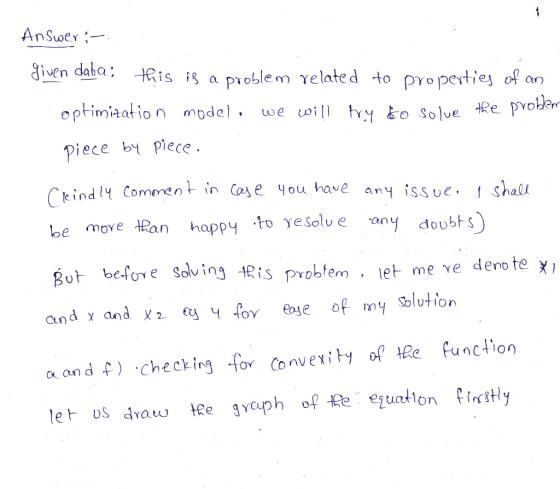
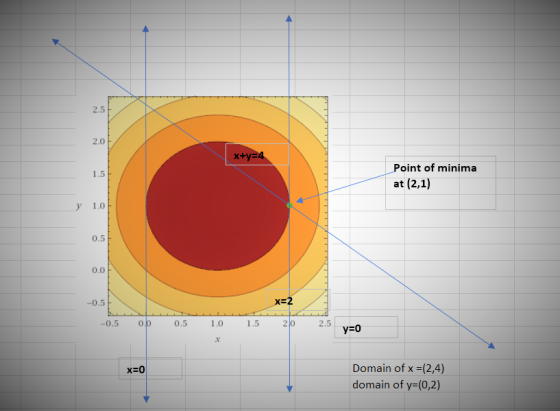
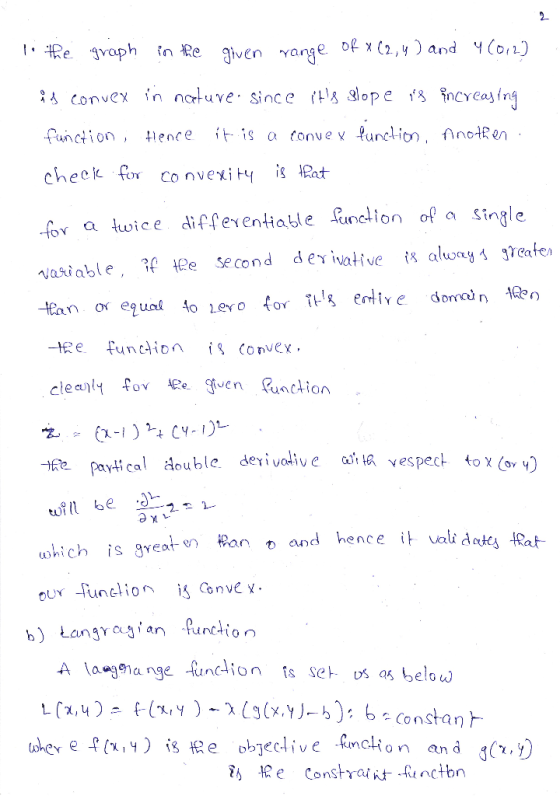
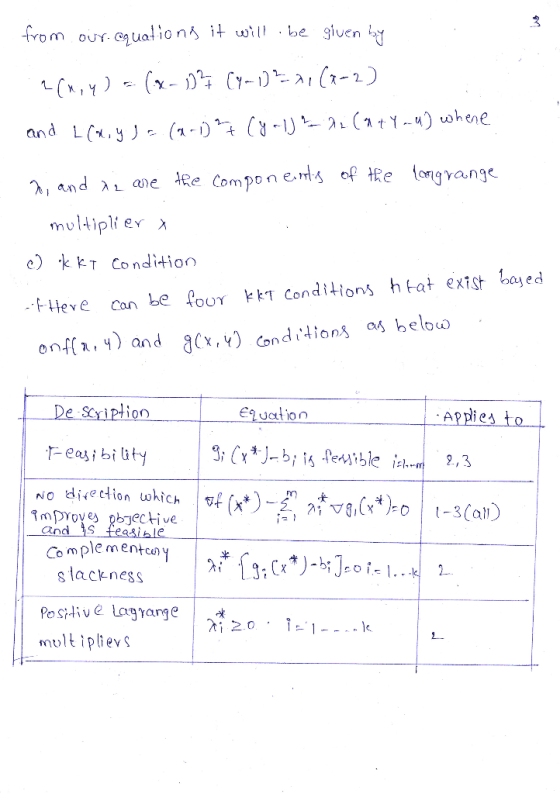
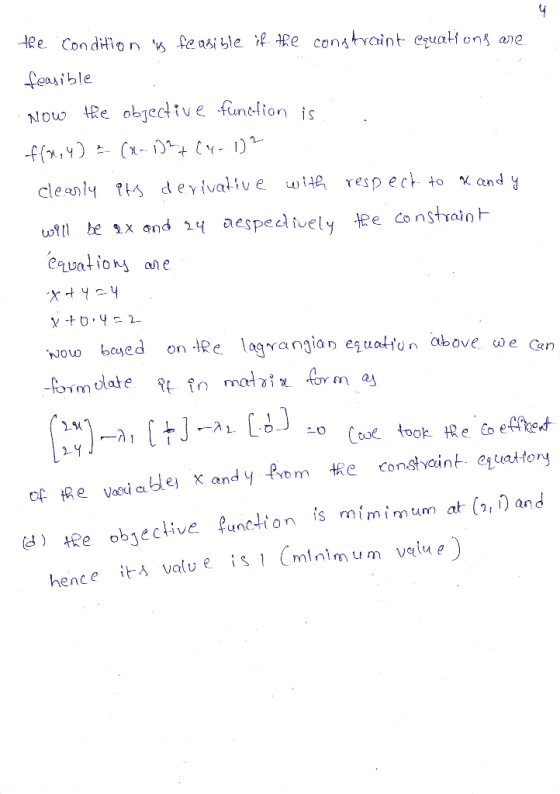
1. Consider the constrained optimization problem: min f(x,x2) - (x-3)2 (x2 -3)2 Subject to Is this...
(45 Points) Consider the constrained optimization problem: min f(x1, x2) = 2x} + 9x2 + 9x2...
 (45 Points) Consider the constrained optimization problem: min f(x1, x2) = 2x} + 9x2 + 9x2 - 6x1x2 – 18x1 X1 X2 Subject to 4x1 – 3x2 s 20 X1 + 2x2 < 10 -X1 < 0, - x2 < 0 a) Is this problem convex? Justify your answer. (5 Points) b) Form the Lagrange function. (5 Points) c) Formulate KKT conditions. (10 Points) d) Recall that one technique for finding roots of KKT condition is to check all permutations...
X1.x2 Subject to 4x1-3x2 S 20 x1 +2x2 s 10 a) Is this problem convex? Justify your answer. (5 Poi...
 x1.x2 Subject to 4x1-3x2 S 20 x1 +2x2 s 10 a) Is this problem convex? Justify your answer. (5 Points) b) Form the Lagrangian function. (5 Points) c) Formulate KKT conditions. (10 Points) d) Recall that one technique for finding roots of KKT condition is to check all permutations of the switching conditions. Find an optimal solution (x*) via e) Compute the objective function and identify each constraint as active or f) Solve this problem using graphical optimization to check...
Exercise 7.3. Consider the nonlinearly constrained problem minimize xER2 to (7.1) a x2 1 = 0. subject 1)T is a feasible...
 Exercise 7.3. Consider the nonlinearly constrained problem minimize xER2 to (7.1) a x2 1 = 0. subject 1)T is a feasible path for the nonlinear constraint (a) Show that x(a) x x - 1 = 0 of problem (7.1). Compute the tangent to the feasible path at E = (0, 0)7 (sin a, cos a - + X (b) Find another feasible path for the constraint x? + (x2 + 1)2 - 1 = 0. Compute the tangent to the...
3. (8 marks) Regarding the optimization of f(x) subject to the constraint g(x) x(n) are choice va...
 3. (8 marks) Regarding the optimization of f(x) subject to the constraint g(x) x(n) are choice variables and c is a parameter, state the optimization problem and the first-order and second-order conditions for both a maximum and a minimum, where the Lagrangian and Lagrangian multiplier are denoted as l(x) and λ, respectively. c, where
3. (8 marks) Regarding the optimization of f(x) subject to the constraint g(x) x(n) are choice variables and c is a parameter, state the optimization problem...
3. (8 marks) Regarding the optimization of f(x) subject to the constraint g(x) x(n) are choice variables and c is a parameter, state the optimization problem and the first-order and second-order conditions for both a maximum and a minimum, where the Lagrangian and Lagrangian multiplier are denoted as l(x) and λ, respectively. c, where
3. (8 marks) Regarding the optimization of f(x) subject to the constraint g(x) x(n) are choice variables and c is a parameter, state the optimization problem...
Consider the optimization problem minimize f(x) subject to αεΩ where f(x) = x122, where x =...
 Consider the optimization problem minimize f(x) subject to αεΩ where f(x) = x122, where x = [11, [2], and N = {x € R2 : x1 = 22, Xı >0}. (a) Find all points satisfying the KKT condition. (b) Do each of the points found in part (a) satisfy the second-order necessary condition? (c) Do each of the points found in part (a) satisfy the second-order sufficient condition?
Problem 1: Consider the following problem x+y+1=1 x2 +y2+z2 =1 max f(x ,y,z)=er+y+1 subject to (a)...
 Problem 1: Consider the following problem x+y+1=1 x2 +y2+z2 =1 max f(x ,y,z)=er+y+1 subject to (a) Solve the problem. (b) Replace the constraints byx+y+1=1.02 and x2+y2+Z2-0.98. What is the approximate change in the optimal value of the objective function? (c) Classify the candidate points for optimality in the local optimization problem.
Q1: Consider the minimisation of the following function of two variables: f(t, z.) %3D — In(1+ 7) — Т2. Subject to the...
 Q1: Consider the minimisation of the following function of two variables: f(t, z.) %3D — In(1+ 7) — Т2. Subject to the linear constraints: 2я1 + х2 < 3;B х, 22 2 0. (a) Prove that this is a convex minimisation problem (b) Write down the Karush-Kuhn-Tucker conditions for this problem. (c) Find all solutions of the above KKT conditions (d) Are the solutions you found a local or a global minimum (maximum)? Justify your answer.
Q1: Consider the minimisation...
Q1: Consider the minimisation of the following function of two variables: f(t, z.) %3D — In(1+ 7) — Т2. Subject to the linear constraints: 2я1 + х2 < 3;B х, 22 2 0. (a) Prove that this is a convex minimisation problem (b) Write down the Karush-Kuhn-Tucker conditions for this problem. (c) Find all solutions of the above KKT conditions (d) Are the solutions you found a local or a global minimum (maximum)? Justify your answer.
Q1: Consider the minimisation...
4) Consider the following constrained optimization problem: S.1 2x, + 5x, + x, =3 a) (10pts)...
 4) Consider the following constrained optimization problem: S.1 2x, + 5x, + x, =3 a) (10pts) Determine a null space matrix Z for A (given the constraint set A b b) (25pts) Perform two iterations of the reduced Newton method starting from the point r0
Problem 1: Consider the following linear optimization problem: max 1 +22x;3 subject to x1 + x2...
 Problem 1: Consider the following linear optimization problem: max 1 +22x;3 subject to x1 + x2 +r3 10 2x1 -r2 2-4 i20, -1,2,3 a) Bring the problem to a standard form (b) Show that the point (2,8,0)T is optimal by the optimality condition of the linear program- ming. Is it an extreme point? Provide arguments for your answers (c) Determine at least one other point different than (2,8,0)T, which is an extreme point of the constraint set 1) (d) Find...
8.(15 POINTS) Consider the following optimization problem: Max xi + subject to : 5xí +60192 +...
 8.(15 POINTS) Consider the following optimization problem: Max xi + subject to : 5xí +60192 + 5x3 = 1 and 21 > 0,22 > 0. where 2 and 32 are choice variables. (a) Write the Lagrangean and the Kuhn-Tucker conditions. (6) State and verify the second order condition. Distinguish between sufficient and necessary condi tions. (c) Is the constraint qualification condition satisfied? Show clearly why or why not. (d) Solve the Kuhn-Tucker conditions for the optimal choice: x1, x, and...
 (45 Points) Consider the constrained optimization problem: min f(x1, x2) = 2x} + 9x2 + 9x2 - 6x1x2 – 18x1 X1 X2 Subject to 4x1 – 3x2 s 20 X1 + 2x2 < 10 -X1 < 0, - x2 < 0 a) Is this problem convex? Justify your answer. (5 Points) b) Form the Lagrange function. (5 Points) c) Formulate KKT conditions. (10 Points) d) Recall that one technique for finding roots of KKT condition is to check all permutations...
 x1.x2 Subject to 4x1-3x2 S 20 x1 +2x2 s 10 a) Is this problem convex? Justify your answer. (5 Points) b) Form the Lagrangian function. (5 Points) c) Formulate KKT conditions. (10 Points) d) Recall that one technique for finding roots of KKT condition is to check all permutations of the switching conditions. Find an optimal solution (x*) via e) Compute the objective function and identify each constraint as active or f) Solve this problem using graphical optimization to check...
 Exercise 7.3. Consider the nonlinearly constrained problem minimize xER2 to (7.1) a x2 1 = 0. subject 1)T is a feasible path for the nonlinear constraint (a) Show that x(a) x x - 1 = 0 of problem (7.1). Compute the tangent to the feasible path at E = (0, 0)7 (sin a, cos a - + X (b) Find another feasible path for the constraint x? + (x2 + 1)2 - 1 = 0. Compute the tangent to the...
 3. (8 marks) Regarding the optimization of f(x) subject to the constraint g(x) x(n) are choice variables and c is a parameter, state the optimization problem and the first-order and second-order conditions for both a maximum and a minimum, where the Lagrangian and Lagrangian multiplier are denoted as l(x) and λ, respectively. c, where
3. (8 marks) Regarding the optimization of f(x) subject to the constraint g(x) x(n) are choice variables and c is a parameter, state the optimization problem...
3. (8 marks) Regarding the optimization of f(x) subject to the constraint g(x) x(n) are choice variables and c is a parameter, state the optimization problem and the first-order and second-order conditions for both a maximum and a minimum, where the Lagrangian and Lagrangian multiplier are denoted as l(x) and λ, respectively. c, where
3. (8 marks) Regarding the optimization of f(x) subject to the constraint g(x) x(n) are choice variables and c is a parameter, state the optimization problem...
 Consider the optimization problem minimize f(x) subject to αεΩ where f(x) = x122, where x = [11, [2], and N = {x € R2 : x1 = 22, Xı >0}. (a) Find all points satisfying the KKT condition. (b) Do each of the points found in part (a) satisfy the second-order necessary condition? (c) Do each of the points found in part (a) satisfy the second-order sufficient condition?
 Problem 1: Consider the following problem x+y+1=1 x2 +y2+z2 =1 max f(x ,y,z)=er+y+1 subject to (a) Solve the problem. (b) Replace the constraints byx+y+1=1.02 and x2+y2+Z2-0.98. What is the approximate change in the optimal value of the objective function? (c) Classify the candidate points for optimality in the local optimization problem.
 Q1: Consider the minimisation of the following function of two variables: f(t, z.) %3D — In(1+ 7) — Т2. Subject to the linear constraints: 2я1 + х2 < 3;B х, 22 2 0. (a) Prove that this is a convex minimisation problem (b) Write down the Karush-Kuhn-Tucker conditions for this problem. (c) Find all solutions of the above KKT conditions (d) Are the solutions you found a local or a global minimum (maximum)? Justify your answer.
Q1: Consider the minimisation...
Q1: Consider the minimisation of the following function of two variables: f(t, z.) %3D — In(1+ 7) — Т2. Subject to the linear constraints: 2я1 + х2 < 3;B х, 22 2 0. (a) Prove that this is a convex minimisation problem (b) Write down the Karush-Kuhn-Tucker conditions for this problem. (c) Find all solutions of the above KKT conditions (d) Are the solutions you found a local or a global minimum (maximum)? Justify your answer.
Q1: Consider the minimisation...
 4) Consider the following constrained optimization problem: S.1 2x, + 5x, + x, =3 a) (10pts) Determine a null space matrix Z for A (given the constraint set A b b) (25pts) Perform two iterations of the reduced Newton method starting from the point r0
 Problem 1: Consider the following linear optimization problem: max 1 +22x;3 subject to x1 + x2 +r3 10 2x1 -r2 2-4 i20, -1,2,3 a) Bring the problem to a standard form (b) Show that the point (2,8,0)T is optimal by the optimality condition of the linear program- ming. Is it an extreme point? Provide arguments for your answers (c) Determine at least one other point different than (2,8,0)T, which is an extreme point of the constraint set 1) (d) Find...
 8.(15 POINTS) Consider the following optimization problem: Max xi + subject to : 5xí +60192 + 5x3 = 1 and 21 > 0,22 > 0. where 2 and 32 are choice variables. (a) Write the Lagrangean and the Kuhn-Tucker conditions. (6) State and verify the second order condition. Distinguish between sufficient and necessary condi tions. (c) Is the constraint qualification condition satisfied? Show clearly why or why not. (d) Solve the Kuhn-Tucker conditions for the optimal choice: x1, x, and...
Most questions answered within 3 hours.
-
Where is the error in this code sequence?
String s1 = "Hello";
String s2 = "ello";...
asked 11 months ago -
Financial data for Joel de Paris, Inc., for last year
follow:
Joel de Paris, Inc.
Balance...
asked 11 months ago -
Consider this reaction:
Al2(SO4)3 (aq)+ BaCl3
(aq) Al2Cl6 (aq)- +
3BaSO4(s) . What is the...
asked 11 months ago -
Suppose that Savneet is considering increasing her
recent random sample from 20 car rentals to 40...
asked 11 months ago -
Trucks arrive at an unloading terminal at an average rate of 120
per hour.
Trucks arrive...
asked 11 months ago -
Why are methanol and ethanol completely soluble in water while
octanol is not very little soluble....
asked 11 months ago -
A facilities manager at a university reads in a research report
that the mean amount of...
asked 11 months ago -
When the CuSO4 is rehydrated by adding water to the anhydrous
compound, is this an endothermic...
asked 11 months ago -
A ray of sunlight is passing from diamond into crown glass; the
angle of incidence is...
asked 11 months ago -
A block of mass 0.249 kg is placed on top of a light, vertical
spring of...
asked 11 months ago -
how do the kidneys compensate in the presences of acidosis
a) trigger hyperventilate
b) reserve acid...
asked 11 months ago -
Question 501 pts
The rental rate of capital to the firm increases. Which of the
following...
asked 11 months ago