
Homework Answers
Add Answer to:
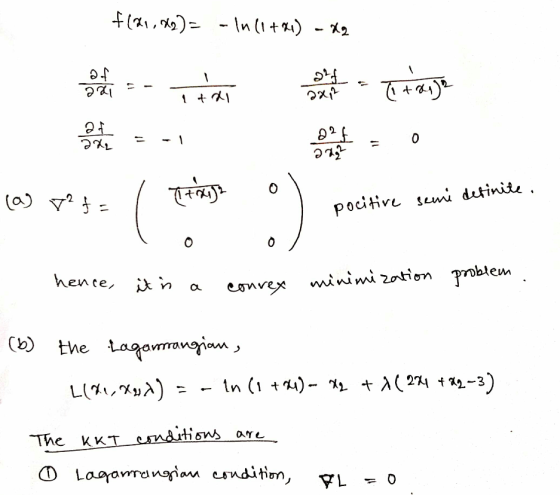
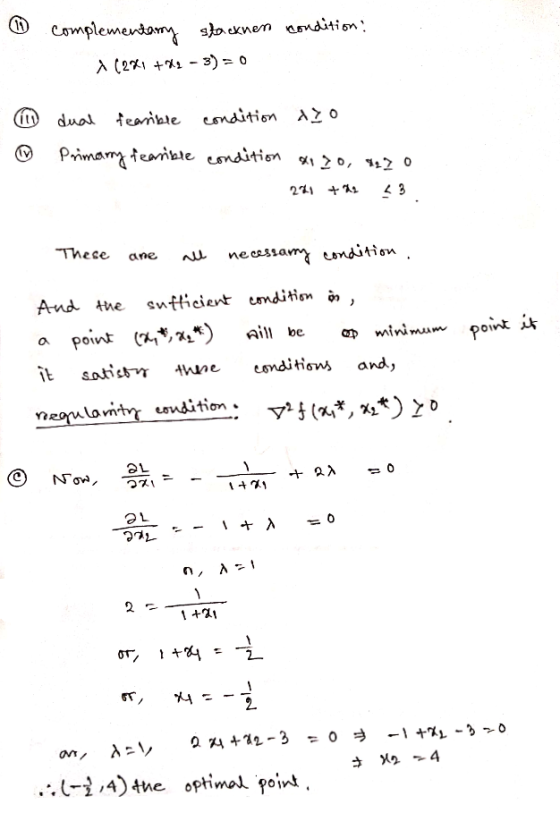
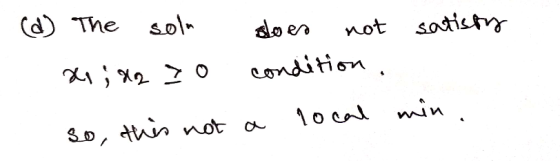
Q1: Consider the minimisation of the following function of two variables: f(t, z.) %3D — In(1+ 7) — Т2. Subject to the...
KKT is karush kuhn tucker Question 5 [15 marks] (Chapters 5, 6, 7 and 11) Consider...
 KKT is karush kuhn tucker
Question 5 [15 marks] (Chapters 5, 6, 7 and 11) Consider the optimization problem min (r1,23)ER3 1 + 222 2a3 = 2, s.t. i) [2 marks] Is this problem convex? Justify your answer. ii) [3 marks] Can we say that this problem has an optimal solution? Justify your answer iii) [4 marks] Are the KKT optimality conditions necessary for this problem? In other words, given a KKT point of this problem, must it be an...
KKT is karush kuhn tucker
Question 5 [15 marks] (Chapters 5, 6, 7 and 11) Consider the optimization problem min (r1,23)ER3 1 + 222 2a3 = 2, s.t. i) [2 marks] Is this problem convex? Justify your answer. ii) [3 marks] Can we say that this problem has an optimal solution? Justify your answer iii) [4 marks] Are the KKT optimality conditions necessary for this problem? In other words, given a KKT point of this problem, must it be an...
Consider the following linear regression model 1. For any X x, let Y xBU, where 3...
 Consider the following linear regression model 1. For any X x, let Y xBU, where 3 E R*. 2. X is exogenous 3. The probability model is {f(u;0) is a distribution on R: Ef [U] = 0, VAR, [U] = 02,0 > 0}. 4. Sampling model: Y} anidependent sample, sequentially generated using Yi x Ui,where the U IID(0,0) are (i) Let K 0 be a given number. We wish to estimate B using least-squares subject to the constraint 6BK2. Write...
T/F For Necessary Conditions for General Constrained Problem in Optimum Design
 T/F For Necessary Conditions for General Constrained Problem in
Optimum Design
8. While solving an optimum design problem by KKT conditions, each case defined by the switching conditions can have multiple solutions. 9. In optimum design problem formulation, "2 type" constraints cannot be treated. the Lagrange function with respect to design variables. 11. Optimum design points having at least one active constraint give stationary value to the cost function. linearly dependent on the gradients of the active constraint functions 13....
T/F For Necessary Conditions for General Constrained Problem in
Optimum Design
8. While solving an optimum design problem by KKT conditions, each case defined by the switching conditions can have multiple solutions. 9. In optimum design problem formulation, "2 type" constraints cannot be treated. the Lagrange function with respect to design variables. 11. Optimum design points having at least one active constraint give stationary value to the cost function. linearly dependent on the gradients of the active constraint functions 13....
(45 Points) Consider the constrained optimization problem: min f(x1, x2) = 2x} + 9x2 + 9x2...
 (45 Points) Consider the constrained optimization problem: min f(x1, x2) = 2x} + 9x2 + 9x2 - 6x1x2 – 18x1 X1 X2 Subject to 4x1 – 3x2 s 20 X1 + 2x2 < 10 -X1 < 0, - x2 < 0 a) Is this problem convex? Justify your answer. (5 Points) b) Form the Lagrange function. (5 Points) c) Formulate KKT conditions. (10 Points) d) Recall that one technique for finding roots of KKT condition is to check all permutations...
1. Consider the given Objective Function and Constraints: axize Z- 38X1 16X2 Subject to: 121 27X2...
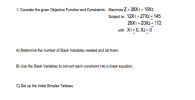 1. Consider the given Objective Function and Constraints: axize Z- 38X1 16X2 Subject to: 121 27X2 145 29X1 20X2<172 with X1 0, X20 A) Determine the number of Slack Variables needed and list them. B) Use the Slack Variables to convert each constraint into a inear equation. C) Set up the Initial Simplex Tableau
1. Consider the constrained optimization problem: min f(x,x2) - (x-3)2 (x2 -3)2 Subject to Is this...
 1. Consider the constrained optimization problem: min f(x,x2) - (x-3)2 (x2 -3)2 Subject to Is this problem convex? Justify your answer Form the Lagrangian function. a. b. Check the necessary and sufficient conditions for candidate local minimum points. Note that equality constraint for a feasible point is always an active constraint c. d. Is the solution you found in part (c) a global minimum? Explain your answer
Consider the following linear regression model 1. For any X = x, let Y = xB+U,...
 Consider the following linear regression model 1. For any X = x, let Y = xB+U, where B erk. 2. X is exogenous. 3. The probability model is {f(u; ) is a distribution on R: Ef [U] = 0, VAR; [U] = 62,0 >0}. 4. Sampling model: {Y}}}=1 is an independent sample, sequentially generated using Y; = xiß +Ui, where the U; are IID(0,62). (i) Let K > 0 be a given number. We wish to estimate B using least-squares...
Problem 1. Consider the nonhomogencous heat equation for u(a,t) subject to the nonhomogeneous boundary conditions u(0,t1, t)- 0, and the initial condition 1--+ sin(z) u(z,0) = e solution u(z, t)...
 Problem 1. Consider the nonhomogencous heat equation for u(a,t) subject to the nonhomogeneous boundary conditions u(0,t1, t)- 0, and the initial condition 1--+ sin(z) u(z,0) = e solution u(z, t) by completing each of the following steps Find the equilibrium temperature distribution we r) Find th (b) Denote v, t)t) - ()Derive the IBVP for the function vz,t). (c) Find v(x, t) (d) Find u(x, t)
Problem 1. Consider the nonhomogencous heat equation for u(a,t) subject to the nonhomogeneous boundary...
Problem 1. Consider the nonhomogencous heat equation for u(a,t) subject to the nonhomogeneous boundary conditions u(0,t1, t)- 0, and the initial condition 1--+ sin(z) u(z,0) = e solution u(z, t) by completing each of the following steps Find the equilibrium temperature distribution we r) Find th (b) Denote v, t)t) - ()Derive the IBVP for the function vz,t). (c) Find v(x, t) (d) Find u(x, t)
Problem 1. Consider the nonhomogencous heat equation for u(a,t) subject to the nonhomogeneous boundary...
Problem 1: Consider the following problem x+y+1=1 x2 +y2+z2 =1 max f(x ,y,z)=er+y+1 subject to (a)...
 Problem 1: Consider the following problem x+y+1=1 x2 +y2+z2 =1 max f(x ,y,z)=er+y+1 subject to (a) Solve the problem. (b) Replace the constraints byx+y+1=1.02 and x2+y2+Z2-0.98. What is the approximate change in the optimal value of the objective function? (c) Classify the candidate points for optimality in the local optimization problem.
Problem 1. Consider the nonhomogeneous heat equation for u(x,t) subject to the nonhomogeneous boundary conditions and the initial condition e solution u(z, t) by completing each of the following...
 Problem 1. Consider the nonhomogeneous heat equation for u(x,t) subject to the nonhomogeneous boundary conditions and the initial condition e solution u(z, t) by completing each of the following steps Find the equilibrium temperature distribution ue(a) (b) Denote v(, t)t) -)Derive the IBVP for the function vz,t). (c) Find v(x, t) (d) Find u(x,t)
Problem 1. Consider the nonhomogeneous heat equation for u(x,t) subject to the nonhomogeneous boundary conditions and the initial condition e solution u(z, t) by completing each...
Problem 1. Consider the nonhomogeneous heat equation for u(x,t) subject to the nonhomogeneous boundary conditions and the initial condition e solution u(z, t) by completing each of the following steps Find the equilibrium temperature distribution ue(a) (b) Denote v(, t)t) -)Derive the IBVP for the function vz,t). (c) Find v(x, t) (d) Find u(x,t)
Problem 1. Consider the nonhomogeneous heat equation for u(x,t) subject to the nonhomogeneous boundary conditions and the initial condition e solution u(z, t) by completing each...
 KKT is karush kuhn tucker
Question 5 [15 marks] (Chapters 5, 6, 7 and 11) Consider the optimization problem min (r1,23)ER3 1 + 222 2a3 = 2, s.t. i) [2 marks] Is this problem convex? Justify your answer. ii) [3 marks] Can we say that this problem has an optimal solution? Justify your answer iii) [4 marks] Are the KKT optimality conditions necessary for this problem? In other words, given a KKT point of this problem, must it be an...
KKT is karush kuhn tucker
Question 5 [15 marks] (Chapters 5, 6, 7 and 11) Consider the optimization problem min (r1,23)ER3 1 + 222 2a3 = 2, s.t. i) [2 marks] Is this problem convex? Justify your answer. ii) [3 marks] Can we say that this problem has an optimal solution? Justify your answer iii) [4 marks] Are the KKT optimality conditions necessary for this problem? In other words, given a KKT point of this problem, must it be an...
 Consider the following linear regression model 1. For any X x, let Y xBU, where 3 E R*. 2. X is exogenous 3. The probability model is {f(u;0) is a distribution on R: Ef [U] = 0, VAR, [U] = 02,0 > 0}. 4. Sampling model: Y} anidependent sample, sequentially generated using Yi x Ui,where the U IID(0,0) are (i) Let K 0 be a given number. We wish to estimate B using least-squares subject to the constraint 6BK2. Write...
 T/F For Necessary Conditions for General Constrained Problem in
Optimum Design
8. While solving an optimum design problem by KKT conditions, each case defined by the switching conditions can have multiple solutions. 9. In optimum design problem formulation, "2 type" constraints cannot be treated. the Lagrange function with respect to design variables. 11. Optimum design points having at least one active constraint give stationary value to the cost function. linearly dependent on the gradients of the active constraint functions 13....
T/F For Necessary Conditions for General Constrained Problem in
Optimum Design
8. While solving an optimum design problem by KKT conditions, each case defined by the switching conditions can have multiple solutions. 9. In optimum design problem formulation, "2 type" constraints cannot be treated. the Lagrange function with respect to design variables. 11. Optimum design points having at least one active constraint give stationary value to the cost function. linearly dependent on the gradients of the active constraint functions 13....
 (45 Points) Consider the constrained optimization problem: min f(x1, x2) = 2x} + 9x2 + 9x2 - 6x1x2 – 18x1 X1 X2 Subject to 4x1 – 3x2 s 20 X1 + 2x2 < 10 -X1 < 0, - x2 < 0 a) Is this problem convex? Justify your answer. (5 Points) b) Form the Lagrange function. (5 Points) c) Formulate KKT conditions. (10 Points) d) Recall that one technique for finding roots of KKT condition is to check all permutations...
 1. Consider the given Objective Function and Constraints: axize Z- 38X1 16X2 Subject to: 121 27X2 145 29X1 20X2<172 with X1 0, X20 A) Determine the number of Slack Variables needed and list them. B) Use the Slack Variables to convert each constraint into a inear equation. C) Set up the Initial Simplex Tableau
 1. Consider the constrained optimization problem: min f(x,x2) - (x-3)2 (x2 -3)2 Subject to Is this problem convex? Justify your answer Form the Lagrangian function. a. b. Check the necessary and sufficient conditions for candidate local minimum points. Note that equality constraint for a feasible point is always an active constraint c. d. Is the solution you found in part (c) a global minimum? Explain your answer
 Consider the following linear regression model 1. For any X = x, let Y = xB+U, where B erk. 2. X is exogenous. 3. The probability model is {f(u; ) is a distribution on R: Ef [U] = 0, VAR; [U] = 62,0 >0}. 4. Sampling model: {Y}}}=1 is an independent sample, sequentially generated using Y; = xiß +Ui, where the U; are IID(0,62). (i) Let K > 0 be a given number. We wish to estimate B using least-squares...
 Problem 1. Consider the nonhomogencous heat equation for u(a,t) subject to the nonhomogeneous boundary conditions u(0,t1, t)- 0, and the initial condition 1--+ sin(z) u(z,0) = e solution u(z, t) by completing each of the following steps Find the equilibrium temperature distribution we r) Find th (b) Denote v, t)t) - ()Derive the IBVP for the function vz,t). (c) Find v(x, t) (d) Find u(x, t)
Problem 1. Consider the nonhomogencous heat equation for u(a,t) subject to the nonhomogeneous boundary...
Problem 1. Consider the nonhomogencous heat equation for u(a,t) subject to the nonhomogeneous boundary conditions u(0,t1, t)- 0, and the initial condition 1--+ sin(z) u(z,0) = e solution u(z, t) by completing each of the following steps Find the equilibrium temperature distribution we r) Find th (b) Denote v, t)t) - ()Derive the IBVP for the function vz,t). (c) Find v(x, t) (d) Find u(x, t)
Problem 1. Consider the nonhomogencous heat equation for u(a,t) subject to the nonhomogeneous boundary...
 Problem 1: Consider the following problem x+y+1=1 x2 +y2+z2 =1 max f(x ,y,z)=er+y+1 subject to (a) Solve the problem. (b) Replace the constraints byx+y+1=1.02 and x2+y2+Z2-0.98. What is the approximate change in the optimal value of the objective function? (c) Classify the candidate points for optimality in the local optimization problem.
 Problem 1. Consider the nonhomogeneous heat equation for u(x,t) subject to the nonhomogeneous boundary conditions and the initial condition e solution u(z, t) by completing each of the following steps Find the equilibrium temperature distribution ue(a) (b) Denote v(, t)t) -)Derive the IBVP for the function vz,t). (c) Find v(x, t) (d) Find u(x,t)
Problem 1. Consider the nonhomogeneous heat equation for u(x,t) subject to the nonhomogeneous boundary conditions and the initial condition e solution u(z, t) by completing each...
Problem 1. Consider the nonhomogeneous heat equation for u(x,t) subject to the nonhomogeneous boundary conditions and the initial condition e solution u(z, t) by completing each of the following steps Find the equilibrium temperature distribution ue(a) (b) Denote v(, t)t) -)Derive the IBVP for the function vz,t). (c) Find v(x, t) (d) Find u(x,t)
Problem 1. Consider the nonhomogeneous heat equation for u(x,t) subject to the nonhomogeneous boundary conditions and the initial condition e solution u(z, t) by completing each...
Most questions answered within 3 hours.
-
Where is the error in this code sequence?
String s1 = "Hello";
String s2 = "ello";...
asked 11 months ago -
Financial data for Joel de Paris, Inc., for last year
follow:
Joel de Paris, Inc.
Balance...
asked 11 months ago -
Consider this reaction:
Al2(SO4)3 (aq)+ BaCl3
(aq) Al2Cl6 (aq)- +
3BaSO4(s) . What is the...
asked 11 months ago -
Suppose that Savneet is considering increasing her
recent random sample from 20 car rentals to 40...
asked 11 months ago -
Trucks arrive at an unloading terminal at an average rate of 120
per hour.
Trucks arrive...
asked 11 months ago -
Why are methanol and ethanol completely soluble in water while
octanol is not very little soluble....
asked 11 months ago -
A facilities manager at a university reads in a research report
that the mean amount of...
asked 11 months ago -
When the CuSO4 is rehydrated by adding water to the anhydrous
compound, is this an endothermic...
asked 11 months ago -
A ray of sunlight is passing from diamond into crown glass; the
angle of incidence is...
asked 11 months ago -
A block of mass 0.249 kg is placed on top of a light, vertical
spring of...
asked 11 months ago -
how do the kidneys compensate in the presences of acidosis
a) trigger hyperventilate
b) reserve acid...
asked 11 months ago -
Question 501 pts
The rental rate of capital to the firm increases. Which of the
following...
asked 11 months ago