
Homework Answers
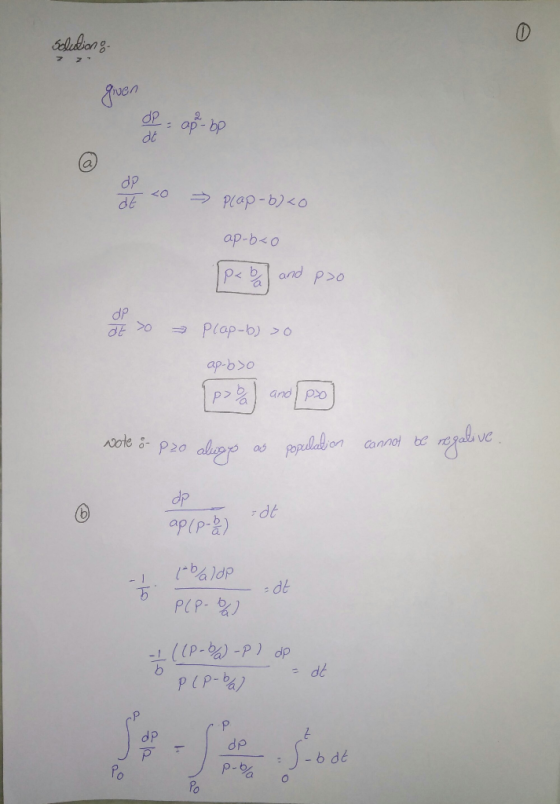
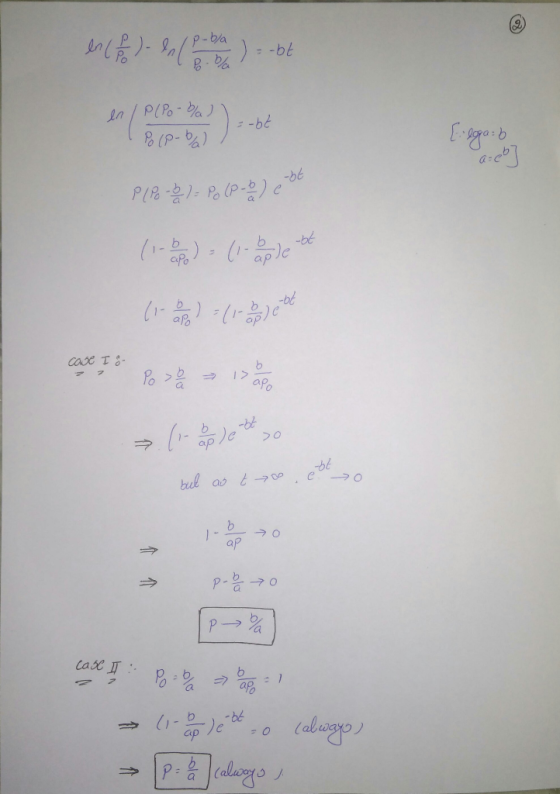
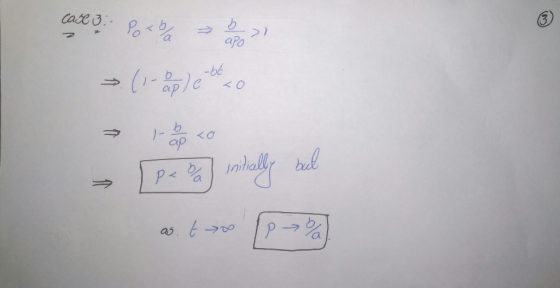
Add Answer to:
(1 point) Any population, P, for which we can ignore immigration, satisfies dP Birth rate –...
Q2: Consider a population P(t) whose birth rate is given by b = bo + cost...
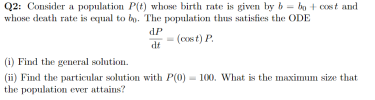 Q2: Consider a population P(t) whose birth rate is given by b = bo + cost and whose death rate is equal to bo. The population thus satisfies the ODE dP dt = (cost) P. (i) Find the general solution. (ii) Find the particular solution with P(0) = 100. What is the maximum size that the population ever attains?
2. Suppose a population P(t) satisfies the logistic differential equation dP dt = 0.1P 1 −...
 2. Suppose a population P(t) satisfies the logistic differential
equation dP dt = 0.1P 1 − P 2000 P(0) = 100 Find the following: a)
P(20) b) When will the population reach 1200?
2. Suppose a population P(t) satisfies the logistic differential equation 2P = 0.1P (1–2000) = 0.1P | P(0) = 100 2000 Find the following: a) P(20) b) When will the population reach 1200?
2. Suppose a population P(t) satisfies the logistic differential
equation dP dt = 0.1P 1 − P 2000 P(0) = 100 Find the following: a)
P(20) b) When will the population reach 1200?
2. Suppose a population P(t) satisfies the logistic differential equation 2P = 0.1P (1–2000) = 0.1P | P(0) = 100 2000 Find the following: a) P(20) b) When will the population reach 1200?
Suppose that the rate of change of a population is given by: dP dt = kP(M-P) a) What model of pop...
 Suppose that the rate of change of a population is given by: dP dt = kP(M-P) a) What model of population growth is this ? b) What does it predict for the growth of the population as the population increases ? c) Sketch what happens to the population if the initial population, Po, were such that G) 0< Po< M/2, (ii) M/2 < PoM and (iii) Po > M (all on the same graph of population as a function of...
A population P obeys the logistic model. It satisfies the equation dp 2 dt = 500...
 A population P obeys the logistic model. It satisfies the equation dp 2 dt = 500 P(5 – P) for P >0. (a) The population is increasing when - Preview <P < 5 Preview (b) The population is decreasing when P > 5 Preview (c) Assume that P(0) = 4. Find P(40). P(40) = 1.93 * Preview
The population of fish, P, in a lake is a function of time, t, measured in years. The rate of cha...
 The population of fish, P, in a lake is a function of time, t, measured in years. The rate of change of P is given by 7600e0.4t fish/year. dt(19 + e0.4t)2 dp dt a. Graph on the domain [0, 20]. Make sure your graph is properly labeled. b. Estimate the change in population on the time interval 0 s t š 20 years. Use 10 intervals, each lasting two years. Use rate of change data from the left side of...
1. Population of bacteris, P, has a fived relative birth rate Trorn -a (so that the absolute birth rate i aP) and the relative death rate that is linearly increasing with population Taeat capacit...
 1. Population of bacteris, P, has a fived relative birth rate Trorn -a (so that the absolute birth rate i aP) and the relative death rate that is linearly increasing with population Taeat capacity in terms of a, b and b DO NOT SOLVE THE EQUATION describing evolution of this population and determine its carrying 2
1. Population of bacteris, P, has a fived relative birth rate Trorn -a (so that the absolute birth rate i aP) and the relative...
1. Population of bacteris, P, has a fived relative birth rate Trorn -a (so that the absolute birth rate i aP) and the relative death rate that is linearly increasing with population Taeat capacity in terms of a, b and b DO NOT SOLVE THE EQUATION describing evolution of this population and determine its carrying 2
1. Population of bacteris, P, has a fived relative birth rate Trorn -a (so that the absolute birth rate i aP) and the relative...
Population Growth: Let P(t) be the number of rabbits in the rabbit population. In the simplest...
 Population Growth: Let P(t) be the number of rabbits in the
rabbit population. In the simplest case we can assume the number of
rabbits born at any moment of time is proportional to the number of
rabbits at this moment of time. Mathematically we can write this as
a differential equation:
Here b is the birth rate, i.e. births per time unit per rabbit.
In the model above we ignore deaths and assume resources are
unlimited.
A. Solve the equation...
Population Growth: Let P(t) be the number of rabbits in the
rabbit population. In the simplest case we can assume the number of
rabbits born at any moment of time is proportional to the number of
rabbits at this moment of time. Mathematically we can write this as
a differential equation:
Here b is the birth rate, i.e. births per time unit per rabbit.
In the model above we ignore deaths and assume resources are
unlimited.
A. Solve the equation...
The growth rate of a particular bacteria is modeled by the differential equation dP/dt = k P. Suppose a population at...
 The growth rate of a particular bacteria is modeled by the differential equation dP/dt = k P. Suppose a population at of bacteria doubles in size every 11 hours. Initially, there are 200 bacteria cells. If we begin growing the bacteria for our experiment at 7: 00pm on September 4, when is the earliest the necessary 5,000,000 bacteria cells will be ready? a) September 07 at 12: 00pm b) September 07 at 9: 00pm c) September 08 at 8: 00am...
Suppose that a population of hacteria grows according to the logistic differential equation dP =0.01P-0.0002P2 dt...
 Suppose that a population of hacteria grows according to the logistic differential equation dP =0.01P-0.0002P2 dt where Pis the population measured in thousands and t is time measured in days. Logistic growth differential equations are often quite difficult to solve. Instead, you will analyze its direction field to acquire infom ation about the solutions to this differential equation. a) Calculate the maximum population M that the sumounding environment can austain. (Note this is also calked the "canying capacity"). Hint: Rewrite...
We go back to the logistic model for population dynamics (without harvesting), but we now allow t...
 part d please
We go back to the logistic model for population dynamics (without harvesting), but we now allow the growth rate and carrying capacity to vary in time: dt M(t) In this case the equation is not autonomous, so we can't use phase line analysis. We will instead find explicit analytical solutions (a) Show that the substitution z 1/P transforms the equation into the linear equation k (t) M(t) dz +k(t) dt (b) Using your result in (a), show...
part d please
We go back to the logistic model for population dynamics (without harvesting), but we now allow the growth rate and carrying capacity to vary in time: dt M(t) In this case the equation is not autonomous, so we can't use phase line analysis. We will instead find explicit analytical solutions (a) Show that the substitution z 1/P transforms the equation into the linear equation k (t) M(t) dz +k(t) dt (b) Using your result in (a), show...
 Q2: Consider a population P(t) whose birth rate is given by b = bo + cost and whose death rate is equal to bo. The population thus satisfies the ODE dP dt = (cost) P. (i) Find the general solution. (ii) Find the particular solution with P(0) = 100. What is the maximum size that the population ever attains?
 2. Suppose a population P(t) satisfies the logistic differential
equation dP dt = 0.1P 1 − P 2000 P(0) = 100 Find the following: a)
P(20) b) When will the population reach 1200?
2. Suppose a population P(t) satisfies the logistic differential equation 2P = 0.1P (1–2000) = 0.1P | P(0) = 100 2000 Find the following: a) P(20) b) When will the population reach 1200?
2. Suppose a population P(t) satisfies the logistic differential
equation dP dt = 0.1P 1 − P 2000 P(0) = 100 Find the following: a)
P(20) b) When will the population reach 1200?
2. Suppose a population P(t) satisfies the logistic differential equation 2P = 0.1P (1–2000) = 0.1P | P(0) = 100 2000 Find the following: a) P(20) b) When will the population reach 1200?
 Suppose that the rate of change of a population is given by: dP dt = kP(M-P) a) What model of population growth is this ? b) What does it predict for the growth of the population as the population increases ? c) Sketch what happens to the population if the initial population, Po, were such that G) 0< Po< M/2, (ii) M/2 < PoM and (iii) Po > M (all on the same graph of population as a function of...
 A population P obeys the logistic model. It satisfies the equation dp 2 dt = 500 P(5 – P) for P >0. (a) The population is increasing when - Preview <P < 5 Preview (b) The population is decreasing when P > 5 Preview (c) Assume that P(0) = 4. Find P(40). P(40) = 1.93 * Preview
 The population of fish, P, in a lake is a function of time, t, measured in years. The rate of change of P is given by 7600e0.4t fish/year. dt(19 + e0.4t)2 dp dt a. Graph on the domain [0, 20]. Make sure your graph is properly labeled. b. Estimate the change in population on the time interval 0 s t š 20 years. Use 10 intervals, each lasting two years. Use rate of change data from the left side of...
 1. Population of bacteris, P, has a fived relative birth rate Trorn -a (so that the absolute birth rate i aP) and the relative death rate that is linearly increasing with population Taeat capacity in terms of a, b and b DO NOT SOLVE THE EQUATION describing evolution of this population and determine its carrying 2
1. Population of bacteris, P, has a fived relative birth rate Trorn -a (so that the absolute birth rate i aP) and the relative...
1. Population of bacteris, P, has a fived relative birth rate Trorn -a (so that the absolute birth rate i aP) and the relative death rate that is linearly increasing with population Taeat capacity in terms of a, b and b DO NOT SOLVE THE EQUATION describing evolution of this population and determine its carrying 2
1. Population of bacteris, P, has a fived relative birth rate Trorn -a (so that the absolute birth rate i aP) and the relative...
 Population Growth: Let P(t) be the number of rabbits in the
rabbit population. In the simplest case we can assume the number of
rabbits born at any moment of time is proportional to the number of
rabbits at this moment of time. Mathematically we can write this as
a differential equation:
Here b is the birth rate, i.e. births per time unit per rabbit.
In the model above we ignore deaths and assume resources are
unlimited.
A. Solve the equation...
Population Growth: Let P(t) be the number of rabbits in the
rabbit population. In the simplest case we can assume the number of
rabbits born at any moment of time is proportional to the number of
rabbits at this moment of time. Mathematically we can write this as
a differential equation:
Here b is the birth rate, i.e. births per time unit per rabbit.
In the model above we ignore deaths and assume resources are
unlimited.
A. Solve the equation...
 The growth rate of a particular bacteria is modeled by the differential equation dP/dt = k P. Suppose a population at of bacteria doubles in size every 11 hours. Initially, there are 200 bacteria cells. If we begin growing the bacteria for our experiment at 7: 00pm on September 4, when is the earliest the necessary 5,000,000 bacteria cells will be ready? a) September 07 at 12: 00pm b) September 07 at 9: 00pm c) September 08 at 8: 00am...
 Suppose that a population of hacteria grows according to the logistic differential equation dP =0.01P-0.0002P2 dt where Pis the population measured in thousands and t is time measured in days. Logistic growth differential equations are often quite difficult to solve. Instead, you will analyze its direction field to acquire infom ation about the solutions to this differential equation. a) Calculate the maximum population M that the sumounding environment can austain. (Note this is also calked the "canying capacity"). Hint: Rewrite...
 part d please
We go back to the logistic model for population dynamics (without harvesting), but we now allow the growth rate and carrying capacity to vary in time: dt M(t) In this case the equation is not autonomous, so we can't use phase line analysis. We will instead find explicit analytical solutions (a) Show that the substitution z 1/P transforms the equation into the linear equation k (t) M(t) dz +k(t) dt (b) Using your result in (a), show...
part d please
We go back to the logistic model for population dynamics (without harvesting), but we now allow the growth rate and carrying capacity to vary in time: dt M(t) In this case the equation is not autonomous, so we can't use phase line analysis. We will instead find explicit analytical solutions (a) Show that the substitution z 1/P transforms the equation into the linear equation k (t) M(t) dz +k(t) dt (b) Using your result in (a), show...
Most questions answered within 3 hours.
-
Where is the error in this code sequence?
String s1 = "Hello";
String s2 = "ello";...
asked 11 months ago -
Financial data for Joel de Paris, Inc., for last year
follow:
Joel de Paris, Inc.
Balance...
asked 11 months ago -
Consider this reaction:
Al2(SO4)3 (aq)+ BaCl3
(aq) Al2Cl6 (aq)- +
3BaSO4(s) . What is the...
asked 11 months ago -
Suppose that Savneet is considering increasing her
recent random sample from 20 car rentals to 40...
asked 11 months ago -
Trucks arrive at an unloading terminal at an average rate of 120
per hour.
Trucks arrive...
asked 11 months ago -
Why are methanol and ethanol completely soluble in water while
octanol is not very little soluble....
asked 11 months ago -
A facilities manager at a university reads in a research report
that the mean amount of...
asked 11 months ago -
When the CuSO4 is rehydrated by adding water to the anhydrous
compound, is this an endothermic...
asked 11 months ago -
A ray of sunlight is passing from diamond into crown glass; the
angle of incidence is...
asked 11 months ago -
A block of mass 0.249 kg is placed on top of a light, vertical
spring of...
asked 11 months ago -
how do the kidneys compensate in the presences of acidosis
a) trigger hyperventilate
b) reserve acid...
asked 11 months ago -
Question 501 pts
The rental rate of capital to the firm increases. Which of the
following...
asked 11 months ago