
Homework Answers
Proteins that contain the Arg-Gly-Asp (RGD) attachment site, together with the integrins that serve as receptors for them, constitute a major recognition system for cell adhesion. The RGD sequence is the cell attachment site of a large number of adhesive extracellular matrix, blood, and cell surface proteins, and nearly half of the over 20 known integrins recognize this sequence in their adhesion protein ligands. Some other integrins bind to related sequences in their ligands. The integrin-binding activity of adhesion proteins can be reproduced by short synthetic peptides containing the RGD sequence. Such peptides promote cell adhesion when insolubilized onto a surface, and inhibit it when presented to cells in solution. Reagents that bind selectively to only one or a few of the RGD-directed integrins can be designed by cyclizing peptides with selected sequences around the RGD and by synthesizing RGD mimics. As the integrin-mediated cell attachment influences and regulates cell migration, growth, differentiation, and apoptosis, the RGD peptides and mimics can be used to probe integrin functions in various biological systems. Drug design based on the RGD structure may provide new treatments for diseases such as thrombosis, osteoporosis, and cancer.
B) The met charge of RGD is Negative at pH7.4.
C) When released into the cell membrane, newly synthesized integrin dimers are speculated to be found in the same "bent" conformation revealed by the structural studies described above. One school of thought claims that this bent form prevents them from interacting with their ligands, although bent forms can predominate in high-resolution EM structures of integrin bound to an ECM ligand. Therefore, at least in biochemical experiments, integrin dimers must apparently not be 'unbent' in order to prime them and allow their binding to the ECM. In cells, the priming is accomplished by a protein talin, which binds to the β tail of the integrin dimer and changes its conformation.[9][10] The α and β integrin chains are both class-I transmembrane proteins: they pass the plasma membrane as single transmembrane alpha-helices. Unfortunately, the helices are too long, and recent studies suggest that, for integrin gpIIbIIIa, they are tilted with respect both to one another and to the plane of the membrane. Talin binding alters the angle of tilt of the β3 chain transmembrane helix in model systems and this may reflect a stage in the process of inside-out signalling which primes integrins. Moreover, talin proteins are able to dimerize and thus are thought to intervene in the clustering of integrin dimers which leads to the formation of a focal adhesion. Recently, the Kindlin-1 and Kindlin-2 proteins have also been found to interact with integrin and activate it
D) One role of cholesterol is to help give the cell membrane extra support. Cholesterol is more rigid than some of the other lipids in the membrane. As Cytochemistry.net explains, cholesterol helps to immobilize some of the lipid molecules around them. This extra rigidity makes the cell membrane stronger and makes it harder for small molecules to pass through the membrane. The presence of cholesterol allows the cell membrane to be strong enough to hold the cell together and to serve as an effective barrier to ions.
E) phosphatidylcholine, phosphatidylethanolamine, phosphatidylserine, and sphingomyelin.
Add Answer to:
The tri-peptide sequence, RGD, is found in the extracellular matrix (ECM) protein fibronectin and serves as...
1) Think about the two terms below. Write an "A" next to the one that's found...
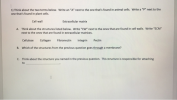 1) Think about the two terms below. Write an "A" next to the one that's found in animal cells. Write a "p" next to the one that's found in plant cells. Cell wall Extracellular matrix A. Think about the structures listed below. Write "CW" next to the ones that are found in cell walls. Write "ECM" next to the ones that are found in extracellular matrices. Cellulose Collagen Fibronectin Integrin Pectin B. Which of the structures from the previous question...
Question 50 (1 point) What is a major difference in the extracellular matrix (ECM) between plant...
 Question 50 (1 point) What is a major difference in the extracellular matrix (ECM) between plant and animal cells? Plant ECM components are release extracellularly by the Golgi stacks, whereas lysosomes function in this capacity in animal cells. Plant ECM is composed primarily of proteins, whereas animal ECM is mainly carbohydrates. O There is no difference O Plant ECM is primarily carbohydrate in nature whereas animal ECM is largely protein-based.
27. Integrins are single-pass integral membrane proteins in the plasma membrane of animal cells and are...
 27. Integrins are single-pass integral membrane proteins in the plasma membrane of animal cells and are involved in the interaction of the cell with the surrounding extracellular matrix. Which of the following descriptions do you think matches the transmembrane part of an integrin molecule? A. It forms a B barrel. B. It is an a helix that is bent in the middle. C. It is about 10 amino acids long, with every other amino acid side chain being hydrophobic. D....
I got this question in an exam : How does the extracellular matrix interact with cells...
I got this question in an exam : How does the extracellular matrix interact with cells : a) with proteoglycans b) with collagen c) with fibronectins d) with tight junctions I answered a because the proteoglycans constitute the network that holds the cells and extracellular proteins. I ruled out fibronectins because they form a dimer with integrins to connect collagen and the cell, which is just an example of an interaction. But proteoglycans are the fibres which collagen is embedded...
RGD is a short functional peptide sequence allowing cell recognition, even selective adhesion. Now you are...
 RGD is a short functional peptide sequence allowing cell recognition, even selective adhesion. Now you are involved in a project to design a new synthetic vascular graft for treating patients with damaged blood vessels. To avoid the problems of thrombus formation, you propose to modify the interior surface of the graft with an immobilized adhesion ligand, a short peptide sequence (REGDVE) you just invented (REDV) for endothelial cells. The objective would be to implant the graft, and have endothelial cells...
Hydropathy analysis of a membrane protein's amino acid sequence predicts the protein's transmembrane segments and orientation...
Hydropathy analysis of a membrane protein's amino acid sequence predicts the protein's transmembrane segments and orientation in the membrane. It is necessary to confirm those predictions with experimental analysis. One experimental approach for plasma membrane proteins is to use the protease trypsin to digest extracellular domains of these proteins. (Trypsin is hydrophilic and cannot cross the plasma membrane to enter the cell.) When added to cells, trypsin digests the hydrophilic portions of plasma membrane proteins exposed outside the cell into...
Determine whether the structure, location, and functions describe proteoglycans, peptidoglycan, glycoproteins, or glycolipids. GlcNAc is N-acetylglucosamine;...
 Determine whether the structure, location, and functions describe proteoglycans, peptidoglycan, glycoproteins, or glycolipids. GlcNAc is N-acetylglucosamine; MurNAc is N-acetylmuramic acid. Proteoglycans Peptidoglycan Glycoproteins Glycolipids Structure Location part of proteins at outer surface of plasma membrane, in extracellular matrix, and in blood Functions many functions, including cell adhesion strength for cell envelope Answer Bank glycosaminoglycan covalently joined to a protein at a Ser residue many functions, including acting as hormones bacterial cell wall extracellular matrix; some are integral membrane proteins outer...
MULTIPLE CHOICE QUESTION 1: Which of the following is true in comparing the protein versus nonprotein...
MULTIPLE CHOICE QUESTION 1: Which of the following is true in comparing the protein versus nonprotein components of the extracellular matrix (ECM)? A. The protein and nonprotein components of the ECM are both extensively negatively charged. B. The individual protein component molecules and nonprotein component molecules are both branching structures. C. The nonprotein component of the ECM contains hydroxyl functional groups, whereas the protein components of the ECM do not. D. The nonprotein component of the ECM is dominated by...
Question 15: Which of the following statements is false? A. Mitotic Cdk must be phosphorylated by...
Question 15: Which of the following statements is false? A. Mitotic Cdk must be phosphorylated by an activating kinase (Cak) before it is active. B. Phosphorylation of mitotic Cdk by the inhibitory kinase (Wee1) makes the Cdk inactive, even if it is phosphorylated by the activating kinase. C. Active M-Cdk phosphorylates the activating phosphatase (Cdc25) in a positive feedback loop. D. The activating phosphatase (Cdc25) removes all phosphates from mitotic Cdk so that M-Cdk will be active. Question 18: Which...
35. Insulin is a peptide (protein) hormone secreted by B-cells located in the pancreas. To be...
 35. Insulin is a peptide (protein) hormone secreted by B-cells located in the pancreas. To be protein) hormone used to regulate the level of glucose in the bloodstream. It is produced and performed. cated in the pancreas. To better understand how insulin is secreted, the following experiments were a. The mature me mature mRNA for insulin encodes a protein that is 110 amino acids in length. If the genes t is 110 amino acids in length. If the gene is...
 1) Think about the two terms below. Write an "A" next to the one that's found in animal cells. Write a "p" next to the one that's found in plant cells. Cell wall Extracellular matrix A. Think about the structures listed below. Write "CW" next to the ones that are found in cell walls. Write "ECM" next to the ones that are found in extracellular matrices. Cellulose Collagen Fibronectin Integrin Pectin B. Which of the structures from the previous question...
 Question 50 (1 point) What is a major difference in the extracellular matrix (ECM) between plant and animal cells? Plant ECM components are release extracellularly by the Golgi stacks, whereas lysosomes function in this capacity in animal cells. Plant ECM is composed primarily of proteins, whereas animal ECM is mainly carbohydrates. O There is no difference O Plant ECM is primarily carbohydrate in nature whereas animal ECM is largely protein-based.
 27. Integrins are single-pass integral membrane proteins in the plasma membrane of animal cells and are involved in the interaction of the cell with the surrounding extracellular matrix. Which of the following descriptions do you think matches the transmembrane part of an integrin molecule? A. It forms a B barrel. B. It is an a helix that is bent in the middle. C. It is about 10 amino acids long, with every other amino acid side chain being hydrophobic. D....
 RGD is a short functional peptide sequence allowing cell recognition, even selective adhesion. Now you are involved in a project to design a new synthetic vascular graft for treating patients with damaged blood vessels. To avoid the problems of thrombus formation, you propose to modify the interior surface of the graft with an immobilized adhesion ligand, a short peptide sequence (REGDVE) you just invented (REDV) for endothelial cells. The objective would be to implant the graft, and have endothelial cells...
 Determine whether the structure, location, and functions describe proteoglycans, peptidoglycan, glycoproteins, or glycolipids. GlcNAc is N-acetylglucosamine; MurNAc is N-acetylmuramic acid. Proteoglycans Peptidoglycan Glycoproteins Glycolipids Structure Location part of proteins at outer surface of plasma membrane, in extracellular matrix, and in blood Functions many functions, including cell adhesion strength for cell envelope Answer Bank glycosaminoglycan covalently joined to a protein at a Ser residue many functions, including acting as hormones bacterial cell wall extracellular matrix; some are integral membrane proteins outer...
 35. Insulin is a peptide (protein) hormone secreted by B-cells located in the pancreas. To be protein) hormone used to regulate the level of glucose in the bloodstream. It is produced and performed. cated in the pancreas. To better understand how insulin is secreted, the following experiments were a. The mature me mature mRNA for insulin encodes a protein that is 110 amino acids in length. If the genes t is 110 amino acids in length. If the gene is...
Most questions answered within 3 hours.
-
Where is the error in this code sequence?
String s1 = "Hello";
String s2 = "ello";...
asked 10 months ago -
Financial data for Joel de Paris, Inc., for last year
follow:
Joel de Paris, Inc.
Balance...
asked 10 months ago -
Consider this reaction:
Al2(SO4)3 (aq)+ BaCl3
(aq) Al2Cl6 (aq)- +
3BaSO4(s) . What is the...
asked 10 months ago -
Suppose that Savneet is considering increasing her
recent random sample from 20 car rentals to 40...
asked 10 months ago -
Trucks arrive at an unloading terminal at an average rate of 120
per hour.
Trucks arrive...
asked 10 months ago -
Why are methanol and ethanol completely soluble in water while
octanol is not very little soluble....
asked 10 months ago -
A facilities manager at a university reads in a research report
that the mean amount of...
asked 10 months ago -
When the CuSO4 is rehydrated by adding water to the anhydrous
compound, is this an endothermic...
asked 10 months ago -
A ray of sunlight is passing from diamond into crown glass; the
angle of incidence is...
asked 10 months ago -
A block of mass 0.249 kg is placed on top of a light, vertical
spring of...
asked 10 months ago -
how do the kidneys compensate in the presences of acidosis
a) trigger hyperventilate
b) reserve acid...
asked 10 months ago -
Question 501 pts
The rental rate of capital to the firm increases. Which of the
following...
asked 10 months ago