
Homework Answers
Add Answer to:
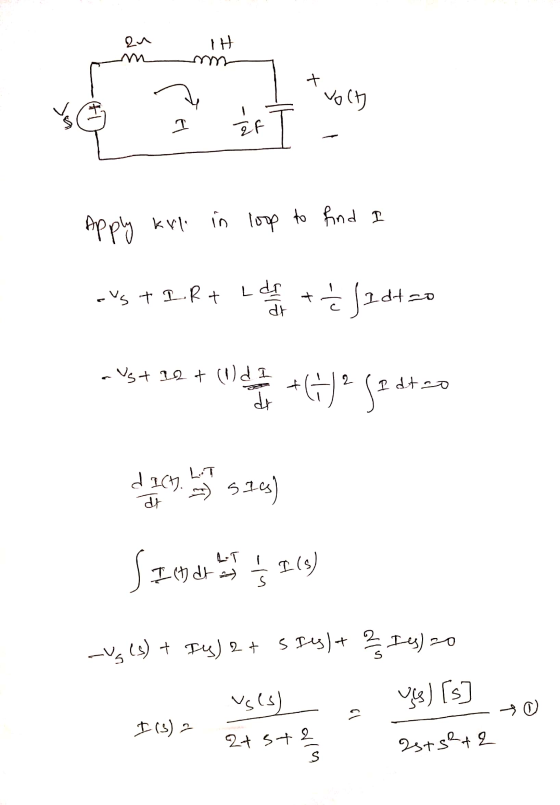
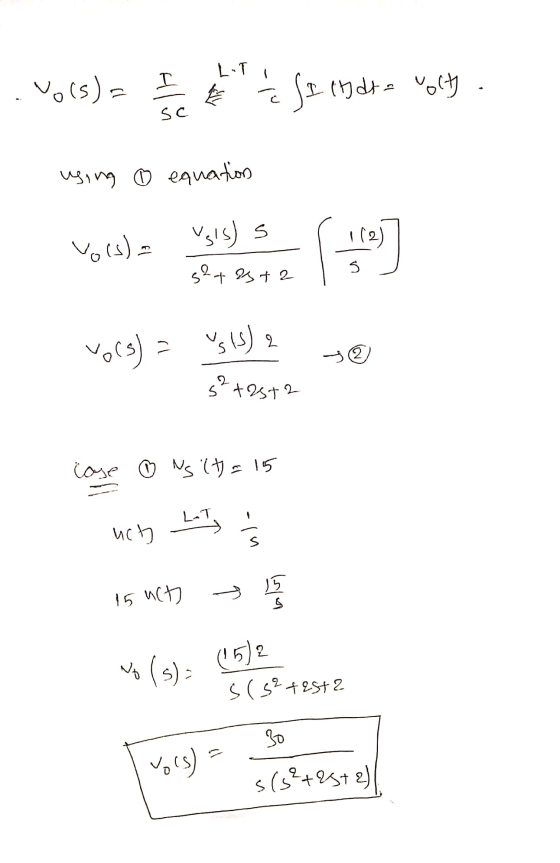
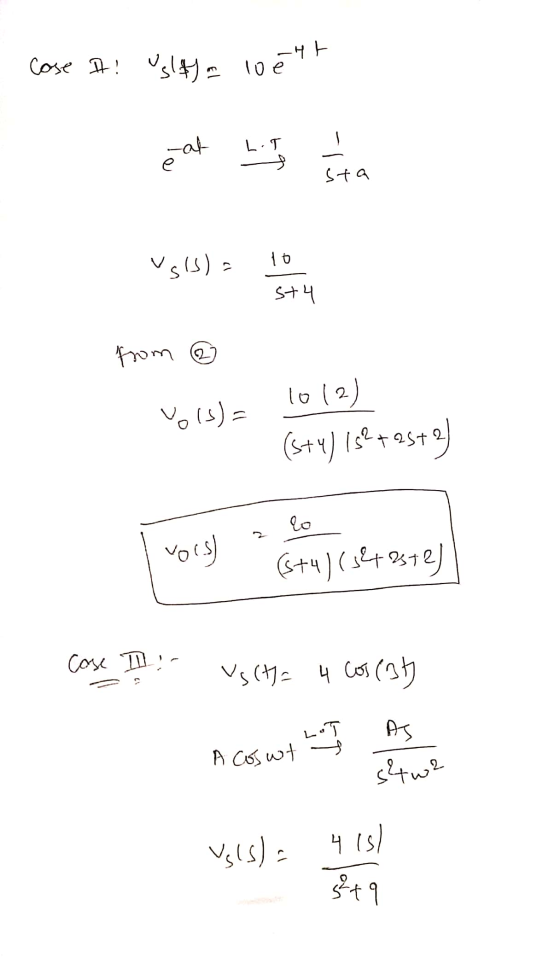
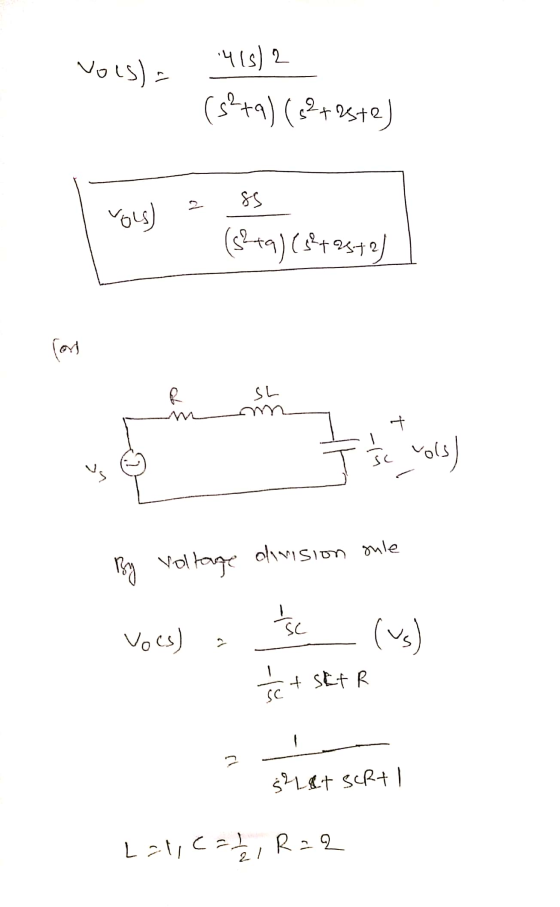
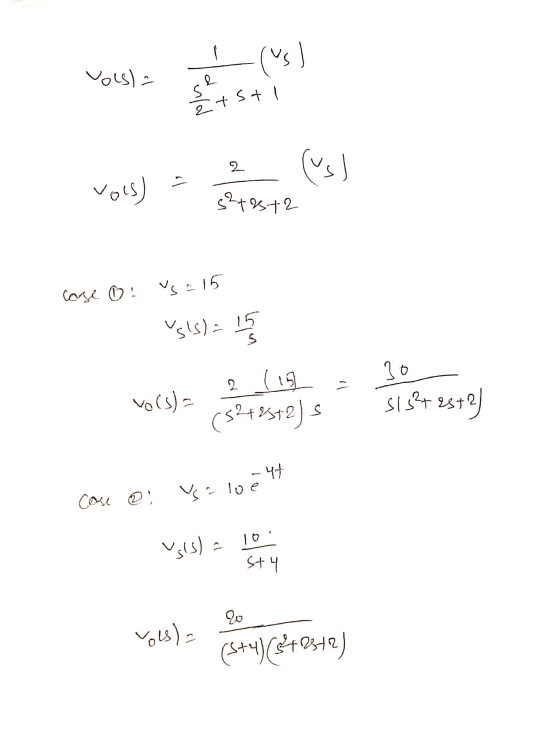
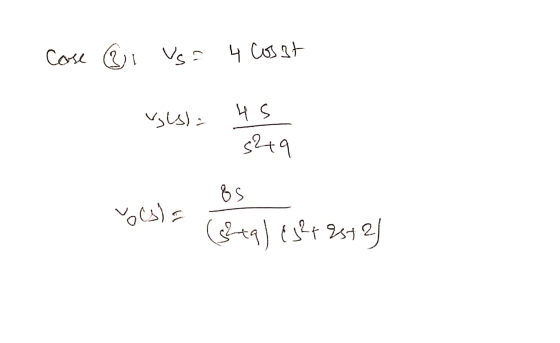
Using the state equation method, solve for Vo(s) for each of
the cases. LEAVE THE ANSWERS...
(1 point) Let -13 Solve the differential equation using Laplace transforms ft S 4r t/16-sin(4t)/64+3/4sin(4t)+4cos(4t)...
 (1 point) Let -13 Solve the differential equation using Laplace transforms ft S 4r t/16-sin(4t)/64+3/4sin(4t)+4cos(4t) y(t) = 3/4sin(4t)+4cos(4t)-pi/4cos(4t)+pi/4 Note: You can earn partial credit on this problem. Preview My Answers Submit Answers Your score was recorded. You have attempted this problem 8 times. You received a score of 50% for this attempt. Your overall recorded score is 50%.
(1 point) Let -13 Solve the differential equation using Laplace transforms ft S 4r t/16-sin(4t)/64+3/4sin(4t)+4cos(4t) y(t) = 3/4sin(4t)+4cos(4t)-pi/4cos(4t)+pi/4 Note: You can earn...
(1 point) Let -13 Solve the differential equation using Laplace transforms ft S 4r t/16-sin(4t)/64+3/4sin(4t)+4cos(4t) y(t) = 3/4sin(4t)+4cos(4t)-pi/4cos(4t)+pi/4 Note: You can earn partial credit on this problem. Preview My Answers Submit Answers Your score was recorded. You have attempted this problem 8 times. You received a score of 50% for this attempt. Your overall recorded score is 50%.
(1 point) Let -13 Solve the differential equation using Laplace transforms ft S 4r t/16-sin(4t)/64+3/4sin(4t)+4cos(4t) y(t) = 3/4sin(4t)+4cos(4t)-pi/4cos(4t)+pi/4 Note: You can earn...
lai). In the diode circuit below use iterative method (use at least 3 iterations) to find...
 lai). In the diode circuit below use iterative method (use at least 3 iterations) to find the diode voltage and current, if VDD=2.0 V, R= 1 KO2, the diode has Is - 10e- 15 A Find diode voltage and current using constant 0.7 V drop model. comment on the results of (i) and (ii) (iii) ang DV. b. Both diodes in the circuit below are rated 0.7V, 1mA. R=1KN Sketch vo vs vi If vi = 2sinot, on the same...
b) Back substitution method: Q: Solve the following system of linear equation! by Gauss elemination method:...
 b) Back substitution method: Q: Solve the following system of linear equation! by Gauss elemination method: X + 2y + 32 - 2x - 3y + 22 + 3x + y - z = 15 o = -5 (i) (ii) (iii)
The equation that describes the above Michaelis-Menten curve: Vo TS]+K Vmax [S] Michaelis-Menten Equation Lineweaver and...
 The equation that describes the above Michaelis-Menten curve: Vo TS]+K Vmax [S] Michaelis-Menten Equation Lineweaver and Burke manipulated the Michaelis-Menten equation to yield: Ko V I S Vmax [S] Lineweaver-Burke Equation Linewenver Burke Equation If you plot 1/ V. vs. 1/[S], you get the following Lineweaver-Burke plot: 1/V. Slope = km/Vmax Intercept = -1/KM -Intercept = 1/Vmax 1/[S] Which is easier to calculate values for Km and Vmax, using the linear (y=mx+b) Lineweaver-Burke Plot or the Michaelis-Menten curve?
Use the node-voltage method to find the steady-state expression for vo(t) in the circuit in (Figure...
 Use the node-voltage method to find the steady-state expression
for vo(t) in the circuit in (Figure 1) if
vg1= 19 sin(400t+143.13∘)V,
vg2= 18.03cos(400t+33.69∘)V.
Write the steady-state expression for vo(t) as vo=Vocos(ωt+ϕ),
where −180∘<ϕ≤180∘.
EE 211/EE 212 FA19 Circuits Analysis for Engineers KEE 211/212 HW #10 -- Impedances, Sinusoidal Steady State Analysis Problem 9.57 PSpicelMultisim Use the node-voltage method to find the steady-state expression for (t) in the circuit in (Figure 1) if gl19 sin(400t143.13°) V. g218.03 cos(400t 33.69o) V. Write...
Use the node-voltage method to find the steady-state expression
for vo(t) in the circuit in (Figure 1) if
vg1= 19 sin(400t+143.13∘)V,
vg2= 18.03cos(400t+33.69∘)V.
Write the steady-state expression for vo(t) as vo=Vocos(ωt+ϕ),
where −180∘<ϕ≤180∘.
EE 211/EE 212 FA19 Circuits Analysis for Engineers KEE 211/212 HW #10 -- Impedances, Sinusoidal Steady State Analysis Problem 9.57 PSpicelMultisim Use the node-voltage method to find the steady-state expression for (t) in the circuit in (Figure 1) if gl19 sin(400t143.13°) V. g218.03 cos(400t 33.69o) V. Write...
please solve the following (simple steps): Q1) i ii iii and Q2) i ii For the circuit shown: XSC1 XFG1 P 1 2 3 4 2 100mH 20% 10k Key A 100nF 0 1) Find equations (step response) for both vc and i f...
 please solve the following (simple steps):
Q1)
i
ii
iii
and
Q2)
i
ii
For the circuit shown: XSC1 XFG1 P 1 2 3 4 2 100mH 20% 10k Key A 100nF 0 1) Find equations (step response) for both vc and i for the following cases: i. ii, iii. R= 12%, R 20%, and R:-29%. 2) Using a square wave with a frequency of 200 Hz and 2-Vpp, simulate the relationship betwee the input, vi, and the output, v3,...
please solve the following (simple steps):
Q1)
i
ii
iii
and
Q2)
i
ii
For the circuit shown: XSC1 XFG1 P 1 2 3 4 2 100mH 20% 10k Key A 100nF 0 1) Find equations (step response) for both vc and i for the following cases: i. ii, iii. R= 12%, R 20%, and R:-29%. 2) Using a square wave with a frequency of 200 Hz and 2-Vpp, simulate the relationship betwee the input, vi, and the output, v3,...
Use the method of separation of variables to solve Laplace's Equation (V V-O)forleither V(xy) in ...
 Complete i, ii, and iii.
Use the method of separation of variables to solve Laplace's Equation (V V-O)forleither V(xy) in 2-D Cartesian coordinates with Vix,0) conditions on the y-axis) V(s, ø) in 2-D cylindrical coordinates, or V(r, 6) in 2-D spherical coordinates. Vx,a) 0 (homogeneous boundary y(
Use the method of separation of variables to solve Laplace's Equation (V V-O)forleither V(xy) in 2-D Cartesian coordinates with Vix,0) conditions on the y-axis) V(s, ø) in 2-D cylindrical coordinates, or V(r, 6)...
Complete i, ii, and iii.
Use the method of separation of variables to solve Laplace's Equation (V V-O)forleither V(xy) in 2-D Cartesian coordinates with Vix,0) conditions on the y-axis) V(s, ø) in 2-D cylindrical coordinates, or V(r, 6) in 2-D spherical coordinates. Vx,a) 0 (homogeneous boundary y(
Use the method of separation of variables to solve Laplace's Equation (V V-O)forleither V(xy) in 2-D Cartesian coordinates with Vix,0) conditions on the y-axis) V(s, ø) in 2-D cylindrical coordinates, or V(r, 6)...
Problem 1 Given the circuit shown below in Fig. 1.1: Write the ordinary differential equation (ODE)...
 Problem 1 Given the circuit shown below in Fig. 1.1: Write the ordinary differential equation (ODE) for the capacitor voltage. Find the zero-state unit step responses of v(t) and i(t) if vs-u(t) V using each of the following three methods of solving the ODE: a. b. i. ii. Solve the ODE by integrating for the solution; Solve the ODE by assuming homogeneous and particular solutions; Solve the ODE by using the general form solution for a 1st order ODE. iii....
Problem E Solve each equation for 0 so<2.1. Answers must be in radians. 51 1) 2V3...
 Problem E Solve each equation for 0 so<2.1. Answers must be in radians. 51 1) 2V3 - 6tan (+ Зл 2) 2sin (@+ I 4) 2cos @ + 1 - 3cos0 --4cos e 3) -6tan -2V3 5) V2sin e + 3cos e - 2 sin cos 0 + 3cos e 6) 2tan 8 + 2tan? 0 - 1 + 3tan?
(basic) Solve T(n) = 4T(n/2) + Θ(n^2) using the recursion tree method. Cleary state the tree...
 (basic) Solve T(n) = 4T(n/2) + Θ(n^2) using the recursion tree
method. Cleary state the tree depth, each subproblem size at depth
d, the number of subproblems/nodes at depth d, workload per
subproblem/node at depth d, (total) workload at depth d.
Please state everything that is asked for or your answer will be
downvoted.
(basic) Solve T(n)-4T(n/2) + Θ(n2) using the recursion tree method. Cleary state the d, workload per subproblem/node at depth d, (total) workload at depth d.
(basic) Solve T(n) = 4T(n/2) + Θ(n^2) using the recursion tree
method. Cleary state the tree depth, each subproblem size at depth
d, the number of subproblems/nodes at depth d, workload per
subproblem/node at depth d, (total) workload at depth d.
Please state everything that is asked for or your answer will be
downvoted.
(basic) Solve T(n)-4T(n/2) + Θ(n2) using the recursion tree method. Cleary state the d, workload per subproblem/node at depth d, (total) workload at depth d.
 (1 point) Let -13 Solve the differential equation using Laplace transforms ft S 4r t/16-sin(4t)/64+3/4sin(4t)+4cos(4t) y(t) = 3/4sin(4t)+4cos(4t)-pi/4cos(4t)+pi/4 Note: You can earn partial credit on this problem. Preview My Answers Submit Answers Your score was recorded. You have attempted this problem 8 times. You received a score of 50% for this attempt. Your overall recorded score is 50%.
(1 point) Let -13 Solve the differential equation using Laplace transforms ft S 4r t/16-sin(4t)/64+3/4sin(4t)+4cos(4t) y(t) = 3/4sin(4t)+4cos(4t)-pi/4cos(4t)+pi/4 Note: You can earn...
(1 point) Let -13 Solve the differential equation using Laplace transforms ft S 4r t/16-sin(4t)/64+3/4sin(4t)+4cos(4t) y(t) = 3/4sin(4t)+4cos(4t)-pi/4cos(4t)+pi/4 Note: You can earn partial credit on this problem. Preview My Answers Submit Answers Your score was recorded. You have attempted this problem 8 times. You received a score of 50% for this attempt. Your overall recorded score is 50%.
(1 point) Let -13 Solve the differential equation using Laplace transforms ft S 4r t/16-sin(4t)/64+3/4sin(4t)+4cos(4t) y(t) = 3/4sin(4t)+4cos(4t)-pi/4cos(4t)+pi/4 Note: You can earn...
 lai). In the diode circuit below use iterative method (use at least 3 iterations) to find the diode voltage and current, if VDD=2.0 V, R= 1 KO2, the diode has Is - 10e- 15 A Find diode voltage and current using constant 0.7 V drop model. comment on the results of (i) and (ii) (iii) ang DV. b. Both diodes in the circuit below are rated 0.7V, 1mA. R=1KN Sketch vo vs vi If vi = 2sinot, on the same...
 b) Back substitution method: Q: Solve the following system of linear equation! by Gauss elemination method: X + 2y + 32 - 2x - 3y + 22 + 3x + y - z = 15 o = -5 (i) (ii) (iii)
 The equation that describes the above Michaelis-Menten curve: Vo TS]+K Vmax [S] Michaelis-Menten Equation Lineweaver and Burke manipulated the Michaelis-Menten equation to yield: Ko V I S Vmax [S] Lineweaver-Burke Equation Linewenver Burke Equation If you plot 1/ V. vs. 1/[S], you get the following Lineweaver-Burke plot: 1/V. Slope = km/Vmax Intercept = -1/KM -Intercept = 1/Vmax 1/[S] Which is easier to calculate values for Km and Vmax, using the linear (y=mx+b) Lineweaver-Burke Plot or the Michaelis-Menten curve?
 Use the node-voltage method to find the steady-state expression
for vo(t) in the circuit in (Figure 1) if
vg1= 19 sin(400t+143.13∘)V,
vg2= 18.03cos(400t+33.69∘)V.
Write the steady-state expression for vo(t) as vo=Vocos(ωt+ϕ),
where −180∘<ϕ≤180∘.
EE 211/EE 212 FA19 Circuits Analysis for Engineers KEE 211/212 HW #10 -- Impedances, Sinusoidal Steady State Analysis Problem 9.57 PSpicelMultisim Use the node-voltage method to find the steady-state expression for (t) in the circuit in (Figure 1) if gl19 sin(400t143.13°) V. g218.03 cos(400t 33.69o) V. Write...
Use the node-voltage method to find the steady-state expression
for vo(t) in the circuit in (Figure 1) if
vg1= 19 sin(400t+143.13∘)V,
vg2= 18.03cos(400t+33.69∘)V.
Write the steady-state expression for vo(t) as vo=Vocos(ωt+ϕ),
where −180∘<ϕ≤180∘.
EE 211/EE 212 FA19 Circuits Analysis for Engineers KEE 211/212 HW #10 -- Impedances, Sinusoidal Steady State Analysis Problem 9.57 PSpicelMultisim Use the node-voltage method to find the steady-state expression for (t) in the circuit in (Figure 1) if gl19 sin(400t143.13°) V. g218.03 cos(400t 33.69o) V. Write...
 please solve the following (simple steps):
Q1)
i
ii
iii
and
Q2)
i
ii
For the circuit shown: XSC1 XFG1 P 1 2 3 4 2 100mH 20% 10k Key A 100nF 0 1) Find equations (step response) for both vc and i for the following cases: i. ii, iii. R= 12%, R 20%, and R:-29%. 2) Using a square wave with a frequency of 200 Hz and 2-Vpp, simulate the relationship betwee the input, vi, and the output, v3,...
please solve the following (simple steps):
Q1)
i
ii
iii
and
Q2)
i
ii
For the circuit shown: XSC1 XFG1 P 1 2 3 4 2 100mH 20% 10k Key A 100nF 0 1) Find equations (step response) for both vc and i for the following cases: i. ii, iii. R= 12%, R 20%, and R:-29%. 2) Using a square wave with a frequency of 200 Hz and 2-Vpp, simulate the relationship betwee the input, vi, and the output, v3,...
 Complete i, ii, and iii.
Use the method of separation of variables to solve Laplace's Equation (V V-O)forleither V(xy) in 2-D Cartesian coordinates with Vix,0) conditions on the y-axis) V(s, ø) in 2-D cylindrical coordinates, or V(r, 6) in 2-D spherical coordinates. Vx,a) 0 (homogeneous boundary y(
Use the method of separation of variables to solve Laplace's Equation (V V-O)forleither V(xy) in 2-D Cartesian coordinates with Vix,0) conditions on the y-axis) V(s, ø) in 2-D cylindrical coordinates, or V(r, 6)...
Complete i, ii, and iii.
Use the method of separation of variables to solve Laplace's Equation (V V-O)forleither V(xy) in 2-D Cartesian coordinates with Vix,0) conditions on the y-axis) V(s, ø) in 2-D cylindrical coordinates, or V(r, 6) in 2-D spherical coordinates. Vx,a) 0 (homogeneous boundary y(
Use the method of separation of variables to solve Laplace's Equation (V V-O)forleither V(xy) in 2-D Cartesian coordinates with Vix,0) conditions on the y-axis) V(s, ø) in 2-D cylindrical coordinates, or V(r, 6)...
 Problem 1 Given the circuit shown below in Fig. 1.1: Write the ordinary differential equation (ODE) for the capacitor voltage. Find the zero-state unit step responses of v(t) and i(t) if vs-u(t) V using each of the following three methods of solving the ODE: a. b. i. ii. Solve the ODE by integrating for the solution; Solve the ODE by assuming homogeneous and particular solutions; Solve the ODE by using the general form solution for a 1st order ODE. iii....
 Problem E Solve each equation for 0 so<2.1. Answers must be in radians. 51 1) 2V3 - 6tan (+ Зл 2) 2sin (@+ I 4) 2cos @ + 1 - 3cos0 --4cos e 3) -6tan -2V3 5) V2sin e + 3cos e - 2 sin cos 0 + 3cos e 6) 2tan 8 + 2tan? 0 - 1 + 3tan?
 (basic) Solve T(n) = 4T(n/2) + Θ(n^2) using the recursion tree
method. Cleary state the tree depth, each subproblem size at depth
d, the number of subproblems/nodes at depth d, workload per
subproblem/node at depth d, (total) workload at depth d.
Please state everything that is asked for or your answer will be
downvoted.
(basic) Solve T(n)-4T(n/2) + Θ(n2) using the recursion tree method. Cleary state the d, workload per subproblem/node at depth d, (total) workload at depth d.
(basic) Solve T(n) = 4T(n/2) + Θ(n^2) using the recursion tree
method. Cleary state the tree depth, each subproblem size at depth
d, the number of subproblems/nodes at depth d, workload per
subproblem/node at depth d, (total) workload at depth d.
Please state everything that is asked for or your answer will be
downvoted.
(basic) Solve T(n)-4T(n/2) + Θ(n2) using the recursion tree method. Cleary state the d, workload per subproblem/node at depth d, (total) workload at depth d.
Most questions answered within 3 hours.
-
Where is the error in this code sequence?
String s1 = "Hello";
String s2 = "ello";...
asked 10 months ago -
Financial data for Joel de Paris, Inc., for last year
follow:
Joel de Paris, Inc.
Balance...
asked 10 months ago -
Consider this reaction:
Al2(SO4)3 (aq)+ BaCl3
(aq) Al2Cl6 (aq)- +
3BaSO4(s) . What is the...
asked 10 months ago -
Suppose that Savneet is considering increasing her
recent random sample from 20 car rentals to 40...
asked 10 months ago -
Trucks arrive at an unloading terminal at an average rate of 120
per hour.
Trucks arrive...
asked 10 months ago -
Why are methanol and ethanol completely soluble in water while
octanol is not very little soluble....
asked 10 months ago -
A facilities manager at a university reads in a research report
that the mean amount of...
asked 10 months ago -
When the CuSO4 is rehydrated by adding water to the anhydrous
compound, is this an endothermic...
asked 10 months ago -
A ray of sunlight is passing from diamond into crown glass; the
angle of incidence is...
asked 10 months ago -
A block of mass 0.249 kg is placed on top of a light, vertical
spring of...
asked 10 months ago -
how do the kidneys compensate in the presences of acidosis
a) trigger hyperventilate
b) reserve acid...
asked 10 months ago -
Question 501 pts
The rental rate of capital to the firm increases. Which of the
following...
asked 10 months ago