(a0Give the derivations and parse trees for the following strings using the grammar given below: •...
(a0Give the derivations and parse trees for the following strings using the grammar given below:
• abba • babab
(b)
Give the derivations and parse trees for the following strings using the grammar given below:
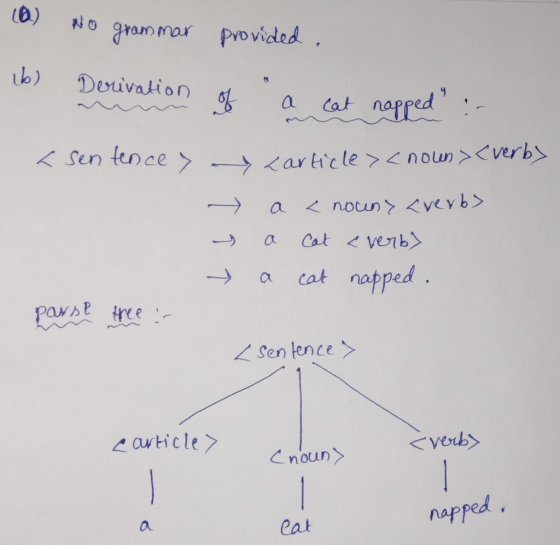
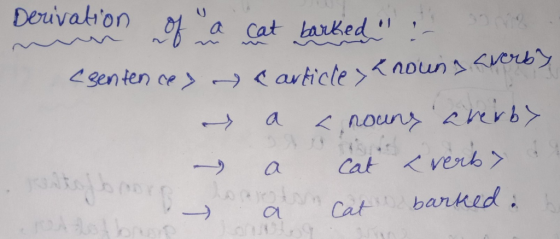
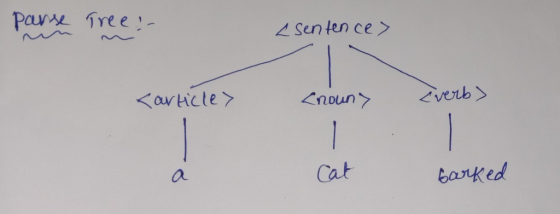
• a cat napped • a cat barked
P={
<sentence> → <article><noun><verb>
<article> → "a"
<article> → "the"
<noun → "dog"
<noun> → "cat"
<verb> → "barked"
<verb> → "napped"
}
Homework Answers
Add Answer to:
(a0Give the derivations and parse trees for the following
strings using the grammar given below:
•...
IN HASKELL Consider a context-free grammar with nonterminal symbols: sentence (the start symbol), noun-phrase, verb-phrase, article,...
IN HASKELL Consider a context-free grammar with nonterminal symbols: sentence (the start symbol), noun-phrase, verb-phrase, article, noun, and verb; terminal symbols: "." (period), "a", "the", "girl", "dog", "sees", and "pets"; and the following rules: sentence = noun-phrase verb-phrase "." . noun-phrase = article noun . article = "a" | "the" . noun = "girl" | "dog" . verb-phrase = verb noun-phrase . verb = "sees" | "pets" . a. Give a left-most derivation of the sentence: a girl pets the...
Given the grammar defined in Figure below, give all the parse trees of a0 + a1...
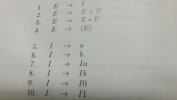 Given the grammar defined in Figure below, give all the parse
trees of a0 + a1 + b.
Given the grammar defined in Figure below, give all the parse trees of a0 + a1 + b.
Given the grammar defined in Figure below, give all the parse
trees of a0 + a1 + b.
Given the grammar defined in Figure below, give all the parse trees of a0 + a1 + b.
3. Using the grammar below, show a parse tree and a leftmost derivation for the statement....
 3. Using the grammar below, show a parse tree and a leftmost derivation for the statement. A = ( A + (B)) * C assign <idxpr expr>? <expr> <term> term <term factor factor (<expr>) l <term I <factor l <id> 4. Prove that the following grammar is ambiguous (Give sentence that has two parse trees, and show the parse trees):
For the grammar and each of the strings, give the parse tree. Exercise 5.1.2: The following...
 For the grammar and each of the strings, give the parse
tree.
Exercise 5.1.2: The following grammar generates the language of regulair expression 0'1(0 1): SA1B * а) 00101. Ь) 1001. с) 00011.
For the grammar and each of the strings, give the parse
tree.
Exercise 5.1.2: The following grammar generates the language of regulair expression 0'1(0 1): SA1B * а) 00101. Ь) 1001. с) 00011.
Write a grammar for English sentences using the following words (only) time, arrow, banana, flies, like,...
Write a grammar for English sentences using the following words (only) time, arrow, banana, flies, like, a, an, the, fruit and the semicolon. Be sure to include all the senses (noun, verb, etc.) of each word, and the basic sentence parts like subject, predicate, etc. Then show that this grammar is ambiguous by exhibiting more than one parse tree for "time flies like an arrow; fruit flies like a banana."
Given the following grammar with start symbol : ?: ? → b? | a? ? →...
Given the following grammar with start symbol : ?: ? → b? | a? ? → a? | ε a) Give two strings derived from this grammar and their corresponding derivations. (Please mention the derivation as well).
Show that the following grammar is ambiguous. Hint: Show two different leftmost or rightmost derivations for...
Show that the following grammar is ambiguous. Hint: Show two different leftmost or rightmost derivations for the same string. Equivalently, you can show two different parse trees for the same string. <expr> ::= <expr> + <expr> | <expr> - <expr> | <expr> * <expr> | <expr> / <expr> | int int ::= 0 | 1 | 2 | 3 | 4 | 5 | 6 | 7 | 8 | 9 Using this grammar show that ambiguity is not acceptable...
Homework. Section 5.1 #m}. Hint: Think of this language 1. Design a context-free grammar for the...
 Homework. Section 5.1 #m}. Hint: Think of this language 1. Design a context-free grammar for the language {a" b n as the union of {a"b" | n > m} and {a") n<m}. 2. Consider the context-free grammar G = (N,T, P, S), defined by N = {S}, T = {a,b), and P = {S + Sbs | bSaS | }. Find derivations, and corresponding parse trees, for the following strings: aaabbb, bbbaaa, ababab. What is L(G)?
) Using the following grammar, show a parse tree and a leftmost derivation for the following...
) Using the following grammar, show a parse tree and a leftmost derivation for the following sentence (make sure you do not omit parentheses in your derivation): Grammar <assign> → <id> = <expr> <id> → A | B | C <expr> → <expr> + <term> | <term> <term> → <term> * <factor> | <factor> <factor> → (<expr>) | <id> Derive C = (A+B)*(C+A)*(C+B)
Consider the following grammar: S → A1B A → 0A |ϵ B → 0B | 1B...
Consider the following grammar: S → A1B A → 0A |ϵ B → 0B | 1B |ϵ Give parse trees for each of the strings: a. 00101 b. 1001 c. 00011
 Given the grammar defined in Figure below, give all the parse
trees of a0 + a1 + b.
Given the grammar defined in Figure below, give all the parse trees of a0 + a1 + b.
Given the grammar defined in Figure below, give all the parse
trees of a0 + a1 + b.
Given the grammar defined in Figure below, give all the parse trees of a0 + a1 + b.
 3. Using the grammar below, show a parse tree and a leftmost derivation for the statement. A = ( A + (B)) * C assign <idxpr expr>? <expr> <term> term <term factor factor (<expr>) l <term I <factor l <id> 4. Prove that the following grammar is ambiguous (Give sentence that has two parse trees, and show the parse trees):
 For the grammar and each of the strings, give the parse
tree.
Exercise 5.1.2: The following grammar generates the language of regulair expression 0'1(0 1): SA1B * а) 00101. Ь) 1001. с) 00011.
For the grammar and each of the strings, give the parse
tree.
Exercise 5.1.2: The following grammar generates the language of regulair expression 0'1(0 1): SA1B * а) 00101. Ь) 1001. с) 00011.
 Homework. Section 5.1 #m}. Hint: Think of this language 1. Design a context-free grammar for the language {a" b n as the union of {a"b" | n > m} and {a") n<m}. 2. Consider the context-free grammar G = (N,T, P, S), defined by N = {S}, T = {a,b), and P = {S + Sbs | bSaS | }. Find derivations, and corresponding parse trees, for the following strings: aaabbb, bbbaaa, ababab. What is L(G)?
Most questions answered within 3 hours.
-
Where is the error in this code sequence?
String s1 = "Hello";
String s2 = "ello";...
asked 10 months ago -
Financial data for Joel de Paris, Inc., for last year
follow:
Joel de Paris, Inc.
Balance...
asked 10 months ago -
Consider this reaction:
Al2(SO4)3 (aq)+ BaCl3
(aq) Al2Cl6 (aq)- +
3BaSO4(s) . What is the...
asked 10 months ago -
Suppose that Savneet is considering increasing her
recent random sample from 20 car rentals to 40...
asked 10 months ago -
Trucks arrive at an unloading terminal at an average rate of 120
per hour.
Trucks arrive...
asked 10 months ago -
Why are methanol and ethanol completely soluble in water while
octanol is not very little soluble....
asked 10 months ago -
A facilities manager at a university reads in a research report
that the mean amount of...
asked 10 months ago -
When the CuSO4 is rehydrated by adding water to the anhydrous
compound, is this an endothermic...
asked 10 months ago -
A ray of sunlight is passing from diamond into crown glass; the
angle of incidence is...
asked 10 months ago -
A block of mass 0.249 kg is placed on top of a light, vertical
spring of...
asked 10 months ago -
how do the kidneys compensate in the presences of acidosis
a) trigger hyperventilate
b) reserve acid...
asked 10 months ago -
Question 501 pts
The rental rate of capital to the firm increases. Which of the
following...
asked 10 months ago