Show that the following grammar is ambiguous. Hint: Show two different leftmost or rightmost derivations for...
Show that the
following grammar is ambiguous.
Hint: Show two different leftmost or rightmost derivations
for the same string. Equivalently, you can show two different parse
trees for the same string.
<expr> ::= <expr> + <expr> | <expr> - <expr> | <expr> * <expr> | <expr> / <expr> | int
int ::= 0 | 1 | 2 | 3 | 4 | 5 | 6 | 7 | 8 | 9
Using this grammar show that ambiguity is not acceptable for programming languages.
Hint: Show that the same expression can be evaluated in different ways depending on the derivation.
Homework Answers


Add Answer to:
Show that the
following grammar is ambiguous.
Hint: Show two different leftmost or rightmost derivations
for...
3. Using the grammar below, show a parse tree and a leftmost derivation for the statement....
 3. Using the grammar below, show a parse tree and a leftmost derivation for the statement. A = ( A + (B)) * C assign <idxpr expr>? <expr> <term> term <term factor factor (<expr>) l <term I <factor l <id> 4. Prove that the following grammar is ambiguous (Give sentence that has two parse trees, and show the parse trees):
) Using the following grammar, show a parse tree and a leftmost derivation for the following...
) Using the following grammar, show a parse tree and a leftmost derivation for the following sentence (make sure you do not omit parentheses in your derivation): Grammar <assign> → <id> = <expr> <id> → A | B | C <expr> → <expr> + <term> | <term> <term> → <term> * <factor> | <factor> <factor> → (<expr>) | <id> Derive C = (A+B)*(C+A)*(C+B)
Question 3: Given the following grammar: assign → id := expr expr → expr + term \ term term -term *factor lfactor factor-(expr) id Using the above grammar, show a leftmost derivation (first five step...
 Question 3: Given the following grammar: assign → id := expr expr → expr + term \ term term -term *factor lfactor factor-(expr) id Using the above grammar, show a leftmost derivation (first five steps) for the following assignment statement: A ((A B)+ C) a. [3 marks] b. Using the above grammar, show a rightmost derivation (first five steps) for the following assignment statement: A:-A+B+C)+A [3 marks] Draw the abstract syntax tree for each of the above statements [4 marks]...
4. (5 points) Is the following grammar ambiguous? Justify your answer (give a string and derive...
 4. (5 points) Is the following grammar ambiguous? Justify your answer (give a string and derive it with two leftmost derivations using G). If it is ambiguous, rewrite this grammar to an unambiguous one (hint: recall "dangling else" as we discussed in the class)
1.) Consider the following grammar in which S, A, and B are nonterminal symbols and S...
1.) Consider the following grammar in which S, A, and B are nonterminal symbols and S is the start symbol. S → 1A | 0B A → A0 | 1B B → 10A| 1 Show that the grammar is ambiguous by showing two parse trees for the sentence 1110110 using leftmost derivation.
Ambiguous Grammars Question 3 [10 points be an ambiguous context-free grammar. We know that the l...
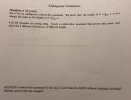 Ambiguous Grammars Question 3 [10 points be an ambiguous context-free grammar. We know that the length of S Mwis not always the same as the length of S → M w. 15/10] Consider the string abba. Create a context-free grammar that proves this point, and show the 2 different derivations of different length. ·15/10 If a context-free grammar is not LL(1) can it then be LR(1) without changing anything? Explain and/or give an example.
Ambiguous Grammars Question 3 [10 points...
Ambiguous Grammars Question 3 [10 points be an ambiguous context-free grammar. We know that the length of S Mwis not always the same as the length of S → M w. 15/10] Consider the string abba. Create a context-free grammar that proves this point, and show the 2 different derivations of different length. ·15/10 If a context-free grammar is not LL(1) can it then be LR(1) without changing anything? Explain and/or give an example.
Ambiguous Grammars Question 3 [10 points...
(3) Consider the grammar G=(V.T.E.P) with V={E,1). T={a,b,c,++,() ), and productions EI, EE+E, EE+E, E (E),...
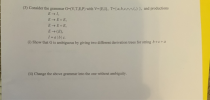 (3) Consider the grammar G=(V.T.E.P) with V={E,1). T={a,b,c,++,() ), and productions EI, EE+E, EE+E, E (E), I=abc. (1) Show that G is ambiguous by giving two different derivation trees for string b+c+a (ii) Change the above grammar into the one without ambiguity.
1. In a language, each sentence is a string starting with a capital letter followed by...
1. In a language, each sentence is a string starting with a capital letter followed by two or more small letters and ending with three or more digits. Example sentences are Abc001, Zyxw9876 etc. a) Write a BNF grammar for the language. b) Show the derivation and the parse tree of the string Test3501. 2. Augment the following BNF to write an attribute grammar. Assume the only possible variable types are integer and float. The language rules are as follows:...
I need help with the following problems, any help you can provide is deeply appreciated! CSC...
 I
need help with the following problems, any help you can provide is
deeply appreciated!
CSC 404 Exam 1 Question I continued - 9. The syntax rules for most languages ignore spaces. An exception is which tises indents and therefore spaces to form the indents) to group statements (a) FORTRAN (6) Pascal (e) Python (d) Lip (e) C++ 10. Identifiers, constants and operators are typical examples of (a) tokens. (b) leafons. (c) signifiers. (d) lexicons. (e) parsicles. 0) non-terminals. 11....
I
need help with the following problems, any help you can provide is
deeply appreciated!
CSC 404 Exam 1 Question I continued - 9. The syntax rules for most languages ignore spaces. An exception is which tises indents and therefore spaces to form the indents) to group statements (a) FORTRAN (6) Pascal (e) Python (d) Lip (e) C++ 10. Identifiers, constants and operators are typical examples of (a) tokens. (b) leafons. (c) signifiers. (d) lexicons. (e) parsicles. 0) non-terminals. 11....
9. Mark the best description (smallest language class) for each of the following lang • R...
 9. Mark the best description (smallest language class) for each of the following lang • R if it is regular • C if it is context free, but not regular . N if it is "bigger than" context free You do not have to prove your answer. L = {www: we {a,b}"} L2 = {a" : n > 2, m < 5} L3 = {a"m : n + m is even } LA = {w:na(w) + no(w) = n(w)} Ls...
 3. Using the grammar below, show a parse tree and a leftmost derivation for the statement. A = ( A + (B)) * C assign <idxpr expr>? <expr> <term> term <term factor factor (<expr>) l <term I <factor l <id> 4. Prove that the following grammar is ambiguous (Give sentence that has two parse trees, and show the parse trees):
 Question 3: Given the following grammar: assign → id := expr expr → expr + term \ term term -term *factor lfactor factor-(expr) id Using the above grammar, show a leftmost derivation (first five steps) for the following assignment statement: A ((A B)+ C) a. [3 marks] b. Using the above grammar, show a rightmost derivation (first five steps) for the following assignment statement: A:-A+B+C)+A [3 marks] Draw the abstract syntax tree for each of the above statements [4 marks]...
 4. (5 points) Is the following grammar ambiguous? Justify your answer (give a string and derive it with two leftmost derivations using G). If it is ambiguous, rewrite this grammar to an unambiguous one (hint: recall "dangling else" as we discussed in the class)
 Ambiguous Grammars Question 3 [10 points be an ambiguous context-free grammar. We know that the length of S Mwis not always the same as the length of S → M w. 15/10] Consider the string abba. Create a context-free grammar that proves this point, and show the 2 different derivations of different length. ·15/10 If a context-free grammar is not LL(1) can it then be LR(1) without changing anything? Explain and/or give an example.
Ambiguous Grammars Question 3 [10 points...
Ambiguous Grammars Question 3 [10 points be an ambiguous context-free grammar. We know that the length of S Mwis not always the same as the length of S → M w. 15/10] Consider the string abba. Create a context-free grammar that proves this point, and show the 2 different derivations of different length. ·15/10 If a context-free grammar is not LL(1) can it then be LR(1) without changing anything? Explain and/or give an example.
Ambiguous Grammars Question 3 [10 points...
 (3) Consider the grammar G=(V.T.E.P) with V={E,1). T={a,b,c,++,() ), and productions EI, EE+E, EE+E, E (E), I=abc. (1) Show that G is ambiguous by giving two different derivation trees for string b+c+a (ii) Change the above grammar into the one without ambiguity.
 I
need help with the following problems, any help you can provide is
deeply appreciated!
CSC 404 Exam 1 Question I continued - 9. The syntax rules for most languages ignore spaces. An exception is which tises indents and therefore spaces to form the indents) to group statements (a) FORTRAN (6) Pascal (e) Python (d) Lip (e) C++ 10. Identifiers, constants and operators are typical examples of (a) tokens. (b) leafons. (c) signifiers. (d) lexicons. (e) parsicles. 0) non-terminals. 11....
I
need help with the following problems, any help you can provide is
deeply appreciated!
CSC 404 Exam 1 Question I continued - 9. The syntax rules for most languages ignore spaces. An exception is which tises indents and therefore spaces to form the indents) to group statements (a) FORTRAN (6) Pascal (e) Python (d) Lip (e) C++ 10. Identifiers, constants and operators are typical examples of (a) tokens. (b) leafons. (c) signifiers. (d) lexicons. (e) parsicles. 0) non-terminals. 11....
 9. Mark the best description (smallest language class) for each of the following lang • R if it is regular • C if it is context free, but not regular . N if it is "bigger than" context free You do not have to prove your answer. L = {www: we {a,b}"} L2 = {a" : n > 2, m < 5} L3 = {a"m : n + m is even } LA = {w:na(w) + no(w) = n(w)} Ls...
Most questions answered within 3 hours.
-
Where is the error in this code sequence?
String s1 = "Hello";
String s2 = "ello";...
asked 10 months ago -
Financial data for Joel de Paris, Inc., for last year
follow:
Joel de Paris, Inc.
Balance...
asked 10 months ago -
Consider this reaction:
Al2(SO4)3 (aq)+ BaCl3
(aq) Al2Cl6 (aq)- +
3BaSO4(s) . What is the...
asked 10 months ago -
Suppose that Savneet is considering increasing her
recent random sample from 20 car rentals to 40...
asked 10 months ago -
Trucks arrive at an unloading terminal at an average rate of 120
per hour.
Trucks arrive...
asked 10 months ago -
Why are methanol and ethanol completely soluble in water while
octanol is not very little soluble....
asked 10 months ago -
A facilities manager at a university reads in a research report
that the mean amount of...
asked 10 months ago -
When the CuSO4 is rehydrated by adding water to the anhydrous
compound, is this an endothermic...
asked 10 months ago -
A ray of sunlight is passing from diamond into crown glass; the
angle of incidence is...
asked 10 months ago -
A block of mass 0.249 kg is placed on top of a light, vertical
spring of...
asked 10 months ago -
how do the kidneys compensate in the presences of acidosis
a) trigger hyperventilate
b) reserve acid...
asked 10 months ago -
Question 501 pts
The rental rate of capital to the firm increases. Which of the
following...
asked 10 months ago