1. When the cell’s ATP supply is depleted, which of the following enzyme’s activity is increased?...
1. When the cell’s ATP supply is depleted, which of the following enzyme’s activity is increased?
- Hexokinase
- Pyruvate kinase
- Glucokinase
- Phosphofructokinase
Explain why this enzyme activity is tied to ATP levels.
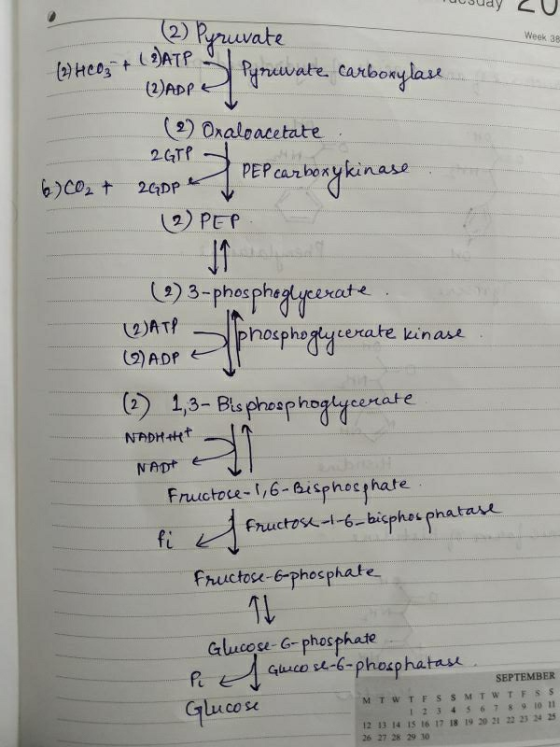
2. The pyruvate kinase catalyzed step is not a reversible reaction in glycolysis, how then does gluconeogenesis start from pyruvate? Show the mechanism of the first step of gluconeogenesis.
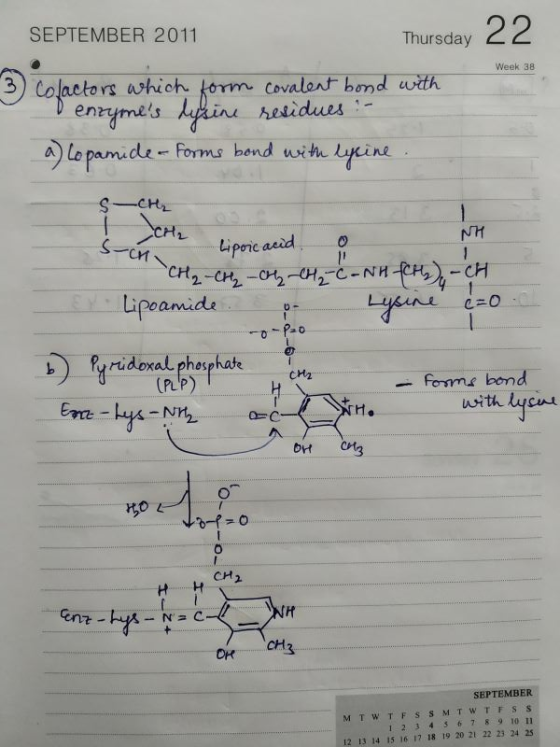
3. Which of the following cofactors do not form a covalent bond with enzymes' lysine residues?
- Lipoamide
- Biotin
- NADH
- Pyridoxyl phosphate
- All of the above
- None of the above
4. Choose any one of the cofactors in question 3 and show an enzymatic mechanism that uses the co-factor with complete arrow pushing. Please draw the entire cofactor structure in your answer at least once. Show the mechanism.
5. Which of the following is NOT true for the reaction catalyzed by the PDC (pyruvate dehydrogenase complex)?
- The reaction occurs in the mitochondrial matrix
- The substrate is held by the lipoamide-lysine ‘swinging arm’
- Two different cofactors that contain the thiol group participate in the reaction
- Biotin is used for the decarboxylation step.
Homework Answers
3) cofactors which do not form covalent bond with lysine-
B- biotin, C- NADH
5) D- biotin is used for the decarboxylation step
The detailed mechanisms and other answers are attached in the following images-

Add Answer to:
1. When the cell’s ATP supply is depleted, which of the
following enzyme’s activity is increased?...
Which of the diagrams illustrates the way in which the rate of an enzyme-controlled reaction depends...
 Which of the diagrams illustrates the way in which the rate of an enzyme-controlled reaction depends on substrate concentration? * А B Rate of reaction MÚN Substrate concentration A B D When starch and amylase are mixed in the presence of iodine solution, the blue-black colour rapidly disappears. This is due to the formation of which molecule? * glucose O glycogen sucrose O maltose Which of the following enzyme groups can catalyse oxidation reactions? * O phosphorylases isomerases hydrolases dehydrogenases...
Glycolysis activity 1: Metabolic pathway puzzle Try to complete the activity without using the textbook. 1....
 Glycolysis activity 1: Metabolic pathway puzzle Try to complete the activity without using the textbook. 1. Slides 4 and 5 show the 10 reactions for glycolysis, but some of the molecules are missing. Draw the missing molecules in the proper place (on the handout). The missing molecules are shown on the next slide, you have to use the clues on the handout and your organic chemistry knowledge to figure out where each molecule belongs. 3. In the red dotted boxes...
15. Genetic defect in pyruvate dehydrogenase complex lead a. maple syrup urine disease b. phenyike d....
 15. Genetic defect in pyruvate dehydrogenase complex lead a. maple syrup urine disease b. phenyike d. lactic acidemia e. pellagra syrup urine disease b, phenylketonuria c. galactosemia 10. Chemical modification by phosphorylation of pyruvate dehydros a. deactivates the enzyme b. activates the enzyme lation of pyruvate dehydrogenase complex : 17. Pyruvate carboxylase is positively ated through the allosteric mechanism by : a. ATP b. NADH c. Acetyl-SCOA d. TPP e. Biotin 18. Which of the listed coenzymes does not particip...
1. According to the paper, what does lactate dehydrogenase (LDH) do and what does it allow...
 1. According to the paper, what does lactate dehydrogenase
(LDH) do and what does it allow to happen within the myofiber? (5
points)
2. According to the paper, what is the major disadvantage of
relying on glycolysis during high-intensity exercise? (5
points)
3. Using Figure 1 in the paper, briefly describe the different
sources of ATP production at 50% versus 90% AND explain whether you
believe this depiction of ATP production applies to a Type IIX
myofiber in a human....
1. According to the paper, what does lactate dehydrogenase
(LDH) do and what does it allow to happen within the myofiber? (5
points)
2. According to the paper, what is the major disadvantage of
relying on glycolysis during high-intensity exercise? (5
points)
3. Using Figure 1 in the paper, briefly describe the different
sources of ATP production at 50% versus 90% AND explain whether you
believe this depiction of ATP production applies to a Type IIX
myofiber in a human....
 Which of the diagrams illustrates the way in which the rate of an enzyme-controlled reaction depends on substrate concentration? * А B Rate of reaction MÚN Substrate concentration A B D When starch and amylase are mixed in the presence of iodine solution, the blue-black colour rapidly disappears. This is due to the formation of which molecule? * glucose O glycogen sucrose O maltose Which of the following enzyme groups can catalyse oxidation reactions? * O phosphorylases isomerases hydrolases dehydrogenases...
 Glycolysis activity 1: Metabolic pathway puzzle Try to complete the activity without using the textbook. 1. Slides 4 and 5 show the 10 reactions for glycolysis, but some of the molecules are missing. Draw the missing molecules in the proper place (on the handout). The missing molecules are shown on the next slide, you have to use the clues on the handout and your organic chemistry knowledge to figure out where each molecule belongs. 3. In the red dotted boxes...
 15. Genetic defect in pyruvate dehydrogenase complex lead a. maple syrup urine disease b. phenyike d. lactic acidemia e. pellagra syrup urine disease b, phenylketonuria c. galactosemia 10. Chemical modification by phosphorylation of pyruvate dehydros a. deactivates the enzyme b. activates the enzyme lation of pyruvate dehydrogenase complex : 17. Pyruvate carboxylase is positively ated through the allosteric mechanism by : a. ATP b. NADH c. Acetyl-SCOA d. TPP e. Biotin 18. Which of the listed coenzymes does not particip...
 1. According to the paper, what does lactate dehydrogenase
(LDH) do and what does it allow to happen within the myofiber? (5
points)
2. According to the paper, what is the major disadvantage of
relying on glycolysis during high-intensity exercise? (5
points)
3. Using Figure 1 in the paper, briefly describe the different
sources of ATP production at 50% versus 90% AND explain whether you
believe this depiction of ATP production applies to a Type IIX
myofiber in a human....
1. According to the paper, what does lactate dehydrogenase
(LDH) do and what does it allow to happen within the myofiber? (5
points)
2. According to the paper, what is the major disadvantage of
relying on glycolysis during high-intensity exercise? (5
points)
3. Using Figure 1 in the paper, briefly describe the different
sources of ATP production at 50% versus 90% AND explain whether you
believe this depiction of ATP production applies to a Type IIX
myofiber in a human....
Most questions answered within 3 hours.
-
Where is the error in this code sequence?
String s1 = "Hello";
String s2 = "ello";...
asked 10 months ago -
Financial data for Joel de Paris, Inc., for last year
follow:
Joel de Paris, Inc.
Balance...
asked 10 months ago -
Consider this reaction:
Al2(SO4)3 (aq)+ BaCl3
(aq) Al2Cl6 (aq)- +
3BaSO4(s) . What is the...
asked 10 months ago -
Suppose that Savneet is considering increasing her
recent random sample from 20 car rentals to 40...
asked 10 months ago -
Trucks arrive at an unloading terminal at an average rate of 120
per hour.
Trucks arrive...
asked 10 months ago -
Why are methanol and ethanol completely soluble in water while
octanol is not very little soluble....
asked 10 months ago -
A facilities manager at a university reads in a research report
that the mean amount of...
asked 10 months ago -
When the CuSO4 is rehydrated by adding water to the anhydrous
compound, is this an endothermic...
asked 10 months ago -
A ray of sunlight is passing from diamond into crown glass; the
angle of incidence is...
asked 10 months ago -
A block of mass 0.249 kg is placed on top of a light, vertical
spring of...
asked 10 months ago -
how do the kidneys compensate in the presences of acidosis
a) trigger hyperventilate
b) reserve acid...
asked 10 months ago -
Question 501 pts
The rental rate of capital to the firm increases. Which of the
following...
asked 10 months ago