
Homework Answers

Add Answer to:
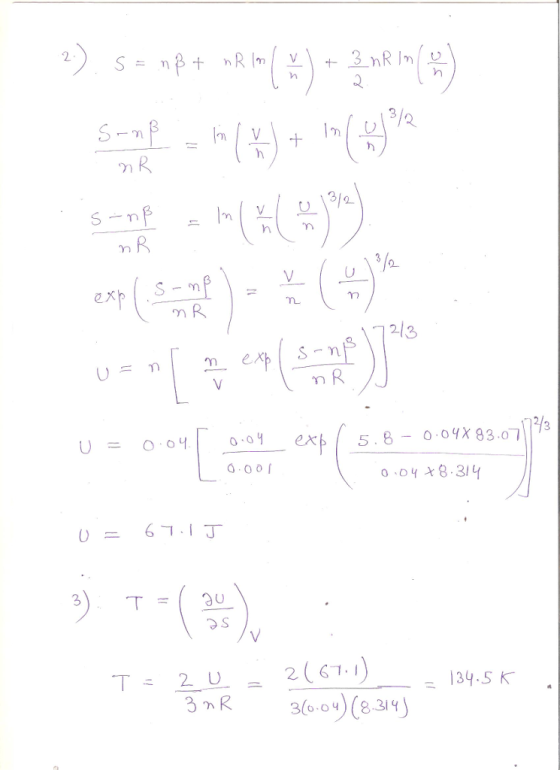
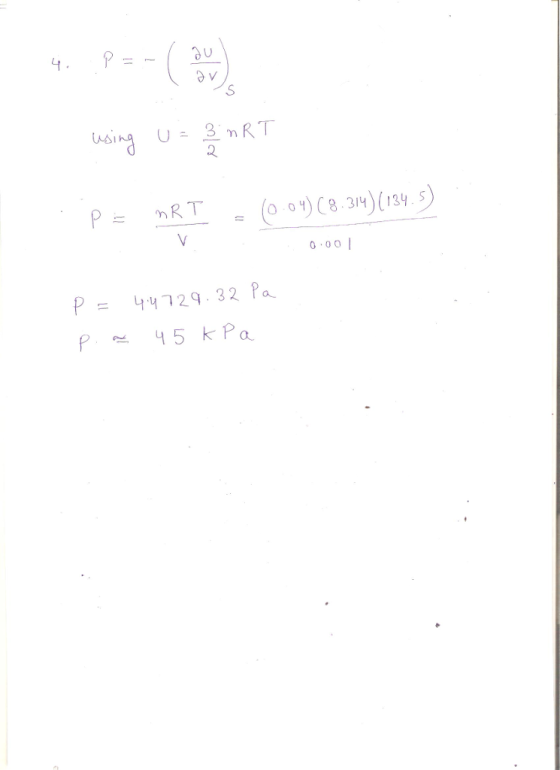
The Sackur-Tetrode Equation gives the entropy of a sample of n moles of monatomic ideal gas...
A sample of n moles of a monatomic ideal gas is expanded isothermally and reversibly at...
A sample of n moles of a monatomic ideal gas is expanded isothermally and reversibly at a constant temperature T from a volume V to 3V. Note that since the temperature of the gas is constant, the internal energy will remain constant. a) Write an expression for the change in entropy ΔS for the system. b) The sample has 7 moles of gas and is kept at a temperature of 305 K. The volume is changed from 0.065 m3 to...
B.2 The multiplicity of a monatomic ideal gas is given by 2 = f(N)VN U3N/2, where...
 B.2 The multiplicity of a monatomic ideal gas is given by 2 = f(N)VN U3N/2, where V is the volume occupied by the gas, U its internal energy, N the number of particles in the gas and f(N) a complicated function of N. [2] (i) Show that the entropy S of this system is given by 3 S = Nkg In V + ŽNkg In U + g(N), where g(N) is some function of N. (ii) Define the temperature T...
(80 pts) Entropy of the ideal gas: Consider a monatomic gas of identical non-interacting particles of...
 (80 pts) Entropy of the ideal gas: Consider a monatomic gas of identical non-interacting particles of mass m. The kinetic energy of each particle is given in terms of its momentum p by Ekinp2/(2m). For a given total energy U, volume V and total particle number N (with N » 1) calculate the entropy S(U, V,N)-klog Ω(U, V,N), where Ω(U, V,N) counts the number of different microscopic configurations for given N, U and V. To get a finite number for...
TSD.1 In this problem, we will see (in outline) how we can calculate the multiplicity of a monatomic ideal gas This derivation involves concepts presented in chapter 17 Note that the task is to...
 TSD.1 In this problem, we will see (in outline) how we can calculate the multiplicity of a monatomic ideal gas This derivation involves concepts presented in chapter 17 Note that the task is to count the number of microstates that are compatible with a given gas macrostate, which we describe by specifying the gas's total energy u (within a tiny range of width dlu), the gas's volume V and the num- ber of molecules N in the gas. We will...
A cylinder with a movable piston contains 17.5 moles of a monatomic ideal gas at a...
A cylinder with a movable piston contains 17.5 moles of a monatomic ideal gas at a pressure of 1.66 × 10⁵ Pa. The gas is initially at a temperature of 300 K. An electric heater adds 46600 J of energy into the gas while the piston moves in such a way that the pressure remains constant. It may help you to recall that CPCP = 20.79 J/K/mole for a monatomic ideal gas, and that the number of gas molecules is...
Using Boltzmann’s equation, calculate the entropy of a system consisting of one mole of gas in...
Using Boltzmann’s equation, calculate the entropy of a system consisting of one mole of gas in which each molecule of gas has 10 possible microstates. How does this value compare with the standard molar entropy of helium gas (see lecture slides for examples of standard values!). (Boltzmann’s constant k = 1.38 x 10⁻²³ J/K)
Ten. moles of ideal gas (monatomic), in the initial state P1=10atm, T1=300K are taken round the...
Ten. moles of ideal gas (monatomic), in the initial state P1=10atm, T1=300K are taken round the following cycle: a. A reversible isothermal expansion to V=246 liters, and b. A reversible adiabatic process to P=10 atm c. A reversible isobaric compression to V=24.6 liters Calculate the change of work (w), heat (q), internal energy (U), and entropy (S) of the system for each process?
A piston contains 580 moles of an ideal monatomic gas that initally has a pressure of...
 A piston contains 580 moles of an ideal monatomic gas that initally has a pressure of 1.06 x 10⁵ Pa and a volume of 1.3 m3. The piston is connected to a hot and cold reservoir and the gas goes through the following quasi-static cycle accepting energy from the hot reservoir and exhausting energy into the cold reservoir. The pressure of the gas is increased to 4.06 x 10⁵ Pa while maintaining a constant volume. The volume of the gas...
The volume of four moles of an ideal monatomic gas at 300 K is reduced to...
The volume of four moles of an ideal monatomic gas at 300 K is reduced to one third its previous volume while the pressure is quadrupled. What is the change in the internal energy in moles?
The temperature of a sample of dilute argon gas with n = 2.7 moles decreases by...
The temperature of a sample of dilute argon gas with n = 2.7 moles decreases by 260 K. If 35430 J of heat are extracted from the gas, what is the work done by the gas on its surroundings? If you use the universal gas constant to solve this problem, use 8.31 J/(mol*K) rather than 8.314 J/(mol*K).
 B.2 The multiplicity of a monatomic ideal gas is given by 2 = f(N)VN U3N/2, where V is the volume occupied by the gas, U its internal energy, N the number of particles in the gas and f(N) a complicated function of N. [2] (i) Show that the entropy S of this system is given by 3 S = Nkg In V + ŽNkg In U + g(N), where g(N) is some function of N. (ii) Define the temperature T...
 (80 pts) Entropy of the ideal gas: Consider a monatomic gas of identical non-interacting particles of mass m. The kinetic energy of each particle is given in terms of its momentum p by Ekinp2/(2m). For a given total energy U, volume V and total particle number N (with N » 1) calculate the entropy S(U, V,N)-klog Ω(U, V,N), where Ω(U, V,N) counts the number of different microscopic configurations for given N, U and V. To get a finite number for...
 TSD.1 In this problem, we will see (in outline) how we can calculate the multiplicity of a monatomic ideal gas This derivation involves concepts presented in chapter 17 Note that the task is to count the number of microstates that are compatible with a given gas macrostate, which we describe by specifying the gas's total energy u (within a tiny range of width dlu), the gas's volume V and the num- ber of molecules N in the gas. We will...
 A piston contains 580 moles of an ideal monatomic gas that initally has a pressure of 1.06 x 10⁵ Pa and a volume of 1.3 m3. The piston is connected to a hot and cold reservoir and the gas goes through the following quasi-static cycle accepting energy from the hot reservoir and exhausting energy into the cold reservoir. The pressure of the gas is increased to 4.06 x 10⁵ Pa while maintaining a constant volume. The volume of the gas...
Most questions answered within 3 hours.
-
Where is the error in this code sequence?
String s1 = "Hello";
String s2 = "ello";...
asked 11 months ago -
Financial data for Joel de Paris, Inc., for last year
follow:
Joel de Paris, Inc.
Balance...
asked 11 months ago -
Consider this reaction:
Al2(SO4)3 (aq)+ BaCl3
(aq) Al2Cl6 (aq)- +
3BaSO4(s) . What is the...
asked 11 months ago -
Suppose that Savneet is considering increasing her
recent random sample from 20 car rentals to 40...
asked 11 months ago -
Trucks arrive at an unloading terminal at an average rate of 120
per hour.
Trucks arrive...
asked 11 months ago -
Why are methanol and ethanol completely soluble in water while
octanol is not very little soluble....
asked 11 months ago -
A facilities manager at a university reads in a research report
that the mean amount of...
asked 11 months ago -
When the CuSO4 is rehydrated by adding water to the anhydrous
compound, is this an endothermic...
asked 11 months ago -
A ray of sunlight is passing from diamond into crown glass; the
angle of incidence is...
asked 11 months ago -
A block of mass 0.249 kg is placed on top of a light, vertical
spring of...
asked 11 months ago -
how do the kidneys compensate in the presences of acidosis
a) trigger hyperventilate
b) reserve acid...
asked 11 months ago -
Question 501 pts
The rental rate of capital to the firm increases. Which of the
following...
asked 11 months ago