
Homework Answers
Answer: Mitochondria.
Explanation: Mitochondria also known as power House cell. Krebs cycle and electron transport chain occurs in mitochondria which in the end yields the high energy molecules called ATP.
Add Answer to:
(2.02 LC) Which of the following organelles provide energy needed by the cell by generating ATP?...
34. Which of the following membrane-enclosed organelles is the site of synthesis of membrane proteins and secretory proteins?
34. Which of the following membrane-enclosed organelles is the site of synthesis of membrane proteins and secretory proteins? a) rough endoplasmic reticulum b) smooth endoplasmic reticulum c) nucleus d) centrosome e) Golgi complex 35. Which of the following membrane-enclosed organelles modifies, s destined for other regions of the cell? sorts, and packages proteins a) endoplasmic reticulum b) Golgi complex c) peroxisomes d) nucleus e) proteasome 36. Which of the following membrane-enclosed organelles contains several oxidases that are involved in oxidation of fatty acids and...
hich of the following organelles are the destination for proteins synthetized by cytosolic ribosomes Peroxisomes, endoplasmic...
 hich of the following organelles are the destination for proteins synthetized by cytosolic ribosomes Peroxisomes, endoplasmic reticulum, and the Golgi apparatus The Golgi apparatus, lysosomes, and the nucleus Peroxisomes, mitochondria, and lysosomes Peroxisomes, mitochondria, and the nucleus Mitochondria, lysosomes, and the nucleus What is the fate of N-terminus signal peptide after it directs the protein to the ER translocator O It is linked to the transported protein by S-S bond It is cleaved and then released into the membrane It...
Chapter 4: A Tour of the Cell 5. Smooth endoplasmic reticulum (SER) lacks _, which gives...
 Chapter 4: A Tour of the Cell 5. Smooth endoplasmic reticulum (SER) lacks _, which gives it a "smooth" appearance. 6. True or false: If false, make it a correct statement. The smooth endoplasmic reticulum con- tains many enzymes that allow it perform functions like detoxify circulating drugs. 7. Use Figures 4.14 (page 65 of your textbook) and 4.17 (page 67 of your textbook) to answer the following question. Place the following steps in the order in which they occur...
Which of the following organelles is involved in synthesizing ATP? a)nuclues b) lysomes c) chloroplasts d)...
Which of the following organelles is involved in synthesizing ATP? a)nuclues b) lysomes c) chloroplasts d) endoplasmic reticulum
Question 2 1 pts Which of the following supports endosymbiotic theory? O Chloroplasts are organelles that...
 Question 2 1 pts Which of the following supports endosymbiotic theory? O Chloroplasts are organelles that do not contain any DNA. Chloroplasts are "carnivores, capable of phagocytosing cells. Chloroplasts are organelles with two phospholipid bilayers. O Chloroplasts use oxygen to generate ATP. Question 3 1 pts Which of the following does NOT correctly describe ATP? ATP is a nucleotide. O ATP is a nucleoside triphosphate. ATP is used by RNA polymerase when the template has a "T" base. O ATP...
Which of the following is not a characteristic of bacteria? DNA is free in the cytoplasm....
Which of the following is not a characteristic of bacteria? DNA is free in the cytoplasm. Ribosomes are present as the site of protein synthesis. The cell wall is made of peptidoglycan or other distinct polysaccharides. Organelles termed mitochondria are the site of ATP production.
Which of the following is NOT a component of ATP A.Adenosine B.Thymine C.Phosphate Groups D. Ribose...
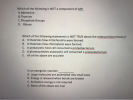 Which of the following is NOT a component of ATP A.Adenosine B.Thymine C.Phosphate Groups D. Ribose Which of the following statements is NOT TRUE about the endosymbiont theory? A. It theorizes how mitochondria were formed. B. It theorizes how chloroplasts were formed. C. A prokaryotic host cell consumed a proteobacterium D. A photosynthetic eukaryotic cell consumed a proteobacterium E. All of the above are accurate In an exergonic reaction A. Large molecules are assembled into small ones B. Energy is...
Match the functions listed on the left to the subcellular organelles responsible for those functions listed...
Match the functions listed on the left to the subcellular organelles responsible for those functions listed on the right. Question 6 options: 12345678910 sub-cellular organellse actually responsible for the packaging of cellular proteins that must be contained within membrane-bound vesicle. Proteins 'packaged' by these organelles would include hydrolytic digestive enzymes that are used within the cell but must be sequestered away from other parts of the cell so they don't digest the cell itself, or enzymes like catalases and dismutases...
3. Which type of cell has membrane-bound organelles, like a mitochondria? Cukan 4. Which type of...
 3. Which type of cell has membrane-bound organelles, like a mitochondria? Cukan 4. Which type of cell has ribosomes? Prokaryotes 4 eukaryote 5. Which type of cell has cell membranes? Prokaryotes deukaryo Quick Eukaryotic Cell Function Questions: 1. What is the endoplasmic reticulum composed of? folded membranes 2. What is the largest organelle of the cell? 3. Which organelle is responsible for releasing energy from sugar? 4. Which organelle packages and distributes organic compounds? 5. The controls the passage of...
11) In a plant cell, DNA may be found (1 pts) O only in the nucleus...
 11) In a plant cell, DNA may be found (1 pts) O only in the nucleus and chloroplasts only in the nucleus in the nucleus, mitochondria, and chloroplasts in the nucleus, mitochondria, chloroplasts, and peroxisomes 12) You have a cube of modeling Clay in your hands. Which of the following changes to the shape of pts) this cube of clay will decrease its surface area relative to its volume? stretch the cube into a long shoebox shape round the clay...
 hich of the following organelles are the destination for proteins synthetized by cytosolic ribosomes Peroxisomes, endoplasmic reticulum, and the Golgi apparatus The Golgi apparatus, lysosomes, and the nucleus Peroxisomes, mitochondria, and lysosomes Peroxisomes, mitochondria, and the nucleus Mitochondria, lysosomes, and the nucleus What is the fate of N-terminus signal peptide after it directs the protein to the ER translocator O It is linked to the transported protein by S-S bond It is cleaved and then released into the membrane It...
 Chapter 4: A Tour of the Cell 5. Smooth endoplasmic reticulum (SER) lacks _, which gives it a "smooth" appearance. 6. True or false: If false, make it a correct statement. The smooth endoplasmic reticulum con- tains many enzymes that allow it perform functions like detoxify circulating drugs. 7. Use Figures 4.14 (page 65 of your textbook) and 4.17 (page 67 of your textbook) to answer the following question. Place the following steps in the order in which they occur...
 Question 2 1 pts Which of the following supports endosymbiotic theory? O Chloroplasts are organelles that do not contain any DNA. Chloroplasts are "carnivores, capable of phagocytosing cells. Chloroplasts are organelles with two phospholipid bilayers. O Chloroplasts use oxygen to generate ATP. Question 3 1 pts Which of the following does NOT correctly describe ATP? ATP is a nucleotide. O ATP is a nucleoside triphosphate. ATP is used by RNA polymerase when the template has a "T" base. O ATP...
 Which of the following is NOT a component of ATP A.Adenosine B.Thymine C.Phosphate Groups D. Ribose Which of the following statements is NOT TRUE about the endosymbiont theory? A. It theorizes how mitochondria were formed. B. It theorizes how chloroplasts were formed. C. A prokaryotic host cell consumed a proteobacterium D. A photosynthetic eukaryotic cell consumed a proteobacterium E. All of the above are accurate In an exergonic reaction A. Large molecules are assembled into small ones B. Energy is...
 3. Which type of cell has membrane-bound organelles, like a mitochondria? Cukan 4. Which type of cell has ribosomes? Prokaryotes 4 eukaryote 5. Which type of cell has cell membranes? Prokaryotes deukaryo Quick Eukaryotic Cell Function Questions: 1. What is the endoplasmic reticulum composed of? folded membranes 2. What is the largest organelle of the cell? 3. Which organelle is responsible for releasing energy from sugar? 4. Which organelle packages and distributes organic compounds? 5. The controls the passage of...
 11) In a plant cell, DNA may be found (1 pts) O only in the nucleus and chloroplasts only in the nucleus in the nucleus, mitochondria, and chloroplasts in the nucleus, mitochondria, chloroplasts, and peroxisomes 12) You have a cube of modeling Clay in your hands. Which of the following changes to the shape of pts) this cube of clay will decrease its surface area relative to its volume? stretch the cube into a long shoebox shape round the clay...
Most questions answered within 3 hours.
-
Where is the error in this code sequence?
String s1 = "Hello";
String s2 = "ello";...
asked 11 months ago -
Financial data for Joel de Paris, Inc., for last year
follow:
Joel de Paris, Inc.
Balance...
asked 11 months ago -
Consider this reaction:
Al2(SO4)3 (aq)+ BaCl3
(aq) Al2Cl6 (aq)- +
3BaSO4(s) . What is the...
asked 11 months ago -
Suppose that Savneet is considering increasing her
recent random sample from 20 car rentals to 40...
asked 11 months ago -
Trucks arrive at an unloading terminal at an average rate of 120
per hour.
Trucks arrive...
asked 11 months ago -
Why are methanol and ethanol completely soluble in water while
octanol is not very little soluble....
asked 11 months ago -
A facilities manager at a university reads in a research report
that the mean amount of...
asked 11 months ago -
When the CuSO4 is rehydrated by adding water to the anhydrous
compound, is this an endothermic...
asked 11 months ago -
A ray of sunlight is passing from diamond into crown glass; the
angle of incidence is...
asked 11 months ago -
A block of mass 0.249 kg is placed on top of a light, vertical
spring of...
asked 11 months ago -
how do the kidneys compensate in the presences of acidosis
a) trigger hyperventilate
b) reserve acid...
asked 11 months ago -
Question 501 pts
The rental rate of capital to the firm increases. Which of the
following...
asked 11 months ago