Please show as much work as possible
Homework Answers
The intiial acceleration is


The velocity of the object when it thrust is zero

Now applying the time of flight for the remaining journey of the rocket is


Add Answer to:
Please show as much work as possible
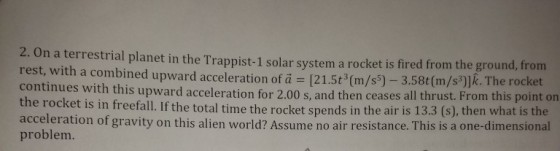
2.0n a terrestrial planet in the Trappist-1 solar system...
SECTION2 You wake up one morning to find yourself in a strange room with opaque walls, and no vis...
 SECTION2 You wake up one morning to find yourself in a strange room with opaque walls, and no visible doors or windows. Clearly you've been abducted in your sleep! You're immediately aware that the local gravity feels different from what you're accustomed to, so it's clear you're not at rest on the surface of the Earth. You decide to do some experiments to find out more about your strange situation. Fortunately there seems to be some measuring equipment in the...
SECTION2 You wake up one morning to find yourself in a strange room with opaque walls,...
 SECTION2 You wake up one morning to find yourself in a strange room with opaque walls, and no visible doors or windows. Clearly you've been abducted in your sleep! You're immediately aware that the local gravity feels different from what you're accustomed to, so it's clear you're not at rest on the surface of the Earth. You decide to do some experiments to find out more about your strange situation. Fortunately there seems to be some measuring equipment in the...
1. A rocket is launched vertically from the Earth, and the thrust (pushing force) from the engines...
1. A rocket is launched vertically from the Earth, and the thrust (pushing force) from the engines is directed upward, and has a magnitude of 5.00 x 10⁶ N. The mass of the rocket is initially 2.00 x 10⁵ kg. (a) What is the initial acceleration of the rocket, assuming you can neglect air resistance? (b) After the rocket has been in flight for a while, burning and exhausting a lot of fuel, its mass has decreased to 1.20 x 10⁵ kg, and...
NEED ALL OF THE CORRECT ANSWERS PLEASE. IF YOU CANNOT ANSWER ALL, DO NOT WASTE MY...
 NEED ALL OF THE CORRECT ANSWERS
PLEASE. IF YOU CANNOT ANSWER ALL, DO
NOT WASTE MY CHANCE FOR QUESTIONS, PLEASE.
MUCH APPRECIATED!
……
Question 5 -- /5 Two blocks are positioned on surfaces, each inclined at the same angle of 57.4 degrees with respect to the horizontal. The blocks are connected by a rope which rests on a frictionless pulley at the top of the inclines as shown, so the blocks can slide together. The mass of the black block...
NEED ALL OF THE CORRECT ANSWERS
PLEASE. IF YOU CANNOT ANSWER ALL, DO
NOT WASTE MY CHANCE FOR QUESTIONS, PLEASE.
MUCH APPRECIATED!
……
Question 5 -- /5 Two blocks are positioned on surfaces, each inclined at the same angle of 57.4 degrees with respect to the horizontal. The blocks are connected by a rope which rests on a frictionless pulley at the top of the inclines as shown, so the blocks can slide together. The mass of the black block...
.Please form info discussion groups of 3 (no more than 3) to solve the following questions....
 .Please form info discussion groups of 3 (no more than 3) to solve the following questions. Use the boards in the classroom to discuss the details of your solutions and show of work. Markers and erasers will be provided. Please return them after end of the class. Groups will be called to solve the questions for the rest of the class (bonus points opportunity) The final answers to each question is provided in the parenthesis. You need to arrive at...
6. An astronaut ona distant planet wants to determine its acceleration due to gravity. The astronaut...
 6. An astronaut ona distant planet wants to determine its acceleration due to gravity. The astronaut throws a rock straight up with a velocity of +15 m/s and measures a time of 20.0 s before the rock returns to his hand. What is the acceleration (magnitude and direction) due to gravity on this planet? See Diagram below: 20.0s v,15 m/s Show your work below: 7. Problem using vectors: A sailboat sails for 1 hr at 4 km/hr (relative to the...
Can someone help me with this question and show all work 1) Planet Velocities and Energy...
 Can someone help me with this question and show all
work
1) Planet Velocities and Energy (33 pts) We talked about how planet formation involves the collisions of bodies (planetesimals, embryos) leading to the growth (and heating) of a planet. Let's think about the velocities and energies involved here. a) The speed of a body in its orbit around the Sun is given by the equation: Here Vis the speed of the body in m/s, G is the gravitational constant,...
Can someone help me with this question and show all
work
1) Planet Velocities and Energy (33 pts) We talked about how planet formation involves the collisions of bodies (planetesimals, embryos) leading to the growth (and heating) of a planet. Let's think about the velocities and energies involved here. a) The speed of a body in its orbit around the Sun is given by the equation: Here Vis the speed of the body in m/s, G is the gravitational constant,...
- 1 Normal 11 No Spac... Heading 1 Title Paragraph Styles Problem 1: A military helicopter...
 - 1 Normal 11 No Spac... Heading 1 Title Paragraph Styles Problem 1: A military helicopter is motionless in the air at an elevation of 1500 m above ground (elevation is defined as vertical height above ground). A shell is fired from that location with a speed of 80 m/s at an angle of 30° above the horizon. (a) The time elapsed until the shell lands is 21.77sec (b) The speed of the shell after 8 s is __s0m/s Problem...
Please help with Q1 a)b)c). Question 1: In the lectures we considered simple projectile motion. Here we extend the description to include air resistance. For macroscopic objects in air, the dynamics...
 Please help with Q1 a)b)c).
Question 1: In the lectures we considered simple projectile motion. Here we extend the description to include air resistance. For macroscopic objects in air, the dynamics equations including air resistance may be written V and ^- where m is the mass of the object, g is the acceleration due to gravity, y is the vertical direction, C is a dimensionless drag coefficient, A is the cross-sectional area of the object, pa 1.2kg/m3 is the density...
Please help with Q1 a)b)c).
Question 1: In the lectures we considered simple projectile motion. Here we extend the description to include air resistance. For macroscopic objects in air, the dynamics equations including air resistance may be written V and ^- where m is the mass of the object, g is the acceleration due to gravity, y is the vertical direction, C is a dimensionless drag coefficient, A is the cross-sectional area of the object, pa 1.2kg/m3 is the density...
Please try to answer all questions and show work. Thank you. 1. A baseball player is...
 Please try to answer all questions and show work. Thank
you.
1. A baseball player is warming up and tosses a ball straight up into the air. The ball travels up until it reaches some maximum height, and then falls back down to the player's hand. If we neglect air resistance, then the magnitude of the acceleration of the ball is? A. largest the moment after it leaves the players hand. B. smallgst the moment after it leaves the player's...
Please try to answer all questions and show work. Thank
you.
1. A baseball player is warming up and tosses a ball straight up into the air. The ball travels up until it reaches some maximum height, and then falls back down to the player's hand. If we neglect air resistance, then the magnitude of the acceleration of the ball is? A. largest the moment after it leaves the players hand. B. smallgst the moment after it leaves the player's...
 SECTION2 You wake up one morning to find yourself in a strange room with opaque walls, and no visible doors or windows. Clearly you've been abducted in your sleep! You're immediately aware that the local gravity feels different from what you're accustomed to, so it's clear you're not at rest on the surface of the Earth. You decide to do some experiments to find out more about your strange situation. Fortunately there seems to be some measuring equipment in the...
 SECTION2 You wake up one morning to find yourself in a strange room with opaque walls, and no visible doors or windows. Clearly you've been abducted in your sleep! You're immediately aware that the local gravity feels different from what you're accustomed to, so it's clear you're not at rest on the surface of the Earth. You decide to do some experiments to find out more about your strange situation. Fortunately there seems to be some measuring equipment in the...
 NEED ALL OF THE CORRECT ANSWERS
PLEASE. IF YOU CANNOT ANSWER ALL, DO
NOT WASTE MY CHANCE FOR QUESTIONS, PLEASE.
MUCH APPRECIATED!
……
Question 5 -- /5 Two blocks are positioned on surfaces, each inclined at the same angle of 57.4 degrees with respect to the horizontal. The blocks are connected by a rope which rests on a frictionless pulley at the top of the inclines as shown, so the blocks can slide together. The mass of the black block...
NEED ALL OF THE CORRECT ANSWERS
PLEASE. IF YOU CANNOT ANSWER ALL, DO
NOT WASTE MY CHANCE FOR QUESTIONS, PLEASE.
MUCH APPRECIATED!
……
Question 5 -- /5 Two blocks are positioned on surfaces, each inclined at the same angle of 57.4 degrees with respect to the horizontal. The blocks are connected by a rope which rests on a frictionless pulley at the top of the inclines as shown, so the blocks can slide together. The mass of the black block...
 .Please form info discussion groups of 3 (no more than 3) to solve the following questions. Use the boards in the classroom to discuss the details of your solutions and show of work. Markers and erasers will be provided. Please return them after end of the class. Groups will be called to solve the questions for the rest of the class (bonus points opportunity) The final answers to each question is provided in the parenthesis. You need to arrive at...
 6. An astronaut ona distant planet wants to determine its acceleration due to gravity. The astronaut throws a rock straight up with a velocity of +15 m/s and measures a time of 20.0 s before the rock returns to his hand. What is the acceleration (magnitude and direction) due to gravity on this planet? See Diagram below: 20.0s v,15 m/s Show your work below: 7. Problem using vectors: A sailboat sails for 1 hr at 4 km/hr (relative to the...
 Can someone help me with this question and show all
work
1) Planet Velocities and Energy (33 pts) We talked about how planet formation involves the collisions of bodies (planetesimals, embryos) leading to the growth (and heating) of a planet. Let's think about the velocities and energies involved here. a) The speed of a body in its orbit around the Sun is given by the equation: Here Vis the speed of the body in m/s, G is the gravitational constant,...
Can someone help me with this question and show all
work
1) Planet Velocities and Energy (33 pts) We talked about how planet formation involves the collisions of bodies (planetesimals, embryos) leading to the growth (and heating) of a planet. Let's think about the velocities and energies involved here. a) The speed of a body in its orbit around the Sun is given by the equation: Here Vis the speed of the body in m/s, G is the gravitational constant,...
 - 1 Normal 11 No Spac... Heading 1 Title Paragraph Styles Problem 1: A military helicopter is motionless in the air at an elevation of 1500 m above ground (elevation is defined as vertical height above ground). A shell is fired from that location with a speed of 80 m/s at an angle of 30° above the horizon. (a) The time elapsed until the shell lands is 21.77sec (b) The speed of the shell after 8 s is __s0m/s Problem...
 Please help with Q1 a)b)c).
Question 1: In the lectures we considered simple projectile motion. Here we extend the description to include air resistance. For macroscopic objects in air, the dynamics equations including air resistance may be written V and ^- where m is the mass of the object, g is the acceleration due to gravity, y is the vertical direction, C is a dimensionless drag coefficient, A is the cross-sectional area of the object, pa 1.2kg/m3 is the density...
Please help with Q1 a)b)c).
Question 1: In the lectures we considered simple projectile motion. Here we extend the description to include air resistance. For macroscopic objects in air, the dynamics equations including air resistance may be written V and ^- where m is the mass of the object, g is the acceleration due to gravity, y is the vertical direction, C is a dimensionless drag coefficient, A is the cross-sectional area of the object, pa 1.2kg/m3 is the density...
 Please try to answer all questions and show work. Thank
you.
1. A baseball player is warming up and tosses a ball straight up into the air. The ball travels up until it reaches some maximum height, and then falls back down to the player's hand. If we neglect air resistance, then the magnitude of the acceleration of the ball is? A. largest the moment after it leaves the players hand. B. smallgst the moment after it leaves the player's...
Please try to answer all questions and show work. Thank
you.
1. A baseball player is warming up and tosses a ball straight up into the air. The ball travels up until it reaches some maximum height, and then falls back down to the player's hand. If we neglect air resistance, then the magnitude of the acceleration of the ball is? A. largest the moment after it leaves the players hand. B. smallgst the moment after it leaves the player's...
Most questions answered within 3 hours.
-
Where is the error in this code sequence?
String s1 = "Hello";
String s2 = "ello";...
asked 10 months ago -
Financial data for Joel de Paris, Inc., for last year
follow:
Joel de Paris, Inc.
Balance...
asked 10 months ago -
Consider this reaction:
Al2(SO4)3 (aq)+ BaCl3
(aq) Al2Cl6 (aq)- +
3BaSO4(s) . What is the...
asked 10 months ago -
Suppose that Savneet is considering increasing her
recent random sample from 20 car rentals to 40...
asked 10 months ago -
Trucks arrive at an unloading terminal at an average rate of 120
per hour.
Trucks arrive...
asked 10 months ago -
Why are methanol and ethanol completely soluble in water while
octanol is not very little soluble....
asked 10 months ago -
A facilities manager at a university reads in a research report
that the mean amount of...
asked 10 months ago -
When the CuSO4 is rehydrated by adding water to the anhydrous
compound, is this an endothermic...
asked 10 months ago -
A ray of sunlight is passing from diamond into crown glass; the
angle of incidence is...
asked 10 months ago -
A block of mass 0.249 kg is placed on top of a light, vertical
spring of...
asked 10 months ago -
how do the kidneys compensate in the presences of acidosis
a) trigger hyperventilate
b) reserve acid...
asked 10 months ago -
Question 501 pts
The rental rate of capital to the firm increases. Which of the
following...
asked 10 months ago