
Homework Answers
Request Answer!
We need at least 10 more requests to produce the answer.
0 / 10 have requested this problem solution
The more requests, the faster the answer.
Add Answer to:
1. Consider a harmonic oscillator of mass m and angular frequency o). At time 1 -...
[4] Consider a harmonic oscillator of mass m and angular frequency ω. At time t-0, the state of this oscillator is given by y(о) со фо) + с ф.) where the states I 0) .) represent the ground state...
 [4] Consider a harmonic oscillator of mass m and angular frequency ω. At time t-0, the state of this oscillator is given by y(о) со фо) + с ф.) where the states I 0) .) represent the ground state and first excited state respectively. (a) Write the normalization condition for lv(o) and determine the mean value (H) of the energy in terms of co and ci. (b) With the additional requirement (H)-ho. calculate eoand o,p.
[4] Consider a harmonic oscillator...
[4] Consider a harmonic oscillator of mass m and angular frequency ω. At time t-0, the state of this oscillator is given by y(о) со фо) + с ф.) where the states I 0) .) represent the ground state and first excited state respectively. (a) Write the normalization condition for lv(o) and determine the mean value (H) of the energy in terms of co and ci. (b) With the additional requirement (H)-ho. calculate eoand o,p.
[4] Consider a harmonic oscillator...
Consider the dimensionless harmonic oscillator Hamiltonian, (where m = h̄ = 1). Consider the orthogonal wave...
 Consider the dimensionless harmonic oscillator Hamiltonian,
(where m = h̄ = 1).
Consider the orthogonal wave functions
and
, which are eigenfunctions of H with eigenvalues 1/2 and 5/2,
respectively.
with p=_ïda 2 2 We were unable to transcribe this imageY;(r) = (1-2x2)e-r2/2 (a) Let фо(x-AgVo(x) and φ2(x) = A2V2(x) and suppose that φ。(x) and φ2(x) are normalized. Find the constants Ao and A2. (b) Suppose that, at timet0, the state of the oscillator is given by Find the constant...
Consider the dimensionless harmonic oscillator Hamiltonian,
(where m = h̄ = 1).
Consider the orthogonal wave functions
and
, which are eigenfunctions of H with eigenvalues 1/2 and 5/2,
respectively.
with p=_ïda 2 2 We were unable to transcribe this imageY;(r) = (1-2x2)e-r2/2 (a) Let фо(x-AgVo(x) and φ2(x) = A2V2(x) and suppose that φ。(x) and φ2(x) are normalized. Find the constants Ao and A2. (b) Suppose that, at timet0, the state of the oscillator is given by Find the constant...
Consider a harmonic oscillator with reduced mass μ and angular frequency a. The equilibrium posit...
 please help
Consider a harmonic oscillator with reduced mass μ and angular frequency a. The equilibrium position is set at x-0 (a) What is the n-4 vibrational eigenfunction? Look it up on the Internet and give the normalized wave function, the derivation is not necessary (b) Show that the wave function you give in (a) is normalized. Use an integral table if needed. (c) What are the classical turning points of the n-4 vibrational state? (d) Calculate the probability that...
please help
Consider a harmonic oscillator with reduced mass μ and angular frequency a. The equilibrium position is set at x-0 (a) What is the n-4 vibrational eigenfunction? Look it up on the Internet and give the normalized wave function, the derivation is not necessary (b) Show that the wave function you give in (a) is normalized. Use an integral table if needed. (c) What are the classical turning points of the n-4 vibrational state? (d) Calculate the probability that...
Consider a particle with mass m described by the Hamilton operator for a one-dimensional harmonic oscillator...
 Consider a particle with mass m described by the Hamilton operator for a one-dimensional harmonic oscillator 2 Zm 2 The normalized eigenfunctions for Hare φη (x) with energies E,,-(n + 2) ha. At time t-0 the wavefunction of the particle is given by у(x,0)- (V3іфі (x) + ф3(x)). Now let H' be an operator given by where k is a positive constant. 1) Show that H' is Hermitian. 2) Express H' by the step-operators a+ and a 3) Calculate the...
Problem 5. (30 points) Consider a Harmonic oscillator with H that H=(ata + 1 / 2)ho,...
 Problem 5. (30 points) Consider a Harmonic oscillator with H that H=(ata + 1 / 2)ho, where a=dma)X + i (a) (4 points) Show P, and a x 2h 2h 2moh P. Show also 2moh that [a, a]-l. (b) (6 points) Starting from the commuters la, HJand la', A), where H-H(h) show that the eigenvalues of Hare e,=(n+1/2) for n-0, 1,2, Show also that alm)-nln-l), and a l). (( points) Find the normalized ground state wavefunction by projecting alo)-0 on...
l. Explicitly calculate ?? ?p of the ld quantum harmonic oscillator with mass m and angular...
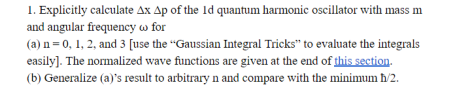 l. Explicitly calculate ?? ?p of the ld quantum harmonic oscillator with mass m and angular frequency ? for (a) n 0, 1, 2, and 3 [use the "Gaussian Integral Tricks" to evaluate the integrals easily]. The normalized wave functions are given at the end of this section (b) Generalize (a)'s result to arbitrary n and compare with the minimum h/2.
A particle of mass m is bound by the spherically-symmetric three-dimensional harmonic- oscillator potential energy ,...
 A particle of mass m is bound by the spherically-symmetric three-dimensional harmonic- oscillator potential energy , and ф are the usual spherical coordinates. (a) In the form given above, why is it clear that the potential energy function V) is (b) For this problem, it will be more convenient to express this spherically-symmetric where r , spherically symmetric? A brief answer is sufficient. potential energy in Cartesian coordinates x, y, and z as physically the same potential energy as the...
3. Anharmonicity (6 marks] Consider the three-dimensional isotropic harmonic oscillator 2 1 242 р...
 3. Anharmonicity (6 marks] Consider the three-dimensional isotropic harmonic oscillator 2 1 242 рґ which has energy eigenvalues En-hu(n+3/2), where n- 0,1,2.. (a) Calculate the first-order shift in the ground-state energy of the harmonic oscillator due to the addition of an anharmonic term C24 to the potential, where C> 0. (b) Calculate instead the first-order shifts in the energies of the n - 1 ercited states due to the addition of the anharmonic term C (c) For the lowest energy...
[20 points] A particle in the simple harmonic oscillator potential with angular frequency a is initially...
 [20 points] A particle in the simple harmonic oscillator potential with angular frequency a is initially in the ground state: c,y, (x) =Yo(x Att = 0 , the angular frequency of the oscillator suddenly doubles: a} → a½-2.4 The initial wave function can be written in terms of the modified potential (denoted with a tilde:~: Recall that the general form of the first few stationary states for the harmonic oscillator are given on page 56 of your text. a. What...
A harmonic oscillator is in a state such that a measurement of the energy would yield...
 A harmonic oscillator is in a state such that a measurement of the energy would yield either Eo=(1/2ho 1/3 of the time or E1-(3/2)hw, 2/3 of the time time-dependent wave function which describes this state. (b) Find the average position of the particle (x(t)). (c) Find the expectation value of the energy. Given that E(H), is the energy associate with this state constant or it oscillates in time between Eo and E1?
 [4] Consider a harmonic oscillator of mass m and angular frequency ω. At time t-0, the state of this oscillator is given by y(о) со фо) + с ф.) where the states I 0) .) represent the ground state and first excited state respectively. (a) Write the normalization condition for lv(o) and determine the mean value (H) of the energy in terms of co and ci. (b) With the additional requirement (H)-ho. calculate eoand o,p.
[4] Consider a harmonic oscillator...
[4] Consider a harmonic oscillator of mass m and angular frequency ω. At time t-0, the state of this oscillator is given by y(о) со фо) + с ф.) where the states I 0) .) represent the ground state and first excited state respectively. (a) Write the normalization condition for lv(o) and determine the mean value (H) of the energy in terms of co and ci. (b) With the additional requirement (H)-ho. calculate eoand o,p.
[4] Consider a harmonic oscillator...
 Consider the dimensionless harmonic oscillator Hamiltonian,
(where m = h̄ = 1).
Consider the orthogonal wave functions
and
, which are eigenfunctions of H with eigenvalues 1/2 and 5/2,
respectively.
with p=_ïda 2 2 We were unable to transcribe this imageY;(r) = (1-2x2)e-r2/2 (a) Let фо(x-AgVo(x) and φ2(x) = A2V2(x) and suppose that φ。(x) and φ2(x) are normalized. Find the constants Ao and A2. (b) Suppose that, at timet0, the state of the oscillator is given by Find the constant...
Consider the dimensionless harmonic oscillator Hamiltonian,
(where m = h̄ = 1).
Consider the orthogonal wave functions
and
, which are eigenfunctions of H with eigenvalues 1/2 and 5/2,
respectively.
with p=_ïda 2 2 We were unable to transcribe this imageY;(r) = (1-2x2)e-r2/2 (a) Let фо(x-AgVo(x) and φ2(x) = A2V2(x) and suppose that φ。(x) and φ2(x) are normalized. Find the constants Ao and A2. (b) Suppose that, at timet0, the state of the oscillator is given by Find the constant...
 please help
Consider a harmonic oscillator with reduced mass μ and angular frequency a. The equilibrium position is set at x-0 (a) What is the n-4 vibrational eigenfunction? Look it up on the Internet and give the normalized wave function, the derivation is not necessary (b) Show that the wave function you give in (a) is normalized. Use an integral table if needed. (c) What are the classical turning points of the n-4 vibrational state? (d) Calculate the probability that...
please help
Consider a harmonic oscillator with reduced mass μ and angular frequency a. The equilibrium position is set at x-0 (a) What is the n-4 vibrational eigenfunction? Look it up on the Internet and give the normalized wave function, the derivation is not necessary (b) Show that the wave function you give in (a) is normalized. Use an integral table if needed. (c) What are the classical turning points of the n-4 vibrational state? (d) Calculate the probability that...
 Consider a particle with mass m described by the Hamilton operator for a one-dimensional harmonic oscillator 2 Zm 2 The normalized eigenfunctions for Hare φη (x) with energies E,,-(n + 2) ha. At time t-0 the wavefunction of the particle is given by у(x,0)- (V3іфі (x) + ф3(x)). Now let H' be an operator given by where k is a positive constant. 1) Show that H' is Hermitian. 2) Express H' by the step-operators a+ and a 3) Calculate the...
 Problem 5. (30 points) Consider a Harmonic oscillator with H that H=(ata + 1 / 2)ho, where a=dma)X + i (a) (4 points) Show P, and a x 2h 2h 2moh P. Show also 2moh that [a, a]-l. (b) (6 points) Starting from the commuters la, HJand la', A), where H-H(h) show that the eigenvalues of Hare e,=(n+1/2) for n-0, 1,2, Show also that alm)-nln-l), and a l). (( points) Find the normalized ground state wavefunction by projecting alo)-0 on...
 l. Explicitly calculate ?? ?p of the ld quantum harmonic oscillator with mass m and angular frequency ? for (a) n 0, 1, 2, and 3 [use the "Gaussian Integral Tricks" to evaluate the integrals easily]. The normalized wave functions are given at the end of this section (b) Generalize (a)'s result to arbitrary n and compare with the minimum h/2.
 A particle of mass m is bound by the spherically-symmetric three-dimensional harmonic- oscillator potential energy , and ф are the usual spherical coordinates. (a) In the form given above, why is it clear that the potential energy function V) is (b) For this problem, it will be more convenient to express this spherically-symmetric where r , spherically symmetric? A brief answer is sufficient. potential energy in Cartesian coordinates x, y, and z as physically the same potential energy as the...
 3. Anharmonicity (6 marks] Consider the three-dimensional isotropic harmonic oscillator 2 1 242 рґ which has energy eigenvalues En-hu(n+3/2), where n- 0,1,2.. (a) Calculate the first-order shift in the ground-state energy of the harmonic oscillator due to the addition of an anharmonic term C24 to the potential, where C> 0. (b) Calculate instead the first-order shifts in the energies of the n - 1 ercited states due to the addition of the anharmonic term C (c) For the lowest energy...
 [20 points] A particle in the simple harmonic oscillator potential with angular frequency a is initially in the ground state: c,y, (x) =Yo(x Att = 0 , the angular frequency of the oscillator suddenly doubles: a} → a½-2.4 The initial wave function can be written in terms of the modified potential (denoted with a tilde:~: Recall that the general form of the first few stationary states for the harmonic oscillator are given on page 56 of your text. a. What...
 A harmonic oscillator is in a state such that a measurement of the energy would yield either Eo=(1/2ho 1/3 of the time or E1-(3/2)hw, 2/3 of the time time-dependent wave function which describes this state. (b) Find the average position of the particle (x(t)). (c) Find the expectation value of the energy. Given that E(H), is the energy associate with this state constant or it oscillates in time between Eo and E1?
Most questions answered within 3 hours.
-
Where is the error in this code sequence?
String s1 = "Hello";
String s2 = "ello";...
asked 11 months ago -
Financial data for Joel de Paris, Inc., for last year
follow:
Joel de Paris, Inc.
Balance...
asked 11 months ago -
Consider this reaction:
Al2(SO4)3 (aq)+ BaCl3
(aq) Al2Cl6 (aq)- +
3BaSO4(s) . What is the...
asked 11 months ago -
Suppose that Savneet is considering increasing her
recent random sample from 20 car rentals to 40...
asked 11 months ago -
Trucks arrive at an unloading terminal at an average rate of 120
per hour.
Trucks arrive...
asked 11 months ago -
Why are methanol and ethanol completely soluble in water while
octanol is not very little soluble....
asked 11 months ago -
A facilities manager at a university reads in a research report
that the mean amount of...
asked 11 months ago -
When the CuSO4 is rehydrated by adding water to the anhydrous
compound, is this an endothermic...
asked 11 months ago -
A ray of sunlight is passing from diamond into crown glass; the
angle of incidence is...
asked 11 months ago -
A block of mass 0.249 kg is placed on top of a light, vertical
spring of...
asked 11 months ago -
how do the kidneys compensate in the presences of acidosis
a) trigger hyperventilate
b) reserve acid...
asked 11 months ago -
Question 501 pts
The rental rate of capital to the firm increases. Which of the
following...
asked 11 months ago