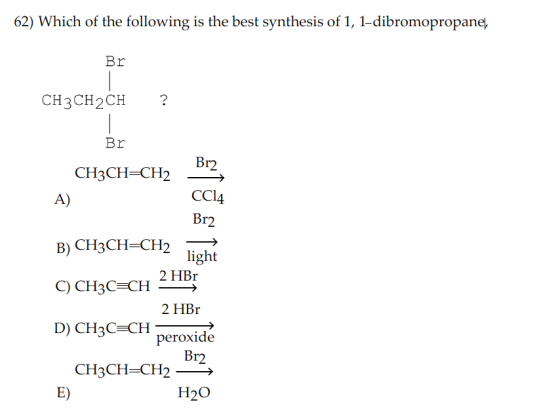
please show proper initiation and propagation mechanism
Homework Answers
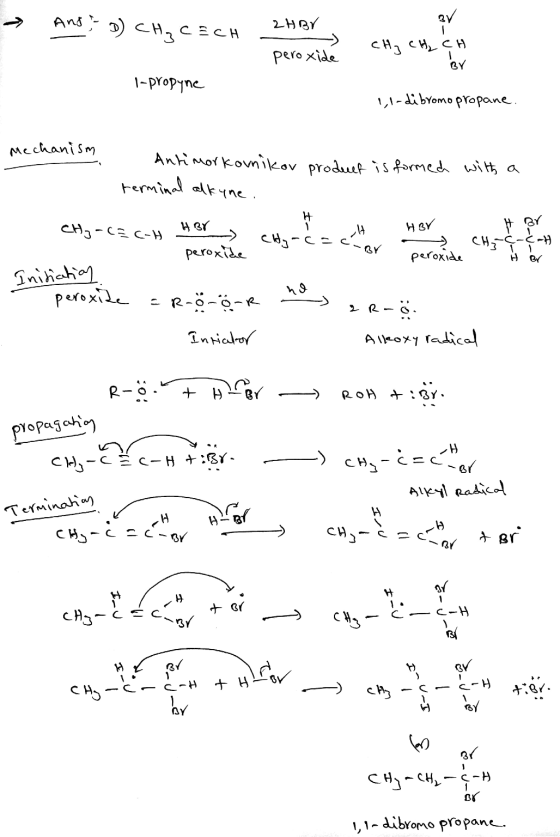
The given product is formed from the alkyne (propyne) react with
HBr in the presence of peroxide they given anti morkownikov product
Add Answer to:
please show proper initiation and propagation mechanism
62) Which of the following is the best synthesis...
Consider the following reaction mechanism: 1) Initiation Br2 → 2 Br• 2) Propagation (here a cycle...
Consider the following reaction mechanism: 1) Initiation Br2 → 2 Br• 2) Propagation (here a cycle of two steps) Br• + H2 → HBr + H• H• + Br2 → HBr + Br• 3) Termination 2 Br• → Br2 This reaction is catalyzed by platinum. Wat causes the bromine to split in the initiation step? Does the platinum influences this or is it just due the weak bonding between Br-Br?
Consider the following reaction mechanism: 1) Initiation Br2 → 2 Br• 2) Propagation (here a cycle...
Consider the following reaction mechanism: 1) Initiation Br2 → 2 Br• 2) Propagation (here a cycle of two steps) Br• + H2 → HBr + H• H• + Br2 → HBr + Br• 3) Termination 2 Br• → Br2 This reaction is catalyzed by platinum. My question is what does the platinum do? I know that platinum is able to split the H2 bond but is that the only function of the platinum in this reaction?
Sp2019 4. (2 pts) Show the most probable initiation and one subsequent propagation mechanism for the...
 Sp2019 4. (2 pts) Show the most probable initiation and one subsequent propagation mechanism for the ng reaction. Note the first propagation step will NOT lead to the indicated product HBr, ROOR light Initiation: Propagation: Extra Credit (2 pts) Show the most probable propagation mechanism that leads to the desired product shown in the above reaction.
Choose the sequence of reagents which would best accomplish the following transformation: 2-bromopropane ----------> 1,2-dibromopropane [(R)...
 Choose the sequence of reagents which would best accomplish the following transformation: 2-bromopropane ----------> 1,2-dibromopropane [(R) + (S)] 01. (i) KMnO4, NaOH in water at 0 °C 2. (i) Br2 in CCl4 (ii) excess NaNH2 (iii) CH31 (iv) H20, H2SO4, HgSO4 Choose the sequence of reagents which would best accomplish the following transformation: 2-bromopropane ---------> 1,2-dibromopropane [(R) + (S)] 01. (i) KMnO4, NaOH in water at 0 °C 2. (i) Br2 in CC14 (ii) excess NaNH2 (iii) CH3 (iv) H20,...
For the following reaction give the detailed mechanism in terms of: electron flow energy diagram, put...
For the following reaction give the detailed mechanism in terms of: electron flow energy diagram, put both propagation step 1 and step 2 on the same diagram CH3--CH3 + Br2 ------> CH3CH2--Br + HBr This is what I have so far, and I think I'm correct. Im having trouble with the energy diagram. Initiation Br--Br ---> 2 Br . (dot symbolizes radical) Propagation (step 1) Br . + H--CH2--CH3 ---><---- Br-H + . CH2--CH3 Propagation (step 2) . CH2--CH3 +...
a) Show the mechanism for the free radical chlorination of bromopropane. Clearly show the initiation, propagation,...
 a) Show the mechanism for the free radical chlorination of
bromopropane. Clearly show the initiation, propagation, and
termination steps.
b) Use the BDEs shown on page 1 to calculate the enthalpy change
for this reaction.
c) Unfortunately, the student’s attempt in question 3 failed,
and he only made traces of 2- chloropropane by using this approach.
What was the major product of the reaction, and explain why it was
formed instead. You may find the BDEs on page 1 to...
a) Show the mechanism for the free radical chlorination of
bromopropane. Clearly show the initiation, propagation, and
termination steps.
b) Use the BDEs shown on page 1 to calculate the enthalpy change
for this reaction.
c) Unfortunately, the student’s attempt in question 3 failed,
and he only made traces of 2- chloropropane by using this approach.
What was the major product of the reaction, and explain why it was
formed instead. You may find the BDEs on page 1 to...
reaction mech: initiation , propagation, and termination of the synthesis of polystyrene Polymersti 2. Write the...
 reaction mech: initiation , propagation, and termination of
the synthesis of polystyrene
Polymersti 2. Write the reaction mechanism (showing arrows) of the synthesis of polystyrene. 4pts • Include and show arrows in 2 initiation steps with benzoyl peroxide forming the phenyl radical. (this is shown in Figure 9 of the lab- just add all arrows) A propagation step of the styrene (the monomer) and phenyl radical. A second propagation step showing polymer growth by reacting styrene and the radical product...
reaction mech: initiation , propagation, and termination of
the synthesis of polystyrene
Polymersti 2. Write the reaction mechanism (showing arrows) of the synthesis of polystyrene. 4pts • Include and show arrows in 2 initiation steps with benzoyl peroxide forming the phenyl radical. (this is shown in Figure 9 of the lab- just add all arrows) A propagation step of the styrene (the monomer) and phenyl radical. A second propagation step showing polymer growth by reacting styrene and the radical product...
Question 13 (4 points) Which of the following is the best synthesis for 2-bromopropane? Addition of...
 Question 13 (4 points) Which of the following is the best synthesis for 2-bromopropane? Addition of HBr to propyne. Addition of HBr to propyne in the presence of peroxides. Bromination of propane using Br2/light. Addition of Br2 in CCl4 to propene. Question 14 (4 points) Which of these is used to make an alcohol into a substrate with a good leaving group? NaNH2 pyridine, then CH3SO2CI NaOH NaBr
Write a mechanism for each of the following reactions. Clearly label the initiation,propagation, and termination steps...
Write a mechanism for each of the following reactions. Clearly label the initiation,propagation, and termination steps in each reaction. 1. The light-initiated reaction of cyclohexane with chlorine to give chlorocyclohexane. 2.the reaction between cyclobutane and bromine to give bromocyclohexane. 3. The reaction between bromine and propane. 4.the reaction between bromine and cyclohexane to give bromocyclohexane.
Show the full electron pushing mechanism with arrows for the synthesis of p-bromoaniline from aniline. Show...
 Show the full electron pushing mechanism with arrows for the
synthesis of p-bromoaniline from aniline. Show any side
products
NH3 N 'CH3 NH CH HCI, H2O 1) H+, H20 Br2 H3C CH COONa CH COOH 2) 5% NaOH Aniline Acetic anhydride Acetanilide p-bromo acetanilide p-bromoaniline bp 184 oC mp 114 oC mp 166 oC mp 64 oC
Show the full electron pushing mechanism with arrows for the
synthesis of p-bromoaniline from aniline. Show any side
products
NH3 N 'CH3 NH CH HCI, H2O 1) H+, H20 Br2 H3C CH COONa CH COOH 2) 5% NaOH Aniline Acetic anhydride Acetanilide p-bromo acetanilide p-bromoaniline bp 184 oC mp 114 oC mp 166 oC mp 64 oC
 Sp2019 4. (2 pts) Show the most probable initiation and one subsequent propagation mechanism for the ng reaction. Note the first propagation step will NOT lead to the indicated product HBr, ROOR light Initiation: Propagation: Extra Credit (2 pts) Show the most probable propagation mechanism that leads to the desired product shown in the above reaction.
 Choose the sequence of reagents which would best accomplish the following transformation: 2-bromopropane ----------> 1,2-dibromopropane [(R) + (S)] 01. (i) KMnO4, NaOH in water at 0 °C 2. (i) Br2 in CCl4 (ii) excess NaNH2 (iii) CH31 (iv) H20, H2SO4, HgSO4 Choose the sequence of reagents which would best accomplish the following transformation: 2-bromopropane ---------> 1,2-dibromopropane [(R) + (S)] 01. (i) KMnO4, NaOH in water at 0 °C 2. (i) Br2 in CC14 (ii) excess NaNH2 (iii) CH3 (iv) H20,...
 a) Show the mechanism for the free radical chlorination of
bromopropane. Clearly show the initiation, propagation, and
termination steps.
b) Use the BDEs shown on page 1 to calculate the enthalpy change
for this reaction.
c) Unfortunately, the student’s attempt in question 3 failed,
and he only made traces of 2- chloropropane by using this approach.
What was the major product of the reaction, and explain why it was
formed instead. You may find the BDEs on page 1 to...
a) Show the mechanism for the free radical chlorination of
bromopropane. Clearly show the initiation, propagation, and
termination steps.
b) Use the BDEs shown on page 1 to calculate the enthalpy change
for this reaction.
c) Unfortunately, the student’s attempt in question 3 failed,
and he only made traces of 2- chloropropane by using this approach.
What was the major product of the reaction, and explain why it was
formed instead. You may find the BDEs on page 1 to...
 reaction mech: initiation , propagation, and termination of
the synthesis of polystyrene
Polymersti 2. Write the reaction mechanism (showing arrows) of the synthesis of polystyrene. 4pts • Include and show arrows in 2 initiation steps with benzoyl peroxide forming the phenyl radical. (this is shown in Figure 9 of the lab- just add all arrows) A propagation step of the styrene (the monomer) and phenyl radical. A second propagation step showing polymer growth by reacting styrene and the radical product...
reaction mech: initiation , propagation, and termination of
the synthesis of polystyrene
Polymersti 2. Write the reaction mechanism (showing arrows) of the synthesis of polystyrene. 4pts • Include and show arrows in 2 initiation steps with benzoyl peroxide forming the phenyl radical. (this is shown in Figure 9 of the lab- just add all arrows) A propagation step of the styrene (the monomer) and phenyl radical. A second propagation step showing polymer growth by reacting styrene and the radical product...
 Question 13 (4 points) Which of the following is the best synthesis for 2-bromopropane? Addition of HBr to propyne. Addition of HBr to propyne in the presence of peroxides. Bromination of propane using Br2/light. Addition of Br2 in CCl4 to propene. Question 14 (4 points) Which of these is used to make an alcohol into a substrate with a good leaving group? NaNH2 pyridine, then CH3SO2CI NaOH NaBr
 Show the full electron pushing mechanism with arrows for the
synthesis of p-bromoaniline from aniline. Show any side
products
NH3 N 'CH3 NH CH HCI, H2O 1) H+, H20 Br2 H3C CH COONa CH COOH 2) 5% NaOH Aniline Acetic anhydride Acetanilide p-bromo acetanilide p-bromoaniline bp 184 oC mp 114 oC mp 166 oC mp 64 oC
Show the full electron pushing mechanism with arrows for the
synthesis of p-bromoaniline from aniline. Show any side
products
NH3 N 'CH3 NH CH HCI, H2O 1) H+, H20 Br2 H3C CH COONa CH COOH 2) 5% NaOH Aniline Acetic anhydride Acetanilide p-bromo acetanilide p-bromoaniline bp 184 oC mp 114 oC mp 166 oC mp 64 oC
Most questions answered within 3 hours.
-
Where is the error in this code sequence?
String s1 = "Hello";
String s2 = "ello";...
asked 10 months ago -
Financial data for Joel de Paris, Inc., for last year
follow:
Joel de Paris, Inc.
Balance...
asked 10 months ago -
Consider this reaction:
Al2(SO4)3 (aq)+ BaCl3
(aq) Al2Cl6 (aq)- +
3BaSO4(s) . What is the...
asked 10 months ago -
Suppose that Savneet is considering increasing her
recent random sample from 20 car rentals to 40...
asked 10 months ago -
Trucks arrive at an unloading terminal at an average rate of 120
per hour.
Trucks arrive...
asked 10 months ago -
Why are methanol and ethanol completely soluble in water while
octanol is not very little soluble....
asked 10 months ago -
A facilities manager at a university reads in a research report
that the mean amount of...
asked 10 months ago -
When the CuSO4 is rehydrated by adding water to the anhydrous
compound, is this an endothermic...
asked 10 months ago -
A ray of sunlight is passing from diamond into crown glass; the
angle of incidence is...
asked 10 months ago -
A block of mass 0.249 kg is placed on top of a light, vertical
spring of...
asked 10 months ago -
how do the kidneys compensate in the presences of acidosis
a) trigger hyperventilate
b) reserve acid...
asked 10 months ago -
Question 501 pts
The rental rate of capital to the firm increases. Which of the
following...
asked 10 months ago