
Homework Answers
Add Answer to:
Question 13 (4 points) Which of the following is the best synthesis for 2-bromopropane? Addition of...
Choose the sequence of reagents which would best accomplish the following transformation: 2-bromopropane ----------> 1,2-dibromopropane [(R)...
 Choose the sequence of reagents which would best accomplish the following transformation: 2-bromopropane ----------> 1,2-dibromopropane [(R) + (S)] 01. (i) KMnO4, NaOH in water at 0 °C 2. (i) Br2 in CCl4 (ii) excess NaNH2 (iii) CH31 (iv) H20, H2SO4, HgSO4 Choose the sequence of reagents which would best accomplish the following transformation: 2-bromopropane ---------> 1,2-dibromopropane [(R) + (S)] 01. (i) KMnO4, NaOH in water at 0 °C 2. (i) Br2 in CC14 (ii) excess NaNH2 (iii) CH3 (iv) H20,...
please show proper initiation and propagation mechanism 62) Which of the following is the best synthesis...
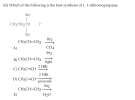 please show proper initiation and propagation mechanism
62) Which of the following is the best synthesis of 1, 1-dibromopropane, Br CH3CH2CH ? Br Br2 CH3CH=CH2 CCl4 Br2 light 2 HBr B) CH3CH=CH2 C) CH3C=CH 2 HB: D) CH3C=CH peroxide CH3CH=CH2 Brz E) H20
please show proper initiation and propagation mechanism
62) Which of the following is the best synthesis of 1, 1-dibromopropane, Br CH3CH2CH ? Br Br2 CH3CH=CH2 CCl4 Br2 light 2 HBr B) CH3CH=CH2 C) CH3C=CH 2 HB: D) CH3C=CH peroxide CH3CH=CH2 Brz E) H20
4) Which of the following reactions is faster: Addition of HBr to 2-methyl propene or addition...
 4) Which of the following reactions is faster: Addition of HBr to 2-methyl propene or addition of HBr to trans-2-butene. Assume the energy difference between starting alkenes can be ignored. Explain. (2 pts)
QUESTION 1 2 points Save Answer Which statement applies to halide S N 1, but NOT...
 QUESTION 1 2 points Save Answer Which statement applies to halide S N 1, but NOT SN 2 substitution reactions? Reaction is favored because a weaker base is produced. The nucleophile substitutes the leaving group in the substrate. A carbocation intermediate is involved in the reaction Halogens act as leaving group. QUESTION 2 2 points Save Answer What is the expect product for the following reaction HCEN CHз Нс Br Cн Нас Br CH3 Нас CH3 Нас CN CH3 Hас...
Please answer! thanks Question 33 2 pts Which reagent/set of reagents (from the list above) should...
 Please answer! thanks
Question 33 2 pts Which reagent/set of reagents (from the list above) should be used for the following reaction? reagent(s) Reagents Questio 3 pts Which we [Select) A-HBr B - NBS, hy C - HBr, peroxides D-Br2 E-Br2, light F-NaNH2 G - Na, NH3 H - KCN, DME |- CI2 J-CI2, H20 K-H2, Pt L-H20, H2SO4 M - Os04, etc (see the list) N - Hg(OAc)2, etc (see the list) O(see structure in the list) P-BH3, etc...
Please answer! thanks
Question 33 2 pts Which reagent/set of reagents (from the list above) should be used for the following reaction? reagent(s) Reagents Questio 3 pts Which we [Select) A-HBr B - NBS, hy C - HBr, peroxides D-Br2 E-Br2, light F-NaNH2 G - Na, NH3 H - KCN, DME |- CI2 J-CI2, H20 K-H2, Pt L-H20, H2SO4 M - Os04, etc (see the list) N - Hg(OAc)2, etc (see the list) O(see structure in the list) P-BH3, etc...
Question 32 (4 points) Which arrow is used to indicate resonance structures? ξ Ο Ο Ο...
 Question 32 (4 points) Which arrow is used to indicate resonance structures? ξ Ο Ο Ο Ο Question 33 (4 points) Which reagents would lead to the following transformation? H3C H H3C-=-H Br OHBr (1 mol) O Brz O HBr (1 mol), peroxides Bre, heat Question 34 (4 points) In which direction would plane-polarized light rotate when passed through a solution of the following CH F H- ci HCI CHF clockwise O counter-clockwise Ono rotation cannot be determined Question 35.(4...
need help with the boxed bullet point. writing the chemical reaction scheme for the experiment. Synthesis of an A...
 need help with the boxed bullet point. writing the chemical
reaction scheme for the experiment.
Synthesis of an Alkyl Halide: A Nucleophilic Substitution Reaction, Part I Pre-lab Assignment for Synthesis of an Alkyl Halide: A Nucleophilic Substitution Reaction, Part 1 1. From The Organic Chem Lab Survival Manual ( edition) by Zubrick • Review pages 201-204: Standard Reflux. • Review pages 127-140: Extraction • Review pages 164-189: Distillation, Simple Distillation. The Distillation Example, and The Distillation Mistake. 2. Read this...
need help with the boxed bullet point. writing the chemical
reaction scheme for the experiment.
Synthesis of an Alkyl Halide: A Nucleophilic Substitution Reaction, Part I Pre-lab Assignment for Synthesis of an Alkyl Halide: A Nucleophilic Substitution Reaction, Part 1 1. From The Organic Chem Lab Survival Manual ( edition) by Zubrick • Review pages 201-204: Standard Reflux. • Review pages 127-140: Extraction • Review pages 164-189: Distillation, Simple Distillation. The Distillation Example, and The Distillation Mistake. 2. Read this...
Question 3 (2 points) Predict the product(s) of the following reaction. HBr ROOR a) HBr addition...
 Question 3 (2 points) Predict the product(s) of the following reaction. HBr ROOR a) HBr addition at the alkene position following Markonikov's rule Ob) H20 addition at the alkene position following Markonikov's rule c) HBr addition at the alkene position following Anti-Markonikov's rule d) H20 addition at the alkene position following Anti-Markonikov's rule Question 4 (2 points) For which of the following compounds will the M+2 peak intensity be equal to the intensity of the molecular ion peak M? a)...
Question 30 (4 points) What is the best set of reagents and order for the following...
 Question 30 (4 points) What is the best set of reagents and order for the following transformation? ОН ? 1) CH3CH2C1, AlCl3; 2) Br2, hv; 3) NaOH 4) BH3-THF; 5) H2O2, KOH 1) Br2, FeBrz; 2) Mg, ether; 3) 4) H30+; 5) PCC 1) CH3C1, AlCl3; 2) NBS, hv; 3) NaOH; 4) PCC 1) Br2, FeBrz; 2) Mg, ether; 3) H2CO; 4) H30+; 5) PCC
Question 27 (2 points) Which of the following substituents will not direct the incoming group to...
 Question 27 (2 points) Which of the following substituents will not direct the incoming group to the ortho/para position during electrophilic aromatic substitution? Oa) -OCOCH3 ob) -COOCH3 OC) -CH2CH3 od) -N(CH3)2 Question 28 (2 points) Provide the reagents necessary to carry out the following conversion. OH OH B Br Br oa) Br2, hn ob) HBr (3 moles) oc) Br2, FeBr3 od) Br2
 Choose the sequence of reagents which would best accomplish the following transformation: 2-bromopropane ----------> 1,2-dibromopropane [(R) + (S)] 01. (i) KMnO4, NaOH in water at 0 °C 2. (i) Br2 in CCl4 (ii) excess NaNH2 (iii) CH31 (iv) H20, H2SO4, HgSO4 Choose the sequence of reagents which would best accomplish the following transformation: 2-bromopropane ---------> 1,2-dibromopropane [(R) + (S)] 01. (i) KMnO4, NaOH in water at 0 °C 2. (i) Br2 in CC14 (ii) excess NaNH2 (iii) CH3 (iv) H20,...
 please show proper initiation and propagation mechanism
62) Which of the following is the best synthesis of 1, 1-dibromopropane, Br CH3CH2CH ? Br Br2 CH3CH=CH2 CCl4 Br2 light 2 HBr B) CH3CH=CH2 C) CH3C=CH 2 HB: D) CH3C=CH peroxide CH3CH=CH2 Brz E) H20
please show proper initiation and propagation mechanism
62) Which of the following is the best synthesis of 1, 1-dibromopropane, Br CH3CH2CH ? Br Br2 CH3CH=CH2 CCl4 Br2 light 2 HBr B) CH3CH=CH2 C) CH3C=CH 2 HB: D) CH3C=CH peroxide CH3CH=CH2 Brz E) H20
 4) Which of the following reactions is faster: Addition of HBr to 2-methyl propene or addition of HBr to trans-2-butene. Assume the energy difference between starting alkenes can be ignored. Explain. (2 pts)
 QUESTION 1 2 points Save Answer Which statement applies to halide S N 1, but NOT SN 2 substitution reactions? Reaction is favored because a weaker base is produced. The nucleophile substitutes the leaving group in the substrate. A carbocation intermediate is involved in the reaction Halogens act as leaving group. QUESTION 2 2 points Save Answer What is the expect product for the following reaction HCEN CHз Нс Br Cн Нас Br CH3 Нас CH3 Нас CN CH3 Hас...
 Please answer! thanks
Question 33 2 pts Which reagent/set of reagents (from the list above) should be used for the following reaction? reagent(s) Reagents Questio 3 pts Which we [Select) A-HBr B - NBS, hy C - HBr, peroxides D-Br2 E-Br2, light F-NaNH2 G - Na, NH3 H - KCN, DME |- CI2 J-CI2, H20 K-H2, Pt L-H20, H2SO4 M - Os04, etc (see the list) N - Hg(OAc)2, etc (see the list) O(see structure in the list) P-BH3, etc...
Please answer! thanks
Question 33 2 pts Which reagent/set of reagents (from the list above) should be used for the following reaction? reagent(s) Reagents Questio 3 pts Which we [Select) A-HBr B - NBS, hy C - HBr, peroxides D-Br2 E-Br2, light F-NaNH2 G - Na, NH3 H - KCN, DME |- CI2 J-CI2, H20 K-H2, Pt L-H20, H2SO4 M - Os04, etc (see the list) N - Hg(OAc)2, etc (see the list) O(see structure in the list) P-BH3, etc...
 Question 32 (4 points) Which arrow is used to indicate resonance structures? ξ Ο Ο Ο Ο Question 33 (4 points) Which reagents would lead to the following transformation? H3C H H3C-=-H Br OHBr (1 mol) O Brz O HBr (1 mol), peroxides Bre, heat Question 34 (4 points) In which direction would plane-polarized light rotate when passed through a solution of the following CH F H- ci HCI CHF clockwise O counter-clockwise Ono rotation cannot be determined Question 35.(4...
 need help with the boxed bullet point. writing the chemical
reaction scheme for the experiment.
Synthesis of an Alkyl Halide: A Nucleophilic Substitution Reaction, Part I Pre-lab Assignment for Synthesis of an Alkyl Halide: A Nucleophilic Substitution Reaction, Part 1 1. From The Organic Chem Lab Survival Manual ( edition) by Zubrick • Review pages 201-204: Standard Reflux. • Review pages 127-140: Extraction • Review pages 164-189: Distillation, Simple Distillation. The Distillation Example, and The Distillation Mistake. 2. Read this...
need help with the boxed bullet point. writing the chemical
reaction scheme for the experiment.
Synthesis of an Alkyl Halide: A Nucleophilic Substitution Reaction, Part I Pre-lab Assignment for Synthesis of an Alkyl Halide: A Nucleophilic Substitution Reaction, Part 1 1. From The Organic Chem Lab Survival Manual ( edition) by Zubrick • Review pages 201-204: Standard Reflux. • Review pages 127-140: Extraction • Review pages 164-189: Distillation, Simple Distillation. The Distillation Example, and The Distillation Mistake. 2. Read this...
 Question 3 (2 points) Predict the product(s) of the following reaction. HBr ROOR a) HBr addition at the alkene position following Markonikov's rule Ob) H20 addition at the alkene position following Markonikov's rule c) HBr addition at the alkene position following Anti-Markonikov's rule d) H20 addition at the alkene position following Anti-Markonikov's rule Question 4 (2 points) For which of the following compounds will the M+2 peak intensity be equal to the intensity of the molecular ion peak M? a)...
 Question 30 (4 points) What is the best set of reagents and order for the following transformation? ОН ? 1) CH3CH2C1, AlCl3; 2) Br2, hv; 3) NaOH 4) BH3-THF; 5) H2O2, KOH 1) Br2, FeBrz; 2) Mg, ether; 3) 4) H30+; 5) PCC 1) CH3C1, AlCl3; 2) NBS, hv; 3) NaOH; 4) PCC 1) Br2, FeBrz; 2) Mg, ether; 3) H2CO; 4) H30+; 5) PCC
 Question 27 (2 points) Which of the following substituents will not direct the incoming group to the ortho/para position during electrophilic aromatic substitution? Oa) -OCOCH3 ob) -COOCH3 OC) -CH2CH3 od) -N(CH3)2 Question 28 (2 points) Provide the reagents necessary to carry out the following conversion. OH OH B Br Br oa) Br2, hn ob) HBr (3 moles) oc) Br2, FeBr3 od) Br2
Most questions answered within 3 hours.
-
Where is the error in this code sequence?
String s1 = "Hello";
String s2 = "ello";...
asked 10 months ago -
Financial data for Joel de Paris, Inc., for last year
follow:
Joel de Paris, Inc.
Balance...
asked 10 months ago -
Consider this reaction:
Al2(SO4)3 (aq)+ BaCl3
(aq) Al2Cl6 (aq)- +
3BaSO4(s) . What is the...
asked 10 months ago -
Suppose that Savneet is considering increasing her
recent random sample from 20 car rentals to 40...
asked 10 months ago -
Trucks arrive at an unloading terminal at an average rate of 120
per hour.
Trucks arrive...
asked 10 months ago -
Why are methanol and ethanol completely soluble in water while
octanol is not very little soluble....
asked 10 months ago -
A facilities manager at a university reads in a research report
that the mean amount of...
asked 10 months ago -
When the CuSO4 is rehydrated by adding water to the anhydrous
compound, is this an endothermic...
asked 10 months ago -
A ray of sunlight is passing from diamond into crown glass; the
angle of incidence is...
asked 10 months ago -
A block of mass 0.249 kg is placed on top of a light, vertical
spring of...
asked 10 months ago -
how do the kidneys compensate in the presences of acidosis
a) trigger hyperventilate
b) reserve acid...
asked 10 months ago -
Question 501 pts
The rental rate of capital to the firm increases. Which of the
following...
asked 10 months ago