
Homework Answers
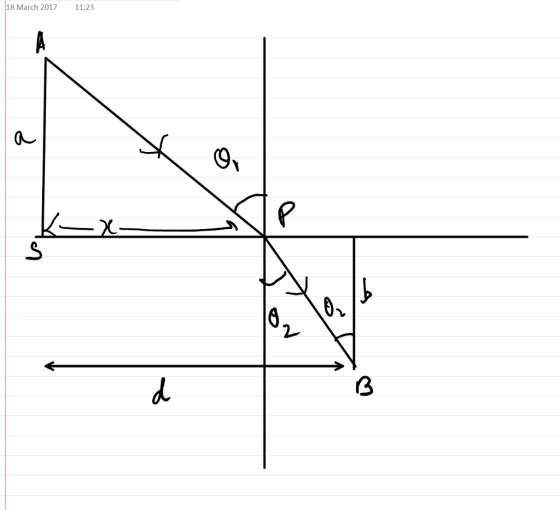
From figure , which shows that the points A and B are in ywo
optically different medium with their refractive index  and
and
 respectively. Lets the velocity at the two side of the moundary are
 and
and  respectively. From
figure, total time of travel is,
respectively. From
figure, total time of travel is,

By using relation
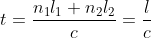
Where  is optical path length.
According to fermat principle ,
is optical path length.
According to fermat principle ,

hence
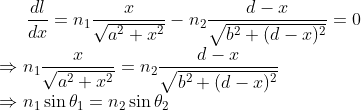
Which is Snells law.
Add Answer to:
Derive Snell's law from Fermat's Principle. Assume that the interface between the two materials is a...
.8,Snell's law may also be derived by using Fermat's principle, which states that a ray from...
 .8,Snell's law may also be derived by using Fermat's principle, which states that a ray from one fixed point to another will follow a path which minimizes the propagation time between the two points. As an analogy, consider a farmer standing in a flat, dry field who suddenly notices that his tractor is on fire in a freshly plowed neighboring field. The farmer wishes to run to his tractor in the shortest time. His running speed in the dry field...
VE 3. (Similar to problem 2.11 from the textbook.) Using the Fermat's principle of least time...
 VE 3. (Similar to problem 2.11 from the textbook.) Using the Fermat's principle of least time derive Snell's Law (the relationship between the angles of incidence and refraction) for an incident P-wave and refracted S-wave. Use Fig. 1 and the notation in the figure to set up and solve the problem. (a) A (b) A Fig. 1
(a) When discussing reflection and refraction of an electromagnetic interface between two materials, explain what is...
 (a) When discussing reflection and refraction of an electromagnetic interface between two materials, explain what is meant by the "Plane of Incidence". Go on to describe the two polarisation states of light with respect to the this plane. Include a suitable diagram in your answer 6. wave at an [6] (b) State the four boundary conditions that must be satisfied by dielectric interface an electromagnetic [6] wave incident on a (c) Consider a beam of light polarised parallel to the...
Partner: Date Name 11 Snell's Law Introduction When light passes from one material to another it ...
 Partner: Date Name 11 Snell's Law Introduction When light passes from one material to another it is always bent away from its original path. This process is known as refraction and the change in direction depends on the change in optical density (or refractive index) of the two materials. A larger change in refractive index results in a larger change in angle between incoming and outgoing light beams. A light beam bends closer to the normal in the material with...
Match the following two columns Refractive Index Law of reflection Snell's law ( ) Real image...
 Match the following two columns Refractive Index Law of reflection Snell's law ( ) Real image ( )Focal point () Focal length () Concave mirror Concave lens in air ( ) Virtual Image () Fiber guide (Light pipe) 1. Image on a screen 2. Describes refraction at interface 3. Uses total internal reflection 4. Negative for convex mirror 5. Normal Result of diverging lens 6. Ir 7. At infinity for plane mirror 8. Converges parallel rays 9. Diverges parallel rays...
21) Use Snell's Law and a straightedge and protractor to draw the complete path of the beam from ...
 21) Use Snell's Law and a straightedge and protractor to draw the complete path of the beam from the laser shown below, and determine which number on the stick it will hit. The refractive indices of the materials are given. air (n 1.00) 10 20 30 40 50 glass (n 1.7) 01 #21 | #22
21) Use Snell's Law and a straightedge and protractor to draw the complete path of the beam from the laser shown below, and determine which...
21) Use Snell's Law and a straightedge and protractor to draw the complete path of the beam from the laser shown below, and determine which number on the stick it will hit. The refractive indices of the materials are given. air (n 1.00) 10 20 30 40 50 glass (n 1.7) 01 #21 | #22
21) Use Snell's Law and a straightedge and protractor to draw the complete path of the beam from the laser shown below, and determine which...
A light ray is incident on an interface between materials 1 and 2. The light ray...
A light ray is incident on an interface between materials 1 and 2. The light ray starts in medium 1, and has incident angle θi when it strikes the surface. The light ray refracts and continues on in medium 2, bending away from the normal. (a) Draw the path of the light ray. Label in your picture θi . (b) What is bigger, n1 or n2? Explain using Snell’s law.
Recall the boundary conditions on static E and B at an interface between two materials: E,...
 Recall the boundary conditions on static E and B at an interface between two materials: E, and B are always continuous, and H is continuous in the absence of free surface current. What boundary condition(s) does this imply for S? Do they make physical sense? An explanation is required.
Snell's Law and the Law of Reflection explain how light is redirected when it encounters a...
Snell's Law and the Law of Reflection explain how light is redirected when it encounters a surface between two media. In the extreme, light may only reflect at a boundary, and go back into the medium it was in. More often, some of it reflects and some goes through. If the boundary is plane and flat, then these laws are easy to interpret. When the boundary is curved, they describe happens at every point on the surface. One of the...
The figure shows the vertical interface between two transparent materials with different indices of refraction. You...
 The figure shows the vertical interface between two transparent
materials with different indices of refraction. You do not know the
exact value of
for each material, but you are told that total internal reflection
is possible for light rays incident on the interface from the right
side.
Given this information, which of the numbered rays is a possible
refracted ray for the incident ray shown?
The figure shows the vertical interface between two transparent
materials with different indices of refraction. You do not know the
exact value of
for each material, but you are told that total internal reflection
is possible for light rays incident on the interface from the right
side.
Given this information, which of the numbered rays is a possible
refracted ray for the incident ray shown?
 .8,Snell's law may also be derived by using Fermat's principle, which states that a ray from one fixed point to another will follow a path which minimizes the propagation time between the two points. As an analogy, consider a farmer standing in a flat, dry field who suddenly notices that his tractor is on fire in a freshly plowed neighboring field. The farmer wishes to run to his tractor in the shortest time. His running speed in the dry field...
 VE 3. (Similar to problem 2.11 from the textbook.) Using the Fermat's principle of least time derive Snell's Law (the relationship between the angles of incidence and refraction) for an incident P-wave and refracted S-wave. Use Fig. 1 and the notation in the figure to set up and solve the problem. (a) A (b) A Fig. 1
 (a) When discussing reflection and refraction of an electromagnetic interface between two materials, explain what is meant by the "Plane of Incidence". Go on to describe the two polarisation states of light with respect to the this plane. Include a suitable diagram in your answer 6. wave at an [6] (b) State the four boundary conditions that must be satisfied by dielectric interface an electromagnetic [6] wave incident on a (c) Consider a beam of light polarised parallel to the...
 Partner: Date Name 11 Snell's Law Introduction When light passes from one material to another it is always bent away from its original path. This process is known as refraction and the change in direction depends on the change in optical density (or refractive index) of the two materials. A larger change in refractive index results in a larger change in angle between incoming and outgoing light beams. A light beam bends closer to the normal in the material with...
 Match the following two columns Refractive Index Law of reflection Snell's law ( ) Real image ( )Focal point () Focal length () Concave mirror Concave lens in air ( ) Virtual Image () Fiber guide (Light pipe) 1. Image on a screen 2. Describes refraction at interface 3. Uses total internal reflection 4. Negative for convex mirror 5. Normal Result of diverging lens 6. Ir 7. At infinity for plane mirror 8. Converges parallel rays 9. Diverges parallel rays...
 21) Use Snell's Law and a straightedge and protractor to draw the complete path of the beam from the laser shown below, and determine which number on the stick it will hit. The refractive indices of the materials are given. air (n 1.00) 10 20 30 40 50 glass (n 1.7) 01 #21 | #22
21) Use Snell's Law and a straightedge and protractor to draw the complete path of the beam from the laser shown below, and determine which...
21) Use Snell's Law and a straightedge and protractor to draw the complete path of the beam from the laser shown below, and determine which number on the stick it will hit. The refractive indices of the materials are given. air (n 1.00) 10 20 30 40 50 glass (n 1.7) 01 #21 | #22
21) Use Snell's Law and a straightedge and protractor to draw the complete path of the beam from the laser shown below, and determine which...
 Recall the boundary conditions on static E and B at an interface between two materials: E, and B are always continuous, and H is continuous in the absence of free surface current. What boundary condition(s) does this imply for S? Do they make physical sense? An explanation is required.
 The figure shows the vertical interface between two transparent
materials with different indices of refraction. You do not know the
exact value of
for each material, but you are told that total internal reflection
is possible for light rays incident on the interface from the right
side.
Given this information, which of the numbered rays is a possible
refracted ray for the incident ray shown?
The figure shows the vertical interface between two transparent
materials with different indices of refraction. You do not know the
exact value of
for each material, but you are told that total internal reflection
is possible for light rays incident on the interface from the right
side.
Given this information, which of the numbered rays is a possible
refracted ray for the incident ray shown?
Most questions answered within 3 hours.
-
Where is the error in this code sequence?
String s1 = "Hello";
String s2 = "ello";...
asked 10 months ago -
Financial data for Joel de Paris, Inc., for last year
follow:
Joel de Paris, Inc.
Balance...
asked 10 months ago -
Consider this reaction:
Al2(SO4)3 (aq)+ BaCl3
(aq) Al2Cl6 (aq)- +
3BaSO4(s) . What is the...
asked 10 months ago -
Suppose that Savneet is considering increasing her
recent random sample from 20 car rentals to 40...
asked 10 months ago -
Trucks arrive at an unloading terminal at an average rate of 120
per hour.
Trucks arrive...
asked 10 months ago -
Why are methanol and ethanol completely soluble in water while
octanol is not very little soluble....
asked 10 months ago -
A facilities manager at a university reads in a research report
that the mean amount of...
asked 10 months ago -
When the CuSO4 is rehydrated by adding water to the anhydrous
compound, is this an endothermic...
asked 10 months ago -
A ray of sunlight is passing from diamond into crown glass; the
angle of incidence is...
asked 10 months ago -
A block of mass 0.249 kg is placed on top of a light, vertical
spring of...
asked 10 months ago -
how do the kidneys compensate in the presences of acidosis
a) trigger hyperventilate
b) reserve acid...
asked 10 months ago -
Question 501 pts
The rental rate of capital to the firm increases. Which of the
following...
asked 10 months ago