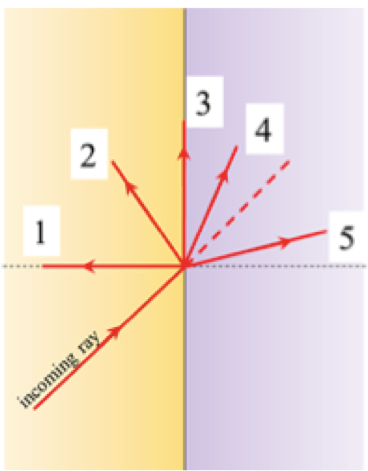
The figure shows the vertical interface between two transparent materials with different indices of refraction. You...
The figure shows the vertical interface between two transparent
materials with different indices of refraction. You do not know the
exact value of  for each material, but you are told that total internal reflection
is possible for light rays incident on the interface from the right
side.
for each material, but you are told that total internal reflection
is possible for light rays incident on the interface from the right
side.
Given this information, which of the numbered rays is a possible refracted ray for the incident ray shown?
Homework Answers
Answer: Numbered 5 is possible refracted ray for the incident ray shown.
Reason and explaination:
Since it is stated that total internal reflection is possible for light ray incident from right side on the interface. It means right side medium is denser with respect to left side, as total internal reflection takes place when ray is incident from denser medium to rarer. When ray is incident from denser to rarer then ray bend away from normal and then if we increase the angle of incidence then , at a particular value of angle of incidence the angle of refraction is 900. This angle of refraction is called critical angle. When ray is incident more that critical angle then ray reflects back to same medium.
Since it is decided now that right side medium is denser so it is clear now that when incident ray is from left means ray is incident from rarer to denser, hence it will bend towards the normal. Ray numbered 5 is the refracted ray in this case for the incident shown.
Add Answer to:
The figure shows the vertical interface between two transparent
materials with different indices of refraction. You...
At an interface between an unknown transparent materials and water, a ray of light is incident...
At an interface between an unknown transparent materials and water, a ray of light is incident from the water side at an angle of 45 degree to the normal. The refracted ray makes an angle of 36.8 degree with the normal. A) What is the index of refraction for the unknown materials? B) what is the critical angle for total internal reflection for the interface described? C) make a drawing showing the geometry for rays that would undergo total internal reflection...
At an interface between an unknown transparent material and water, a ray of light is incident...
At an interface between an unknown transparent material and water, a ray of light is incident from the water side at an angle of 30.0 degrees to the normal. The refracted ray makes an angle of 25.0 degrees. A) what is the index of refraction for the unknown material? B) what is the critical angle for total internal reflection for the interface described? C) Make a drawing showing the geometry for rays that would undergo total internal reflection at this...
An incident coherent light ray strikes the interface between two different media with indices of refraction...
An incident coherent light ray strikes the interface between two different media with indices of refraction n1 and n2 (see figure below). Part of the ray gets reflected, and part of the ray gets refracted. Based on the information shown in the figure, which of the following is true? Let v1 and v2 be the speed of light in media 1 and 2, respectively. v1 < v2 v1 = v2 The reflected ray undergoes no phase shift relative to the...
UIDE QUESTIONS 1. If the transparent material has an index of refraction of 1.60, what is...
 UIDE QUESTIONS 1. If the transparent material has an index of refraction of 1.60, what is the angle of incidence beyond which total internal reflection occurs? 2. Is it possible for the critical angle to exist when light goes from air ( n = 1.00 ) into water (n 1.33)? Explain your answer. PROBLEMS 1. A ray of light from air, incident at an angle of 60° on top of a transparent surface, is refracted and reflected partly. It is...
water interface (the surface of the lake), it is partly reflected back into the air and...
 water interface (the surface of the lake), it is partly
reflected back into the air and partly refracted
or transmitted into the water. This explains why on the surface of
a lake sometimes you see the reflection of the surrounding
landscape and other times the underwater vegetation.
These effects on light propagation occur because light travels at
different speeds depending on the medium. The index of refraction
of a material, denoted by n, gives an indication of the speed of...
water interface (the surface of the lake), it is partly
reflected back into the air and partly refracted
or transmitted into the water. This explains why on the surface of
a lake sometimes you see the reflection of the surrounding
landscape and other times the underwater vegetation.
These effects on light propagation occur because light travels at
different speeds depending on the medium. The index of refraction
of a material, denoted by n, gives an indication of the speed of...
The drawing shows a ray of light traveling through three materials whose surfaces are parallel to...
 The drawing shows a ray of light traveling through three
materials whose surfaces are parallel to each other. The refracted
rays (but not the reflected rays) are shown as the light passes
through each material. A ray of light strikes the
a–b interface at a 50.0˚ angle of incidence. The
index of refraction of material a is
na = 1.20. The angles of refraction in
materials b and c are, respectively, 44.0˚ and
53.5˚. Find the indices of refraction in...
The drawing shows a ray of light traveling through three
materials whose surfaces are parallel to each other. The refracted
rays (but not the reflected rays) are shown as the light passes
through each material. A ray of light strikes the
a–b interface at a 50.0˚ angle of incidence. The
index of refraction of material a is
na = 1.20. The angles of refraction in
materials b and c are, respectively, 44.0˚ and
53.5˚. Find the indices of refraction in...
The drawing shows a ray of light traveling through three materials whose surfaces are parallel to...
 The drawing shows a ray of light traveling through three materials whose surfaces are parallel to each other. The refracted rays (but not the reflected rays) are shown as the light passes through each material. A ray of light strikes the a-b interface at a 50.0 degree angle of incidence. The index of refraction of material a is n_a = 1.20. The angles of refraction in materials b and c are, respectively, 45.0 degree and 56.7 degree. Find the indices...
The figure below shows the path of a light beam through several slabs with different indices...
 The
figure below shows the path of a light beam through several slabs
with different indices of refraction. (n4 = 1.06)
The figure below shows the path of a light beam through several slabs with different indices of refraction. (n4 1.06) n1.60 1.40 1.20 (a) If 01 33.0°, what is the angle 02 of the emerging beam? (b) What must the incident angle 01 be to have total internal reflection at the surface between the medium with n 1.20 and...
The
figure below shows the path of a light beam through several slabs
with different indices of refraction. (n4 = 1.06)
The figure below shows the path of a light beam through several slabs with different indices of refraction. (n4 1.06) n1.60 1.40 1.20 (a) If 01 33.0°, what is the angle 02 of the emerging beam? (b) What must the incident angle 01 be to have total internal reflection at the surface between the medium with n 1.20 and...
The drawing shows a ray of light traveling through three materials whose surfaces are parallel to...
 The drawing shows a ray of light traveling through three
materials whose surfaces are parallel to each other. The refracted
rays (but not the reflected rays) are shown as the light passes
through each material. A ray of light strikes the a–b interface at
a 50.0˚ angle of incidence. The index of refraction of material a
is na = 1.20. The angles of refraction in materials b and c are,
respectively, 38.7˚ and 58.1˚. Find the indices of refraction in...
The drawing shows a ray of light traveling through three
materials whose surfaces are parallel to each other. The refracted
rays (but not the reflected rays) are shown as the light passes
through each material. A ray of light strikes the a–b interface at
a 50.0˚ angle of incidence. The index of refraction of material a
is na = 1.20. The angles of refraction in materials b and c are,
respectively, 38.7˚ and 58.1˚. Find the indices of refraction in...
(a) When discussing reflection and refraction of an electromagnetic interface between two materials, explain what is...
 (a) When discussing reflection and refraction of an electromagnetic interface between two materials, explain what is meant by the "Plane of Incidence". Go on to describe the two polarisation states of light with respect to the this plane. Include a suitable diagram in your answer 6. wave at an [6] (b) State the four boundary conditions that must be satisfied by dielectric interface an electromagnetic [6] wave incident on a (c) Consider a beam of light polarised parallel to the...
 UIDE QUESTIONS 1. If the transparent material has an index of refraction of 1.60, what is the angle of incidence beyond which total internal reflection occurs? 2. Is it possible for the critical angle to exist when light goes from air ( n = 1.00 ) into water (n 1.33)? Explain your answer. PROBLEMS 1. A ray of light from air, incident at an angle of 60° on top of a transparent surface, is refracted and reflected partly. It is...
 water interface (the surface of the lake), it is partly
reflected back into the air and partly refracted
or transmitted into the water. This explains why on the surface of
a lake sometimes you see the reflection of the surrounding
landscape and other times the underwater vegetation.
These effects on light propagation occur because light travels at
different speeds depending on the medium. The index of refraction
of a material, denoted by n, gives an indication of the speed of...
water interface (the surface of the lake), it is partly
reflected back into the air and partly refracted
or transmitted into the water. This explains why on the surface of
a lake sometimes you see the reflection of the surrounding
landscape and other times the underwater vegetation.
These effects on light propagation occur because light travels at
different speeds depending on the medium. The index of refraction
of a material, denoted by n, gives an indication of the speed of...
 The drawing shows a ray of light traveling through three materials whose surfaces are parallel to each other. The refracted rays (but not the reflected rays) are shown as the light passes through each material. A ray of light strikes the a-b interface at a 50.0 degree angle of incidence. The index of refraction of material a is n_a = 1.20. The angles of refraction in materials b and c are, respectively, 45.0 degree and 56.7 degree. Find the indices...
 The
figure below shows the path of a light beam through several slabs
with different indices of refraction. (n4 = 1.06)
The figure below shows the path of a light beam through several slabs with different indices of refraction. (n4 1.06) n1.60 1.40 1.20 (a) If 01 33.0°, what is the angle 02 of the emerging beam? (b) What must the incident angle 01 be to have total internal reflection at the surface between the medium with n 1.20 and...
The
figure below shows the path of a light beam through several slabs
with different indices of refraction. (n4 = 1.06)
The figure below shows the path of a light beam through several slabs with different indices of refraction. (n4 1.06) n1.60 1.40 1.20 (a) If 01 33.0°, what is the angle 02 of the emerging beam? (b) What must the incident angle 01 be to have total internal reflection at the surface between the medium with n 1.20 and...
 The drawing shows a ray of light traveling through three
materials whose surfaces are parallel to each other. The refracted
rays (but not the reflected rays) are shown as the light passes
through each material. A ray of light strikes the a–b interface at
a 50.0˚ angle of incidence. The index of refraction of material a
is na = 1.20. The angles of refraction in materials b and c are,
respectively, 38.7˚ and 58.1˚. Find the indices of refraction in...
The drawing shows a ray of light traveling through three
materials whose surfaces are parallel to each other. The refracted
rays (but not the reflected rays) are shown as the light passes
through each material. A ray of light strikes the a–b interface at
a 50.0˚ angle of incidence. The index of refraction of material a
is na = 1.20. The angles of refraction in materials b and c are,
respectively, 38.7˚ and 58.1˚. Find the indices of refraction in...
 (a) When discussing reflection and refraction of an electromagnetic interface between two materials, explain what is meant by the "Plane of Incidence". Go on to describe the two polarisation states of light with respect to the this plane. Include a suitable diagram in your answer 6. wave at an [6] (b) State the four boundary conditions that must be satisfied by dielectric interface an electromagnetic [6] wave incident on a (c) Consider a beam of light polarised parallel to the...
Most questions answered within 3 hours.
-
Where is the error in this code sequence?
String s1 = "Hello";
String s2 = "ello";...
asked 10 months ago -
Financial data for Joel de Paris, Inc., for last year
follow:
Joel de Paris, Inc.
Balance...
asked 10 months ago -
Consider this reaction:
Al2(SO4)3 (aq)+ BaCl3
(aq) Al2Cl6 (aq)- +
3BaSO4(s) . What is the...
asked 10 months ago -
Suppose that Savneet is considering increasing her
recent random sample from 20 car rentals to 40...
asked 10 months ago -
Trucks arrive at an unloading terminal at an average rate of 120
per hour.
Trucks arrive...
asked 10 months ago -
Why are methanol and ethanol completely soluble in water while
octanol is not very little soluble....
asked 10 months ago -
A facilities manager at a university reads in a research report
that the mean amount of...
asked 10 months ago -
When the CuSO4 is rehydrated by adding water to the anhydrous
compound, is this an endothermic...
asked 10 months ago -
A ray of sunlight is passing from diamond into crown glass; the
angle of incidence is...
asked 10 months ago -
A block of mass 0.249 kg is placed on top of a light, vertical
spring of...
asked 10 months ago -
how do the kidneys compensate in the presences of acidosis
a) trigger hyperventilate
b) reserve acid...
asked 10 months ago -
Question 501 pts
The rental rate of capital to the firm increases. Which of the
following...
asked 10 months ago