

Homework Answers
Dear student,
Find this solution, and RATE IT ,If you find it is helpful .your rating is very important to me.If any incorrectness ,kindly let me know I will rectify them soon.
Thanks for asking ..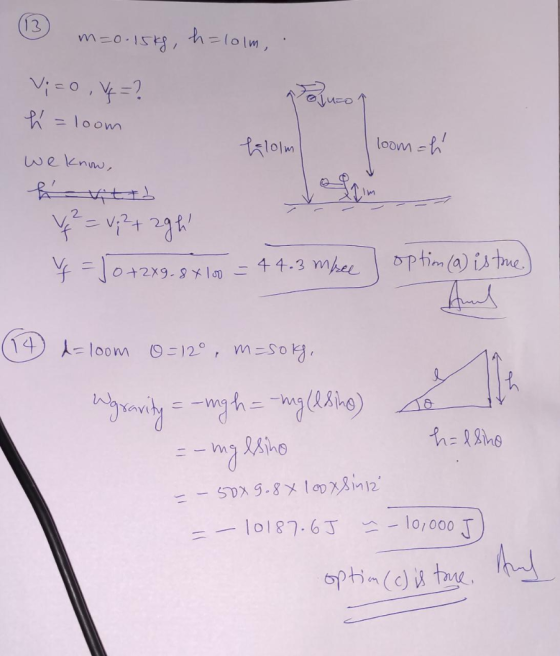
Add Answer to:
13. A baseball catcher puts on an exhibition by catching a 0.15-kg ball dropped from a...
A baseball catcher is catching a fastball that is thrown at 43m/s (96 mi/h) by...
A baseball catcher is catching a fastball that is thrown at 43 m/s (96 mi/h) by the pitcher. If the mass of the ball is 0.15 kg and if the catcher moves his mitt backward toward his body by 8.0 cm as the ball lands in the glove, what is the magnitude of the average force acting on the catcher's mitt? Estimate the time interval required for the catcher to move his hands.
A 0.15 kg baseball is pitched with a speed of 35m/s. When the ball hits the...
A 0.15 kg baseball is pitched with a speed of 35m/s. When the ball hits the catcher's mitt, the glove moves back by 5.0 cm as it stops the ball. Assuming a constant acceleration what was the magnitude of the average net force applied to the baseball by the catcher's mitt?
A baseball catcher extends his arm straight up to catch a fast ball with a speed...
A baseball catcher extends his arm straight up to catch a fast ball with a speed of 45 m/s. The baseball is 0.145 kg and the catcher's arm length is 0.65 m and mass 4.5 kg. (Indicate the direction with the signs of your answers.) (a) What is the angular velocity (in rad/s) of the arm immediately after catching the ball as measured from the arm socket? (Assume his arm rotates counterclockwise after catching the ball.) rad/s (b) What is...
8.34 A catcher catches a 145 g baseball traveling horizontally at 30.0 m/s . A. How large an impulse does the ball gi...
8.34 A catcher catches a 145 g baseball traveling horizontally at 30.0 m/s . A. How large an impulse does the ball give to the catcher? ANSWER: p= ___________ Kg*m/s B. If it takes the ball 25.0 ms to stop once it is in contact with the catcher's glove, what average force did the ball exert on the catcher? ANSWER: F= __________ N
A pitcher throws a 0.145 kg baseball at 40.19 m/s at the catcher (who is standing...
A pitcher throws a 0.145 kg baseball at 40.19 m/s at the catcher (who is standing still). It takes the catcher 0.07 seconds to stop the baseball after catching it. What was average force required to catch the ball?
1 A ball is dropped from 20.0 ft above the ground. Using energy considerations only, what...
 1 A ball is dropped from 20.0 ft above the ground. Using energy considerations only, what is the velocity (in ft/s) of the ball just as it hits the ground? Enter answer 2 What is the velocity (in m/s) of a 55.0 kg jogger with a kinetic energy of 1,380.0 J? Enter answer 3. A small sports car and a pickup truck start coasting down a 35.0 m hill together, side by side Assuming no friction, what is the velocity...
A baseball catcher moves his glove away from a 34.0 m/s fastball as he catches it....
A baseball catcher moves his glove away from a 34.0 m/s fastball as he catches it. If the average force he exerts on the ball is 1.12 103 N, how far does the glove move? Assume constant deceleration of the ball, which has a mass of 0.142 kg
A billiard ball of mass 0.15 kg is dropped from a four story building, corresponding to...
 A billiard ball of mass 0.15 kg is dropped from a four story building, corresponding to a height of 12 m. If mechanical energy is conserved, what are the (1) kinetic energy and (2) the velocity of the ball just before it strikes the ground surface? Assume that the ball remains intact after impact and that the collision is elastic (kinetic energy is conserved). By using the definitions given for the kinetic theory of gases in Chapter 1, what is...
5. A 0.6 kg ball is dropped with no initial speed from a height of 8...
5. A 0.6 kg ball is dropped with no initial speed from a height of 8 m. The ball bounces off the ground vertically, reaching a height of 7 m. Calculate: (i) The speed of the ball when it hits the ground. (ii) The speed of the ball when it nounces off the ground. (iii) The (magnitude of the) impulse provided by the ground. 6. A 0.2 kg ball hits a bat at 20 m/s and bounces back at 40...
A baseball is dropped from rest from a height of 1.6 m from the ground. What...
 A baseball is dropped from rest from a height of 1.6 m from the ground. What is its velocity when it hits the ground? O a.3.1 m/s O b.9.8 m/s O c.5.6 m/s O d. 2.1 m/s O e.7.3 m/s & QUESTION 2 Continuing from the previous problem, how long was it in the air? O a. 6.2 s O b.4.3 OC.5.1 s O d.1.0 S O e.0.6s
 1 A ball is dropped from 20.0 ft above the ground. Using energy considerations only, what is the velocity (in ft/s) of the ball just as it hits the ground? Enter answer 2 What is the velocity (in m/s) of a 55.0 kg jogger with a kinetic energy of 1,380.0 J? Enter answer 3. A small sports car and a pickup truck start coasting down a 35.0 m hill together, side by side Assuming no friction, what is the velocity...
 A billiard ball of mass 0.15 kg is dropped from a four story building, corresponding to a height of 12 m. If mechanical energy is conserved, what are the (1) kinetic energy and (2) the velocity of the ball just before it strikes the ground surface? Assume that the ball remains intact after impact and that the collision is elastic (kinetic energy is conserved). By using the definitions given for the kinetic theory of gases in Chapter 1, what is...
 A baseball is dropped from rest from a height of 1.6 m from the ground. What is its velocity when it hits the ground? O a.3.1 m/s O b.9.8 m/s O c.5.6 m/s O d. 2.1 m/s O e.7.3 m/s & QUESTION 2 Continuing from the previous problem, how long was it in the air? O a. 6.2 s O b.4.3 OC.5.1 s O d.1.0 S O e.0.6s
Most questions answered within 3 hours.
-
Where is the error in this code sequence?
String s1 = "Hello";
String s2 = "ello";...
asked 10 months ago -
Financial data for Joel de Paris, Inc., for last year
follow:
Joel de Paris, Inc.
Balance...
asked 10 months ago -
Consider this reaction:
Al2(SO4)3 (aq)+ BaCl3
(aq) Al2Cl6 (aq)- +
3BaSO4(s) . What is the...
asked 10 months ago -
Suppose that Savneet is considering increasing her
recent random sample from 20 car rentals to 40...
asked 10 months ago -
Trucks arrive at an unloading terminal at an average rate of 120
per hour.
Trucks arrive...
asked 10 months ago -
Why are methanol and ethanol completely soluble in water while
octanol is not very little soluble....
asked 10 months ago -
A facilities manager at a university reads in a research report
that the mean amount of...
asked 10 months ago -
When the CuSO4 is rehydrated by adding water to the anhydrous
compound, is this an endothermic...
asked 10 months ago -
A ray of sunlight is passing from diamond into crown glass; the
angle of incidence is...
asked 10 months ago -
A block of mass 0.249 kg is placed on top of a light, vertical
spring of...
asked 10 months ago -
how do the kidneys compensate in the presences of acidosis
a) trigger hyperventilate
b) reserve acid...
asked 10 months ago -
Question 501 pts
The rental rate of capital to the firm increases. Which of the
following...
asked 10 months ago