 please show mechanism arrows with steps
Homework Answers
The product of the given epoxide reaction in acidic conditions is to be determined.

Epoxides are cyclic ethers which have a lot of ring strain, so opening of epoxide is very common reaction when epoxide undergoes solvolysis.
When epoxides are reacted with methanol in slightly acidic medium, then ring opening occurs by SN1 mechanism and the nucleophilic attack occurs at more substituted carbon atom.
It occurs in two steps-
Oxygen atom of epoxide is protonated to turn it into a good leaving group.
Then nucleophile attacks at the most substituted carbon.

Thus, for the given reaction, nucleophile is CH3O- and acid is H2SO4.

Add Answer to:
please show mechanism arrows with steps
4. Determine the product of the following epoxide reaction in...
please help with mechanism 4. Draw the mechanism for the following reaction using curved arrows. NaBH...
 please help with mechanism
4. Draw the mechanism for the following reaction using curved arrows. NaBH CH3OH OH
please help with mechanism
4. Draw the mechanism for the following reaction using curved arrows. NaBH CH3OH OH
4. It is known that an epoxide can be made in the following way: олон кон anok - epoxide a. Propose a mechanism, us...
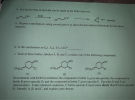 4. It is known that an epoxide can be made in the following way: олон кон anok - epoxide a. Propose a mechanism, using curved arrows to show the movement of electrons for the above reaction. b. Is this mechanism an S1, S2, E1, or E2? c. Each of three bottles, labeled A, B, and C. contains one of the following compounds: (3) (2) On treatment with KOH in methanol, the compound in bottle A gives no epoxide; the compound...
The product is the epoxide shown below. H3C b Write a mechanism for the reaction using...
 The product is the epoxide shown below. H3C b Write a mechanism for the reaction using curved arrows to show electron reorganization. Arrow-pushing Instructions no-X HH :0: H₃C CH₃
Provide a mechanism for the following reaction. Please show all intermediates and use arrows to show...
 Provide a mechanism for the following reaction. Please show all intermediates and use arrows to show the movement of electrons. Propose a synthesis for the following compound. You may use any reagents needed. Complete the synthesis in 4 steps or less (more than one step is needed).
Only using E1 and E2 and please show mechanism. Thank you. Determine the major elimination product(s)...
 Only using E1 and E2 and please show mechanism. Thank
you.
Determine the major elimination product(s) for each of the following reactions. addition, please state the mechanism that is employed in the formation product. (12 points) HO H2SO4 Br NaOC(CH3)3 CH3OH CH3OH Heat
Only using E1 and E2 and please show mechanism. Thank
you.
Determine the major elimination product(s) for each of the following reactions. addition, please state the mechanism that is employed in the formation product. (12 points) HO H2SO4 Br NaOC(CH3)3 CH3OH CH3OH Heat
For the mechanism, show all the steps with multiple reaction arrows, electron arrows, formal charges, etc. CONCEPT QUES...
 For the mechanism, show all the steps with multiple reaction
arrows, electron arrows, formal charges, etc.
CONCEPT QUESTIONS Predict the Product. Provide the stable organic product(s) for the reactions below. 1. Mgº, CH3CH2OCH,CH3 2. CO2 (g) 3. H20, HCI 1. MgBr (1eq.) 2. H20, HCI Mechanism. Using ChemDraw, provide the complete mechanism for the following transformation. You must include appropriate arrows, intermediates, and formal charges. 1. MgCI 2. H20, HCI
For the mechanism, show all the steps with multiple reaction
arrows, electron arrows, formal charges, etc.
CONCEPT QUESTIONS Predict the Product. Provide the stable organic product(s) for the reactions below. 1. Mgº, CH3CH2OCH,CH3 2. CO2 (g) 3. H20, HCI 1. MgBr (1eq.) 2. H20, HCI Mechanism. Using ChemDraw, provide the complete mechanism for the following transformation. You must include appropriate arrows, intermediates, and formal charges. 1. MgCI 2. H20, HCI
What is the mechanism and main product for the following series of reactions? Please show arrows,...
 What is the mechanism and main product for the following series
of reactions?
Please show arrows, steps, main product and mechanisms of each
clearly! Thank you in advance.
3.) What is the mechanism and main product for the following series of reactions? (5 points) 1.) Br, hv 2.) Na CN 3.) excess H2O 5.) What is the mechanism and main product for the following series or reactions? (5 points) 1.) I, hv 2.) NaOH 3.) PCC 4.) HN-NH, H cat....
What is the mechanism and main product for the following series
of reactions?
Please show arrows, steps, main product and mechanisms of each
clearly! Thank you in advance.
3.) What is the mechanism and main product for the following series of reactions? (5 points) 1.) Br, hv 2.) Na CN 3.) excess H2O 5.) What is the mechanism and main product for the following series or reactions? (5 points) 1.) I, hv 2.) NaOH 3.) PCC 4.) HN-NH, H cat....
please show all steps including each mechanism (arrows) and also if SN1 has any rearrangements of...
 please show all steps including each mechanism (arrows) and
also if SN1 has any rearrangements of carbocation intermediate
through a hydride shift and/or methyl shift. DO NOT NEED
ELIMINATION. ONLY SUBSTITUTION.
Sy1/E1 versus S2/E2 Learning Checks Draw the major organic substitution and/or elimination products in the following reactions. If no reaction is possible, write “No Reaction". Substitution Product(s) Elimination Product(s) 2) 2) OH BrCH K* -Ot-Bu NaOCH н"Сн, сн,он нсн, Ph NaOCH Br H CH3OH CH NaOCH NaOH T.CH, I...
please show all steps including each mechanism (arrows) and
also if SN1 has any rearrangements of carbocation intermediate
through a hydride shift and/or methyl shift. DO NOT NEED
ELIMINATION. ONLY SUBSTITUTION.
Sy1/E1 versus S2/E2 Learning Checks Draw the major organic substitution and/or elimination products in the following reactions. If no reaction is possible, write “No Reaction". Substitution Product(s) Elimination Product(s) 2) 2) OH BrCH K* -Ot-Bu NaOCH н"Сн, сн,он нсн, Ph NaOCH Br H CH3OH CH NaOCH NaOH T.CH, I...
please show all steps (a) Write the reaction mechanism for the hydrolysis of the amide under...
 please show all steps
(a) Write the reaction mechanism for the hydrolysis of the amide under acidic conditions: 2 Et Н,о° heat OH + EtzNH2 Et (b) Write the reaction mechanism for the base catalyzed hydrolysis of the ester Na +n-BuOH OBu NaOH (aq)
please show all steps
(a) Write the reaction mechanism for the hydrolysis of the amide under acidic conditions: 2 Et Н,о° heat OH + EtzNH2 Et (b) Write the reaction mechanism for the base catalyzed hydrolysis of the ester Na +n-BuOH OBu NaOH (aq)
4. Propose a mechanism for the following reaction, as in show all the arrows and all intermediates (if any) that wo...
 4. Propose a mechanism for the following reaction, as in show all the arrows and all intermediates (if any) that would eventually provide you the product from the alkyl iodide to the resulting alkene (a) is the product above the Zaitsev product? Why? (yes/no) (b) How would you change the reaction conditions to specifically get the alkene product drawn below instead: Base Solvent Temperature (c) How would you change the reaction conditions to specifically get the following substitution product drawn...
 please help with mechanism
4. Draw the mechanism for the following reaction using curved arrows. NaBH CH3OH OH
please help with mechanism
4. Draw the mechanism for the following reaction using curved arrows. NaBH CH3OH OH
 4. It is known that an epoxide can be made in the following way: олон кон anok - epoxide a. Propose a mechanism, using curved arrows to show the movement of electrons for the above reaction. b. Is this mechanism an S1, S2, E1, or E2? c. Each of three bottles, labeled A, B, and C. contains one of the following compounds: (3) (2) On treatment with KOH in methanol, the compound in bottle A gives no epoxide; the compound...
 The product is the epoxide shown below. H3C b Write a mechanism for the reaction using curved arrows to show electron reorganization. Arrow-pushing Instructions no-X HH :0: H₃C CH₃
 Provide a mechanism for the following reaction. Please show all intermediates and use arrows to show the movement of electrons. Propose a synthesis for the following compound. You may use any reagents needed. Complete the synthesis in 4 steps or less (more than one step is needed).
 Only using E1 and E2 and please show mechanism. Thank
you.
Determine the major elimination product(s) for each of the following reactions. addition, please state the mechanism that is employed in the formation product. (12 points) HO H2SO4 Br NaOC(CH3)3 CH3OH CH3OH Heat
Only using E1 and E2 and please show mechanism. Thank
you.
Determine the major elimination product(s) for each of the following reactions. addition, please state the mechanism that is employed in the formation product. (12 points) HO H2SO4 Br NaOC(CH3)3 CH3OH CH3OH Heat
 For the mechanism, show all the steps with multiple reaction
arrows, electron arrows, formal charges, etc.
CONCEPT QUESTIONS Predict the Product. Provide the stable organic product(s) for the reactions below. 1. Mgº, CH3CH2OCH,CH3 2. CO2 (g) 3. H20, HCI 1. MgBr (1eq.) 2. H20, HCI Mechanism. Using ChemDraw, provide the complete mechanism for the following transformation. You must include appropriate arrows, intermediates, and formal charges. 1. MgCI 2. H20, HCI
For the mechanism, show all the steps with multiple reaction
arrows, electron arrows, formal charges, etc.
CONCEPT QUESTIONS Predict the Product. Provide the stable organic product(s) for the reactions below. 1. Mgº, CH3CH2OCH,CH3 2. CO2 (g) 3. H20, HCI 1. MgBr (1eq.) 2. H20, HCI Mechanism. Using ChemDraw, provide the complete mechanism for the following transformation. You must include appropriate arrows, intermediates, and formal charges. 1. MgCI 2. H20, HCI
 What is the mechanism and main product for the following series
of reactions?
Please show arrows, steps, main product and mechanisms of each
clearly! Thank you in advance.
3.) What is the mechanism and main product for the following series of reactions? (5 points) 1.) Br, hv 2.) Na CN 3.) excess H2O 5.) What is the mechanism and main product for the following series or reactions? (5 points) 1.) I, hv 2.) NaOH 3.) PCC 4.) HN-NH, H cat....
What is the mechanism and main product for the following series
of reactions?
Please show arrows, steps, main product and mechanisms of each
clearly! Thank you in advance.
3.) What is the mechanism and main product for the following series of reactions? (5 points) 1.) Br, hv 2.) Na CN 3.) excess H2O 5.) What is the mechanism and main product for the following series or reactions? (5 points) 1.) I, hv 2.) NaOH 3.) PCC 4.) HN-NH, H cat....
 please show all steps including each mechanism (arrows) and
also if SN1 has any rearrangements of carbocation intermediate
through a hydride shift and/or methyl shift. DO NOT NEED
ELIMINATION. ONLY SUBSTITUTION.
Sy1/E1 versus S2/E2 Learning Checks Draw the major organic substitution and/or elimination products in the following reactions. If no reaction is possible, write “No Reaction". Substitution Product(s) Elimination Product(s) 2) 2) OH BrCH K* -Ot-Bu NaOCH н"Сн, сн,он нсн, Ph NaOCH Br H CH3OH CH NaOCH NaOH T.CH, I...
please show all steps including each mechanism (arrows) and
also if SN1 has any rearrangements of carbocation intermediate
through a hydride shift and/or methyl shift. DO NOT NEED
ELIMINATION. ONLY SUBSTITUTION.
Sy1/E1 versus S2/E2 Learning Checks Draw the major organic substitution and/or elimination products in the following reactions. If no reaction is possible, write “No Reaction". Substitution Product(s) Elimination Product(s) 2) 2) OH BrCH K* -Ot-Bu NaOCH н"Сн, сн,он нсн, Ph NaOCH Br H CH3OH CH NaOCH NaOH T.CH, I...
 please show all steps
(a) Write the reaction mechanism for the hydrolysis of the amide under acidic conditions: 2 Et Н,о° heat OH + EtzNH2 Et (b) Write the reaction mechanism for the base catalyzed hydrolysis of the ester Na +n-BuOH OBu NaOH (aq)
please show all steps
(a) Write the reaction mechanism for the hydrolysis of the amide under acidic conditions: 2 Et Н,о° heat OH + EtzNH2 Et (b) Write the reaction mechanism for the base catalyzed hydrolysis of the ester Na +n-BuOH OBu NaOH (aq)
 4. Propose a mechanism for the following reaction, as in show all the arrows and all intermediates (if any) that would eventually provide you the product from the alkyl iodide to the resulting alkene (a) is the product above the Zaitsev product? Why? (yes/no) (b) How would you change the reaction conditions to specifically get the alkene product drawn below instead: Base Solvent Temperature (c) How would you change the reaction conditions to specifically get the following substitution product drawn...
Most questions answered within 3 hours.
-
Where is the error in this code sequence?
String s1 = "Hello";
String s2 = "ello";...
asked 11 months ago -
Financial data for Joel de Paris, Inc., for last year
follow:
Joel de Paris, Inc.
Balance...
asked 11 months ago -
Consider this reaction:
Al2(SO4)3 (aq)+ BaCl3
(aq) Al2Cl6 (aq)- +
3BaSO4(s) . What is the...
asked 11 months ago -
Suppose that Savneet is considering increasing her
recent random sample from 20 car rentals to 40...
asked 11 months ago -
Trucks arrive at an unloading terminal at an average rate of 120
per hour.
Trucks arrive...
asked 11 months ago -
Why are methanol and ethanol completely soluble in water while
octanol is not very little soluble....
asked 11 months ago -
A facilities manager at a university reads in a research report
that the mean amount of...
asked 11 months ago -
When the CuSO4 is rehydrated by adding water to the anhydrous
compound, is this an endothermic...
asked 11 months ago -
A ray of sunlight is passing from diamond into crown glass; the
angle of incidence is...
asked 11 months ago -
A block of mass 0.249 kg is placed on top of a light, vertical
spring of...
asked 11 months ago -
how do the kidneys compensate in the presences of acidosis
a) trigger hyperventilate
b) reserve acid...
asked 11 months ago -
Question 501 pts
The rental rate of capital to the firm increases. Which of the
following...
asked 11 months ago