
Homework Answers


Add Answer to:
One particle travels along the space curve rı(t) = (t,t?, t) and another particle travels along...
• Only one submission is necessary for each group. = 1. At time t, particle P...
 • Only one submission is necessary for each group. = 1. At time t, particle P has position plt) (1 + 2t, 2 + 5t, 3 – 4t), particle Q has position a(t) (-6+t, -14 + 2t, 2 + 3t), and particle R has position F(t) = (18 – 3t, 10 – 2t, –4 + 4t). (a) Do any of the particles ever collide? Which particles, and when and where do they collide? (b) Do any of the paths of...
(1 point) Consider the curve defined by r()-(--t2, 1 -2t (a) The maximum curvature is max κ = (b)...
 Edit: Please provide the points of intersection so I can see the
methodology. Thanks!
(1 point) Consider the curve defined by r()-(--t2, 1 -2t (a) The maximum curvature is max κ = (b) Consider two particles: one with position r(t) and the other with position S(t) -r e-πιν). Then The two particles A. do not collide and their paths do not intersect. B. collide C. do not collide, but their paths intersect.
(1 point) Consider the curve defined by r()-(--t2,...
Edit: Please provide the points of intersection so I can see the
methodology. Thanks!
(1 point) Consider the curve defined by r()-(--t2, 1 -2t (a) The maximum curvature is max κ = (b) Consider two particles: one with position r(t) and the other with position S(t) -r e-πιν). Then The two particles A. do not collide and their paths do not intersect. B. collide C. do not collide, but their paths intersect.
(1 point) Consider the curve defined by r()-(--t2,...
The journeys of two particles moving in space are described by the linear motions u(s) =...
 The journeys of two particles moving in space are described by the linear motions u(s) = (1, 2, 1) + s(6, -2,8) and v(t) = (-2,3,-3) +t(9, -3, 12) (a) Do the paths of the particles cross each other? (Hint: The paths cross each other exactly when there is a time s and a time t so that the location of the u-particle at time s is the location of the v-particle at time t; i.e. u(s) = v(t).) (b)...
EX #1: For t > 0, a particle moves along a curve so that its position...
 EX #1: For t > 0, a particle moves along a curve so that its position at time t is (x(t), y(t)), where x(t) = 4t and = 1 - 2t. Find the time t at which the speed of the particle is 5.
A particle moves along a space curve,r=r(t) is the time measured from some initial time. if...
A particle moves along a space curve,r=r(t) is the time measured from some initial time. if v=/dr/dt/=ds/dt is the magnitude of the velocity of the particle (s is the arc length along space curve measured from the initial position),prove that the acceleration a of particle is given by a=dv/dtT+v^2/pN where T and N are unit tangent and normal vectors to the space curve and p=|d^2r/ds^2|^-1={(d^2/ds^2)^2+. (d^2y/ds^2)^2 + (d^2z/ds^2)^2}^-1/2
the acceleration of a particle as it moves along a straight line is given by a=(2t-1)m/s^2, where t is in seconds
the acceleration of a particle as it moves along a straight line is given by a=(2t-1)m/s^2, where t is in seconds.if s=1m and v= 2m/s when t=0,determine the particles velocity and position when t=6s. Also, determine the total distance the particle travels during this time period.
I need help with B, C, D. These are Calc 3 problems 32. Suppose a particle...
 I need help with B, C, D. These are Calc 3 problems
32. Suppose a particle of mass m has position given by r(0) =< 1,0,0 >, and velocity given by v(0)0,1,-1 > at time t = 0. Also, assume that for every time t 20 the particle experiences only the force given by the vector function F(t) = m < -cos(t), 0, sin(t) >. Disregard units in this problem a) Use Newton's Second Law, F(t) = ma(t) (where a(t)...
I need help with B, C, D. These are Calc 3 problems
32. Suppose a particle of mass m has position given by r(0) =< 1,0,0 >, and velocity given by v(0)0,1,-1 > at time t = 0. Also, assume that for every time t 20 the particle experiences only the force given by the vector function F(t) = m < -cos(t), 0, sin(t) >. Disregard units in this problem a) Use Newton's Second Law, F(t) = ma(t) (where a(t)...
The table gives coordinates of a particle moving through space along a smooth curve. yz 2.8...
 The table gives coordinates of a particle moving through space along a smooth curve. yz 2.8 9.5 3.8 0 0.5 3.1 7.7 .4 1.0 4.96,2 3.2 5.9 6.8 2.8 1.5 2,0 7,1 7,6 2.7 (a) Find the average velocities over the time intervals [0, 1], [0.5, 1], [1, 21, and [1, 1.5]. (Round your answers to the nearest tenth.) [0, 1] Vave [0.5, 1] Vave 1, 2]: vave 1, 1.5] Vave the particle at t = 1. (Use the time...
The table gives coordinates of a particle moving through space along a smooth curve. 0 2.8...
 The table gives coordinates of a particle moving through space along a smooth curve. 0 2.8 9.6 3.8 0.5 3.7 7.5 3.4 1.0 4.1 6.0 3.0 1.5 5.1 6.8 2.9 2.0 7.6 7.4 2.6 (a) Find the average velocities over the time intervals [0, 1], [0.5, 1], [1, 2], and [1, 1.5]. (Round your answers to the nearest tenth.) [0.5, 1: Vave - [1, 2] Vave [1,15% [1, 1.5]: Vave vave- (b) Estimate the velocity and speed of the particle...
Suppose that the position of one particle at time t is given by y1-2 cost), x,-4 sin(t), ostsZr a...
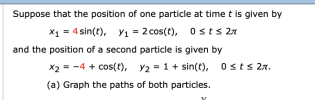 Suppose that the position of one particle at time t is given by y1-2 cost), x,-4 sin(t), ostsZr and the position of a second particle is given by 4 (a) Graph the paths of both particles. We were unable to transcribe this image
Suppose that the position of one particle at time t is given by y1-2 cost), x,-4 sin(t), ostsZr and the position of a second particle is given by 4 (a) Graph the paths of both particles.
Suppose that the position of one particle at time t is given by y1-2 cost), x,-4 sin(t), ostsZr and the position of a second particle is given by 4 (a) Graph the paths of both particles. We were unable to transcribe this image
Suppose that the position of one particle at time t is given by y1-2 cost), x,-4 sin(t), ostsZr and the position of a second particle is given by 4 (a) Graph the paths of both particles.
 • Only one submission is necessary for each group. = 1. At time t, particle P has position plt) (1 + 2t, 2 + 5t, 3 – 4t), particle Q has position a(t) (-6+t, -14 + 2t, 2 + 3t), and particle R has position F(t) = (18 – 3t, 10 – 2t, –4 + 4t). (a) Do any of the particles ever collide? Which particles, and when and where do they collide? (b) Do any of the paths of...
 Edit: Please provide the points of intersection so I can see the
methodology. Thanks!
(1 point) Consider the curve defined by r()-(--t2, 1 -2t (a) The maximum curvature is max κ = (b) Consider two particles: one with position r(t) and the other with position S(t) -r e-πιν). Then The two particles A. do not collide and their paths do not intersect. B. collide C. do not collide, but their paths intersect.
(1 point) Consider the curve defined by r()-(--t2,...
Edit: Please provide the points of intersection so I can see the
methodology. Thanks!
(1 point) Consider the curve defined by r()-(--t2, 1 -2t (a) The maximum curvature is max κ = (b) Consider two particles: one with position r(t) and the other with position S(t) -r e-πιν). Then The two particles A. do not collide and their paths do not intersect. B. collide C. do not collide, but their paths intersect.
(1 point) Consider the curve defined by r()-(--t2,...
 The journeys of two particles moving in space are described by the linear motions u(s) = (1, 2, 1) + s(6, -2,8) and v(t) = (-2,3,-3) +t(9, -3, 12) (a) Do the paths of the particles cross each other? (Hint: The paths cross each other exactly when there is a time s and a time t so that the location of the u-particle at time s is the location of the v-particle at time t; i.e. u(s) = v(t).) (b)...
 EX #1: For t > 0, a particle moves along a curve so that its position at time t is (x(t), y(t)), where x(t) = 4t and = 1 - 2t. Find the time t at which the speed of the particle is 5.
 I need help with B, C, D. These are Calc 3 problems
32. Suppose a particle of mass m has position given by r(0) =< 1,0,0 >, and velocity given by v(0)0,1,-1 > at time t = 0. Also, assume that for every time t 20 the particle experiences only the force given by the vector function F(t) = m < -cos(t), 0, sin(t) >. Disregard units in this problem a) Use Newton's Second Law, F(t) = ma(t) (where a(t)...
I need help with B, C, D. These are Calc 3 problems
32. Suppose a particle of mass m has position given by r(0) =< 1,0,0 >, and velocity given by v(0)0,1,-1 > at time t = 0. Also, assume that for every time t 20 the particle experiences only the force given by the vector function F(t) = m < -cos(t), 0, sin(t) >. Disregard units in this problem a) Use Newton's Second Law, F(t) = ma(t) (where a(t)...
 The table gives coordinates of a particle moving through space along a smooth curve. yz 2.8 9.5 3.8 0 0.5 3.1 7.7 .4 1.0 4.96,2 3.2 5.9 6.8 2.8 1.5 2,0 7,1 7,6 2.7 (a) Find the average velocities over the time intervals [0, 1], [0.5, 1], [1, 21, and [1, 1.5]. (Round your answers to the nearest tenth.) [0, 1] Vave [0.5, 1] Vave 1, 2]: vave 1, 1.5] Vave the particle at t = 1. (Use the time...
 The table gives coordinates of a particle moving through space along a smooth curve. 0 2.8 9.6 3.8 0.5 3.7 7.5 3.4 1.0 4.1 6.0 3.0 1.5 5.1 6.8 2.9 2.0 7.6 7.4 2.6 (a) Find the average velocities over the time intervals [0, 1], [0.5, 1], [1, 2], and [1, 1.5]. (Round your answers to the nearest tenth.) [0.5, 1: Vave - [1, 2] Vave [1,15% [1, 1.5]: Vave vave- (b) Estimate the velocity and speed of the particle...
 Suppose that the position of one particle at time t is given by y1-2 cost), x,-4 sin(t), ostsZr and the position of a second particle is given by 4 (a) Graph the paths of both particles. We were unable to transcribe this image
Suppose that the position of one particle at time t is given by y1-2 cost), x,-4 sin(t), ostsZr and the position of a second particle is given by 4 (a) Graph the paths of both particles.
Suppose that the position of one particle at time t is given by y1-2 cost), x,-4 sin(t), ostsZr and the position of a second particle is given by 4 (a) Graph the paths of both particles. We were unable to transcribe this image
Suppose that the position of one particle at time t is given by y1-2 cost), x,-4 sin(t), ostsZr and the position of a second particle is given by 4 (a) Graph the paths of both particles.
Most questions answered within 3 hours.
-
Where is the error in this code sequence?
String s1 = "Hello";
String s2 = "ello";...
asked 11 months ago -
Financial data for Joel de Paris, Inc., for last year
follow:
Joel de Paris, Inc.
Balance...
asked 11 months ago -
Consider this reaction:
Al2(SO4)3 (aq)+ BaCl3
(aq) Al2Cl6 (aq)- +
3BaSO4(s) . What is the...
asked 11 months ago -
Suppose that Savneet is considering increasing her
recent random sample from 20 car rentals to 40...
asked 11 months ago -
Trucks arrive at an unloading terminal at an average rate of 120
per hour.
Trucks arrive...
asked 11 months ago -
Why are methanol and ethanol completely soluble in water while
octanol is not very little soluble....
asked 11 months ago -
A facilities manager at a university reads in a research report
that the mean amount of...
asked 11 months ago -
When the CuSO4 is rehydrated by adding water to the anhydrous
compound, is this an endothermic...
asked 11 months ago -
A ray of sunlight is passing from diamond into crown glass; the
angle of incidence is...
asked 11 months ago -
A block of mass 0.249 kg is placed on top of a light, vertical
spring of...
asked 11 months ago -
how do the kidneys compensate in the presences of acidosis
a) trigger hyperventilate
b) reserve acid...
asked 11 months ago -
Question 501 pts
The rental rate of capital to the firm increases. Which of the
following...
asked 11 months ago