A particle moves along a space curve,r=r(t) is the time measured from some initial time. if...
A particle moves along a space curve,r=r(t) is the time measured from some initial time. if v=/dr/dt/=ds/dt is the magnitude of the velocity of the particle (s is the arc length along space curve measured from the initial position),prove that the acceleration a of particle is given by a=dv/dtT+v^2/pN where T and N are unit tangent and normal vectors to the space curve and p=|d^2r/ds^2|^-1={(d^2/ds^2)^2+. (d^2y/ds^2)^2 + (d^2z/ds^2)^2}^-1/2
Homework Answers

Add Answer to:
A particle moves along a space curve,r=r(t) is the
time measured from some initial time. if...
A particle moves along the curve y = x^3/2 such that its distance from the origin, measured along...
A particle moves along the curve y = x^3/2 such that its distance from the origin, measured along the curve, is given by s = t^3 . Determine the acceleration in vector form when t = 2 seconds. The units are inches and seconds.
r(t) is the position of a particle in space at time t. Find the angle between...
 r(t) is the position of a particle in space at time t. Find the angle between the velocity and acceleration vectors at time t = 0. r(t) = (ln(t? + 1))i + (tan-At)j + V +2 + 1k
EX #1: For t > 0, a particle moves along a curve so that its position...
 EX #1: For t > 0, a particle moves along a curve so that its position at time t is (x(t), y(t)), where x(t) = 4t and = 1 - 2t. Find the time t at which the speed of the particle is 5.
For t ≥ 0, a particle moves along the x-axis. The velocity of the particle at time t is given by ...
For t ≥ 0, a particle moves along the x-axis. The velocity of the particle at time t is given by v(t)=1+2sin(t^2/2). The particle is at x=2 at time t=4. a)Find position of particle at t=0 b)Find the total distance the particle travels from time t=0 to time t=3
One particle travels along the space curve rı(t) = (t,t?, t) and another particle travels along...
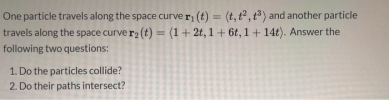 One particle travels along the space curve rı(t) = (t,t?, t) and another particle travels along the space curve rz(t) = (1 + 2t, 1 + 61,1 + 14t). Answer the following two questions: 1. Do the particles collide? 2. Do their paths intersect?
A particle moves along a line with a velocity v(t)=4t−6, measured in meters per second. Find...
A particle moves along a line with a velocity v(t)=4t−6, measured in meters per second. Find the total distance the particle travels over the time interval [0,3] .
(14 pts.) 3. A particle moves along a line so that its velocity at time t...
 (14 pts.) 3. A particle moves along a line so that its velocity at time t is v(t) = + - + - 6 (measured in meters per second). a) Find the displacement of the particle during the time period 1 st 54. b) Find the distance traveled during this time period.
Question 2 A particle moves along a curve given by r(t)-et,t2t> from the point(0,0,0) to the...
 Question 2 A particle moves along a curve given by r(t)-et,t2t> from the point(0,0,0) to the point (1.1.1) under a force given by Fixx.x) - < 2x2, yzyz? > Calculate the work done on the particle by the force. HTME Editor M B 3 x'
3. The particle moves along a planar curve y = et, where r and y are...
 3. The particle moves along a planar curve y = et, where r and y are measured in meters. It has a constant speed v = 12 m/s. Then the tangential and normal components of acceleration are at = m/s2 and an = m/s2 at y= 1 m. (Express the answer to two significant p=(1+roji figures. Hint: ) = (TT51FTS) 13: 23:
A particle moves in the plane with position given by the vector valued function r(t)=cos^3(t)i+sin^3(t)j MA330...
 A particle moves in the plane with position given by the
vector valued function r(t)=cos^3(t)i+sin^3(t)j
MA330 Homework #2 particle moves in the plane with position given by the vector-valued function The curve it generates is called an astrid and is plotted for you below. (a) Find the position att x/4 by evaluating r(x/4). Then draw this vector on the graph (b) Find the velocity vector vt)-r)-.Be sure to apply the power and (e) Find the velocity at t /4 by...
A particle moves in the plane with position given by the
vector valued function r(t)=cos^3(t)i+sin^3(t)j
MA330 Homework #2 particle moves in the plane with position given by the vector-valued function The curve it generates is called an astrid and is plotted for you below. (a) Find the position att x/4 by evaluating r(x/4). Then draw this vector on the graph (b) Find the velocity vector vt)-r)-.Be sure to apply the power and (e) Find the velocity at t /4 by...
 r(t) is the position of a particle in space at time t. Find the angle between the velocity and acceleration vectors at time t = 0. r(t) = (ln(t? + 1))i + (tan-At)j + V +2 + 1k
 EX #1: For t > 0, a particle moves along a curve so that its position at time t is (x(t), y(t)), where x(t) = 4t and = 1 - 2t. Find the time t at which the speed of the particle is 5.
 One particle travels along the space curve rı(t) = (t,t?, t) and another particle travels along the space curve rz(t) = (1 + 2t, 1 + 61,1 + 14t). Answer the following two questions: 1. Do the particles collide? 2. Do their paths intersect?
 (14 pts.) 3. A particle moves along a line so that its velocity at time t is v(t) = + - + - 6 (measured in meters per second). a) Find the displacement of the particle during the time period 1 st 54. b) Find the distance traveled during this time period.
 Question 2 A particle moves along a curve given by r(t)-et,t2t> from the point(0,0,0) to the point (1.1.1) under a force given by Fixx.x) - < 2x2, yzyz? > Calculate the work done on the particle by the force. HTME Editor M B 3 x'
 3. The particle moves along a planar curve y = et, where r and y are measured in meters. It has a constant speed v = 12 m/s. Then the tangential and normal components of acceleration are at = m/s2 and an = m/s2 at y= 1 m. (Express the answer to two significant p=(1+roji figures. Hint: ) = (TT51FTS) 13: 23:
 A particle moves in the plane with position given by the
vector valued function r(t)=cos^3(t)i+sin^3(t)j
MA330 Homework #2 particle moves in the plane with position given by the vector-valued function The curve it generates is called an astrid and is plotted for you below. (a) Find the position att x/4 by evaluating r(x/4). Then draw this vector on the graph (b) Find the velocity vector vt)-r)-.Be sure to apply the power and (e) Find the velocity at t /4 by...
A particle moves in the plane with position given by the
vector valued function r(t)=cos^3(t)i+sin^3(t)j
MA330 Homework #2 particle moves in the plane with position given by the vector-valued function The curve it generates is called an astrid and is plotted for you below. (a) Find the position att x/4 by evaluating r(x/4). Then draw this vector on the graph (b) Find the velocity vector vt)-r)-.Be sure to apply the power and (e) Find the velocity at t /4 by...
Most questions answered within 3 hours.
-
Where is the error in this code sequence?
String s1 = "Hello";
String s2 = "ello";...
asked 10 months ago -
Financial data for Joel de Paris, Inc., for last year
follow:
Joel de Paris, Inc.
Balance...
asked 10 months ago -
Consider this reaction:
Al2(SO4)3 (aq)+ BaCl3
(aq) Al2Cl6 (aq)- +
3BaSO4(s) . What is the...
asked 10 months ago -
Suppose that Savneet is considering increasing her
recent random sample from 20 car rentals to 40...
asked 10 months ago -
Trucks arrive at an unloading terminal at an average rate of 120
per hour.
Trucks arrive...
asked 10 months ago -
Why are methanol and ethanol completely soluble in water while
octanol is not very little soluble....
asked 10 months ago -
A facilities manager at a university reads in a research report
that the mean amount of...
asked 10 months ago -
When the CuSO4 is rehydrated by adding water to the anhydrous
compound, is this an endothermic...
asked 10 months ago -
A ray of sunlight is passing from diamond into crown glass; the
angle of incidence is...
asked 10 months ago -
A block of mass 0.249 kg is placed on top of a light, vertical
spring of...
asked 10 months ago -
how do the kidneys compensate in the presences of acidosis
a) trigger hyperventilate
b) reserve acid...
asked 10 months ago -
Question 501 pts
The rental rate of capital to the firm increases. Which of the
following...
asked 10 months ago