
Homework Answers
Step by step solution are as follows 
Add Answer to:
A Random mass m is located at the origin. Evaluate the work done on a second...
A particle with mass m and charge q is emitted from the origin, (x,y)=(0,0). A large,...
A particle with mass m and charge q is emitted from the origin, (x,y)=(0,0). A large, flat fluorescent screen is located at x=L. There is a target on the screen at y position yh, where yh>0. Ignore gravity in this problem. Part A Suppose the charge is emitted with velocity v0 in the positive x direction. Between the origin and the screen, the charge travels through a constant electric field pointing in the positive y direction. What should the magnitude...
An charge with mass and charge is emitted from the origin, . A large, flat screen...
An charge with mass m and charge q is emitted from the origin, (x, y) = (0, 0). A large, flat screen is located at x=L. There is a target on the screen at y position yh, where yh > 0 . In this problem, you will examine two different ways that the charge might hit the target. Ignore gravity in this problem.Part A:Assume that the charge is emitted with velocity v0 in the positive x direction. Between the origin and...
An object located at the origin and having mass M explodes into 3 pieces having masses M/4, M/8, and 5M/8. The pieces sc...
An object located at the origin and having mass M explodes into 3 pieces having masses M/4, M/8, and 5M/8. The pieces scatter on a horizontal, frictionless xy-plane. The piece with mass M/4 flies away with velocity 7.2 m/s at 37 degrees above the x - axis. The piece with mass M/8 has velocity 4.5 m/s directed at an angle of 45 degrees above the -x axis. a) What are the velocity components of the 3rd piece? b)Describe the motion...
2. A bead of mass m is free to slide along a frictionless wire bent in...
 2. A bead of mass m is free to slide along a frictionless wire bent in the curve yx3 where a is a positive constant. The bead starts from rest at x - a and slides under the influence of a constant gravitational field g pointing in the negative y direction. Find the time required for the bead to reach the origin. Express your answer in terms of the constants a and g Hint: Use the energy method. You may...
Consider a square plate of side a and mass m located with one corner on the...
Consider a square plate of side a and mass m located with one corner on the origin of the x, y plane. Assuming homogeneous surface density, calculate the inertia tensor (remember that it is still a 3 × 3 object). Then calculate the angular momentum around the origin and the rotational kinetic energy if the square is rotating with angular speed ω about (a) the x-axis and (b) the diagonal through the origin.
MY QUESTION involves the problem below: Describe the motion of the mass m under the action...
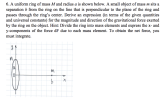 MY QUESTION involves the problem below: Describe the motion of
the mass m under the action of the force you derived and show
whether it is simple harmonic.
Solution to 6:
QUESTION: Describe the motion of the mass m under the
action of the force you derived and show whether it is simple
harmonic in problem 6.
6. A uniform ring of mass M and radius a is shown below. A small object of mass m sitsa n b from...
MY QUESTION involves the problem below: Describe the motion of
the mass m under the action of the force you derived and show
whether it is simple harmonic.
Solution to 6:
QUESTION: Describe the motion of the mass m under the
action of the force you derived and show whether it is simple
harmonic in problem 6.
6. A uniform ring of mass M and radius a is shown below. A small object of mass m sitsa n b from...
Part A How much work must be done on a particle with a mass of m...
 Part A How much work must be done on a particle with a mass of m to accelerate it from rest to a speed of 0.086c? Express your answer in terms of mc. V AED ? WA = mc2 Submit Previous Answers Request Answer X Incorrect; Try Again; 10 attempts remaining Part B How much work must be done on a particle with a mass of m to accelerate it from a speed of 0.900c to a speed of 0.986c?...
A point charge q1 = -5.00 nC is located at the origin, and the second point charge q2 = -3.00 nC is on the x-axis at x = 1.00 m
A point charge q1 = -5.00 nC is located at the origin, and the second point charge q2 = -3.00 nC is on the x-axis at x = 1.00 m. What is the total electric flux due to those two point charges through a spherical surface centered at the origin and with radius.a) 0.500 m? b) 2.00 m?
please solve both. thank you! A mass of 1.25 kg stretches a spring 0.06 m. The...
 please solve both. thank
you!
A mass of 1.25 kg stretches a spring 0.06 m. The mass is in a medium that exerts a viscous resistance of 56 N when the mass has a velocity of 2 . The viscous resistance is proportional to the speed of the object. Suppose the object is displaced an additional 0.03 m and released. Find an function to express the object's displacement from the spring's equilibrium position, in m after t seconds. Let positive...
please solve both. thank
you!
A mass of 1.25 kg stretches a spring 0.06 m. The mass is in a medium that exerts a viscous resistance of 56 N when the mass has a velocity of 2 . The viscous resistance is proportional to the speed of the object. Suppose the object is displaced an additional 0.03 m and released. Find an function to express the object's displacement from the spring's equilibrium position, in m after t seconds. Let positive...
(a) A uniform disk of mass 14 kg, thickness 0.5 m, and radius 0.4 m is located at the origin, oriented with its axis al...
 (a) A uniform disk of mass 14 kg, thickness 0.5 m, and radius 0.4 m is located at the origin, oriented with its axis along the y axis. It rotates clockwise around its axis when viewed from above (that is, you stand at a point on the +y axis and look toward the origin at the disk). The disk makes one complete rotation every 0.5 s. What is the rotational angular momentum of the disk? What is the rotational kinetic...
 2. A bead of mass m is free to slide along a frictionless wire bent in the curve yx3 where a is a positive constant. The bead starts from rest at x - a and slides under the influence of a constant gravitational field g pointing in the negative y direction. Find the time required for the bead to reach the origin. Express your answer in terms of the constants a and g Hint: Use the energy method. You may...
 MY QUESTION involves the problem below: Describe the motion of
the mass m under the action of the force you derived and show
whether it is simple harmonic.
Solution to 6:
QUESTION: Describe the motion of the mass m under the
action of the force you derived and show whether it is simple
harmonic in problem 6.
6. A uniform ring of mass M and radius a is shown below. A small object of mass m sitsa n b from...
MY QUESTION involves the problem below: Describe the motion of
the mass m under the action of the force you derived and show
whether it is simple harmonic.
Solution to 6:
QUESTION: Describe the motion of the mass m under the
action of the force you derived and show whether it is simple
harmonic in problem 6.
6. A uniform ring of mass M and radius a is shown below. A small object of mass m sitsa n b from...
 Part A How much work must be done on a particle with a mass of m to accelerate it from rest to a speed of 0.086c? Express your answer in terms of mc. V AED ? WA = mc2 Submit Previous Answers Request Answer X Incorrect; Try Again; 10 attempts remaining Part B How much work must be done on a particle with a mass of m to accelerate it from a speed of 0.900c to a speed of 0.986c?...
 please solve both. thank
you!
A mass of 1.25 kg stretches a spring 0.06 m. The mass is in a medium that exerts a viscous resistance of 56 N when the mass has a velocity of 2 . The viscous resistance is proportional to the speed of the object. Suppose the object is displaced an additional 0.03 m and released. Find an function to express the object's displacement from the spring's equilibrium position, in m after t seconds. Let positive...
please solve both. thank
you!
A mass of 1.25 kg stretches a spring 0.06 m. The mass is in a medium that exerts a viscous resistance of 56 N when the mass has a velocity of 2 . The viscous resistance is proportional to the speed of the object. Suppose the object is displaced an additional 0.03 m and released. Find an function to express the object's displacement from the spring's equilibrium position, in m after t seconds. Let positive...
 (a) A uniform disk of mass 14 kg, thickness 0.5 m, and radius 0.4 m is located at the origin, oriented with its axis along the y axis. It rotates clockwise around its axis when viewed from above (that is, you stand at a point on the +y axis and look toward the origin at the disk). The disk makes one complete rotation every 0.5 s. What is the rotational angular momentum of the disk? What is the rotational kinetic...
Most questions answered within 3 hours.
-
Where is the error in this code sequence?
String s1 = "Hello";
String s2 = "ello";...
asked 10 months ago -
Financial data for Joel de Paris, Inc., for last year
follow:
Joel de Paris, Inc.
Balance...
asked 10 months ago -
Consider this reaction:
Al2(SO4)3 (aq)+ BaCl3
(aq) Al2Cl6 (aq)- +
3BaSO4(s) . What is the...
asked 10 months ago -
Suppose that Savneet is considering increasing her
recent random sample from 20 car rentals to 40...
asked 10 months ago -
Trucks arrive at an unloading terminal at an average rate of 120
per hour.
Trucks arrive...
asked 10 months ago -
Why are methanol and ethanol completely soluble in water while
octanol is not very little soluble....
asked 10 months ago -
A facilities manager at a university reads in a research report
that the mean amount of...
asked 10 months ago -
When the CuSO4 is rehydrated by adding water to the anhydrous
compound, is this an endothermic...
asked 10 months ago -
A ray of sunlight is passing from diamond into crown glass; the
angle of incidence is...
asked 10 months ago -
A block of mass 0.249 kg is placed on top of a light, vertical
spring of...
asked 10 months ago -
how do the kidneys compensate in the presences of acidosis
a) trigger hyperventilate
b) reserve acid...
asked 10 months ago -
Question 501 pts
The rental rate of capital to the firm increases. Which of the
following...
asked 10 months ago