![[12] Two firms, A and B. operate in a market as Cournot competitors. Each has the following reaction functions As reaction f](http://img.homeworklib.com/questions/c4046980-773e-11eb-bdb6-579c0e7d8429.png?x-oss-process=image/resize,w_560)
![[12] Two firms, A and B. operate in a market as Cournot competitors. Each has the following reaction functions As reaction f](http://img.homeworklib.com/questions/c4b69050-773e-11eb-aa72-f9082114bc27.png?x-oss-process=image/resize,w_560)
Homework Answers
Add Answer to:
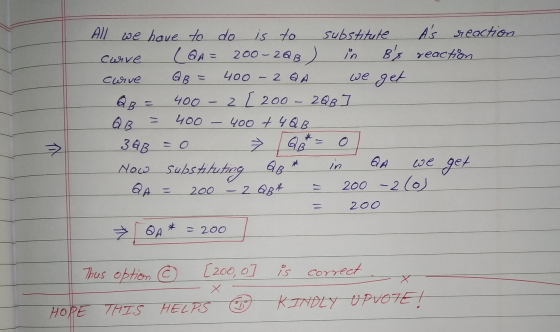
[12] Two firms, A and B. operate in a market as Cournot competitors. Each has the...
Firm A and Firm B compete in the sale of a product with market inverse demand...
 Firm A and Firm B compete in the sale of a product with market inverse demand given by P(0) = 160-Q, where Q is market output, and Q = qA + qB (8a-Firm A's output, qB-Firm B's output). Firm A's Total Cost function is given by TCA(qA) 10qA and Firm B's is given by Find the value of Q when Firms A and B Cournot compete to maximize profits (i.e when they simultaneously determine profit maximizing output). At what price...
There are two Cournot competitors, A & B. Each has total cost of 12x, where x...
There are two Cournot competitors, A & B. Each has total cost of 12x, where x is a firm’s output, and demand is X = 400 – P, where P is market price. The Nash equilibrium for this game is (a.) Both firms produce 119.9 units (b.) Both firms produce 122.2 units (c.) Both firms produce 129.3 units (d.) Both firms produce 135 units Graph it with labels, thanks!
Cournot: Consider a Cournot duopoly in which firms A and B simultaneously choose quantity. Both firms...
Cournot: Consider a Cournot duopoly in which firms A and B simultaneously choose quantity. Both firms have constant marginal cost of $20 and zero fixed cost. Market demand is given by: P = 140 − qA − qB. (a) Derive the best-response functions for each firm and plot them on the same graph. (b) Calculate the profits of each firm in the Nash Equilibrium outcome.
Two firms sell identical products and compete as Cournot (price-setting) competitors in a market with a...
Two firms sell identical products and compete as Cournot (price-setting) competitors in a market with a demand of p = 150 - Q. Each firm has a constant marginal and average cost of $3 per unit of output. Find the quantity each firm will produce and the price in equilibrium.
8. Consider a market where two firms are Cournot competitors with constant average and marginal costs....
 8. Consider a market where two firms are Cournot competitors with constant average and marginal costs. Due to political favoritism, the government decides to levy a per-unit tax on one of the firms, but not the other. Which of the following do you NOT expect to happen in this market? (A) The market share of the taxed firm decreases. (B) The market share of the favored (non-taxed) firm increases. (C) The equilibrium price increases. (D) The equilibrium quantity sold increases.
Find the value of Q when Firms A and B Cournot compete to maximize profits (i.e....
 Find the value of Q when Firms A and B Cournot compete to
maximize profits (i.e. when they simultaneously determine profit
maximizing output).
Firm A and Firm B compete in the sale of a product with market inverse demand given by P(0) = 260-Q, where Q is market output, and Q = 9A + 96 (9A = Firm A's output, 93 = Firm B's output). Firm A's Total Cost function is given by TCA9A) = 209A and Firm B's is...
Find the value of Q when Firms A and B Cournot compete to
maximize profits (i.e. when they simultaneously determine profit
maximizing output).
Firm A and Firm B compete in the sale of a product with market inverse demand given by P(0) = 260-Q, where Q is market output, and Q = 9A + 96 (9A = Firm A's output, 93 = Firm B's output). Firm A's Total Cost function is given by TCA9A) = 209A and Firm B's is...
In a Cournot market structure with two firms, firm A's reaction function gives: optimal quantity for...
In a Cournot market structure with two firms, firm A's reaction function gives: optimal quantity for A as a function of price for A and price for B. optimal price for A as a function of price for B. optimal quantity for A as a function of price for B. optimal quantity for A as a function of quantity for B. *option 1 is incorrect
Firm A and Firm B compete in the sale of a product with market inverse demand...
 Firm A and Firm B compete in the sale of a product with market inverse demand given by P(Q) = 260-Q, where Q is market output, and Q = 9A + 9B (9A = Firm A's output, 9B = Firm B's output). Firm A's Total Cost function is given by TCA9A) = 209A and Firm B's is given by TCB(9B) = 209B. 15. (20 points) Find the value of Q when Firms A and B Cournot compete to maximize profits...
Two firms (A and B) play a simultaneous-move quantity competition game (i.e. Cournot competition) in which...
Two firms (A and B) play a simultaneous-move quantity competition game (i.e. Cournot competition) in which they can choose any Qi ∊ [0, ). The firms have cost functions C(Qi) = 10Qi + 0.5Qi^2, and thus MCi = 10 + Qi. They face a market demand curve of P = 220 – (QA + QB) and have MRi = 220 – 2Qi – Q-i. a. What is firm A’s profit as a function of QA and QB? b. What is...
Consider two firms (Firm A and Firm B) competing in this market. They simultaneously decide on...
Consider two firms (Firm A and Firm B) competing in this market. They simultaneously decide on the price of the product in a typical Bertrand fashion while producing an identical product. Both firms face the same cost function: C(qA) = 12qA and C(qB) = 12qB, where qA is the output of Firm A and qB is the output of Firm B. The demand curve is P = 30 - Q. (i) What will be the Bertrand-Nash equilibrium price (pB) chosen...
 Firm A and Firm B compete in the sale of a product with market inverse demand given by P(0) = 160-Q, where Q is market output, and Q = qA + qB (8a-Firm A's output, qB-Firm B's output). Firm A's Total Cost function is given by TCA(qA) 10qA and Firm B's is given by Find the value of Q when Firms A and B Cournot compete to maximize profits (i.e when they simultaneously determine profit maximizing output). At what price...
 8. Consider a market where two firms are Cournot competitors with constant average and marginal costs. Due to political favoritism, the government decides to levy a per-unit tax on one of the firms, but not the other. Which of the following do you NOT expect to happen in this market? (A) The market share of the taxed firm decreases. (B) The market share of the favored (non-taxed) firm increases. (C) The equilibrium price increases. (D) The equilibrium quantity sold increases.
 Find the value of Q when Firms A and B Cournot compete to
maximize profits (i.e. when they simultaneously determine profit
maximizing output).
Firm A and Firm B compete in the sale of a product with market inverse demand given by P(0) = 260-Q, where Q is market output, and Q = 9A + 96 (9A = Firm A's output, 93 = Firm B's output). Firm A's Total Cost function is given by TCA9A) = 209A and Firm B's is...
Find the value of Q when Firms A and B Cournot compete to
maximize profits (i.e. when they simultaneously determine profit
maximizing output).
Firm A and Firm B compete in the sale of a product with market inverse demand given by P(0) = 260-Q, where Q is market output, and Q = 9A + 96 (9A = Firm A's output, 93 = Firm B's output). Firm A's Total Cost function is given by TCA9A) = 209A and Firm B's is...
 Firm A and Firm B compete in the sale of a product with market inverse demand given by P(Q) = 260-Q, where Q is market output, and Q = 9A + 9B (9A = Firm A's output, 9B = Firm B's output). Firm A's Total Cost function is given by TCA9A) = 209A and Firm B's is given by TCB(9B) = 209B. 15. (20 points) Find the value of Q when Firms A and B Cournot compete to maximize profits...
Most questions answered within 3 hours.
-
Where is the error in this code sequence?
String s1 = "Hello";
String s2 = "ello";...
asked 11 months ago -
Financial data for Joel de Paris, Inc., for last year
follow:
Joel de Paris, Inc.
Balance...
asked 11 months ago -
Consider this reaction:
Al2(SO4)3 (aq)+ BaCl3
(aq) Al2Cl6 (aq)- +
3BaSO4(s) . What is the...
asked 11 months ago -
Suppose that Savneet is considering increasing her
recent random sample from 20 car rentals to 40...
asked 11 months ago -
Trucks arrive at an unloading terminal at an average rate of 120
per hour.
Trucks arrive...
asked 11 months ago -
Why are methanol and ethanol completely soluble in water while
octanol is not very little soluble....
asked 11 months ago -
A facilities manager at a university reads in a research report
that the mean amount of...
asked 11 months ago -
When the CuSO4 is rehydrated by adding water to the anhydrous
compound, is this an endothermic...
asked 11 months ago -
A ray of sunlight is passing from diamond into crown glass; the
angle of incidence is...
asked 11 months ago -
A block of mass 0.249 kg is placed on top of a light, vertical
spring of...
asked 11 months ago -
how do the kidneys compensate in the presences of acidosis
a) trigger hyperventilate
b) reserve acid...
asked 11 months ago -
Question 501 pts
The rental rate of capital to the firm increases. Which of the
following...
asked 11 months ago