
Homework Answers
Add Answer to:
Lab 2 This is a one week lab. For each of the following counter circuits you...
Name: Section Number: Lab by jeg/modified by jec 4450:220 DIGITAL LOGIC DESIGN, Spring 2018 Pre-Lab 7:...
 Name: Section Number: Lab by jeg/modified by jec 4450:220 DIGITAL LOGIC DESIGN, Spring 2018 Pre-Lab 7: Counters and Timers Week Eight Objectives To learn about binary and decade counters, and to design a one-hundred second timer. The Counter A counter is a hardware circuit whose output counts in sequence, changing at each rising has a three-bit out rolls over" back to zero to count through the sequence again. We can d edge of a clock input signal. As an example,...
solve 1 2 and 3 Problems 1 and 2 require a 7-segment display. You may want to re-use the display driver you developed in Lab 3. Use a push-button as the clock - the pushbuttons are debounced, whereas...
 solve 1 2 and 3
Problems 1 and 2 require a 7-segment display. You may want to re-use the display driver you developed in Lab 3. Use a push-button as the clock - the pushbuttons are debounced, whereas the slide switches are not. Remember to provide columnsfor lest data in your state lables (use the observed next state as the test data in problems I and 2, and the observed next state and preseni output as the lest data in...
solve 1 2 and 3
Problems 1 and 2 require a 7-segment display. You may want to re-use the display driver you developed in Lab 3. Use a push-button as the clock - the pushbuttons are debounced, whereas the slide switches are not. Remember to provide columnsfor lest data in your state lables (use the observed next state as the test data in problems I and 2, and the observed next state and preseni output as the lest data in...
Objective: In this lab, we will learn how we can design sequential circuits using behavioral mode...
 Just need the code for the
random counter,Thanks
Objective: In this lab, we will learn how we can design sequential circuits using behavioral modelling, and implementing the design in FPGA. Problem: Design a random counter with the following counting sequence: Counting Sequence: 04 2 9 168573 Design Description: The counter has one clock (Clock), one reset (Reset), and one move left or right control signal (L/R) as input. The counter also has one 4bit output O and one 2bit output...
Just need the code for the
random counter,Thanks
Objective: In this lab, we will learn how we can design sequential circuits using behavioral modelling, and implementing the design in FPGA. Problem: Design a random counter with the following counting sequence: Counting Sequence: 04 2 9 168573 Design Description: The counter has one clock (Clock), one reset (Reset), and one move left or right control signal (L/R) as input. The counter also has one 4bit output O and one 2bit output...
Logic Circuits Lab Project ELEG 3021 2018 Fall Obiective: Given a practical problem, using the knowledge...
 Logic Circuits Lab Project ELEG 3021 2018 Fall Obiective: Given a practical problem, using the knowledge learned in Logic Circuit class and practical skills gained in the Logic Circuit Lab, develop and conduct appropriate experimentation, analyze and interpret data, and use engineering judgment to draw conclusions. Problem: Given any two unsigned 4-bit numbers A (AsA2AiAo) and B (B;B B Bo), please compare the magnitude of this two numbers and pass the larger one of the two to the output Y...
Design C-1 (modulo-10 up-counter): Using the behavioral VHDL coding, create an up-counter to count upward. The...
 Design C-1 (modulo-10 up-counter): Using the behavioral VHDL coding, create an up-counter to count upward. The up counter has the following control inputs En.reset, CLK. The counting outputs are Q0, O1, Q2. and O3 reset clears the outputs of the counter to 0. En enables the counting when En-1. When En-0, the counter stops. The counter sequentially counts all the possible numbers and loops again, from 0 to 9, back to 0 and 9, etc Design C-2: Ten-second Counter with...
Required to construct counters using synchronous sequential logic. Use one hex digit to display the result....
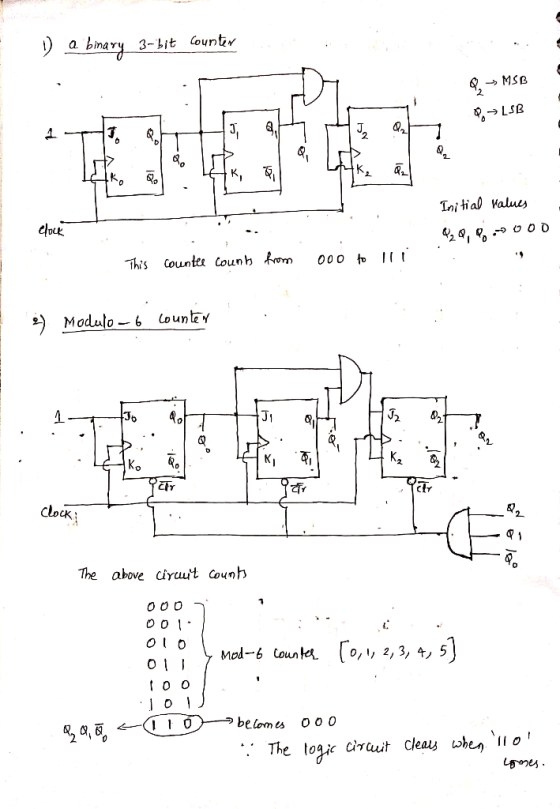
Required to construct counters using synchronous sequential logic. Use one hex digit to display the result. ONLY AND/OR/NOT/XOR gates and flip flops allowed.BCD counters count from 0 to 9. LOGISIM - not code 1. A 3-bit binary counter with 3 JK flip flops WITH enable if possible please use Logisim to build it and answer with picture of how its made Thank you!
Please show process and I will rate faster!!! 2. Design a two-bit up/down binary counter using...
 Please show process and I will rate faster!!!
2. Design a two-bit up/down binary counter using T-fip-flops that can count in binary from 0 to 3. When the control input x is 0, the circuit counts up and when it is 1, the circuit counts down. (a) Obtain the state table of the two-bit counter (P. S., Input, N. S., Output). (b) Obtain the state diagram. (c) Draw the logic diagram of the circuit.
Please show process and I will rate faster!!!
2. Design a two-bit up/down binary counter using T-fip-flops that can count in binary from 0 to 3. When the control input x is 0, the circuit counts up and when it is 1, the circuit counts down. (a) Obtain the state table of the two-bit counter (P. S., Input, N. S., Output). (b) Obtain the state diagram. (c) Draw the logic diagram of the circuit.
Design a circuit to add two 2-bit binary numbers and display the results of the addition...
Design a circuit to add two 2-bit binary numbers and display the results of the addition as a 3-bit binary number, with the most significant bit be the carry out. To do this, you will use the four switches on your Breadboard Companion as your two 2-bit number inputs. Three of your LEDs will be used to represent the 3-bit output of your circuit. Complete a truth table for the expected output values on the lab data sheet attached. Use...
Up-Down counter with enable using JK flip-flops: Design, construct and test a 2-bit counter that counts up or down.
Up-Down counter with enable using JK flip-flops: Design, construct and test a 2-bit counter that counts up or down. An enable input E determines whether the counter is on or off. If E = 0, the counter is disabled and remains in the present count even though clock pulses are applied to the flip-flops. If E= 1, the counter in enabled and a second input, x, determines the count direction. If x= 1, the circuit counts up with the sequence...
Lab Exercise 2 (20 ma rks) Title: Asynchronous Counters (using Dual JK Negative-Edge-Triggered fl...
 Lab Exercise 2 (20 ma rks) Title: Asynchronous Counters (using Dual JK Negative-Edge-Triggered flip-flops) Objective: To understand usage and theory of the Asynchronous Counters built using the JK-FF Component: 74LS73 Dual JK Negative-Edge-Triggered Flip-flops LED (2 Units) 330 2 resistor (2 units) DC Power supply Oscilloscope with 2 probes with build-in function generator or Oscilloscope with 2 probes with separate unit Enter Shift Function Generator + Paup Other Equipment: Jumper wires, NI Elvis Tester Board (optional) End Procedure: Construct the...
 Name: Section Number: Lab by jeg/modified by jec 4450:220 DIGITAL LOGIC DESIGN, Spring 2018 Pre-Lab 7: Counters and Timers Week Eight Objectives To learn about binary and decade counters, and to design a one-hundred second timer. The Counter A counter is a hardware circuit whose output counts in sequence, changing at each rising has a three-bit out rolls over" back to zero to count through the sequence again. We can d edge of a clock input signal. As an example,...
 solve 1 2 and 3
Problems 1 and 2 require a 7-segment display. You may want to re-use the display driver you developed in Lab 3. Use a push-button as the clock - the pushbuttons are debounced, whereas the slide switches are not. Remember to provide columnsfor lest data in your state lables (use the observed next state as the test data in problems I and 2, and the observed next state and preseni output as the lest data in...
solve 1 2 and 3
Problems 1 and 2 require a 7-segment display. You may want to re-use the display driver you developed in Lab 3. Use a push-button as the clock - the pushbuttons are debounced, whereas the slide switches are not. Remember to provide columnsfor lest data in your state lables (use the observed next state as the test data in problems I and 2, and the observed next state and preseni output as the lest data in...
 Just need the code for the
random counter,Thanks
Objective: In this lab, we will learn how we can design sequential circuits using behavioral modelling, and implementing the design in FPGA. Problem: Design a random counter with the following counting sequence: Counting Sequence: 04 2 9 168573 Design Description: The counter has one clock (Clock), one reset (Reset), and one move left or right control signal (L/R) as input. The counter also has one 4bit output O and one 2bit output...
Just need the code for the
random counter,Thanks
Objective: In this lab, we will learn how we can design sequential circuits using behavioral modelling, and implementing the design in FPGA. Problem: Design a random counter with the following counting sequence: Counting Sequence: 04 2 9 168573 Design Description: The counter has one clock (Clock), one reset (Reset), and one move left or right control signal (L/R) as input. The counter also has one 4bit output O and one 2bit output...
 Logic Circuits Lab Project ELEG 3021 2018 Fall Obiective: Given a practical problem, using the knowledge learned in Logic Circuit class and practical skills gained in the Logic Circuit Lab, develop and conduct appropriate experimentation, analyze and interpret data, and use engineering judgment to draw conclusions. Problem: Given any two unsigned 4-bit numbers A (AsA2AiAo) and B (B;B B Bo), please compare the magnitude of this two numbers and pass the larger one of the two to the output Y...
 Design C-1 (modulo-10 up-counter): Using the behavioral VHDL coding, create an up-counter to count upward. The up counter has the following control inputs En.reset, CLK. The counting outputs are Q0, O1, Q2. and O3 reset clears the outputs of the counter to 0. En enables the counting when En-1. When En-0, the counter stops. The counter sequentially counts all the possible numbers and loops again, from 0 to 9, back to 0 and 9, etc Design C-2: Ten-second Counter with...
 Please show process and I will rate faster!!!
2. Design a two-bit up/down binary counter using T-fip-flops that can count in binary from 0 to 3. When the control input x is 0, the circuit counts up and when it is 1, the circuit counts down. (a) Obtain the state table of the two-bit counter (P. S., Input, N. S., Output). (b) Obtain the state diagram. (c) Draw the logic diagram of the circuit.
Please show process and I will rate faster!!!
2. Design a two-bit up/down binary counter using T-fip-flops that can count in binary from 0 to 3. When the control input x is 0, the circuit counts up and when it is 1, the circuit counts down. (a) Obtain the state table of the two-bit counter (P. S., Input, N. S., Output). (b) Obtain the state diagram. (c) Draw the logic diagram of the circuit.
 Lab Exercise 2 (20 ma rks) Title: Asynchronous Counters (using Dual JK Negative-Edge-Triggered flip-flops) Objective: To understand usage and theory of the Asynchronous Counters built using the JK-FF Component: 74LS73 Dual JK Negative-Edge-Triggered Flip-flops LED (2 Units) 330 2 resistor (2 units) DC Power supply Oscilloscope with 2 probes with build-in function generator or Oscilloscope with 2 probes with separate unit Enter Shift Function Generator + Paup Other Equipment: Jumper wires, NI Elvis Tester Board (optional) End Procedure: Construct the...
Most questions answered within 3 hours.
-
Where is the error in this code sequence?
String s1 = "Hello";
String s2 = "ello";...
asked 11 months ago -
Financial data for Joel de Paris, Inc., for last year
follow:
Joel de Paris, Inc.
Balance...
asked 11 months ago -
Consider this reaction:
Al2(SO4)3 (aq)+ BaCl3
(aq) Al2Cl6 (aq)- +
3BaSO4(s) . What is the...
asked 11 months ago -
Suppose that Savneet is considering increasing her
recent random sample from 20 car rentals to 40...
asked 11 months ago -
Trucks arrive at an unloading terminal at an average rate of 120
per hour.
Trucks arrive...
asked 11 months ago -
Why are methanol and ethanol completely soluble in water while
octanol is not very little soluble....
asked 11 months ago -
A facilities manager at a university reads in a research report
that the mean amount of...
asked 11 months ago -
When the CuSO4 is rehydrated by adding water to the anhydrous
compound, is this an endothermic...
asked 11 months ago -
A ray of sunlight is passing from diamond into crown glass; the
angle of incidence is...
asked 11 months ago -
A block of mass 0.249 kg is placed on top of a light, vertical
spring of...
asked 11 months ago -
how do the kidneys compensate in the presences of acidosis
a) trigger hyperventilate
b) reserve acid...
asked 11 months ago -
Question 501 pts
The rental rate of capital to the firm increases. Which of the
following...
asked 11 months ago