Numerical Analysis 4.3.8
Show that a simple converse to Taylor's theorem does not hold. Find a function f: Reals with no second derivative at x=0 such that ..

Homework Answers

Add Answer to:
Numerical Analysis 4.3.8
Show that a simple converse to Taylor's theorem does not hold.
Find a...
A tinctlon of series y I Taylor The 6. Taylor's Remainder Theorem. fn)(0) where fw) is the n-th d...
 a tinctlon of series y I Taylor The 6. Taylor's Remainder Theorem. fn)(0) where fw) is the n-th derivative of f, and the remainder term Ry is given by NN+1 for some point c between 0 and z. (Note. You do not need to prove Taylor's Remainder Theorem.) Problems (a) (5%) write this series for the function ez for a general N (b) (10%) Apply Taylor's Remainder Theorem to show that the Taylor series of function f = ez converges...
Derive the following numerical approximation to the second derivative of f(x) using Taylor's series. Show all...
 Derive the following numerical approximation to the second derivative of f(x) using Taylor's series. Show all of your steps and derive also the order of accuracy of this approximation in terms of h. - f(x + 2h) + 16f(x + h) – 30f(x) + 16 f(x – h) – f(x – 2h) 12h2 1 (C)
Theorem 10.1.15 (Chain rule). Let X, Y be subsets of R, let xo e X be...
 Theorem 10.1.15 (Chain rule). Let X, Y be subsets of R, let xo e X be a limit point of X, and let yo e Y be a limit point of Y. Let f : X+Y be a function such that f(xo) = yo, and such that f is differentiable at Xo. Suppose that g:Y + R is a function which is differentiable at yo. Then the function gof:X + R is differentiable at xo, and .. (gºf)'(xo) = g'(yo)...
6. (4 points) Show that f(x)= 1/x is not uniformly continuous on (0,1]. 7. (4 points) Show that t.-nlg(1+ 1n is convergent, and find the limit. To do this, apply Taylor's theorem, and use tha...
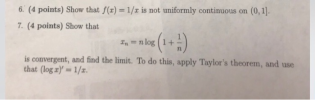 6. (4 points) Show that f(x)= 1/x is not uniformly continuous on (0,1]. 7. (4 points) Show that t.-nlg(1+ 1n is convergent, and find the limit. To do this, apply Taylor's theorem, and use that (logr)'-1/
6. (4 points) Show that f(x)= 1/x is not uniformly continuous on (0,1]. 7. (4 points) Show that t.-nlg(1+ 1n is convergent, and find the limit. To do this, apply Taylor's theorem, and use that (logr)'-1/
6. (4 points) Show that f(x)= 1/x is not uniformly continuous on (0,1]. 7. (4 points) Show that t.-nlg(1+ 1n is convergent, and find the limit. To do this, apply Taylor's theorem, and use that (logr)'-1/
all a,b,c,d 1. Suppose C is simple closed curve in the plane given by the parametric equation and recall that the outward unit normal vector n to C is given by y(t r'(t) If g is a scalar field on...
 all a,b,c,d
1. Suppose C is simple closed curve in the plane given by the parametric equation and recall that the outward unit normal vector n to C is given by y(t r'(t) If g is a scalar field on C with gradient Vg, we define the normal derivative Dng by and we define the Laplacian, V2g, of g by For this problem, assume D and C satisfy the hypotheses of Green's Theorem and the appropriate partial derivatives of f...
all a,b,c,d
1. Suppose C is simple closed curve in the plane given by the parametric equation and recall that the outward unit normal vector n to C is given by y(t r'(t) If g is a scalar field on C with gradient Vg, we define the normal derivative Dng by and we define the Laplacian, V2g, of g by For this problem, assume D and C satisfy the hypotheses of Green's Theorem and the appropriate partial derivatives of f...
real analysis 1,2,3,4,8please 5.1.5a Thus iff: I→R is differentiable on n E N. is differentiable on / with g'...
 real analysis
1,2,3,4,8please
5.1.5a
Thus iff: I→R is differentiable on n E N. is differentiable on / with g'(e) ()ain tained from Theorem 5.1.5(b) using mathematical induction, TOu the interal 1i then by the cho 174 Chapter s Differentiation ■ EXERCISES 5.1 the definition to find the derivative of each of the following functions. I. Use r+ 1 2. "Prove that for all integers n, O if n is negative). 3. "a. Prove that (cosx)--sinx. -- b. Find the derivative...
real analysis
1,2,3,4,8please
5.1.5a
Thus iff: I→R is differentiable on n E N. is differentiable on / with g'(e) ()ain tained from Theorem 5.1.5(b) using mathematical induction, TOu the interal 1i then by the cho 174 Chapter s Differentiation ■ EXERCISES 5.1 the definition to find the derivative of each of the following functions. I. Use r+ 1 2. "Prove that for all integers n, O if n is negative). 3. "a. Prove that (cosx)--sinx. -- b. Find the derivative...
(Numerical analysis) Here's a challenging problem for those who know a little calculus. The Newton-Raphson method...
 (Numerical analysis) Here's a challenging problem for those who know a little calculus. The Newton-Raphson method can be used to find the roots of any equation0.n this method the (i + Dst approximation, xi-1, to a root ofy(x) = 0 İs given in terms of the ith approximation, xi by the following formula, where y' denotes the derivative of y(x) with respect tox: For example, if yx) 32+2x - 2, then y()-2, and the roots are found by making a...
2. Rolle's theorem states that if F : [a, b] → R is a continuous function,...
 2. Rolle's theorem states that if F : [a, b] → R is a continuous function, differentiable on Ja, bl, and F(a) = F(b) then there exists a cela, b[ such that F"(c) = 0. (a) Suppose g : [a, b] → R is a continuous function, differentiable on ja, bl, with the property that (c) +0 for all cela, b[. Using Rolle's theorem, show that g(a) + g(b). [6 Marks] (b) Now, with g still as in part (a),...
How does the 2nd derivative calculate? Please show the calculation. Find the first and second...
 How does the 2nd derivative calculate? Please show the
calculation.
Find the first and second derivatives of the function f(x) (x2 2)5 10x (x2 + 2)4 f '(x) f ")10(x22)3( 9x2 +2)
How does the 2nd derivative calculate? Please show the
calculation.
Find the first and second derivatives of the function f(x) (x2 2)5 10x (x2 + 2)4 f '(x) f ")10(x22)3( 9x2 +2)
Question 10 RD 1 (X-μ)/μ|. Show that (5.28) 9. See Problem 5.8. Compute the signal-to-noise ratio...
 Question 10
RD 1 (X-μ)/μ|. Show that (5.28) 9. See Problem 5.8. Compute the signal-to-noise ratio r for the random variables from the fol. lowing distributions: (a) P(A), (b) E(n, p), (c) G(p), (d) Γ(α, β), (e) W (α, β), (f) LNue). and (g) P(α,0), where α > 2. 10. Let X and F be the sample means from two independent samples of size n from a popu- lation with finite mean μ and variance σ. Use the Central Limit...
Question 10
RD 1 (X-μ)/μ|. Show that (5.28) 9. See Problem 5.8. Compute the signal-to-noise ratio r for the random variables from the fol. lowing distributions: (a) P(A), (b) E(n, p), (c) G(p), (d) Γ(α, β), (e) W (α, β), (f) LNue). and (g) P(α,0), where α > 2. 10. Let X and F be the sample means from two independent samples of size n from a popu- lation with finite mean μ and variance σ. Use the Central Limit...
 a tinctlon of series y I Taylor The 6. Taylor's Remainder Theorem. fn)(0) where fw) is the n-th derivative of f, and the remainder term Ry is given by NN+1 for some point c between 0 and z. (Note. You do not need to prove Taylor's Remainder Theorem.) Problems (a) (5%) write this series for the function ez for a general N (b) (10%) Apply Taylor's Remainder Theorem to show that the Taylor series of function f = ez converges...
 Derive the following numerical approximation to the second derivative of f(x) using Taylor's series. Show all of your steps and derive also the order of accuracy of this approximation in terms of h. - f(x + 2h) + 16f(x + h) – 30f(x) + 16 f(x – h) – f(x – 2h) 12h2 1 (C)
 Theorem 10.1.15 (Chain rule). Let X, Y be subsets of R, let xo e X be a limit point of X, and let yo e Y be a limit point of Y. Let f : X+Y be a function such that f(xo) = yo, and such that f is differentiable at Xo. Suppose that g:Y + R is a function which is differentiable at yo. Then the function gof:X + R is differentiable at xo, and .. (gºf)'(xo) = g'(yo)...
 6. (4 points) Show that f(x)= 1/x is not uniformly continuous on (0,1]. 7. (4 points) Show that t.-nlg(1+ 1n is convergent, and find the limit. To do this, apply Taylor's theorem, and use that (logr)'-1/
6. (4 points) Show that f(x)= 1/x is not uniformly continuous on (0,1]. 7. (4 points) Show that t.-nlg(1+ 1n is convergent, and find the limit. To do this, apply Taylor's theorem, and use that (logr)'-1/
6. (4 points) Show that f(x)= 1/x is not uniformly continuous on (0,1]. 7. (4 points) Show that t.-nlg(1+ 1n is convergent, and find the limit. To do this, apply Taylor's theorem, and use that (logr)'-1/
 all a,b,c,d
1. Suppose C is simple closed curve in the plane given by the parametric equation and recall that the outward unit normal vector n to C is given by y(t r'(t) If g is a scalar field on C with gradient Vg, we define the normal derivative Dng by and we define the Laplacian, V2g, of g by For this problem, assume D and C satisfy the hypotheses of Green's Theorem and the appropriate partial derivatives of f...
all a,b,c,d
1. Suppose C is simple closed curve in the plane given by the parametric equation and recall that the outward unit normal vector n to C is given by y(t r'(t) If g is a scalar field on C with gradient Vg, we define the normal derivative Dng by and we define the Laplacian, V2g, of g by For this problem, assume D and C satisfy the hypotheses of Green's Theorem and the appropriate partial derivatives of f...
 real analysis
1,2,3,4,8please
5.1.5a
Thus iff: I→R is differentiable on n E N. is differentiable on / with g'(e) ()ain tained from Theorem 5.1.5(b) using mathematical induction, TOu the interal 1i then by the cho 174 Chapter s Differentiation ■ EXERCISES 5.1 the definition to find the derivative of each of the following functions. I. Use r+ 1 2. "Prove that for all integers n, O if n is negative). 3. "a. Prove that (cosx)--sinx. -- b. Find the derivative...
real analysis
1,2,3,4,8please
5.1.5a
Thus iff: I→R is differentiable on n E N. is differentiable on / with g'(e) ()ain tained from Theorem 5.1.5(b) using mathematical induction, TOu the interal 1i then by the cho 174 Chapter s Differentiation ■ EXERCISES 5.1 the definition to find the derivative of each of the following functions. I. Use r+ 1 2. "Prove that for all integers n, O if n is negative). 3. "a. Prove that (cosx)--sinx. -- b. Find the derivative...
 (Numerical analysis) Here's a challenging problem for those who know a little calculus. The Newton-Raphson method can be used to find the roots of any equation0.n this method the (i + Dst approximation, xi-1, to a root ofy(x) = 0 İs given in terms of the ith approximation, xi by the following formula, where y' denotes the derivative of y(x) with respect tox: For example, if yx) 32+2x - 2, then y()-2, and the roots are found by making a...
 2. Rolle's theorem states that if F : [a, b] → R is a continuous function, differentiable on Ja, bl, and F(a) = F(b) then there exists a cela, b[ such that F"(c) = 0. (a) Suppose g : [a, b] → R is a continuous function, differentiable on ja, bl, with the property that (c) +0 for all cela, b[. Using Rolle's theorem, show that g(a) + g(b). [6 Marks] (b) Now, with g still as in part (a),...
 How does the 2nd derivative calculate? Please show the
calculation.
Find the first and second derivatives of the function f(x) (x2 2)5 10x (x2 + 2)4 f '(x) f ")10(x22)3( 9x2 +2)
How does the 2nd derivative calculate? Please show the
calculation.
Find the first and second derivatives of the function f(x) (x2 2)5 10x (x2 + 2)4 f '(x) f ")10(x22)3( 9x2 +2)
 Question 10
RD 1 (X-μ)/μ|. Show that (5.28) 9. See Problem 5.8. Compute the signal-to-noise ratio r for the random variables from the fol. lowing distributions: (a) P(A), (b) E(n, p), (c) G(p), (d) Γ(α, β), (e) W (α, β), (f) LNue). and (g) P(α,0), where α > 2. 10. Let X and F be the sample means from two independent samples of size n from a popu- lation with finite mean μ and variance σ. Use the Central Limit...
Question 10
RD 1 (X-μ)/μ|. Show that (5.28) 9. See Problem 5.8. Compute the signal-to-noise ratio r for the random variables from the fol. lowing distributions: (a) P(A), (b) E(n, p), (c) G(p), (d) Γ(α, β), (e) W (α, β), (f) LNue). and (g) P(α,0), where α > 2. 10. Let X and F be the sample means from two independent samples of size n from a popu- lation with finite mean μ and variance σ. Use the Central Limit...
Most questions answered within 3 hours.
-
Where is the error in this code sequence?
String s1 = "Hello";
String s2 = "ello";...
asked 10 months ago -
Financial data for Joel de Paris, Inc., for last year
follow:
Joel de Paris, Inc.
Balance...
asked 10 months ago -
Consider this reaction:
Al2(SO4)3 (aq)+ BaCl3
(aq) Al2Cl6 (aq)- +
3BaSO4(s) . What is the...
asked 10 months ago -
Suppose that Savneet is considering increasing her
recent random sample from 20 car rentals to 40...
asked 10 months ago -
Trucks arrive at an unloading terminal at an average rate of 120
per hour.
Trucks arrive...
asked 10 months ago -
Why are methanol and ethanol completely soluble in water while
octanol is not very little soluble....
asked 10 months ago -
A facilities manager at a university reads in a research report
that the mean amount of...
asked 10 months ago -
When the CuSO4 is rehydrated by adding water to the anhydrous
compound, is this an endothermic...
asked 10 months ago -
A ray of sunlight is passing from diamond into crown glass; the
angle of incidence is...
asked 10 months ago -
A block of mass 0.249 kg is placed on top of a light, vertical
spring of...
asked 10 months ago -
how do the kidneys compensate in the presences of acidosis
a) trigger hyperventilate
b) reserve acid...
asked 10 months ago -
Question 501 pts
The rental rate of capital to the firm increases. Which of the
following...
asked 10 months ago