True or False. Because patents create monopolies, consumers would be better off if no patents were...
True or False. Because patents create monopolies, consumers would be better off if no patents were allowed for new products.
Homework Answers
Answer
False
The patents encourage new Innoventions and if there are no patent rights then there may be very few innovations that will reduce consumer surplus in total from all goods and services so it is not true that the consumer is better off without patents.
Add Answer to:
True or False. Because patents create monopolies, consumers
would be better off if no patents were...
Deflation: a. might easily make both producers and consumers better off because consumers might lose jobs...
Deflation: a. might easily make both producers and consumers better off because consumers might lose jobs due to falling prices and profit margins, and the falling profit margins would negatively impact producers. b. might make you better off if your nominal wages fall more rapidly than prices. c. automatically occurs when there are more goods with falling prices than there are goods with increasing prices. d. would negatively affect producers but positively affect consumers because producers must accept lower prices....
3. True or False. Please tell whether each of the following statements is true or false...
3. True or False. Please tell whether each of the following statements is true or false and justify your answer in a few sentences. (a) “Free trade is always good and governments should not manage trade.” (b) “Vertical FDI and trade are substitutes, while horizontal FDI and trade are complements.” (c) An import quota cannot make a country better off. (d) Increasing returns to scale will lead to monopolies in world trade and therefore consumers will lose from trade.
After a good falls in price, consumers are better off because they can buy the same...
After a good falls in price, consumers are better off because they can buy the same amount of the good for less money, and thus have money left over for additional purchases. This fact is called: the income effect. the substitution effect. the wealth effect. the price effect.
Information supplied to consumers by the government rarely ever helps in making better decisions. True False
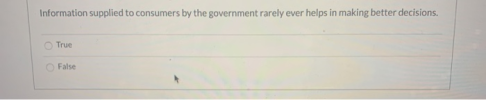 Information supplied to consumers by the government rarely ever helps in making better decisions. True False
QUESTION 1 Right brain–dominant consumers tend to deal better with verbal processing. True False 1 points...
QUESTION 1 Right brain–dominant consumers tend to deal better with verbal processing. True False 1 points QUESTION 2 Attempts to demarket a product can be implemented by stigmatizing consumption with a negative stereotype. True False 1 points QUESTION 3 Knowledge in long-term memory is stored in echoic storage. True False 1 points QUESTION 4 Consumers who reach the elaboration stage are least likely to meaningfully encode information. True False
Complete the following statement. better off if there were no middlemen because middlemen transaction costs People...
 Complete the following statement. better off if there were no middlemen because middlemen transaction costs People Grade It Now
Which of the following can create monopolies? Instructions: You may select more than one answer. Click...
 Which of the following can create monopolies? Instructions: You may select more than one answer. Click the box with a check mark for correct answers and click to empty the box for the wrong answers. ? Scarce resources ? Government intervention 7 Economies of scale ? Aggressive business tactics Governments create monopolies through intellectual property rights such as patents and copyrights because: Othey want firms to make profits. they do not understand the losses due to monopoly. they do not...
It is not necessarily true that all new products benefit consumers or society. What are some...
It is not necessarily true that all new products benefit consumers or society. What are some new products that have made our lives better? What are some new products that have actually been harmful to consumers or to society? Should there be a way to monitor or “police” new products that are introduced to the marketplace?
Bentham believed that a benevolent God would approve of euthanasia. Select one: True False Utilitarians would...
Bentham believed that a benevolent God would approve of euthanasia. Select one: True False Utilitarians would be in favor of legalizing the casual use of marijuana. Select one: True False The author believes hat society would be better off if marijuana replaced alcohol. Select one: True False
7. (True/false) Because glycolysis produces pyruvate, glycolysis is an anabolic pathway, • True • False 8....
 7. (True/false) Because glycolysis produces pyruvate, glycolysis is an anabolic pathway, • True • False 8. Which metabolism is better equipped to support chemotaxis? • Aerobic respiration • Anaerobic respiration • Aerobic chemolithotrophic metabolisms • Gycolysis alone • Tricarboxylic acid cycle alone 9. Comparing a Saccharomyces cerevisiae yeast cell to a Staphylococcus aureus bacterial cell, which one would have the higher S/V ratio? • Staphylococcus aureus • Saccharomyces cerevisiae 10. (True/false) Metabolic pathways represent a predictable linear set of reactions...
 Information supplied to consumers by the government rarely ever helps in making better decisions. True False
 Complete the following statement. better off if there were no middlemen because middlemen transaction costs People Grade It Now
 Which of the following can create monopolies? Instructions: You may select more than one answer. Click the box with a check mark for correct answers and click to empty the box for the wrong answers. ? Scarce resources ? Government intervention 7 Economies of scale ? Aggressive business tactics Governments create monopolies through intellectual property rights such as patents and copyrights because: Othey want firms to make profits. they do not understand the losses due to monopoly. they do not...
 7. (True/false) Because glycolysis produces pyruvate, glycolysis is an anabolic pathway, • True • False 8. Which metabolism is better equipped to support chemotaxis? • Aerobic respiration • Anaerobic respiration • Aerobic chemolithotrophic metabolisms • Gycolysis alone • Tricarboxylic acid cycle alone 9. Comparing a Saccharomyces cerevisiae yeast cell to a Staphylococcus aureus bacterial cell, which one would have the higher S/V ratio? • Staphylococcus aureus • Saccharomyces cerevisiae 10. (True/false) Metabolic pathways represent a predictable linear set of reactions...
Most questions answered within 3 hours.
-
Where is the error in this code sequence?
String s1 = "Hello";
String s2 = "ello";...
asked 10 months ago -
Financial data for Joel de Paris, Inc., for last year
follow:
Joel de Paris, Inc.
Balance...
asked 10 months ago -
Consider this reaction:
Al2(SO4)3 (aq)+ BaCl3
(aq) Al2Cl6 (aq)- +
3BaSO4(s) . What is the...
asked 10 months ago -
Suppose that Savneet is considering increasing her
recent random sample from 20 car rentals to 40...
asked 10 months ago -
Trucks arrive at an unloading terminal at an average rate of 120
per hour.
Trucks arrive...
asked 10 months ago -
Why are methanol and ethanol completely soluble in water while
octanol is not very little soluble....
asked 10 months ago -
A facilities manager at a university reads in a research report
that the mean amount of...
asked 10 months ago -
When the CuSO4 is rehydrated by adding water to the anhydrous
compound, is this an endothermic...
asked 10 months ago -
A ray of sunlight is passing from diamond into crown glass; the
angle of incidence is...
asked 10 months ago -
A block of mass 0.249 kg is placed on top of a light, vertical
spring of...
asked 10 months ago -
how do the kidneys compensate in the presences of acidosis
a) trigger hyperventilate
b) reserve acid...
asked 10 months ago -
Question 501 pts
The rental rate of capital to the firm increases. Which of the
following...
asked 10 months ago