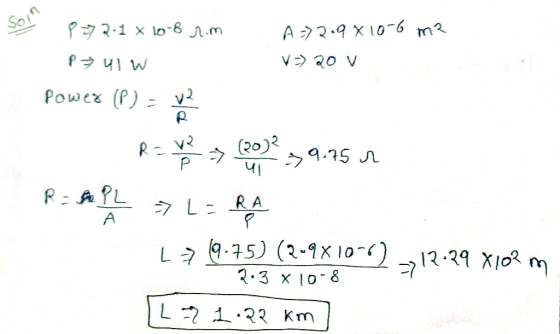
A particular wire has a resistivity of 2.1*10^-8 Ω · m and a cross-sectional area of...
A particular wire has a resistivity of 2.1*10^-8 Ω · m and a cross-sectional area of 2.9*10^-6 m2. A length of this wire is to be used as a resistor that will receive 41 W of power when connected across a 20-V battery. What length of wire is required? _________km
Homework Answers
Add Answer to:
A particular wire has a resistivity of 2.1*10^-8 Ω · m and a
cross-sectional area of...
A particular wire has a resistivity of 2.7 x 10-82. m and a cross-sectional area of...
 A particular wire has a resistivity of 2.7 x 10-82. m and a cross-sectional area of 4.3 x 10⁻⁶ m2. A length of this wire is to be used as a resistor that will develop 45 W of power when connected across a 20-V battery. What length of wire is required? km
A particular wire has a resistivity of 5.37×10⁻⁸ Ωm and a cross-sectional area of 1.78 mm2....
A particular wire has a resistivity of 5.37×10⁻⁸ Ωm and a cross-sectional area of 1.78 mm2. A length of this wire is to be used as a resistor that will develop 150 W of power when connected to a 6.50 V battery. What length of wire is required?
The aluminum (resistivity = 2.82 x 10⁻⁸ Ω⋅m) wire used for a high-voltage power line has...
The aluminum (resistivity = 2.82 x 10⁻⁸ Ω⋅m) wire used for a high-voltage power line has a cross-sectional area of 6.5 x 10⁻⁴ m2. What is the resistance, in ohms, of 12 kilometers of this wire?
A wire 2.60 m long with a cross-sectional area of 7.07x10⁻⁶ m2 is connected to a...
A wire 2.60 m long with a cross-sectional area of 7.07x10⁻⁶ m2 is connected to a 30.0 V power supply. If a current of 12.0 A is measured in the wire, a) what is the resistivity of the wire in ohm-meters? Answer in scientific notation. b) If this resistivity had been measured at 20.0 °C, what temperature, in Celsius, would we need to heat/cool the wire to for the resistance to be 4.25 Ω if the temperature coefficient of resistivity...
The resistivity of a 1.0 m long wire is 1.72 × 10⁻⁸ ?m and its cross sectional area is 2.0 ×...
The resistivity of a 1.0 m long wire is 1.72 × 10⁻⁸ Om and its cross sectional area is 2.0 × 10⁻⁶ m2. If the wire carries a current of 0.20 A, what is the voltageacross the wire?a) 10 mVb) 17 mVc) 0.90 mVd) 1.7 mVe) 90 mV
a wire has a resistivity of 1.68 × 10^-8 ohms•m, and a cross sectional area of...
a wire has a resistivity of 1.68 × 10^-8 ohms•m, and a cross sectional area of 2 cm^2. It is bent into a circle of radius 50 cm. A magnetic field, directed perpendicular through the region bounded by the wire, is uniformly increasing at .04 T/s throughout the region. Find the current (magnitude and direction) induced in the wire.
Consider copper wire with a cross-sectional area 7.85 × 10⁻⁵ m2. Caculate the required length of...
Consider copper wire with a cross-sectional area 7.85 × 10⁻⁵ m2. Caculate the required length of this wire such that it has a resistance of 0.341 Ω at a temperature of 180°C. The resistivity of copper is 1.68 × 10⁻⁸ Ω·m at 20°C and the temperature coefficient of resitivity of copper is 3.86 × 10⁻³ °C-1. Ingore any effects of thermal expansion on the dimensions of the wire. Can you please also explain how to use the temperature coefficient to...
1. A wire of length L and cross-sectional area A has a resistance of 5 Ω. What...
1. A wire of length L and cross-sectional area A has a resistance of 5 Ω. What is the resistance if the same amount of material is used to make a wire triple as long? 2. What is the resistance of 15 m length of household no. 14 copper circular wire having a diameter of 1.6 mm? (Hint: the resistivity of copper – textbook, page 782)
A certain metal wire has a cross-sectional area of 1.0 cm2 and a resistivity of 1.7...
A certain metal wire has a cross-sectional area of 1.0 cm2 and a resistivity of 1.7 × 10⁻⁸ Ω ∙ m. How long would it have to be to have a resistance of 1.0 Ω? Answers: A. 5.9 x 10⁶ m B. 5.9 km C. 5.9 x 10⁴ m D. 5.9 m E. 590 m
A copper wire of cross-sectional area of 8.2x10^-7 m^2 has a resistance of 1.11 Ω. a)....
A copper wire of cross-sectional area of 8.2x10^-7 m^2 has a resistance of 1.11 Ω. a). How long is the wire? b). If a potential of 12.0 V is applied across the ends of the wire, what current will flow through the wire? c). How much electrical power is supplied to the spool? d). How many electrons (N) pass through this wire in 1.00 minutes?
 A particular wire has a resistivity of 2.7 x 10-82. m and a cross-sectional area of 4.3 x 10⁻⁶ m2. A length of this wire is to be used as a resistor that will develop 45 W of power when connected across a 20-V battery. What length of wire is required? km
Most questions answered within 3 hours.
-
Where is the error in this code sequence?
String s1 = "Hello";
String s2 = "ello";...
asked 11 months ago -
Financial data for Joel de Paris, Inc., for last year
follow:
Joel de Paris, Inc.
Balance...
asked 11 months ago -
Consider this reaction:
Al2(SO4)3 (aq)+ BaCl3
(aq) Al2Cl6 (aq)- +
3BaSO4(s) . What is the...
asked 11 months ago -
Suppose that Savneet is considering increasing her
recent random sample from 20 car rentals to 40...
asked 11 months ago -
Trucks arrive at an unloading terminal at an average rate of 120
per hour.
Trucks arrive...
asked 11 months ago -
Why are methanol and ethanol completely soluble in water while
octanol is not very little soluble....
asked 11 months ago -
A facilities manager at a university reads in a research report
that the mean amount of...
asked 11 months ago -
When the CuSO4 is rehydrated by adding water to the anhydrous
compound, is this an endothermic...
asked 11 months ago -
A ray of sunlight is passing from diamond into crown glass; the
angle of incidence is...
asked 11 months ago -
A block of mass 0.249 kg is placed on top of a light, vertical
spring of...
asked 11 months ago -
how do the kidneys compensate in the presences of acidosis
a) trigger hyperventilate
b) reserve acid...
asked 11 months ago -
Question 501 pts
The rental rate of capital to the firm increases. Which of the
following...
asked 11 months ago