Calculate the real work (in kJ) to compress 1 mol of n-butane from 1.0 bar to...
Calculate the real work (in kJ) to compress 1 mol of n-butane from 1.0 bar to 15 bar isothermally at 125oC and compare to the ideal gas equation of state.
Homework Answers


Add Answer to:
Calculate the real work (in kJ) to compress 1 mol of n-butane
from 1.0 bar to...
One hundred cubic meters of carbon dioxide initially at 150 degrees Celsius and 50 bar is...
One hundred cubic meters of carbon dioxide initially at 150 degrees Celsius and 50 bar is to be isothermally compressed in a frictionless piston-and-cylinder device to a final pressure of 300 bar. Assume that this is a reversible process. a.) Use the ideal gas equation of state to calculate: i. The volume of the compressed gas ii. The work done to compress the gas iii. The heat flow on compression b.) Use the van der Waals equation of state to...
P2: Comparison of EOS methods for gases Calculate the molar volume of n-butane at 510K and...
 P2: Comparison of EOS methods for gases Calculate the molar volume of n-butane at 510K and 25bar, using the (a) ideal-gas law, (b) the truncated virial equation, and 0 (c) the Pitzer correlation with the Lee-Kesler values for Z and Z For n-butane T 425.1 K, P 37.96 bar, w 0.2 P3: Comparison of cubic EOS Calculate V for sulfur hexafluoride at 75 C and 15 bar by the following equations: (a) The van der waals equation (b) The Redlich/Kwong...
calculate U and H when the pressure of 0.02 mol of an ideal gas at 2...
 calculate
U and
H when the pressure of 0.02 mol of an ideal gas at 2 bar and 0.25 L
is reduced to 1 bar and 0.25 L.
calculateU
andH
when the volume of 0.02 mol of an ideal gas at 1 bar and 0.25 L is
increased to 1 bar and 0.50 L.
calculateU
andH
when 0.02 mol of an ideal gas at 2 bar and 0.25 L is expanded to
1.0 bar and 0.50 L isothermally.
calculate
U and
H when the pressure of 0.02 mol of an ideal gas at 2 bar and 0.25 L
is reduced to 1 bar and 0.25 L.
calculateU
andH
when the volume of 0.02 mol of an ideal gas at 1 bar and 0.25 L is
increased to 1 bar and 0.50 L.
calculateU
andH
when 0.02 mol of an ideal gas at 2 bar and 0.25 L is expanded to
1.0 bar and 0.50 L isothermally.
4. (25pts) 20L nitrogen gas is compressed in a tank at 10 bar and 25°C. Calculate the maximum work (in joules) that can be obtained when the gas is allowed to expand reversibly to a pressure of 1...
 4. (25pts) 20L nitrogen gas is compressed in a tank at 10 bar and 25°C. Calculate the maximum work (in joules) that can be obtained when the gas is allowed to expand reversibly to a pressure of 1 bar; (a) (10pts) isothermally (b) (15pts) adiabatically The molar heat apacity of nitrogen at constant volume is 20.8 J/K mol. Assume that nitrogen behaves as an ideal gas
4. (25pts) 20L nitrogen gas is compressed in a tank at 10 bar and...
4. (25pts) 20L nitrogen gas is compressed in a tank at 10 bar and 25°C. Calculate the maximum work (in joules) that can be obtained when the gas is allowed to expand reversibly to a pressure of 1 bar; (a) (10pts) isothermally (b) (15pts) adiabatically The molar heat apacity of nitrogen at constant volume is 20.8 J/K mol. Assume that nitrogen behaves as an ideal gas
4. (25pts) 20L nitrogen gas is compressed in a tank at 10 bar and...
Please answer all three parts and show work. Thank you! 1. An ideal gas assumes molecules...
 Please answer all three parts and show work. Thank you!
1. An ideal gas assumes molecules are point particles and do not interact with each other. In reality, molecules occupy space! To correct for this, the ideal gas equation of state is adjusted to take the volume occupied by the molecules into account for a real gas: PV = nRT or P = nRTV is modified to P = nRT/(V-nb) (IDEAL GAS) (REAL GAS Where "b" is related to the...
Please answer all three parts and show work. Thank you!
1. An ideal gas assumes molecules are point particles and do not interact with each other. In reality, molecules occupy space! To correct for this, the ideal gas equation of state is adjusted to take the volume occupied by the molecules into account for a real gas: PV = nRT or P = nRTV is modified to P = nRT/(V-nb) (IDEAL GAS) (REAL GAS Where "b" is related to the...
What is the minimum amount of Work required to compress 1 kg of H2O isothermally from...
What is the minimum amount of Work required to compress 1 kg of H2O isothermally from an initial state of 1 bar and 120 C to a final volume equal to one=third of the initial volume? (Assume none of the H2O is allowed to escape its confinement during the process)
Vol calculate mol sample of an ideal gas expands reversibly and isothermally to a final OL...
 Vol calculate mol sample of an ideal gas expands reversibly and isothermally to a final OL If the initial pressure is 7.0 am and the temperature is 57.0°C (a) the initial volume of the gas (b) the final pressure of the gas (c) the work done in kJ (5) A 2 50 mol sample of an ideal monoatomic gas at 300K expands adiabatically and reversibly from a volume of 15.0 L to 60.0L Calculate the (a) final temperature of the...
. Consider Ar undergoing an isothermal, reversible, compression from 1.0 L at 2.0 bar to a...
. Consider Ar undergoing an isothermal, reversible, compression from 1.0 L at 2.0 bar to a final volume and pressure of 0.5 L and 4.0 bar respectively. Calculate w, q, and delta U for this process if: a) Ar is represented as an ideal gas b) using the the van der Waals equation to represent Ar. Compare w, q, and delta U calculated for parts a) and b).
Calculate the work done on one mol of oxygen that is reversibly compressed from 1 to...
Calculate the work done on one mol of oxygen that is reversibly compressed from 1 to 200 atmospheres pressure isothermally at 298K. Use the van der Waals equation of state with the following critical-point values: Tc = 155K, Vc = 73.4 cm3/mole. (Please show work.)
1. Combustion. Balance the Equation below for the combustion of n-butane. Show your work. Then, calculate...
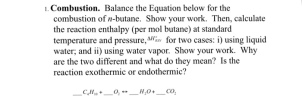 1. Combustion. Balance the Equation below for the combustion of n-butane. Show your work. Then, calculate the reaction enthalpy (per mol butane) at standard temperature and pressure, Allar for two cases: i) using liquid water; and ii) using water vapor. Show your work. Why are the two different and what do they mean? Is the reaction exothermic or endothermic?
 P2: Comparison of EOS methods for gases Calculate the molar volume of n-butane at 510K and 25bar, using the (a) ideal-gas law, (b) the truncated virial equation, and 0 (c) the Pitzer correlation with the Lee-Kesler values for Z and Z For n-butane T 425.1 K, P 37.96 bar, w 0.2 P3: Comparison of cubic EOS Calculate V for sulfur hexafluoride at 75 C and 15 bar by the following equations: (a) The van der waals equation (b) The Redlich/Kwong...
 calculate
U and
H when the pressure of 0.02 mol of an ideal gas at 2 bar and 0.25 L
is reduced to 1 bar and 0.25 L.
calculateU
andH
when the volume of 0.02 mol of an ideal gas at 1 bar and 0.25 L is
increased to 1 bar and 0.50 L.
calculateU
andH
when 0.02 mol of an ideal gas at 2 bar and 0.25 L is expanded to
1.0 bar and 0.50 L isothermally.
calculate
U and
H when the pressure of 0.02 mol of an ideal gas at 2 bar and 0.25 L
is reduced to 1 bar and 0.25 L.
calculateU
andH
when the volume of 0.02 mol of an ideal gas at 1 bar and 0.25 L is
increased to 1 bar and 0.50 L.
calculateU
andH
when 0.02 mol of an ideal gas at 2 bar and 0.25 L is expanded to
1.0 bar and 0.50 L isothermally.
 4. (25pts) 20L nitrogen gas is compressed in a tank at 10 bar and 25°C. Calculate the maximum work (in joules) that can be obtained when the gas is allowed to expand reversibly to a pressure of 1 bar; (a) (10pts) isothermally (b) (15pts) adiabatically The molar heat apacity of nitrogen at constant volume is 20.8 J/K mol. Assume that nitrogen behaves as an ideal gas
4. (25pts) 20L nitrogen gas is compressed in a tank at 10 bar and...
4. (25pts) 20L nitrogen gas is compressed in a tank at 10 bar and 25°C. Calculate the maximum work (in joules) that can be obtained when the gas is allowed to expand reversibly to a pressure of 1 bar; (a) (10pts) isothermally (b) (15pts) adiabatically The molar heat apacity of nitrogen at constant volume is 20.8 J/K mol. Assume that nitrogen behaves as an ideal gas
4. (25pts) 20L nitrogen gas is compressed in a tank at 10 bar and...
 Please answer all three parts and show work. Thank you!
1. An ideal gas assumes molecules are point particles and do not interact with each other. In reality, molecules occupy space! To correct for this, the ideal gas equation of state is adjusted to take the volume occupied by the molecules into account for a real gas: PV = nRT or P = nRTV is modified to P = nRT/(V-nb) (IDEAL GAS) (REAL GAS Where "b" is related to the...
Please answer all three parts and show work. Thank you!
1. An ideal gas assumes molecules are point particles and do not interact with each other. In reality, molecules occupy space! To correct for this, the ideal gas equation of state is adjusted to take the volume occupied by the molecules into account for a real gas: PV = nRT or P = nRTV is modified to P = nRT/(V-nb) (IDEAL GAS) (REAL GAS Where "b" is related to the...
 Vol calculate mol sample of an ideal gas expands reversibly and isothermally to a final OL If the initial pressure is 7.0 am and the temperature is 57.0°C (a) the initial volume of the gas (b) the final pressure of the gas (c) the work done in kJ (5) A 2 50 mol sample of an ideal monoatomic gas at 300K expands adiabatically and reversibly from a volume of 15.0 L to 60.0L Calculate the (a) final temperature of the...
 1. Combustion. Balance the Equation below for the combustion of n-butane. Show your work. Then, calculate the reaction enthalpy (per mol butane) at standard temperature and pressure, Allar for two cases: i) using liquid water; and ii) using water vapor. Show your work. Why are the two different and what do they mean? Is the reaction exothermic or endothermic?
Most questions answered within 3 hours.
-
Where is the error in this code sequence?
String s1 = "Hello";
String s2 = "ello";...
asked 11 months ago -
Financial data for Joel de Paris, Inc., for last year
follow:
Joel de Paris, Inc.
Balance...
asked 11 months ago -
Consider this reaction:
Al2(SO4)3 (aq)+ BaCl3
(aq) Al2Cl6 (aq)- +
3BaSO4(s) . What is the...
asked 11 months ago -
Suppose that Savneet is considering increasing her
recent random sample from 20 car rentals to 40...
asked 11 months ago -
Trucks arrive at an unloading terminal at an average rate of 120
per hour.
Trucks arrive...
asked 11 months ago -
Why are methanol and ethanol completely soluble in water while
octanol is not very little soluble....
asked 11 months ago -
A facilities manager at a university reads in a research report
that the mean amount of...
asked 11 months ago -
When the CuSO4 is rehydrated by adding water to the anhydrous
compound, is this an endothermic...
asked 11 months ago -
A ray of sunlight is passing from diamond into crown glass; the
angle of incidence is...
asked 11 months ago -
A block of mass 0.249 kg is placed on top of a light, vertical
spring of...
asked 11 months ago -
how do the kidneys compensate in the presences of acidosis
a) trigger hyperventilate
b) reserve acid...
asked 11 months ago -
Question 501 pts
The rental rate of capital to the firm increases. Which of the
following...
asked 11 months ago