. Consider Ar undergoing an isothermal, reversible, compression from 1.0 L at 2.0 bar to a...
. Consider Ar undergoing an isothermal, reversible, compression from 1.0 L at 2.0 bar to a final volume and pressure of 0.5 L and 4.0 bar respectively. Calculate w, q, and delta U for this process if:
a) Ar is represented as an ideal gas
b) using the the van der Waals equation to represent Ar.
Compare w, q, and delta U calculated for parts a) and b).
Homework Answers

Add Answer to:
. Consider Ar undergoing an isothermal, reversible, compression
from 1.0 L at 2.0 bar to a...
A van der Waals gas undergoes an isothermal reversible compression under conditions such that z=0.95. What...
A van der Waals gas undergoes an isothermal reversible compression under conditions such that z=0.95. What is the ratio of the work for this process compared to the work for the same process with an ideal gas?
One mole of an ideal gas undergoes a reversible adiabatic expansion from T_1, to T_2 while...
 One mole of an ideal gas undergoes a reversible adiabatic expansion from T_1, to T_2 while tripling the volume of the gas. What is the relation between T_1 and T-2? T-2/3 < T_1<T_2 T_2/3 < T_1 < T-2 T_1= T_2 T_2<T_1 T_1 lessthanorequalto T_2/3 One mole of Ar gas undergoes the reversible transformation shown. Assuming Ar behaves ideally, which statement is true for step 2? Delta U= C_p DeltaT DeltaH < Delta U Delat S= c_p ln(T_c/T_B) W = etaRt...
One mole of water vapor undergoes reversible isothermal expansion from 1.00 L to 10.00 L at...
One mole of water vapor undergoes reversible isothermal expansion from 1.00 L to 10.00 L at 250C. Calculate the amount of work performed if (a) the gas behaves ideally, and (b) the gas obeys the van der Waals equation with constants a = 5.54 dm6 bar mol-2 and b = 0.031 dm3 /mol please show all the step so I can understand
Consider a reversible isothermal expansion of an ideal gas (step 1 in the Carnot cycle). 1.0...
Consider a reversible isothermal expansion of an ideal gas (step 1 in the Carnot cycle). 1.0 mol of ideal gas with Cv =3/2R expands from 2.5L to 10.0L at a temperature (Thot) of 600K. For this process, a) Compute deltaU and deltaH b) Compute w c) Compute q d) Compute delta S Thank you!
A sample containing 80 g of Ar is enclosed in a container of 0.0802 L at 367 K. a) Calculate P, t...
 A sample containing 80 g of Ar is enclosed in a container of 0.0802 L at 367 K. a) Calculate P, the pressure of the system using the ideal gas, van der Waals, and Redlich Kwong equations of state. The pressure for ideal gas model Pideal gas = | Number |bar The pressure for van der Waals model Pvdw Numberbar The pressure for Redlich-Kwong model PRKEİ Number | bar b) Based on your results (after rounding to the nearest bar),...
Consider the isothermal compression of 1 mole of a monatomic ideal gas, initially at a pressure...
 Consider the isothermal compression of 1 mole of a monatomic ideal gas, initially at a pressure of 0.5 bar and volume of 4 liters to a final pressure of 2 bar. Calculate the following: a. The work done if the compression is reversible-answer in Joules b. The work done if the compression is irreversible-answer in Joules
calculate delta U For a van der Waals gas, (U/aV), = a/V lculate AU for an...
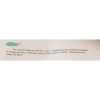 calculate delta U
For a van der Waals gas, (U/aV), = a/V lculate AU for an isothermal expansion of nitrogen gas from a volume (per mole) of 1.00 L to 24. 1 24.8 L at 298 K. What are the molar Calc values of q and w?
calculate delta U
For a van der Waals gas, (U/aV), = a/V lculate AU for an isothermal expansion of nitrogen gas from a volume (per mole) of 1.00 L to 24. 1 24.8 L at 298 K. What are the molar Calc values of q and w?
One mole of H20( is supercooled to-5.00°C at 1 bar pressure before freezing at that temperature....
 One mole of H20( is supercooled to-5.00°C at 1 bar pressure before freezing at that temperature. Calculate ASys, ASum, and ASeotal for this process. Is it spontaneous? CPm (H20, 1)- 75.3 J/mol.K CPm (H20, s)-37.7 J/mol.K AHfusion 6.008 kJ/mol Hint: remember that ASs is computed using q along a reversible path, while ASur is computed using the actual heat transfer during the freezing. For the following equilibrium reaction: Here is an ICE table, starting from no moles of pure 0z...
One hundred cubic meters of carbon dioxide initially at 150 degrees Celsius and 50 bar is...
One hundred cubic meters of carbon dioxide initially at 150 degrees Celsius and 50 bar is to be isothermally compressed in a frictionless piston-and-cylinder device to a final pressure of 300 bar. Assume that this is a reversible process. a.) Use the ideal gas equation of state to calculate: i. The volume of the compressed gas ii. The work done to compress the gas iii. The heat flow on compression b.) Use the van der Waals equation of state to...
One mole of an ideal gas in a closed system undergoes a mechanically reversible adiabatic compression...
One mole of an ideal gas in a closed system undergoes a mechanically reversible adiabatic compression process and changes from V1= 0.05 m^3 and P1= 1 bar to P2= 12 bar. Calculate Q, W, ∆U, and ∆H of the process. If the process will become irreversible with 50% efficiency, calculate the W, Q, ∆U, and ∆H.
 One mole of an ideal gas undergoes a reversible adiabatic expansion from T_1, to T_2 while tripling the volume of the gas. What is the relation between T_1 and T-2? T-2/3 < T_1<T_2 T_2/3 < T_1 < T-2 T_1= T_2 T_2<T_1 T_1 lessthanorequalto T_2/3 One mole of Ar gas undergoes the reversible transformation shown. Assuming Ar behaves ideally, which statement is true for step 2? Delta U= C_p DeltaT DeltaH < Delta U Delat S= c_p ln(T_c/T_B) W = etaRt...
 A sample containing 80 g of Ar is enclosed in a container of 0.0802 L at 367 K. a) Calculate P, the pressure of the system using the ideal gas, van der Waals, and Redlich Kwong equations of state. The pressure for ideal gas model Pideal gas = | Number |bar The pressure for van der Waals model Pvdw Numberbar The pressure for Redlich-Kwong model PRKEİ Number | bar b) Based on your results (after rounding to the nearest bar),...
 Consider the isothermal compression of 1 mole of a monatomic ideal gas, initially at a pressure of 0.5 bar and volume of 4 liters to a final pressure of 2 bar. Calculate the following: a. The work done if the compression is reversible-answer in Joules b. The work done if the compression is irreversible-answer in Joules
 calculate delta U
For a van der Waals gas, (U/aV), = a/V lculate AU for an isothermal expansion of nitrogen gas from a volume (per mole) of 1.00 L to 24. 1 24.8 L at 298 K. What are the molar Calc values of q and w?
calculate delta U
For a van der Waals gas, (U/aV), = a/V lculate AU for an isothermal expansion of nitrogen gas from a volume (per mole) of 1.00 L to 24. 1 24.8 L at 298 K. What are the molar Calc values of q and w?
 One mole of H20( is supercooled to-5.00°C at 1 bar pressure before freezing at that temperature. Calculate ASys, ASum, and ASeotal for this process. Is it spontaneous? CPm (H20, 1)- 75.3 J/mol.K CPm (H20, s)-37.7 J/mol.K AHfusion 6.008 kJ/mol Hint: remember that ASs is computed using q along a reversible path, while ASur is computed using the actual heat transfer during the freezing. For the following equilibrium reaction: Here is an ICE table, starting from no moles of pure 0z...
Most questions answered within 3 hours.
-
Where is the error in this code sequence?
String s1 = "Hello";
String s2 = "ello";...
asked 10 months ago -
Financial data for Joel de Paris, Inc., for last year
follow:
Joel de Paris, Inc.
Balance...
asked 10 months ago -
Consider this reaction:
Al2(SO4)3 (aq)+ BaCl3
(aq) Al2Cl6 (aq)- +
3BaSO4(s) . What is the...
asked 10 months ago -
Suppose that Savneet is considering increasing her
recent random sample from 20 car rentals to 40...
asked 10 months ago -
Trucks arrive at an unloading terminal at an average rate of 120
per hour.
Trucks arrive...
asked 10 months ago -
Why are methanol and ethanol completely soluble in water while
octanol is not very little soluble....
asked 10 months ago -
A facilities manager at a university reads in a research report
that the mean amount of...
asked 10 months ago -
When the CuSO4 is rehydrated by adding water to the anhydrous
compound, is this an endothermic...
asked 10 months ago -
A ray of sunlight is passing from diamond into crown glass; the
angle of incidence is...
asked 10 months ago -
A block of mass 0.249 kg is placed on top of a light, vertical
spring of...
asked 10 months ago -
how do the kidneys compensate in the presences of acidosis
a) trigger hyperventilate
b) reserve acid...
asked 10 months ago -
Question 501 pts
The rental rate of capital to the firm increases. Which of the
following...
asked 10 months ago