
Homework Answers
The plateau phase of the ventricular action potential is caused by - "fast voltage-gated Ca2+ channel opening".
Add Answer to:
The plateau phase of the ventricular action potential is caused by O fast voltage-gated Ca2+ channels...
3. Many neurons contain "delayed K channels". Like voltage-gated Nat channels, these voltage-gated K+ channels open in response to a rise in membrane potential and then undergo inactivati...
 3. Many neurons contain "delayed K channels". Like voltage-gated Nat channels, these voltage-gated K+ channels open in response to a rise in membrane potential and then undergo inactivation. However, opening of the voltage-gated K channels lags behind opening of the voltage-gated Na channels. a) Why does neuronal function require the voltage-gated K channels to open more slowly than the voltage-gated Na channels? b) Compared to a neuron that lacks voltage-gated K channels, what differences would you expect in the shape...
Part A The "pacemaker potential of pacemaker cells is produced by the opening of at the...
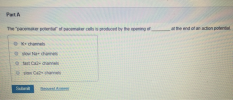 Part A The "pacemaker potential of pacemaker cells is produced by the opening of at the end of an action potential. O K+ channels O slow Na+ channels fast Ca2+ channels slow Ca2+ channels Submit Request Answer
CNCORA 6 of 10 > Action potentials in neurons involve opening and closing of voltage-gated Nat...
 CNCORA 6 of 10 > Action potentials in neurons involve opening and closing of voltage-gated Nat and K ion channels. Place the events of an action potential in order, starting and ending with a cell at its resting membrane potential. Resting state Return to resting state Answer Bank A graded potential brings the membrane to threshold potential. Fast Na+ and slow K* channels are activated. Nat rushes into the cell, causing membrane depolarization. K channels close slowly, resulting in hyperpolarization....
choices for A: Na+/K+ pumps, voltage gated K+ channels, voltage gated Ca+ channels, voltage gated Na+...
 choices for A: Na+/K+ pumps, voltage gated K+ channels,
voltage gated Ca+ channels, voltage gated Na+ channels
choices for B: bidirectionally, unidirectionally
choices for C: Na+/K+ pumps, voltage gated K+ channels,
voltage gated Ca+ channels, voltage gated Na+ channels
choices for D: Na+/K+ pumps, voltage gated K+ channels,
voltage gated Ca+ channels, voltage gated Na+ channels
Consider this graph illustrating the generation of an action potential across the plasma membrane of a stimulated neuron. +40 ACTION POTENTIAL plasma membrane potential...
choices for A: Na+/K+ pumps, voltage gated K+ channels,
voltage gated Ca+ channels, voltage gated Na+ channels
choices for B: bidirectionally, unidirectionally
choices for C: Na+/K+ pumps, voltage gated K+ channels,
voltage gated Ca+ channels, voltage gated Na+ channels
choices for D: Na+/K+ pumps, voltage gated K+ channels,
voltage gated Ca+ channels, voltage gated Na+ channels
Consider this graph illustrating the generation of an action potential across the plasma membrane of a stimulated neuron. +40 ACTION POTENTIAL plasma membrane potential...
1. What triggers the opening of each of the different channels: ligand-gated K+ channels, ligand-gated Na+...
1. What triggers the opening of each of the different channels: ligand-gated K+ channels, ligand-gated Na+ channels, ligand-gated Cl- channels, voltage-gated Na+ channels, voltage-gated K+ channels, voltage-gated Ca2+ channels. 2. What happens to membrane potential in the immediate area where the channel is located when the channel opens and ions flow through? 3. Since graded and action potentials happen in different locations on the neuron, explain what has to happen to link these different events together.
The fixed pattern of changes in membrane potential during an action potential is coordinated by the...
 The fixed pattern of changes in
membrane potential during an action potential is coordinated by the
sequential opening and closing of voltage-gated ion channels. Can
you identify the status (open/closed) of the voltage-gated Na+ and
K+ channels during each phase of an action potential? Drag the
appropriate labels onto the graph to indicate the status (open or
closed) of the voltage-gated Na+ and K+ channels during each phase
of an action potential. Labels may be used once, more than once,...
The fixed pattern of changes in
membrane potential during an action potential is coordinated by the
sequential opening and closing of voltage-gated ion channels. Can
you identify the status (open/closed) of the voltage-gated Na+ and
K+ channels during each phase of an action potential? Drag the
appropriate labels onto the graph to indicate the status (open or
closed) of the voltage-gated Na+ and K+ channels during each phase
of an action potential. Labels may be used once, more than once,...
Dendrotoxins, produced by the mamba snake, are inhibitors of the voltage-gated K+ channels. What phase of...
Dendrotoxins, produced by the mamba snake, are inhibitors of the voltage-gated K+ channels. What phase of the action potential would this toxin affect? How would it affect ion permeability during this phase? How would ion movement be affected?
discuss the steps involved in forming an action potential, starting with the opening of voltage-gated sodium...
discuss the steps involved in forming an action potential, starting with the opening of voltage-gated sodium channels
During an action potential, which of the following actions does not help return the membrane to...
 During an action potential, which of the following actions does not help return the membrane to its resting potential? Choose one: O A. the inactivation of voltage-gated Nat channels O B. the opening of voltage-gated K+ channels O C. the opening of voltage-gated Nat channels O D. the flow of K+ through K+ leak channels
Compare the roles that Na+-gated and K+-gated ion channels play in an action potential.
Compare the roles that Na+-gated and K+-gated ion channels play in an action potential.
 3. Many neurons contain "delayed K channels". Like voltage-gated Nat channels, these voltage-gated K+ channels open in response to a rise in membrane potential and then undergo inactivation. However, opening of the voltage-gated K channels lags behind opening of the voltage-gated Na channels. a) Why does neuronal function require the voltage-gated K channels to open more slowly than the voltage-gated Na channels? b) Compared to a neuron that lacks voltage-gated K channels, what differences would you expect in the shape...
 Part A The "pacemaker potential of pacemaker cells is produced by the opening of at the end of an action potential. O K+ channels O slow Na+ channels fast Ca2+ channels slow Ca2+ channels Submit Request Answer
 CNCORA 6 of 10 > Action potentials in neurons involve opening and closing of voltage-gated Nat and K ion channels. Place the events of an action potential in order, starting and ending with a cell at its resting membrane potential. Resting state Return to resting state Answer Bank A graded potential brings the membrane to threshold potential. Fast Na+ and slow K* channels are activated. Nat rushes into the cell, causing membrane depolarization. K channels close slowly, resulting in hyperpolarization....
 choices for A: Na+/K+ pumps, voltage gated K+ channels,
voltage gated Ca+ channels, voltage gated Na+ channels
choices for B: bidirectionally, unidirectionally
choices for C: Na+/K+ pumps, voltage gated K+ channels,
voltage gated Ca+ channels, voltage gated Na+ channels
choices for D: Na+/K+ pumps, voltage gated K+ channels,
voltage gated Ca+ channels, voltage gated Na+ channels
Consider this graph illustrating the generation of an action potential across the plasma membrane of a stimulated neuron. +40 ACTION POTENTIAL plasma membrane potential...
choices for A: Na+/K+ pumps, voltage gated K+ channels,
voltage gated Ca+ channels, voltage gated Na+ channels
choices for B: bidirectionally, unidirectionally
choices for C: Na+/K+ pumps, voltage gated K+ channels,
voltage gated Ca+ channels, voltage gated Na+ channels
choices for D: Na+/K+ pumps, voltage gated K+ channels,
voltage gated Ca+ channels, voltage gated Na+ channels
Consider this graph illustrating the generation of an action potential across the plasma membrane of a stimulated neuron. +40 ACTION POTENTIAL plasma membrane potential...
 The fixed pattern of changes in
membrane potential during an action potential is coordinated by the
sequential opening and closing of voltage-gated ion channels. Can
you identify the status (open/closed) of the voltage-gated Na+ and
K+ channels during each phase of an action potential? Drag the
appropriate labels onto the graph to indicate the status (open or
closed) of the voltage-gated Na+ and K+ channels during each phase
of an action potential. Labels may be used once, more than once,...
The fixed pattern of changes in
membrane potential during an action potential is coordinated by the
sequential opening and closing of voltage-gated ion channels. Can
you identify the status (open/closed) of the voltage-gated Na+ and
K+ channels during each phase of an action potential? Drag the
appropriate labels onto the graph to indicate the status (open or
closed) of the voltage-gated Na+ and K+ channels during each phase
of an action potential. Labels may be used once, more than once,...
 During an action potential, which of the following actions does not help return the membrane to its resting potential? Choose one: O A. the inactivation of voltage-gated Nat channels O B. the opening of voltage-gated K+ channels O C. the opening of voltage-gated Nat channels O D. the flow of K+ through K+ leak channels
Most questions answered within 3 hours.
-
Where is the error in this code sequence?
String s1 = "Hello";
String s2 = "ello";...
asked 10 months ago -
Financial data for Joel de Paris, Inc., for last year
follow:
Joel de Paris, Inc.
Balance...
asked 10 months ago -
Consider this reaction:
Al2(SO4)3 (aq)+ BaCl3
(aq) Al2Cl6 (aq)- +
3BaSO4(s) . What is the...
asked 10 months ago -
Suppose that Savneet is considering increasing her
recent random sample from 20 car rentals to 40...
asked 10 months ago -
Trucks arrive at an unloading terminal at an average rate of 120
per hour.
Trucks arrive...
asked 10 months ago -
Why are methanol and ethanol completely soluble in water while
octanol is not very little soluble....
asked 10 months ago -
A facilities manager at a university reads in a research report
that the mean amount of...
asked 10 months ago -
When the CuSO4 is rehydrated by adding water to the anhydrous
compound, is this an endothermic...
asked 10 months ago -
A ray of sunlight is passing from diamond into crown glass; the
angle of incidence is...
asked 10 months ago -
A block of mass 0.249 kg is placed on top of a light, vertical
spring of...
asked 10 months ago -
how do the kidneys compensate in the presences of acidosis
a) trigger hyperventilate
b) reserve acid...
asked 10 months ago -
Question 501 pts
The rental rate of capital to the firm increases. Which of the
following...
asked 10 months ago