
Homework Answers
Request Answer!
We need at least 10 more requests to produce the answer.
0 / 10 have requested this problem solution
The more requests, the faster the answer.
Add Answer to:
(bonus) Prove that operator A: L²(0,1) - L’(0,1), Ar(t) = 5 ts(1 – st)x(s)ds is compact...
Let V be a vector space, let S, T L(V), and assume that ST = TS. Prove that if ˇ V is an eigenvec...
 Let V be a vector space, let S, T L(V), and assume that ST = TS. Prove that if ˇ V is an eigenvector for T with eigenvalue λ, then λ is also an eigenvalue for S Find an eigenvector for λ with respect to S, and prove your answer is correct.
Let V be a vector space, let S, T L(V), and assume that ST = TS. Prove that if ˇ V is an eigenvector for T with eigenvalue...
Let V be a vector space, let S, T L(V), and assume that ST = TS. Prove that if ˇ V is an eigenvector for T with eigenvalue λ, then λ is also an eigenvalue for S Find an eigenvector for λ with respect to S, and prove your answer is correct.
Let V be a vector space, let S, T L(V), and assume that ST = TS. Prove that if ˇ V is an eigenvector for T with eigenvalue...
1. Let f : L→ L be a diagonalizable operator with a simple spectrum. a) Prove that any operator g...
 1. Let f : L→ L be a diagonalizable operator with a simple spectrum. a) Prove that any operator g L L such that 9f fg can be represented in -fg can be represented in the form of a polynomial of f. b) Prove that the dimension of the space of such operators g equals dim L. Are these assertions true if the spectrum of f is not simple?
1. Let f : L→ L be a diagonalizable operator with...
1. Let f : L→ L be a diagonalizable operator with a simple spectrum. a) Prove that any operator g L L such that 9f fg can be represented in -fg can be represented in the form of a polynomial of f. b) Prove that the dimension of the space of such operators g equals dim L. Are these assertions true if the spectrum of f is not simple?
1. Let f : L→ L be a diagonalizable operator with...
Compute / F. ds for the given oriented surface. F (e. z. x), G, s) +(s.rts,n. osrs 1, 0 sss 5, oriented by T, x Ts Compute / F. ds for the given oriented surface. F (e. z. x), G, s) +(s.rts,...
 Compute / F. ds for the given oriented surface. F (e. z. x), G, s) +(s.rts,n. osrs 1, 0 sss 5, oriented by T, x Ts
Compute / F. ds for the given oriented surface. F (e. z. x), G, s) +(s.rts,n. osrs 1, 0 sss 5, oriented by T, x Ts
Compute / F. ds for the given oriented surface. F (e. z. x), G, s) +(s.rts,n. osrs 1, 0 sss 5, oriented by T, x Ts
Consider: S (x + 2 x + y)z ds, C: r(t)= (2+, 1-37, 57 +5), te[0,1]...
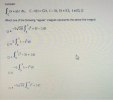 Consider: S (x + 2 x + y)z ds, C: r(t)= (2+, 1-37, 57 +5), te[0,1] Which one of the following "regular" integrals represents the above line integral. -5/38 | 2+31 – Ide a. Ob och 2-33+ 101 -551-pat Od -s/38 1-10
5. [20+5+5] In the regression modely, x,B+ s, pe,+u, ,where I ρ k l and , , let ε, follow an autoregressive (AR) process u' ~ID(Qơ:) , t-l, 2, ,n . <l and u, - Derive the variance-covarian...
 5. [20+5+5] In the regression modely, x,B+ s, pe,+u, ,where I ρ k l and , , let ε, follow an autoregressive (AR) process u' ~ID(Qơ:) , t-l, 2, ,n . <l and u, - Derive the variance-covariance matrix Σ of (q ,6, , , ε" )". From the expression of Σ, identify and interpret Var(.) , t-1, 2, , n . Find the CorrG.ε. and explain its behavior as "s" increases, (s>0). (ii) (iii)
5. [20+5+5] In the regression...
5. [20+5+5] In the regression modely, x,B+ s, pe,+u, ,where I ρ k l and , , let ε, follow an autoregressive (AR) process u' ~ID(Qơ:) , t-l, 2, ,n . <l and u, - Derive the variance-covariance matrix Σ of (q ,6, , , ε" )". From the expression of Σ, identify and interpret Var(.) , t-1, 2, , n . Find the CorrG.ε. and explain its behavior as "s" increases, (s>0). (ii) (iii)
5. [20+5+5] In the regression...
the set A ⊆ L^2 by A = { {xn} ∈ L^ 2 : X∞ n=0 (1 + n)|xn| 2 ≤ 1 } Prove A is totally bounded, and compact.
the set A ⊆ L^2 by A = { {xn} ∈ L^ 2 : X∞ n=0 (1 + n)|xn| 2 ≤ 1 } Prove A is totally bounded, and compact.
a) Prove or disprove: if S,TELluv) then trace ('st) = trove's) tracel T) b) Prove or...
 a) Prove or disprove: if S,TELluv) then trace ('st) = trove's) tracel T) b) Prove or disprove, if S.TELIVE) then det (5+ 7) = det (5) + det (7)
g) Consider the problem Ou(x, t) = Oxxu(x, t), u(x,0) = Q(x), 0,u(0,1) = 0,1(L,t) =...
 g) Consider the problem Ou(x, t) = Oxxu(x, t), u(x,0) = Q(x), 0,u(0,1) = 0,1(L,t) = 0, (x, t) (0, L) x (0,00), T ( [0, LG, te [0,00). with a given function 0. Show that the energy L 1 ENE() = 1 u? (x, t)da decays in time.
2. Consider the set S-[1, oo). Consider the open cover x(n-1,n+)InEN) - (0,2),(1,3),(2.4),(8,5.,..) of S. Prove that X contains no finite subcover of S. Hence S is not compact. 2. Consider t...
 2. Consider the set S-[1, oo). Consider the open cover x(n-1,n+)InEN) - (0,2),(1,3),(2.4),(8,5.,..) of S. Prove that X contains no finite subcover of S. Hence S is not compact.
2. Consider the set S-[1, oo). Consider the open cover x(n-1,n+)InEN) - (0,2),(1,3),(2.4),(8,5.,..) of S. Prove that X contains no finite subcover of S. Hence S is not compact.
2. Consider the set S-[1, oo). Consider the open cover x(n-1,n+)InEN) - (0,2),(1,3),(2.4),(8,5.,..) of S. Prove that X contains no finite subcover of S. Hence S is not compact.
Prove the following corollary: if !lDkf(x + th)|| 〈 M for all t E [0,1], then...
 Prove the following corollary:
if !lDkf(x + th)|| 〈 M for all t E [0,1], then the remainder Rk is bounded by klly S k!
Prove the following corollary:
if !lDkf(x + th)|| 〈 M for all t E [0,1], then the remainder Rk is bounded by klly S k!
 Let V be a vector space, let S, T L(V), and assume that ST = TS. Prove that if ˇ V is an eigenvector for T with eigenvalue λ, then λ is also an eigenvalue for S Find an eigenvector for λ with respect to S, and prove your answer is correct.
Let V be a vector space, let S, T L(V), and assume that ST = TS. Prove that if ˇ V is an eigenvector for T with eigenvalue...
Let V be a vector space, let S, T L(V), and assume that ST = TS. Prove that if ˇ V is an eigenvector for T with eigenvalue λ, then λ is also an eigenvalue for S Find an eigenvector for λ with respect to S, and prove your answer is correct.
Let V be a vector space, let S, T L(V), and assume that ST = TS. Prove that if ˇ V is an eigenvector for T with eigenvalue...
 1. Let f : L→ L be a diagonalizable operator with a simple spectrum. a) Prove that any operator g L L such that 9f fg can be represented in -fg can be represented in the form of a polynomial of f. b) Prove that the dimension of the space of such operators g equals dim L. Are these assertions true if the spectrum of f is not simple?
1. Let f : L→ L be a diagonalizable operator with...
1. Let f : L→ L be a diagonalizable operator with a simple spectrum. a) Prove that any operator g L L such that 9f fg can be represented in -fg can be represented in the form of a polynomial of f. b) Prove that the dimension of the space of such operators g equals dim L. Are these assertions true if the spectrum of f is not simple?
1. Let f : L→ L be a diagonalizable operator with...
 Compute / F. ds for the given oriented surface. F (e. z. x), G, s) +(s.rts,n. osrs 1, 0 sss 5, oriented by T, x Ts
Compute / F. ds for the given oriented surface. F (e. z. x), G, s) +(s.rts,n. osrs 1, 0 sss 5, oriented by T, x Ts
Compute / F. ds for the given oriented surface. F (e. z. x), G, s) +(s.rts,n. osrs 1, 0 sss 5, oriented by T, x Ts
 Consider: S (x + 2 x + y)z ds, C: r(t)= (2+, 1-37, 57 +5), te[0,1] Which one of the following "regular" integrals represents the above line integral. -5/38 | 2+31 – Ide a. Ob och 2-33+ 101 -551-pat Od -s/38 1-10
 5. [20+5+5] In the regression modely, x,B+ s, pe,+u, ,where I ρ k l and , , let ε, follow an autoregressive (AR) process u' ~ID(Qơ:) , t-l, 2, ,n . <l and u, - Derive the variance-covariance matrix Σ of (q ,6, , , ε" )". From the expression of Σ, identify and interpret Var(.) , t-1, 2, , n . Find the CorrG.ε. and explain its behavior as "s" increases, (s>0). (ii) (iii)
5. [20+5+5] In the regression...
5. [20+5+5] In the regression modely, x,B+ s, pe,+u, ,where I ρ k l and , , let ε, follow an autoregressive (AR) process u' ~ID(Qơ:) , t-l, 2, ,n . <l and u, - Derive the variance-covariance matrix Σ of (q ,6, , , ε" )". From the expression of Σ, identify and interpret Var(.) , t-1, 2, , n . Find the CorrG.ε. and explain its behavior as "s" increases, (s>0). (ii) (iii)
5. [20+5+5] In the regression...
 a) Prove or disprove: if S,TELluv) then trace ('st) = trove's) tracel T) b) Prove or disprove, if S.TELIVE) then det (5+ 7) = det (5) + det (7)
 g) Consider the problem Ou(x, t) = Oxxu(x, t), u(x,0) = Q(x), 0,u(0,1) = 0,1(L,t) = 0, (x, t) (0, L) x (0,00), T ( [0, LG, te [0,00). with a given function 0. Show that the energy L 1 ENE() = 1 u? (x, t)da decays in time.
 2. Consider the set S-[1, oo). Consider the open cover x(n-1,n+)InEN) - (0,2),(1,3),(2.4),(8,5.,..) of S. Prove that X contains no finite subcover of S. Hence S is not compact.
2. Consider the set S-[1, oo). Consider the open cover x(n-1,n+)InEN) - (0,2),(1,3),(2.4),(8,5.,..) of S. Prove that X contains no finite subcover of S. Hence S is not compact.
2. Consider the set S-[1, oo). Consider the open cover x(n-1,n+)InEN) - (0,2),(1,3),(2.4),(8,5.,..) of S. Prove that X contains no finite subcover of S. Hence S is not compact.
 Prove the following corollary:
if !lDkf(x + th)|| 〈 M for all t E [0,1], then the remainder Rk is bounded by klly S k!
Prove the following corollary:
if !lDkf(x + th)|| 〈 M for all t E [0,1], then the remainder Rk is bounded by klly S k!
Most questions answered within 3 hours.
-
Where is the error in this code sequence?
String s1 = "Hello";
String s2 = "ello";...
asked 10 months ago -
Financial data for Joel de Paris, Inc., for last year
follow:
Joel de Paris, Inc.
Balance...
asked 10 months ago -
Consider this reaction:
Al2(SO4)3 (aq)+ BaCl3
(aq) Al2Cl6 (aq)- +
3BaSO4(s) . What is the...
asked 10 months ago -
Suppose that Savneet is considering increasing her
recent random sample from 20 car rentals to 40...
asked 10 months ago -
Trucks arrive at an unloading terminal at an average rate of 120
per hour.
Trucks arrive...
asked 10 months ago -
Why are methanol and ethanol completely soluble in water while
octanol is not very little soluble....
asked 10 months ago -
A facilities manager at a university reads in a research report
that the mean amount of...
asked 10 months ago -
When the CuSO4 is rehydrated by adding water to the anhydrous
compound, is this an endothermic...
asked 10 months ago -
A ray of sunlight is passing from diamond into crown glass; the
angle of incidence is...
asked 10 months ago -
A block of mass 0.249 kg is placed on top of a light, vertical
spring of...
asked 10 months ago -
how do the kidneys compensate in the presences of acidosis
a) trigger hyperventilate
b) reserve acid...
asked 10 months ago -
Question 501 pts
The rental rate of capital to the firm increases. Which of the
following...
asked 10 months ago