mechanics dynamics
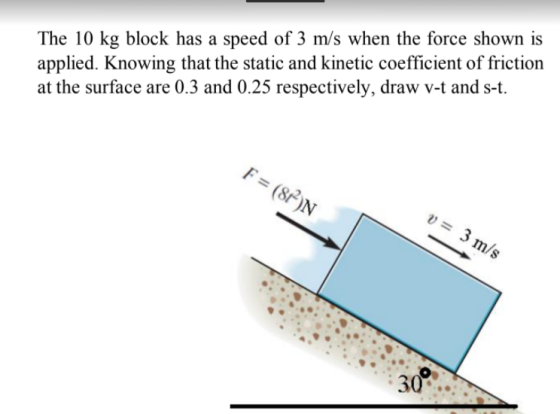
The \(10 \mathrm{~kg}\) block has a speed of \(3 \mathrm{~m} / \mathrm{s}\) when the force shown is applied. Knowing that the static and kinetic coefficient of friction at the surface are 0.3 and 0.25 respectively, draw \(v-t\) and s-t.
Homework Answers


Question 3. A block A, having a mass of 20-kg, is released from rest and slides...
 Question 3. A block A, having a mass of 20-kg, is released from rest and slides down an incline with coeffici an incline with coefficient of static d kinetic friction of 0.25 and 0.10, respectively. When it reaches the bottom of the ramp, it slides ally onto the surface of a 10-kg cart for which the coefficient of static and kinetic friction between Question 3. A block A, having a mass of 20-kg, is released from rest and slides down...
1. (a) The 7-kg block is moving with an initial speed of 8 m/s. If the...
 1. (a) The 7-kg block is moving with an initial speed of 8 m/s. If the coefficient of kinetic friction between the block and plane is 0.3, determine the compression in the spring when the block momentarily stops JkA - BONm 8 m/s (b) The 50 lb block rests on the rough surface for which the coefficient of friction is pl = 0.25. A force F= (30+2s) Ib, where s is in ft, acts on the block in the direction...
The force P is applied to the 49-kg block when it is at rest. Determine the...
 The force P is applied to the 49-kg block when it is at rest.
Determine the magnitude and direction of the friction force exerted
by the surface on the block if (a) P = 0, (b) P = 219 N, and (c) P
= 311 N. (d) What value of P is required to initiate motion up the
incline? The static and kinetic coefficients of friction between
the block and the incline are μs = 0.29 and μk = 0.25,...
The force P is applied to the 49-kg block when it is at rest.
Determine the magnitude and direction of the friction force exerted
by the surface on the block if (a) P = 0, (b) P = 219 N, and (c) P
= 311 N. (d) What value of P is required to initiate motion up the
incline? The static and kinetic coefficients of friction between
the block and the incline are μs = 0.29 and μk = 0.25,...
A horizontal force F, of strength 3.0 N, is applied to a block of mass m...
A horizontal force F, of strength 3.0 N, is applied to a block of mass m = 1.0 kg as shown. The coefficient of static friction between the block and the surface is 0.60, and the coefficient of kinetic friction is 0.20. Will the block move? What is the force of friction that acts on the block?
11. A BO N. horizontal force is applied on a 10 kg block along a rough...
 11. A BO N. horizontal force is applied on a 10 kg block along a rough horizontal surface. If the coefficient of static friction between the block and the surfaces is 0.40 and the coefficient of kinetic friction between the block and the surface hk is 0.3. What is the magnitude of the frictional force that acts on the block? A) 39 N B) 29 N C) 20 N D) 10 N E ) ON
Please help A. A block is pulled along a horizontal surface by a force of 12.0...
 Please help
A. A block is pulled along a horizontal surface by a force of 12.0 N. The block has a mass of 4.00 kg and it accelerates at 2.00 m/s. Find the coefficient of kinetic friction for the interface between the block and the surface. B. A stone falls vertically through the air and experiences a drag force. If the stone's mass is 6.00 kg. and the drag force (upwards force) is 14.0 N, what is the acceleration of...
Please help
A. A block is pulled along a horizontal surface by a force of 12.0 N. The block has a mass of 4.00 kg and it accelerates at 2.00 m/s. Find the coefficient of kinetic friction for the interface between the block and the surface. B. A stone falls vertically through the air and experiences a drag force. If the stone's mass is 6.00 kg. and the drag force (upwards force) is 14.0 N, what is the acceleration of...
C. A 15 0-kg box has a rubber bottom. It is sliding on a horizontal sheet...
 C. A 15 0-kg box has a rubber bottom. It is sliding on a horizontal sheet of ice with a 30.0 force applied to it. Coefficient of friction is 0.22 Determine: a. The force of friction on the box The acceleration of the box c. Later, the horizontal force is reduced to 20.0-N. Determine the acceleration of the box for this condition. d. Is this static of kinetic friction D. A block is pulled along a horizontal surface by a...
1.A box is given a push so that it slides across the floor.How far will it...
1.A box is given a push so that it slides across the floor.How far will it go, given that the coefficient of kinetic friction is 0.20 and the push imparts an initial speed of 3.0m/s? 2.A 14.0 −kg box is released on a 38 ∘ incline and accelerates down the incline at 0.25 m/s2 . a.Find the friction force impeding its motion. b.What is the coefficient of kinetic friction? 3.Consider the system shown in the figure.Block A has weight 5.4...
A 10.0 kg block is resting on a horizontal surface when a force P is applied...
 A 10.0 kg block is resting on a horizontal surface when a force
P is applied to it for 7.00 seconds. The variation of P with time
is shown in the figure where P is in Newtons and t is in seconds.
If the coefficients of static and kinetic friction between the
block and the surface are μs = 0.600 and μk = 0.400 respectively,
and g = 10.0 m/s2 calculate
a) [2] The time t_1 at which the block...
A 10.0 kg block is resting on a horizontal surface when a force
P is applied to it for 7.00 seconds. The variation of P with time
is shown in the figure where P is in Newtons and t is in seconds.
If the coefficients of static and kinetic friction between the
block and the surface are μs = 0.600 and μk = 0.400 respectively,
and g = 10.0 m/s2 calculate
a) [2] The time t_1 at which the block...
Dear Tutors, please help. please look carefully at the questions before attempting. total of 3 questions....
 Dear Tutors, please help. please look carefully at the
questions before attempting. total of 3 questions. question 3
includes part (a) and (b) only, please attempt all... thank you in
advance
Use g = 9.81 m/s2 for all the questions when applicable Question 1 (a) Fig. Q1a shows two masses A and B of masses 0.75 kg and 0.5 kg respectively, connected by a light inelastic string which passes over a frictionless pulley. The system is held at rest with...
Dear Tutors, please help. please look carefully at the
questions before attempting. total of 3 questions. question 3
includes part (a) and (b) only, please attempt all... thank you in
advance
Use g = 9.81 m/s2 for all the questions when applicable Question 1 (a) Fig. Q1a shows two masses A and B of masses 0.75 kg and 0.5 kg respectively, connected by a light inelastic string which passes over a frictionless pulley. The system is held at rest with...
 Question 3. A block A, having a mass of 20-kg, is released from rest and slides down an incline with coeffici an incline with coefficient of static d kinetic friction of 0.25 and 0.10, respectively. When it reaches the bottom of the ramp, it slides ally onto the surface of a 10-kg cart for which the coefficient of static and kinetic friction between Question 3. A block A, having a mass of 20-kg, is released from rest and slides down...
 1. (a) The 7-kg block is moving with an initial speed of 8 m/s. If the coefficient of kinetic friction between the block and plane is 0.3, determine the compression in the spring when the block momentarily stops JkA - BONm 8 m/s (b) The 50 lb block rests on the rough surface for which the coefficient of friction is pl = 0.25. A force F= (30+2s) Ib, where s is in ft, acts on the block in the direction...
 The force P is applied to the 49-kg block when it is at rest.
Determine the magnitude and direction of the friction force exerted
by the surface on the block if (a) P = 0, (b) P = 219 N, and (c) P
= 311 N. (d) What value of P is required to initiate motion up the
incline? The static and kinetic coefficients of friction between
the block and the incline are μs = 0.29 and μk = 0.25,...
The force P is applied to the 49-kg block when it is at rest.
Determine the magnitude and direction of the friction force exerted
by the surface on the block if (a) P = 0, (b) P = 219 N, and (c) P
= 311 N. (d) What value of P is required to initiate motion up the
incline? The static and kinetic coefficients of friction between
the block and the incline are μs = 0.29 and μk = 0.25,...
 11. A BO N. horizontal force is applied on a 10 kg block along a rough horizontal surface. If the coefficient of static friction between the block and the surfaces is 0.40 and the coefficient of kinetic friction between the block and the surface hk is 0.3. What is the magnitude of the frictional force that acts on the block? A) 39 N B) 29 N C) 20 N D) 10 N E ) ON
 Please help
A. A block is pulled along a horizontal surface by a force of 12.0 N. The block has a mass of 4.00 kg and it accelerates at 2.00 m/s. Find the coefficient of kinetic friction for the interface between the block and the surface. B. A stone falls vertically through the air and experiences a drag force. If the stone's mass is 6.00 kg. and the drag force (upwards force) is 14.0 N, what is the acceleration of...
Please help
A. A block is pulled along a horizontal surface by a force of 12.0 N. The block has a mass of 4.00 kg and it accelerates at 2.00 m/s. Find the coefficient of kinetic friction for the interface between the block and the surface. B. A stone falls vertically through the air and experiences a drag force. If the stone's mass is 6.00 kg. and the drag force (upwards force) is 14.0 N, what is the acceleration of...
 C. A 15 0-kg box has a rubber bottom. It is sliding on a horizontal sheet of ice with a 30.0 force applied to it. Coefficient of friction is 0.22 Determine: a. The force of friction on the box The acceleration of the box c. Later, the horizontal force is reduced to 20.0-N. Determine the acceleration of the box for this condition. d. Is this static of kinetic friction D. A block is pulled along a horizontal surface by a...
 A 10.0 kg block is resting on a horizontal surface when a force
P is applied to it for 7.00 seconds. The variation of P with time
is shown in the figure where P is in Newtons and t is in seconds.
If the coefficients of static and kinetic friction between the
block and the surface are μs = 0.600 and μk = 0.400 respectively,
and g = 10.0 m/s2 calculate
a) [2] The time t_1 at which the block...
A 10.0 kg block is resting on a horizontal surface when a force
P is applied to it for 7.00 seconds. The variation of P with time
is shown in the figure where P is in Newtons and t is in seconds.
If the coefficients of static and kinetic friction between the
block and the surface are μs = 0.600 and μk = 0.400 respectively,
and g = 10.0 m/s2 calculate
a) [2] The time t_1 at which the block...
 Dear Tutors, please help. please look carefully at the
questions before attempting. total of 3 questions. question 3
includes part (a) and (b) only, please attempt all... thank you in
advance
Use g = 9.81 m/s2 for all the questions when applicable Question 1 (a) Fig. Q1a shows two masses A and B of masses 0.75 kg and 0.5 kg respectively, connected by a light inelastic string which passes over a frictionless pulley. The system is held at rest with...
Dear Tutors, please help. please look carefully at the
questions before attempting. total of 3 questions. question 3
includes part (a) and (b) only, please attempt all... thank you in
advance
Use g = 9.81 m/s2 for all the questions when applicable Question 1 (a) Fig. Q1a shows two masses A and B of masses 0.75 kg and 0.5 kg respectively, connected by a light inelastic string which passes over a frictionless pulley. The system is held at rest with...
Most questions answered within 3 hours.
-
Where is the error in this code sequence?
String s1 = "Hello";
String s2 = "ello";...
asked 10 months ago -
Financial data for Joel de Paris, Inc., for last year
follow:
Joel de Paris, Inc.
Balance...
asked 10 months ago -
Consider this reaction:
Al2(SO4)3 (aq)+ BaCl3
(aq) Al2Cl6 (aq)- +
3BaSO4(s) . What is the...
asked 10 months ago -
Suppose that Savneet is considering increasing her
recent random sample from 20 car rentals to 40...
asked 10 months ago -
Trucks arrive at an unloading terminal at an average rate of 120
per hour.
Trucks arrive...
asked 10 months ago -
Why are methanol and ethanol completely soluble in water while
octanol is not very little soluble....
asked 10 months ago -
A facilities manager at a university reads in a research report
that the mean amount of...
asked 10 months ago -
When the CuSO4 is rehydrated by adding water to the anhydrous
compound, is this an endothermic...
asked 10 months ago -
A ray of sunlight is passing from diamond into crown glass; the
angle of incidence is...
asked 10 months ago -
A block of mass 0.249 kg is placed on top of a light, vertical
spring of...
asked 10 months ago -
how do the kidneys compensate in the presences of acidosis
a) trigger hyperventilate
b) reserve acid...
asked 10 months ago -
Question 501 pts
The rental rate of capital to the firm increases. Which of the
following...
asked 10 months ago