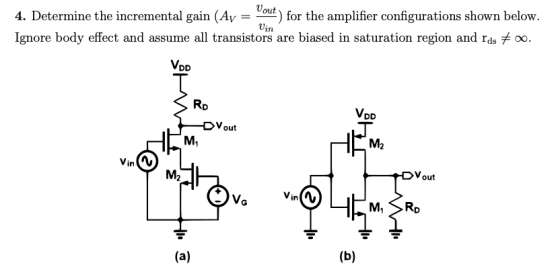
Determine the incremental gain (AV = vout/vin ) for the amplifier configurations shown below.
Ignore body effect and assume all transistors are biased in saturation region and r_ds =/ ∞.
Homework Answers
Request Answer!
We need at least 10 more requests to produce the answer.
0 / 10 have requested this problem solution
The more requests, the faster the answer.
Add Answer to:
Determine the incremental gain (AV = vout/vin ) for the
amplifier configurations shown below.
Ignore body...
Calculate the voltage gain (Av) for the loaded Common Emitter Amplifier below: BAC 200 for all...
 Calculate the voltage gain (Av) for the loaded Common Emitter Amplifier below: BAC 200 for all transistors. Assume re 15 Q for the CE Amplifier. Ignore re' for the DP Amplifier Vcc 12 V, R1 56 K, R2 10 KQ, R4 22 KQ R3 5.6 KQ, RL 8 RE(CE) 628 0, RE(CC) 330 Rc 3.5 KQ, Enter your results. No units. SR3 R1 RC C3 Vcc C1 Beta Q2a HH Vin Beta Q1 Beta Q2b C4 R4 Vs R2 C2...
PROBLEM 4 (20 pts) IMPORTANT: Assume all transistors are in saturation. a) Find the small-signal DC...
 PROBLEM 4 (20 pts) IMPORTANT: Assume all transistors are in saturation. a) Find the small-signal DC gain of the amplifier circuit when the small-signal voltage ViN is applied to the gate of M1. Ignore the body effect for M1 and M2. b) Find the small-signal DC gain of the amplifier circuit when the small-signal voltage Vin is applied to the body of M1. In this case, a DC bias voltage (VB) is applied to the gate of M1. Ignore the...
A MOSFET is wired as a common-source amplifier as shown below. The input voltage vIN is...
 A MOSFET is wired as a common-source amplifier as shown below.
The input voltage vIN is the total of the source for
biasing the circuit at its operating point (vBIAS), and
a small signal ac source providing the signal that we want to
amplify (vin). The total output voltage is
vO.
a) Assume VDD = 5?, VIN = 2?, and ? = 4?Ω
in the circuit and the MOSFET parameters are K =
0.5??/?2, VTH 1?, and ? = 0.05V-1....
A MOSFET is wired as a common-source amplifier as shown below.
The input voltage vIN is the total of the source for
biasing the circuit at its operating point (vBIAS), and
a small signal ac source providing the signal that we want to
amplify (vin). The total output voltage is
vO.
a) Assume VDD = 5?, VIN = 2?, and ? = 4?Ω
in the circuit and the MOSFET parameters are K =
0.5??/?2, VTH 1?, and ? = 0.05V-1....
1) Assuming ideal op-amp characteristics, determine the gains (Vout/Vin) of the following amplifier circuits and the...
 1) Assuming ideal op-amp characteristics, determine the gains (Vout/Vin) of the following amplifier circuits and the indicated currents. You should assume that voltage saturation is not a factor. U2 Vin=2= 11 15 2 Oy v Vout out 12 | 1k 14 Vin=2v — 111K OU Vout | thi I4 W 1 10k 110 U5115 OPAMP IZR1114 R13 Vout 3k R15 1116 ISVR12 3k 114 R16 113 R14 11k c) Vin = 4V
Consider the amplifier given in the figure below. Assume that the transistors Q1 and Q2 are...
 Consider the amplifier given in the figure below. Assume that the transistors Q1 and Q2 are biased in saturation and have small-signal parameters given as: gml, 9m2, rol, ro2. Vop=2.0V Include channel length modulation (you have an r.) and solve for the low frequency small-signal voltage gain A, C= Vout/Vin) of the circuit. SHOW YOUR WORK, INCLUDING YOUR SMALL SIGNAL MODEL!
A two-stage amplifier is shown in figure 7.75. It is constructed by cascading two one-stage amplifiers...
 A two-stage amplifier is shown in figure 7.75. It is constructed
by cascading two one-stage amplifiers of the type seen in Problem
7.2.
PROBLEM 7.3 A two-stage amplifier is shown in Figure 7.75. It is constructed by cascading two one-stage amplifiers of the type seen in Problem 7.2. In analyzing this amplifier, use the MOSFET model described in Problem 7.2 and illustrated in Figure 7.74. V. V. OUT VIN MID a) The fact that a second amplifier stage is connected...
A two-stage amplifier is shown in figure 7.75. It is constructed
by cascading two one-stage amplifiers of the type seen in Problem
7.2.
PROBLEM 7.3 A two-stage amplifier is shown in Figure 7.75. It is constructed by cascading two one-stage amplifiers of the type seen in Problem 7.2. In analyzing this amplifier, use the MOSFET model described in Problem 7.2 and illustrated in Figure 7.74. V. V. OUT VIN MID a) The fact that a second amplifier stage is connected...
For the simple differential amplifier shown below, a) Calculate the differential gain, Av , of th...
 For the simple differential amplifier shown below,
a) Calculate the differential gain, Av , of the circuit
b) Calculate the common-mode gain, ACM, of the
circuit and compute CMRR
c) The common-mode gain can be reduced by replacing the resistor
RE, with a constant current source. Design a current
source that is not dependent on Beta linearly to
replace RE, transistors of the same characteristics as
Q1 and Q2, and resistors of your choice
*(Q1, Q2 = 120; ro =...
For the simple differential amplifier shown below,
a) Calculate the differential gain, Av , of the circuit
b) Calculate the common-mode gain, ACM, of the
circuit and compute CMRR
c) The common-mode gain can be reduced by replacing the resistor
RE, with a constant current source. Design a current
source that is not dependent on Beta linearly to
replace RE, transistors of the same characteristics as
Q1 and Q2, and resistors of your choice
*(Q1, Q2 = 120; ro =...
Problem 2 (10 points) In the amplifier shown in Fig. 2(a), assume Fig. 2(b) that I4 is ideal. Do not ignore the ro of t...
 Problem 2 (10 points) In the amplifier shown in Fig. 2(a), assume Fig. 2(b) that I4 is ideal. Do not ignore the ro of the transistors for this problem, but you can assume that Ri is much smaller than any transistor o I1 and I2 ideal current sources. Also, assume in are (a) Find the small signal differential gain out/vdm of the Fig. 2(a) amplifier in terms of the appropriate small-signal parameters. Then express your answer in terms of appropriate...
5) Consider the Cascode amplifier shown below. For the NMOS transistors, kn 0.2 mA/V2, Vr,-0.5 V,...
 5) Consider the Cascode amplifier shown below. For the NMOS transistors, kn 0.2 mA/V2, Vr,-0.5 V, (W/L)-(W/L)2-5. VDD-GV and IBIAs= 1.0 mA. a) Assuming λ-0 for all transistors, find the required DC gate- source voltages of M1 and M2 (VGsı and VGs2, respectively) BIAS VD out b) Again assuming 0 M2 for all transistors, what is the minimum DC value of VouT for which the amplifier works in high-gain regime? (W/L)2 in M1 For parts c)-f), Assume -0.01 for all...
3. Determine the voltage gain and I/O impedances of the circuits shown in figure below. Assume...
 3. Determine the voltage gain and I/O impedances of the circuits shown in figure below. Assume VA=00. (15 pts) VOD Voo VOD VOD LI M2 M2 M2 M2 R1 RC Rc Vout Vout Vout • Vout Vin 40M Vin 4 M Vin 40M Vin 4M ta a. (3 pts) b. (4 pts) c. (4 pts) d. (4 pts)
 Calculate the voltage gain (Av) for the loaded Common Emitter Amplifier below: BAC 200 for all transistors. Assume re 15 Q for the CE Amplifier. Ignore re' for the DP Amplifier Vcc 12 V, R1 56 K, R2 10 KQ, R4 22 KQ R3 5.6 KQ, RL 8 RE(CE) 628 0, RE(CC) 330 Rc 3.5 KQ, Enter your results. No units. SR3 R1 RC C3 Vcc C1 Beta Q2a HH Vin Beta Q1 Beta Q2b C4 R4 Vs R2 C2...
 PROBLEM 4 (20 pts) IMPORTANT: Assume all transistors are in saturation. a) Find the small-signal DC gain of the amplifier circuit when the small-signal voltage ViN is applied to the gate of M1. Ignore the body effect for M1 and M2. b) Find the small-signal DC gain of the amplifier circuit when the small-signal voltage Vin is applied to the body of M1. In this case, a DC bias voltage (VB) is applied to the gate of M1. Ignore the...
 A MOSFET is wired as a common-source amplifier as shown below.
The input voltage vIN is the total of the source for
biasing the circuit at its operating point (vBIAS), and
a small signal ac source providing the signal that we want to
amplify (vin). The total output voltage is
vO.
a) Assume VDD = 5?, VIN = 2?, and ? = 4?Ω
in the circuit and the MOSFET parameters are K =
0.5??/?2, VTH 1?, and ? = 0.05V-1....
A MOSFET is wired as a common-source amplifier as shown below.
The input voltage vIN is the total of the source for
biasing the circuit at its operating point (vBIAS), and
a small signal ac source providing the signal that we want to
amplify (vin). The total output voltage is
vO.
a) Assume VDD = 5?, VIN = 2?, and ? = 4?Ω
in the circuit and the MOSFET parameters are K =
0.5??/?2, VTH 1?, and ? = 0.05V-1....
 1) Assuming ideal op-amp characteristics, determine the gains (Vout/Vin) of the following amplifier circuits and the indicated currents. You should assume that voltage saturation is not a factor. U2 Vin=2= 11 15 2 Oy v Vout out 12 | 1k 14 Vin=2v — 111K OU Vout | thi I4 W 1 10k 110 U5115 OPAMP IZR1114 R13 Vout 3k R15 1116 ISVR12 3k 114 R16 113 R14 11k c) Vin = 4V
 Consider the amplifier given in the figure below. Assume that the transistors Q1 and Q2 are biased in saturation and have small-signal parameters given as: gml, 9m2, rol, ro2. Vop=2.0V Include channel length modulation (you have an r.) and solve for the low frequency small-signal voltage gain A, C= Vout/Vin) of the circuit. SHOW YOUR WORK, INCLUDING YOUR SMALL SIGNAL MODEL!
 A two-stage amplifier is shown in figure 7.75. It is constructed
by cascading two one-stage amplifiers of the type seen in Problem
7.2.
PROBLEM 7.3 A two-stage amplifier is shown in Figure 7.75. It is constructed by cascading two one-stage amplifiers of the type seen in Problem 7.2. In analyzing this amplifier, use the MOSFET model described in Problem 7.2 and illustrated in Figure 7.74. V. V. OUT VIN MID a) The fact that a second amplifier stage is connected...
A two-stage amplifier is shown in figure 7.75. It is constructed
by cascading two one-stage amplifiers of the type seen in Problem
7.2.
PROBLEM 7.3 A two-stage amplifier is shown in Figure 7.75. It is constructed by cascading two one-stage amplifiers of the type seen in Problem 7.2. In analyzing this amplifier, use the MOSFET model described in Problem 7.2 and illustrated in Figure 7.74. V. V. OUT VIN MID a) The fact that a second amplifier stage is connected...
 For the simple differential amplifier shown below,
a) Calculate the differential gain, Av , of the circuit
b) Calculate the common-mode gain, ACM, of the
circuit and compute CMRR
c) The common-mode gain can be reduced by replacing the resistor
RE, with a constant current source. Design a current
source that is not dependent on Beta linearly to
replace RE, transistors of the same characteristics as
Q1 and Q2, and resistors of your choice
*(Q1, Q2 = 120; ro =...
For the simple differential amplifier shown below,
a) Calculate the differential gain, Av , of the circuit
b) Calculate the common-mode gain, ACM, of the
circuit and compute CMRR
c) The common-mode gain can be reduced by replacing the resistor
RE, with a constant current source. Design a current
source that is not dependent on Beta linearly to
replace RE, transistors of the same characteristics as
Q1 and Q2, and resistors of your choice
*(Q1, Q2 = 120; ro =...
 Problem 2 (10 points) In the amplifier shown in Fig. 2(a), assume Fig. 2(b) that I4 is ideal. Do not ignore the ro of the transistors for this problem, but you can assume that Ri is much smaller than any transistor o I1 and I2 ideal current sources. Also, assume in are (a) Find the small signal differential gain out/vdm of the Fig. 2(a) amplifier in terms of the appropriate small-signal parameters. Then express your answer in terms of appropriate...
 5) Consider the Cascode amplifier shown below. For the NMOS transistors, kn 0.2 mA/V2, Vr,-0.5 V, (W/L)-(W/L)2-5. VDD-GV and IBIAs= 1.0 mA. a) Assuming λ-0 for all transistors, find the required DC gate- source voltages of M1 and M2 (VGsı and VGs2, respectively) BIAS VD out b) Again assuming 0 M2 for all transistors, what is the minimum DC value of VouT for which the amplifier works in high-gain regime? (W/L)2 in M1 For parts c)-f), Assume -0.01 for all...
 3. Determine the voltage gain and I/O impedances of the circuits shown in figure below. Assume VA=00. (15 pts) VOD Voo VOD VOD LI M2 M2 M2 M2 R1 RC Rc Vout Vout Vout • Vout Vin 40M Vin 4 M Vin 40M Vin 4M ta a. (3 pts) b. (4 pts) c. (4 pts) d. (4 pts)
Most questions answered within 3 hours.
-
Where is the error in this code sequence?
String s1 = "Hello";
String s2 = "ello";...
asked 10 months ago -
Financial data for Joel de Paris, Inc., for last year
follow:
Joel de Paris, Inc.
Balance...
asked 10 months ago -
Consider this reaction:
Al2(SO4)3 (aq)+ BaCl3
(aq) Al2Cl6 (aq)- +
3BaSO4(s) . What is the...
asked 10 months ago -
Suppose that Savneet is considering increasing her
recent random sample from 20 car rentals to 40...
asked 10 months ago -
Trucks arrive at an unloading terminal at an average rate of 120
per hour.
Trucks arrive...
asked 10 months ago -
Why are methanol and ethanol completely soluble in water while
octanol is not very little soluble....
asked 10 months ago -
A facilities manager at a university reads in a research report
that the mean amount of...
asked 10 months ago -
When the CuSO4 is rehydrated by adding water to the anhydrous
compound, is this an endothermic...
asked 10 months ago -
A ray of sunlight is passing from diamond into crown glass; the
angle of incidence is...
asked 10 months ago -
A block of mass 0.249 kg is placed on top of a light, vertical
spring of...
asked 10 months ago -
how do the kidneys compensate in the presences of acidosis
a) trigger hyperventilate
b) reserve acid...
asked 10 months ago -
Question 501 pts
The rental rate of capital to the firm increases. Which of the
following...
asked 10 months ago