Answer for element 1 Part B: b. Give two sample strings with a length of 6...
Answer for element 1 Part B:
b. Give two sample strings with a length of 6 that are
constructed from the correct alphabet: One that is in L, and one that is
not in L.
abacab – L
bacbaa – Not L
!!!!!!!!!!!!!!!!!Question!!!!!!!!!!!!!!!!!!!!!:
For the language L from task b) from element 1, complete the following tasks:
a. [20 marks] From the previously built RE (see element 1 exercise b) ),
build a Context-Free Grammar (CFG) for L.
b. [20 marks] From the previously built FA (see element 1 exercise b) ),
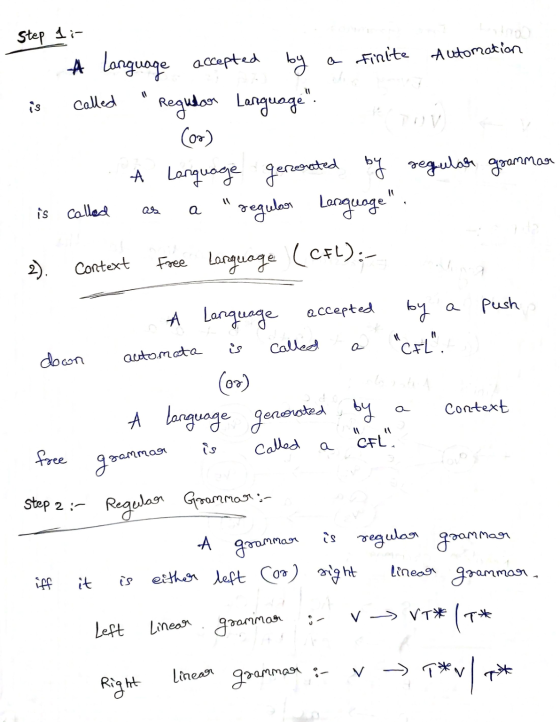
build a regular grammar for L.
Homework Answers
Do like and comment if you have any queries.

Add Answer to:
Answer for element 1 Part B:
b. Give two sample strings with a length of 6...
1. Give a context-free grammar for the set BAL of balanced strings of delimiters of three...
 1. Give a context-free grammar for the set BAL of balanced strings of delimiters of three types (), and . For example, (OOis in BAL but [) is not. Give a nondeterministic pushdown automata that recognizes the set of strings in BAL as defined in problem 1 above. Acceptance should be by accept state. 2. Give a context free grammar for the language L where L-(a"b'am I n>-o and there exists k>-o such that m-2*ktn) 3. Give a nondeterministic pushdown...
DO NUMBER 4 AND 5 2. Let {acgt} and let L be the language of strings consisting of repeated copies of the pairs at, ta,...
 DO NUMBER 4 AND 5
2. Let {acgt} and let L be the language of strings consisting of repeated copies of the pairs at, ta, cg, gc. Construct both a DFSM to accept the language and a regular expression that represents the language 3. Let a,b. For a string w E X", let W denote the string w with the a's and b's flipped. For example, for w aabbab: w bbaaba wR babbaa abaabb {wwR Construct a PDA to accept...
DO NUMBER 4 AND 5
2. Let {acgt} and let L be the language of strings consisting of repeated copies of the pairs at, ta, cg, gc. Construct both a DFSM to accept the language and a regular expression that represents the language 3. Let a,b. For a string w E X", let W denote the string w with the a's and b's flipped. For example, for w aabbab: w bbaaba wR babbaa abaabb {wwR Construct a PDA to accept...
DO NUMBER 3 2. Let {acgt} and let L be the language of strings consisting of repeated copies of the pairs at, ta, cg, g...
 DO NUMBER 3
2. Let {acgt} and let L be the language of strings consisting of repeated copies of the pairs at, ta, cg, gc. Construct both a DFSM to accept the language and a regular expression that represents the language 3. Let a,b. For a string w E X", let W denote the string w with the a's and b's flipped. For example, for w aabbab: w bbaaba wR babbaa abaabb {wwR Construct a PDA to accept the language:...
DO NUMBER 3
2. Let {acgt} and let L be the language of strings consisting of repeated copies of the pairs at, ta, cg, gc. Construct both a DFSM to accept the language and a regular expression that represents the language 3. Let a,b. For a string w E X", let W denote the string w with the a's and b's flipped. For example, for w aabbab: w bbaaba wR babbaa abaabb {wwR Construct a PDA to accept the language:...
1. Consider the alphabet {a,b,c}. Construct a finite automaton that accepts the language described by the...
 1. Consider the alphabet {a,b,c}. Construct a finite automaton that accepts the language described by the following regular expression. 6* (ab U bc)(aa)* ccb* Which of the following strings are in the language: bccc, babbcaacc, cbcaaaaccbb, and bbbbaaaaccccbbb (Give reasons for why the string are or are not in the language). 2. Let G be a context free grammar in Chomsky normal form. Let w be a string produced by that grammar with W = n 1. Prove that the...
Theory of Computation - Push Down Automata (PDA) and Context Free Grammars (CFG) Problem 1. From...
 Theory of Computation - Push Down Automata (PDA) and Context
Free Grammars (CFG)
Problem 1. From a language description to a PDA Show state diagrams of PDAs for the following languages: a. The set of strings over the alphabet fa, b) with twice as many a's as b's. Hint: in class, we showed a PDA when the number of as is the same as the number of bs, based on the idea of a counter. + Can we use a...
Theory of Computation - Push Down Automata (PDA) and Context
Free Grammars (CFG)
Problem 1. From a language description to a PDA Show state diagrams of PDAs for the following languages: a. The set of strings over the alphabet fa, b) with twice as many a's as b's. Hint: in class, we showed a PDA when the number of as is the same as the number of bs, based on the idea of a counter. + Can we use a...
Please answer any 7 of them ТОС Answer any 7 from the followings: 1. Regular expression...
 Please answer any 7 of them
ТОС Answer any 7 from the followings: 1. Regular expression to NFA: i) ab(aUb)* ii) (aba U a)*ab 2. Explain and construct a generalized NFA, 3. NFA to regular expression 0 3 91 93 8 a 4. DFA to regular expression 011 5. Explain the rules of pumping lemma briefly with an example. 6. Give an example of right linear grammar and left linear grammar. 7. L(G) = {1*20 m >= 1 and >=1}....
Please answer any 7 of them
ТОС Answer any 7 from the followings: 1. Regular expression to NFA: i) ab(aUb)* ii) (aba U a)*ab 2. Explain and construct a generalized NFA, 3. NFA to regular expression 0 3 91 93 8 a 4. DFA to regular expression 011 5. Explain the rules of pumping lemma briefly with an example. 6. Give an example of right linear grammar and left linear grammar. 7. L(G) = {1*20 m >= 1 and >=1}....
3 points) Question Three Consider the context-free grammar S >SS+1 SS 1a and the string aa...
 3 points) Question Three Consider the context-free grammar S >SS+1 SS 1a and the string aa Give a leftmost derivation for the string. 3 points) (4 poiots) (5 points) (3 points) sECTION IWOLAttcmpt.any 3.(or 2) questions from this.scction Suppose we have two tokens: (1) the keyword if, and (2) id-entifiers, which are strings of letters other than if. Show the DFA for these tokens. Give a nightmost derivation for the string. Give a parse tree for the string i) Is...
1. Use a Regular Expression to define the set of all bit strings of one or...
 1. Use a Regular Expression to define the set of all bit strings
of one or more 0's followed by only a 1.
2. Use a Regular Expression to define the set of all bit string
of two or more symbols followed by three or more 0's.
3. Are these two grammars the same?
a. S-> aSb|ab|λ
b. S-> aAb|ab A->aAb|λ
4. Use the process of elimination to find the language of the
following FA: (see picture for diagram)
5....
1. Use a Regular Expression to define the set of all bit strings
of one or more 0's followed by only a 1.
2. Use a Regular Expression to define the set of all bit string
of two or more symbols followed by three or more 0's.
3. Are these two grammars the same?
a. S-> aSb|ab|λ
b. S-> aAb|ab A->aAb|λ
4. Use the process of elimination to find the language of the
following FA: (see picture for diagram)
5....
Hi, I need help with part A. Please show all the work, thanks. Decidability 1. Which...
 Hi, I need help with part A. Please show all the work,
thanks.
Decidability 1. Which of the following problems is decidable? Why? a) Given a TM M and a stringy, does M ever write the symbol # on its tape on input y? b) Given a context free grammar G over (a, b), does G generate all the strings of the anguage fa, b* of length s 381? c) Given a context free grammar G over (a, b), does...
Hi, I need help with part A. Please show all the work,
thanks.
Decidability 1. Which of the following problems is decidable? Why? a) Given a TM M and a stringy, does M ever write the symbol # on its tape on input y? b) Given a context free grammar G over (a, b), does G generate all the strings of the anguage fa, b* of length s 381? c) Given a context free grammar G over (a, b), does...
 1. Give a context-free grammar for the set BAL of balanced strings of delimiters of three types (), and . For example, (OOis in BAL but [) is not. Give a nondeterministic pushdown automata that recognizes the set of strings in BAL as defined in problem 1 above. Acceptance should be by accept state. 2. Give a context free grammar for the language L where L-(a"b'am I n>-o and there exists k>-o such that m-2*ktn) 3. Give a nondeterministic pushdown...
 DO NUMBER 4 AND 5
2. Let {acgt} and let L be the language of strings consisting of repeated copies of the pairs at, ta, cg, gc. Construct both a DFSM to accept the language and a regular expression that represents the language 3. Let a,b. For a string w E X", let W denote the string w with the a's and b's flipped. For example, for w aabbab: w bbaaba wR babbaa abaabb {wwR Construct a PDA to accept...
DO NUMBER 4 AND 5
2. Let {acgt} and let L be the language of strings consisting of repeated copies of the pairs at, ta, cg, gc. Construct both a DFSM to accept the language and a regular expression that represents the language 3. Let a,b. For a string w E X", let W denote the string w with the a's and b's flipped. For example, for w aabbab: w bbaaba wR babbaa abaabb {wwR Construct a PDA to accept...
 DO NUMBER 3
2. Let {acgt} and let L be the language of strings consisting of repeated copies of the pairs at, ta, cg, gc. Construct both a DFSM to accept the language and a regular expression that represents the language 3. Let a,b. For a string w E X", let W denote the string w with the a's and b's flipped. For example, for w aabbab: w bbaaba wR babbaa abaabb {wwR Construct a PDA to accept the language:...
DO NUMBER 3
2. Let {acgt} and let L be the language of strings consisting of repeated copies of the pairs at, ta, cg, gc. Construct both a DFSM to accept the language and a regular expression that represents the language 3. Let a,b. For a string w E X", let W denote the string w with the a's and b's flipped. For example, for w aabbab: w bbaaba wR babbaa abaabb {wwR Construct a PDA to accept the language:...
 1. Consider the alphabet {a,b,c}. Construct a finite automaton that accepts the language described by the following regular expression. 6* (ab U bc)(aa)* ccb* Which of the following strings are in the language: bccc, babbcaacc, cbcaaaaccbb, and bbbbaaaaccccbbb (Give reasons for why the string are or are not in the language). 2. Let G be a context free grammar in Chomsky normal form. Let w be a string produced by that grammar with W = n 1. Prove that the...
 Theory of Computation - Push Down Automata (PDA) and Context
Free Grammars (CFG)
Problem 1. From a language description to a PDA Show state diagrams of PDAs for the following languages: a. The set of strings over the alphabet fa, b) with twice as many a's as b's. Hint: in class, we showed a PDA when the number of as is the same as the number of bs, based on the idea of a counter. + Can we use a...
Theory of Computation - Push Down Automata (PDA) and Context
Free Grammars (CFG)
Problem 1. From a language description to a PDA Show state diagrams of PDAs for the following languages: a. The set of strings over the alphabet fa, b) with twice as many a's as b's. Hint: in class, we showed a PDA when the number of as is the same as the number of bs, based on the idea of a counter. + Can we use a...
 Please answer any 7 of them
ТОС Answer any 7 from the followings: 1. Regular expression to NFA: i) ab(aUb)* ii) (aba U a)*ab 2. Explain and construct a generalized NFA, 3. NFA to regular expression 0 3 91 93 8 a 4. DFA to regular expression 011 5. Explain the rules of pumping lemma briefly with an example. 6. Give an example of right linear grammar and left linear grammar. 7. L(G) = {1*20 m >= 1 and >=1}....
Please answer any 7 of them
ТОС Answer any 7 from the followings: 1. Regular expression to NFA: i) ab(aUb)* ii) (aba U a)*ab 2. Explain and construct a generalized NFA, 3. NFA to regular expression 0 3 91 93 8 a 4. DFA to regular expression 011 5. Explain the rules of pumping lemma briefly with an example. 6. Give an example of right linear grammar and left linear grammar. 7. L(G) = {1*20 m >= 1 and >=1}....
 3 points) Question Three Consider the context-free grammar S >SS+1 SS 1a and the string aa Give a leftmost derivation for the string. 3 points) (4 poiots) (5 points) (3 points) sECTION IWOLAttcmpt.any 3.(or 2) questions from this.scction Suppose we have two tokens: (1) the keyword if, and (2) id-entifiers, which are strings of letters other than if. Show the DFA for these tokens. Give a nightmost derivation for the string. Give a parse tree for the string i) Is...
 1. Use a Regular Expression to define the set of all bit strings
of one or more 0's followed by only a 1.
2. Use a Regular Expression to define the set of all bit string
of two or more symbols followed by three or more 0's.
3. Are these two grammars the same?
a. S-> aSb|ab|λ
b. S-> aAb|ab A->aAb|λ
4. Use the process of elimination to find the language of the
following FA: (see picture for diagram)
5....
1. Use a Regular Expression to define the set of all bit strings
of one or more 0's followed by only a 1.
2. Use a Regular Expression to define the set of all bit string
of two or more symbols followed by three or more 0's.
3. Are these two grammars the same?
a. S-> aSb|ab|λ
b. S-> aAb|ab A->aAb|λ
4. Use the process of elimination to find the language of the
following FA: (see picture for diagram)
5....
 Hi, I need help with part A. Please show all the work,
thanks.
Decidability 1. Which of the following problems is decidable? Why? a) Given a TM M and a stringy, does M ever write the symbol # on its tape on input y? b) Given a context free grammar G over (a, b), does G generate all the strings of the anguage fa, b* of length s 381? c) Given a context free grammar G over (a, b), does...
Hi, I need help with part A. Please show all the work,
thanks.
Decidability 1. Which of the following problems is decidable? Why? a) Given a TM M and a stringy, does M ever write the symbol # on its tape on input y? b) Given a context free grammar G over (a, b), does G generate all the strings of the anguage fa, b* of length s 381? c) Given a context free grammar G over (a, b), does...
Most questions answered within 3 hours.
-
Where is the error in this code sequence?
String s1 = "Hello";
String s2 = "ello";...
asked 10 months ago -
Financial data for Joel de Paris, Inc., for last year
follow:
Joel de Paris, Inc.
Balance...
asked 10 months ago -
Consider this reaction:
Al2(SO4)3 (aq)+ BaCl3
(aq) Al2Cl6 (aq)- +
3BaSO4(s) . What is the...
asked 10 months ago -
Suppose that Savneet is considering increasing her
recent random sample from 20 car rentals to 40...
asked 10 months ago -
Trucks arrive at an unloading terminal at an average rate of 120
per hour.
Trucks arrive...
asked 10 months ago -
Why are methanol and ethanol completely soluble in water while
octanol is not very little soluble....
asked 10 months ago -
A facilities manager at a university reads in a research report
that the mean amount of...
asked 10 months ago -
When the CuSO4 is rehydrated by adding water to the anhydrous
compound, is this an endothermic...
asked 10 months ago -
A ray of sunlight is passing from diamond into crown glass; the
angle of incidence is...
asked 10 months ago -
A block of mass 0.249 kg is placed on top of a light, vertical
spring of...
asked 10 months ago -
how do the kidneys compensate in the presences of acidosis
a) trigger hyperventilate
b) reserve acid...
asked 10 months ago -
Question 501 pts
The rental rate of capital to the firm increases. Which of the
following...
asked 10 months ago