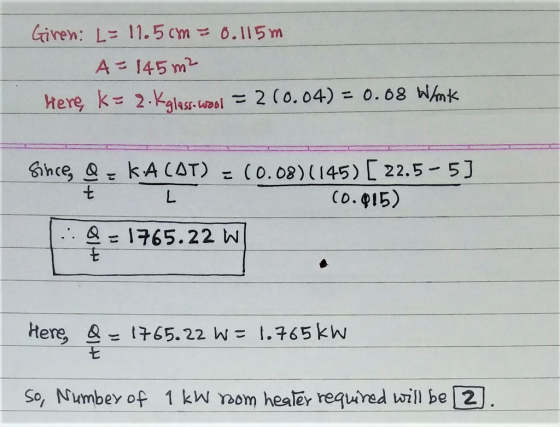
(a) Calculate the rate of heat conduction (in W) through house walls that are 11.5 cm...
(a) Calculate the rate of heat conduction (in W) through house walls that are 11.5 cm thick and that have an average thermal conductivity twice that of glass wool. Assume there are no windows or doors. The surface area of the walls is 145 m2 and their inside surface is at 22.5°C, while their outside surface is at 5.00°C.
(b) How many 1 kW room heaters would be needed to balance the heat transfer due to conduction? (Round your answer to the next whole integer.)
Homework Answers
Alright Dude, If that worked for you... don't forget to give THUMBS
UP.(that will work for me!)
Please Vote...
If I missed something feel free to leave a comment.
atleast before giving down vote.
and, Thanks for using homeworklib- Smarter way to study. And, Wish you
all the Luck for the Final Exams.
Add Answer to:
(a) Calculate the rate of heat conduction (in W) through house
walls that are 11.5 cm...
(a) Calculate the rate of heat conduction through house walls that are 15.5 cm thick and...
(a) Calculate the rate of heat conduction through house walls that are 15.5 cm thick and that have an average thermal conductivity twice that of glass wool. Assume there are no windows or doors. The surface area of the walls is 125 m2 and their inside surface is at 21.0°C, while their outside surface is at 5.00°C. W (b) How many 1-kW room heaters would be needed to balance the heat transfer due to conduction? (Round your answer to the...
(a) Calculate the rate of heat conduction through house walls that are 13.0 cm thick and...
(a) Calculate the rate of heat conduction through house walls that are 13.0 cm thick and that have an average thermal conductivity twice that of glass wool. Assume there are no windows or doors. The surface area of the walls is 120m2 and their inside surface is at 18.0ºC, while their outside surface is at 5.00ºC (b) How many 1-kW room heaters would be needed to balance the heat transfer due to conduction?
14.30 - Conduction Part A Calculate the rate of heat conduction through house walls that are...
 14.30 - Conduction Part A Calculate the rate of heat conduction through house walls that are 13.0 cm thick and that have an average thermal conductivity twice that of glass wool. Assume there are no windows or doors. The surface area of the walls is 290 m2 and their inside surface is at 19.0°C, while their outside surface is at 4.00°C. Submit Answer Tries 0/5 Part B How many 1.0-kw room heaters would be needed to (approximately balance the heat...
Calculate the rate of heat conduction through house walls that are 14.7 cm thick and that...
Calculate the rate of heat conduction through house walls that are 14.7 cm thick and that have an average thermal conductivity of 0.057 J/(s•m•ºC). Assume there are no windows or doors. The surface area of the walls is 136 m2 and their inside surface is at 19.9ºC , while their outside surface is at 4.9ºC .
need help Problem 5: Suppose a house's walls are 14 cm thick and and have an...
 need help
Problem 5: Suppose a house's walls are 14 cm thick and and have an average thermal conductivity twice that of glass wool. Substance Glass wool Wool Glass Human body Ceramic Wood Air Fatty tissue Styrofoam Thermal conductivity (J/s.m.) 0.042 0.04 0.84 0.2 0.84 0.08-0.16 0.023 0.2 0.010 Otheexperta.com Part (a) Calculate the rate of heat conduction, in watts, through the house's walls. Assume there are no windows or doors. The surface area of the walls is 105 m...
need help
Problem 5: Suppose a house's walls are 14 cm thick and and have an average thermal conductivity twice that of glass wool. Substance Glass wool Wool Glass Human body Ceramic Wood Air Fatty tissue Styrofoam Thermal conductivity (J/s.m.) 0.042 0.04 0.84 0.2 0.84 0.08-0.16 0.023 0.2 0.010 Otheexperta.com Part (a) Calculate the rate of heat conduction, in watts, through the house's walls. Assume there are no windows or doors. The surface area of the walls is 105 m...
Compare the rate of heat conduction through a 12 cm thick wall that has an area...
Compare the rate of heat conduction through a 12 cm thick wall that has an area of 15 m2 and a thermal conductivity twice that of glass wool, k=0.042, with the rate of heat conduction through a window, k=0.84, that is 0.8 cm thick and that has an area of 2.75 m2, assuming a temperature difference of 12 °C across each. (a) What is the heat transfer rate through the wall? QtQt = unit (b) What is the heat transfer rate...
Consider the rate of heat conduction through a double-paned window that has a 1.45-m2 area and...
 Consider
the rate of heat conduction through a double-paned window that has
a 1.45-m2 area and is made of two panes of
0.715-cm-thick glass separated by a 1.25-cm air gap. You can ignore
the increased heat transfer in the air gap due to convection.
Calculate the rate of heat conduction through this window, in
watts, given that the inside surface temperature is 15.0°C, while
the outside temperature is -10.0°C. Make the assumption that the
temperature differences across the two glass...
Consider
the rate of heat conduction through a double-paned window that has
a 1.45-m2 area and is made of two panes of
0.715-cm-thick glass separated by a 1.25-cm air gap. You can ignore
the increased heat transfer in the air gap due to convection.
Calculate the rate of heat conduction through this window, in
watts, given that the inside surface temperature is 15.0°C, while
the outside temperature is -10.0°C. Make the assumption that the
temperature differences across the two glass...
(a) Calculate the rate of heat conduction (in W) through a double-paned window that has a...
(a) Calculate the rate of heat conduction (in W) through a double-paned window that has a 5.00 m2 area and is made of two panes of 0.700 cm thick glass separated by a 1.00 cm air gap. The inside surface temperature is 17.0°C, while that on the outside is −20.0°C. (Hint: There are identical temperature drops across the two glass panes. First find these and then the temperature drop across the air gap. This problem ignores the increased heat transfer...
Heat Loss and Heating Costs of a House Part A A house has well-insulated walls 17.1...
 Heat Loss and Heating Costs of a House Part A A house has well-insulated walls 17.1 cm thick (assume conductivity of air) and area 411 m2, a roof of wood б.бб cm thick and area 279 m2, and uncovered windows 0.626 cm thick and total area 33.4 m2. Assuming that the heat loss is only by conduction, calculate the rate at which heat must be supplied to this house to maintain its temperature at 21.4°C if the outside temperature is...
To reduce building heating costs, modern building codes in many parts of the country require the...
 To reduce building heating costs, modern building codes in many parts of the country require the use of double-pane windows (sometimes, called "double-glazed" or "thermopane" windows). Ivpically, a double-pane window consists of two panes of glass separated by a space that contains trapped stagnant air. In one design of a double-pane window, each glass layer is 0.7 cm thick, the stagnant air layer is 2 cm thick, and the area is 4 m2 In the living room of a large...
 14.30 - Conduction Part A Calculate the rate of heat conduction through house walls that are 13.0 cm thick and that have an average thermal conductivity twice that of glass wool. Assume there are no windows or doors. The surface area of the walls is 290 m2 and their inside surface is at 19.0°C, while their outside surface is at 4.00°C. Submit Answer Tries 0/5 Part B How many 1.0-kw room heaters would be needed to (approximately balance the heat...
 need help
Problem 5: Suppose a house's walls are 14 cm thick and and have an average thermal conductivity twice that of glass wool. Substance Glass wool Wool Glass Human body Ceramic Wood Air Fatty tissue Styrofoam Thermal conductivity (J/s.m.) 0.042 0.04 0.84 0.2 0.84 0.08-0.16 0.023 0.2 0.010 Otheexperta.com Part (a) Calculate the rate of heat conduction, in watts, through the house's walls. Assume there are no windows or doors. The surface area of the walls is 105 m...
need help
Problem 5: Suppose a house's walls are 14 cm thick and and have an average thermal conductivity twice that of glass wool. Substance Glass wool Wool Glass Human body Ceramic Wood Air Fatty tissue Styrofoam Thermal conductivity (J/s.m.) 0.042 0.04 0.84 0.2 0.84 0.08-0.16 0.023 0.2 0.010 Otheexperta.com Part (a) Calculate the rate of heat conduction, in watts, through the house's walls. Assume there are no windows or doors. The surface area of the walls is 105 m...
 Consider
the rate of heat conduction through a double-paned window that has
a 1.45-m2 area and is made of two panes of
0.715-cm-thick glass separated by a 1.25-cm air gap. You can ignore
the increased heat transfer in the air gap due to convection.
Calculate the rate of heat conduction through this window, in
watts, given that the inside surface temperature is 15.0°C, while
the outside temperature is -10.0°C. Make the assumption that the
temperature differences across the two glass...
Consider
the rate of heat conduction through a double-paned window that has
a 1.45-m2 area and is made of two panes of
0.715-cm-thick glass separated by a 1.25-cm air gap. You can ignore
the increased heat transfer in the air gap due to convection.
Calculate the rate of heat conduction through this window, in
watts, given that the inside surface temperature is 15.0°C, while
the outside temperature is -10.0°C. Make the assumption that the
temperature differences across the two glass...
 Heat Loss and Heating Costs of a House Part A A house has well-insulated walls 17.1 cm thick (assume conductivity of air) and area 411 m2, a roof of wood б.бб cm thick and area 279 m2, and uncovered windows 0.626 cm thick and total area 33.4 m2. Assuming that the heat loss is only by conduction, calculate the rate at which heat must be supplied to this house to maintain its temperature at 21.4°C if the outside temperature is...
 To reduce building heating costs, modern building codes in many parts of the country require the use of double-pane windows (sometimes, called "double-glazed" or "thermopane" windows). Ivpically, a double-pane window consists of two panes of glass separated by a space that contains trapped stagnant air. In one design of a double-pane window, each glass layer is 0.7 cm thick, the stagnant air layer is 2 cm thick, and the area is 4 m2 In the living room of a large...
Most questions answered within 3 hours.
-
Where is the error in this code sequence?
String s1 = "Hello";
String s2 = "ello";...
asked 11 months ago -
Financial data for Joel de Paris, Inc., for last year
follow:
Joel de Paris, Inc.
Balance...
asked 11 months ago -
Consider this reaction:
Al2(SO4)3 (aq)+ BaCl3
(aq) Al2Cl6 (aq)- +
3BaSO4(s) . What is the...
asked 11 months ago -
Suppose that Savneet is considering increasing her
recent random sample from 20 car rentals to 40...
asked 11 months ago -
Trucks arrive at an unloading terminal at an average rate of 120
per hour.
Trucks arrive...
asked 11 months ago -
Why are methanol and ethanol completely soluble in water while
octanol is not very little soluble....
asked 11 months ago -
A facilities manager at a university reads in a research report
that the mean amount of...
asked 11 months ago -
When the CuSO4 is rehydrated by adding water to the anhydrous
compound, is this an endothermic...
asked 11 months ago -
A ray of sunlight is passing from diamond into crown glass; the
angle of incidence is...
asked 11 months ago -
A block of mass 0.249 kg is placed on top of a light, vertical
spring of...
asked 11 months ago -
how do the kidneys compensate in the presences of acidosis
a) trigger hyperventilate
b) reserve acid...
asked 11 months ago -
Question 501 pts
The rental rate of capital to the firm increases. Which of the
following...
asked 11 months ago