A fuel-air mixture with a fuel-to-air equivalence ratio of 0.6 enters an engine cylinder at 400...
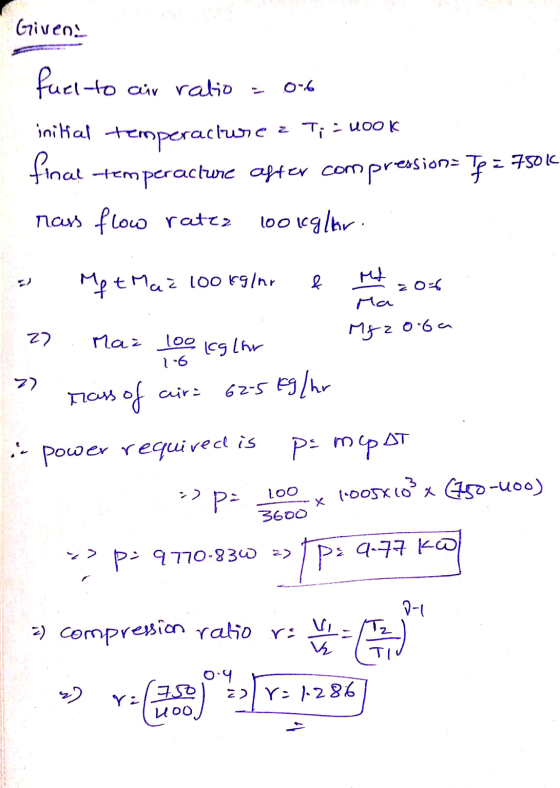
A fuel-air mixture with a fuel-to-air equivalence ratio of 0.6 enters an engine cylinder at 400 K where it is then compressed. After compression the mixture is at 750 K. Calculate the power needed for this compression process if the air mass flow rate is 100 kg/hr. Also calculate the compression ratio for this process.
Textbook : John B. Heywood - Internal Combustion Engine Fundamentals 2nd Edition
Homework Answers
Add Answer to:
A fuel-air mixture with a fuel-to-air equivalence ratio of 0.6
enters an engine cylinder at 400...
Cetane (C16H34) at 25 C is burned with air. The air temperature is 400 C. The...
Cetane (C16H34) at 25 C is burned with air. The air temperature is 400 C. The fuel-to-air equivalence ratio is f=0.50. Calculate the adiabatic flame temperature. Textbook : John B. Heywood - Internal Combustion Engine Fundamentals 2nd Edition
A compression ignition engine is being analyzed. The residual gas fraction is xr=0.02. The fuel-to-air equivalence ratio is...
A compression ignition engine is being analyzed. The residual gas fraction is xr=0.02. The fuel-to-air equivalence ratio is f=0.6. At the end of the compression stroke the temperature is T2=1300 K and specific volume is v2=0.19 m3/kg-air. The maximum cycle pressure is P3=4000 kPa. At the end of the power stroke the specific volume is 1.00 m3/kg-air. Calculate the temperature at the end of the combustion process, T3b, and calculate the work done [kJ/kg-air] during the power stroke.
A 6 cylinder, 4-stroke spark ignition engine operates at 5000 RPM. The engine burns gasoline at...
A 6 cylinder, 4-stroke spark ignition engine operates at 5000 RPM. The engine burns gasoline at the rate of 0.01 kg/s. Each cylinder has a stroke of 8 cm and a bore of 6.5 cm. The indicated fuel conversion efficiency is 28%. The brake mean effective pressure is 800 kPa. Calculate the mechanical efficiency and the brake specific fuel consumption for this engine Using text Book: John B. Heywood - Internal Combustion Engine Fundamental 2nd edition
Problem 1 (65 pts): The cylinder of a Diesel engine is initially filled with air at 100 kPa and 2...
 Problem 1 (65 pts): The cylinder of a Diesel engine is initially filled with air at 100 kPa and 298 K (piston is at BDC). The air is then compressed isentropically with a compression ratio of 20. Fuel, n-dodecane, is then introduced and combusted with the air, which produces work output (i.e. pushes the piston back to BDC). At the end of the power stroke, the temperature of the combustion products is 1020 K. The amount of heat lost to...
. A 4 stroke 4 cylinder spark ignition engine runs on a stoichiometric mixture of ethanol and air...
 . A 4 stroke 4 cylinder spark ignition engine runs on a stoichiometric mixture of ethanol and air at wide open throttle. The 1 liter engine has a compression ratio of 9:1 and operates at 5000 rpm. The intake manifold conditions are standard pressure and temperature, no residual gas in engine combustion chamber. Using k-1.35 for all calculations the a. Calculate the indicated work done by the engine, in joules per cycle b. Calculate the indicated thermal efficiency c. Calculate...
A) Calculate the net work output per kmol fuel. In your analysis, assume that the fuel is introdu...
 A) Calculate the net work output per kmol fuel. In your
analysis, assume that the fuel is introduced as a gas at 298K.
Now consider an Ideal Diesel Cycle that has the same compression
ratio and produces the same net work output as in Problem 1. If the
cycle has a cut-off ratio of 2:
B) Calculate the required heat input per unit mass of air.
C) Find the temperature at each state of the cycle.
Problem 1 (65 pts):...
A) Calculate the net work output per kmol fuel. In your
analysis, assume that the fuel is introduced as a gas at 298K.
Now consider an Ideal Diesel Cycle that has the same compression
ratio and produces the same net work output as in Problem 1. If the
cycle has a cut-off ratio of 2:
B) Calculate the required heat input per unit mass of air.
C) Find the temperature at each state of the cycle.
Problem 1 (65 pts):...
In an internal combustion engine, air at atmospheric pressure and a temperature of about 11 ∘C...
In an internal combustion engine, air at atmospheric pressure and a temperature of about 11 ∘C is compressed in the cylinder by a piston to 1/8 of its original volume (compression ratio = 8.0). Estimate the temperature of the compressed air, assuming the pressure reaches 44 atm . In an internal combustion engine, air at atmospheric pressure and a temperature of about 17 ∘C is compressed in the cylinder by a piston to 1/8 of its original volume (compression ratio...
3. A rich fuel-air ratio of propane in burned in an internal combustion engine. The analysis...
 3. A rich fuel-air ratio of propane in burned in an internal combustion engine. The analysis exhaust gas by the exhaust analyzer shows that CO2 = 17%, C3H8=0.5%, with the rest being N2 and some traces of H20. For this case Calculate: a) Write the balanced chemical equation for propane b) Compute air-fuel ratio and equivalence ratio when the ideal AFR is 14.8 ran
INTERNAL COMBUSTION ENGINES Practice Problems ME 436 A 3 cylinder, 2.7 liter SI engine operates on...
 INTERNAL COMBUSTION ENGINES Practice Problems ME 436 A 3 cylinder, 2.7 liter SI engine operates on a 4 stroke cycle at 3300 RPM with a compression ratio of 8.6:1. At the start of the compression stroke, the temperature is 47°C and the pressure is 82kPa. Assume 3% residual gases. The mechanical efficiency is 81%, combustion efficiency is 96%, and the air-fuel ratio is 16.3, and the fuel heating value is 43,000 kJ/kg. The combustion process starts at TDC and is...
4. Air enters the intake manifold at 25°C and 100 kPa on an SI engine utilizing...
 4. Air enters the intake manifold at 25°C and 100 kPa on an SI engine utilizing throttle body injection. Liquid methanol, CH40, is injected into the intake manifold at an equivalence ratio of 1.1. Assume all the fuel evaporates in the manifold before entering the cylinder. The temperature of the mixture at the entrance to the cylinder is 5°C. a) Calculate how much heat transfer, per kg of air (i.e. kJ/kg air) must be entering the intake manifold. In your...
 Problem 1 (65 pts): The cylinder of a Diesel engine is initially filled with air at 100 kPa and 298 K (piston is at BDC). The air is then compressed isentropically with a compression ratio of 20. Fuel, n-dodecane, is then introduced and combusted with the air, which produces work output (i.e. pushes the piston back to BDC). At the end of the power stroke, the temperature of the combustion products is 1020 K. The amount of heat lost to...
 . A 4 stroke 4 cylinder spark ignition engine runs on a stoichiometric mixture of ethanol and air at wide open throttle. The 1 liter engine has a compression ratio of 9:1 and operates at 5000 rpm. The intake manifold conditions are standard pressure and temperature, no residual gas in engine combustion chamber. Using k-1.35 for all calculations the a. Calculate the indicated work done by the engine, in joules per cycle b. Calculate the indicated thermal efficiency c. Calculate...
 A) Calculate the net work output per kmol fuel. In your
analysis, assume that the fuel is introduced as a gas at 298K.
Now consider an Ideal Diesel Cycle that has the same compression
ratio and produces the same net work output as in Problem 1. If the
cycle has a cut-off ratio of 2:
B) Calculate the required heat input per unit mass of air.
C) Find the temperature at each state of the cycle.
Problem 1 (65 pts):...
A) Calculate the net work output per kmol fuel. In your
analysis, assume that the fuel is introduced as a gas at 298K.
Now consider an Ideal Diesel Cycle that has the same compression
ratio and produces the same net work output as in Problem 1. If the
cycle has a cut-off ratio of 2:
B) Calculate the required heat input per unit mass of air.
C) Find the temperature at each state of the cycle.
Problem 1 (65 pts):...
 3. A rich fuel-air ratio of propane in burned in an internal combustion engine. The analysis exhaust gas by the exhaust analyzer shows that CO2 = 17%, C3H8=0.5%, with the rest being N2 and some traces of H20. For this case Calculate: a) Write the balanced chemical equation for propane b) Compute air-fuel ratio and equivalence ratio when the ideal AFR is 14.8 ran
 INTERNAL COMBUSTION ENGINES Practice Problems ME 436 A 3 cylinder, 2.7 liter SI engine operates on a 4 stroke cycle at 3300 RPM with a compression ratio of 8.6:1. At the start of the compression stroke, the temperature is 47°C and the pressure is 82kPa. Assume 3% residual gases. The mechanical efficiency is 81%, combustion efficiency is 96%, and the air-fuel ratio is 16.3, and the fuel heating value is 43,000 kJ/kg. The combustion process starts at TDC and is...
 4. Air enters the intake manifold at 25°C and 100 kPa on an SI engine utilizing throttle body injection. Liquid methanol, CH40, is injected into the intake manifold at an equivalence ratio of 1.1. Assume all the fuel evaporates in the manifold before entering the cylinder. The temperature of the mixture at the entrance to the cylinder is 5°C. a) Calculate how much heat transfer, per kg of air (i.e. kJ/kg air) must be entering the intake manifold. In your...
Most questions answered within 3 hours.
-
Where is the error in this code sequence?
String s1 = "Hello";
String s2 = "ello";...
asked 11 months ago -
Financial data for Joel de Paris, Inc., for last year
follow:
Joel de Paris, Inc.
Balance...
asked 11 months ago -
Consider this reaction:
Al2(SO4)3 (aq)+ BaCl3
(aq) Al2Cl6 (aq)- +
3BaSO4(s) . What is the...
asked 11 months ago -
Suppose that Savneet is considering increasing her
recent random sample from 20 car rentals to 40...
asked 11 months ago -
Trucks arrive at an unloading terminal at an average rate of 120
per hour.
Trucks arrive...
asked 11 months ago -
Why are methanol and ethanol completely soluble in water while
octanol is not very little soluble....
asked 11 months ago -
A facilities manager at a university reads in a research report
that the mean amount of...
asked 11 months ago -
When the CuSO4 is rehydrated by adding water to the anhydrous
compound, is this an endothermic...
asked 11 months ago -
A ray of sunlight is passing from diamond into crown glass; the
angle of incidence is...
asked 11 months ago -
A block of mass 0.249 kg is placed on top of a light, vertical
spring of...
asked 11 months ago -
how do the kidneys compensate in the presences of acidosis
a) trigger hyperventilate
b) reserve acid...
asked 11 months ago -
Question 501 pts
The rental rate of capital to the firm increases. Which of the
following...
asked 11 months ago