
Homework Answers
ANSWER- 29- ( a ) ( complimentary base pairing )\
-- Chargaff rule is based on complimentary base pairing, adenine is the complimentary base of thymine in DNA and of uracil in RNA, guanine is the complimentary basee of cytosine ( A=T, G=C in DNA ), ( A=U, G=C in RNA )
Add Answer to:
Question 29
C. Ribosomes Cytoplasm membrane 29. Chargaff rules refer to: a. Complimentary base pairing b....
Question 29 (1 point) Base pairing between an A and a C: Never happens Involves hydrogen...
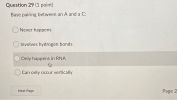 Question 29 (1 point) Base pairing between an A and a C: Never happens Involves hydrogen bonds Only happens in RNA Can only occur vertically Next Page Page 2
1. Transcription occurs in the a. Nucleus. b. Ribosomes of the Rough Endoplasmic Reticulum. c. Mitochondrion....
1. Transcription occurs in the a. Nucleus. b. Ribosomes of the Rough Endoplasmic Reticulum. c. Mitochondrion. d. Cell membrane. e. Smooth Endoplasmic Reticulum. 2. The monomers of DNA and RNA are a. amino acids. b. monosaccharides. c. nucleotides. d. fatty acids. e. nucleic acids. 3. Which of the following statements regarding DNA is false? a. DNA uses the nitrogenous base uracil. b. DNA is a nucleic acid. c. One DNA molecule can include four different nucleotides in its structure. d....
Which is NOT a structure associated with bacteria? membrane cell wall nucleolus nucleoid none are found...
 Which is NOT a structure associated with bacteria? membrane cell wall nucleolus nucleoid none are found m bacteria) modifies molecules such as proteins and lipids for secretion (release from the cell) Chloroplast Golgi apparatus lysosomc Mrtochondren none Energy extraction from nutrients; site of cellular respiration; produces ATP Chloroplast Golgi apparatus lysosome Mitochondrion none Endomembrane Involved in lipid and steroid synthesis Lysosome Peroxisome smooth ER Ribosome rough ER Translates mRNA into protein Lysosome Peroxisome smooth ER Ribosome rough ER Meiosis is...
What are the three functional groups that comprise a nucleotide? What do nucleotides have in common...
What are the three functional groups that comprise a nucleotide? What do nucleotides have in common with amino acids or simple sugars? When the structure of DNA was first elucidated, many biologists quickly saw how this structure explained the passage of information from one generation to another. How does the structure of DNA explain generation-to-generation flow of information? In other words, give a brief description of the structure of DNA and tell how this structure allows for replication. Which of...
Namer A) alternating sugar and nitrogen bases liked by peptide bonds B) complimentary bases held ...
 Namer A) alternating sugar and nitrogen bases liked by peptide bonds B) complimentary bases held together by hydrogen bonds 6) The backbone of a niacleic acid strand consists of: alternating sugar and phosphate groups linked by phosphate ester bonds D) alternating nitrogen bases and phosphate groups linked by amide bonds Q 7) 刁what amino acids are involved in the following tripeptide? NH-CH-C-NH-CH-- CH NH OH D) His-Lys-Phe A) Tyr-His-Lys C) Lys-His-Tyr B) Lys-His-Phe 8) Which list contains only neutral polar...
Please answer 65 - 71!! Thank you! 65) base. Guanine is a base and uracil is...
 Please answer 65 - 71!! Thank you!
65) base. Guanine is a base and uracil is a purine. purine b. purine, pyrimidine pyrimidine, purine pyrimidine, pyrimidine d. 66) a. Adenine is found in both RNA and DNA b. only RNA Only DNA 67) C. d The transmission of information from DNA to mRNA is called replication b. transcription translation 68) In the double helix the individual chains of polydeoxyribonucleotides are connected a. 5 to 3 and 3 to 5 b....
Please answer 65 - 71!! Thank you!
65) base. Guanine is a base and uracil is a purine. purine b. purine, pyrimidine pyrimidine, purine pyrimidine, pyrimidine d. 66) a. Adenine is found in both RNA and DNA b. only RNA Only DNA 67) C. d The transmission of information from DNA to mRNA is called replication b. transcription translation 68) In the double helix the individual chains of polydeoxyribonucleotides are connected a. 5 to 3 and 3 to 5 b....
Answer the questions: Question 1 Transcription begins at the..... a. operon o b. repressor c. genome...
 Answer the questions:
Question 1 Transcription begins at the..... a. operon o b. repressor c. genome 17d. promoter Question 2 0.5 points Save RNA is synthesized on a DNA template in a process called replication, DNA polymerase translation, RNA polymerase transcription, RNA polymerise t ranscription, DNA polymerase Question 3 Which eukaryotic RNA polymerase makes tRNA's? a RNA polymerase IIIb. Any of these RNA polymerase I od RNA polymerase II A Moving to another question will save this response. Question 4...
Answer the questions:
Question 1 Transcription begins at the..... a. operon o b. repressor c. genome 17d. promoter Question 2 0.5 points Save RNA is synthesized on a DNA template in a process called replication, DNA polymerase translation, RNA polymerase transcription, RNA polymerise t ranscription, DNA polymerase Question 3 Which eukaryotic RNA polymerase makes tRNA's? a RNA polymerase IIIb. Any of these RNA polymerase I od RNA polymerase II A Moving to another question will save this response. Question 4...
8. Glycolysis is a(n). A) five-step B) aerobic process C) catabolic D) anaerobic 9. The overall...
 8. Glycolysis is a(n). A) five-step B) aerobic process C) catabolic D) anaerobic 9. The overall process of glycolysis A) produces CO B) is an anabolic pathway C) uses up 4 ATP molecules. D) produces 2 ATP molecules. 10. In step 9 of glycolysis, 2-phosphoglycerate is converted to phosphoenolpyruvate by a(n) reaction ) hydrolysis D) oxidation A) elimination B) addition 11. The nucleotides in the backbone of DNA are held together by A) phosphodiester B) hydrogen bonds D) peptide C)...
a. chromosomes plasmids C. ribosomes d. messenger RNA 14. Protein synthesis in prokaryotes is associated with...
 a. chromosomes plasmids C. ribosomes d. messenger RNA 14. Protein synthesis in prokaryotes is associated with @Ribosomes b. Centrioles and vacuoles c. Nucleus and cell membrane d. Lysosomes and centrioles 15. Differential stains are a Gram stain and acid fast stain B. Gram stain c. Acid fast stain d. Capsule and flagella stain 16. The correct order of the Gram stain is @ Crystal violet Iodine- ethyl alcohol f rei b) Crystal violet---> ethyl alcohol- safranin → Iodine c) Safranin→...
s141) Which nucleotide is used for energy to drive protein synthesis? A) TTP B) CTP C)...
s141) Which nucleotide is used for energy to drive protein synthesis? A) TTP B) CTP C) UTP D) GTP 2) Ribosomal RNA: A) Can bind to prokaryotic mRNA B) Plays no role in peptidyl transferase activity C) In eukaryotes, attaches to mRNA before transcription is completed D) All of the above 3) Spliceosomes: A) Are 40-60S, about the size of ribosomal subutnit B) Are necesssary for DNA replication C) Bind to RNA Polymerase D) Are composed entirely of proteins E)...
 Question 29 (1 point) Base pairing between an A and a C: Never happens Involves hydrogen bonds Only happens in RNA Can only occur vertically Next Page Page 2
 Which is NOT a structure associated with bacteria? membrane cell wall nucleolus nucleoid none are found m bacteria) modifies molecules such as proteins and lipids for secretion (release from the cell) Chloroplast Golgi apparatus lysosomc Mrtochondren none Energy extraction from nutrients; site of cellular respiration; produces ATP Chloroplast Golgi apparatus lysosome Mitochondrion none Endomembrane Involved in lipid and steroid synthesis Lysosome Peroxisome smooth ER Ribosome rough ER Translates mRNA into protein Lysosome Peroxisome smooth ER Ribosome rough ER Meiosis is...
 Namer A) alternating sugar and nitrogen bases liked by peptide bonds B) complimentary bases held together by hydrogen bonds 6) The backbone of a niacleic acid strand consists of: alternating sugar and phosphate groups linked by phosphate ester bonds D) alternating nitrogen bases and phosphate groups linked by amide bonds Q 7) 刁what amino acids are involved in the following tripeptide? NH-CH-C-NH-CH-- CH NH OH D) His-Lys-Phe A) Tyr-His-Lys C) Lys-His-Tyr B) Lys-His-Phe 8) Which list contains only neutral polar...
 Please answer 65 - 71!! Thank you!
65) base. Guanine is a base and uracil is a purine. purine b. purine, pyrimidine pyrimidine, purine pyrimidine, pyrimidine d. 66) a. Adenine is found in both RNA and DNA b. only RNA Only DNA 67) C. d The transmission of information from DNA to mRNA is called replication b. transcription translation 68) In the double helix the individual chains of polydeoxyribonucleotides are connected a. 5 to 3 and 3 to 5 b....
Please answer 65 - 71!! Thank you!
65) base. Guanine is a base and uracil is a purine. purine b. purine, pyrimidine pyrimidine, purine pyrimidine, pyrimidine d. 66) a. Adenine is found in both RNA and DNA b. only RNA Only DNA 67) C. d The transmission of information from DNA to mRNA is called replication b. transcription translation 68) In the double helix the individual chains of polydeoxyribonucleotides are connected a. 5 to 3 and 3 to 5 b....
 Answer the questions:
Question 1 Transcription begins at the..... a. operon o b. repressor c. genome 17d. promoter Question 2 0.5 points Save RNA is synthesized on a DNA template in a process called replication, DNA polymerase translation, RNA polymerase transcription, RNA polymerise t ranscription, DNA polymerase Question 3 Which eukaryotic RNA polymerase makes tRNA's? a RNA polymerase IIIb. Any of these RNA polymerase I od RNA polymerase II A Moving to another question will save this response. Question 4...
Answer the questions:
Question 1 Transcription begins at the..... a. operon o b. repressor c. genome 17d. promoter Question 2 0.5 points Save RNA is synthesized on a DNA template in a process called replication, DNA polymerase translation, RNA polymerase transcription, RNA polymerise t ranscription, DNA polymerase Question 3 Which eukaryotic RNA polymerase makes tRNA's? a RNA polymerase IIIb. Any of these RNA polymerase I od RNA polymerase II A Moving to another question will save this response. Question 4...
 8. Glycolysis is a(n). A) five-step B) aerobic process C) catabolic D) anaerobic 9. The overall process of glycolysis A) produces CO B) is an anabolic pathway C) uses up 4 ATP molecules. D) produces 2 ATP molecules. 10. In step 9 of glycolysis, 2-phosphoglycerate is converted to phosphoenolpyruvate by a(n) reaction ) hydrolysis D) oxidation A) elimination B) addition 11. The nucleotides in the backbone of DNA are held together by A) phosphodiester B) hydrogen bonds D) peptide C)...
 a. chromosomes plasmids C. ribosomes d. messenger RNA 14. Protein synthesis in prokaryotes is associated with @Ribosomes b. Centrioles and vacuoles c. Nucleus and cell membrane d. Lysosomes and centrioles 15. Differential stains are a Gram stain and acid fast stain B. Gram stain c. Acid fast stain d. Capsule and flagella stain 16. The correct order of the Gram stain is @ Crystal violet Iodine- ethyl alcohol f rei b) Crystal violet---> ethyl alcohol- safranin → Iodine c) Safranin→...
Most questions answered within 3 hours.
-
Where is the error in this code sequence?
String s1 = "Hello";
String s2 = "ello";...
asked 10 months ago -
Financial data for Joel de Paris, Inc., for last year
follow:
Joel de Paris, Inc.
Balance...
asked 10 months ago -
Consider this reaction:
Al2(SO4)3 (aq)+ BaCl3
(aq) Al2Cl6 (aq)- +
3BaSO4(s) . What is the...
asked 10 months ago -
Suppose that Savneet is considering increasing her
recent random sample from 20 car rentals to 40...
asked 10 months ago -
Trucks arrive at an unloading terminal at an average rate of 120
per hour.
Trucks arrive...
asked 10 months ago -
Why are methanol and ethanol completely soluble in water while
octanol is not very little soluble....
asked 10 months ago -
A facilities manager at a university reads in a research report
that the mean amount of...
asked 10 months ago -
When the CuSO4 is rehydrated by adding water to the anhydrous
compound, is this an endothermic...
asked 10 months ago -
A ray of sunlight is passing from diamond into crown glass; the
angle of incidence is...
asked 10 months ago -
A block of mass 0.249 kg is placed on top of a light, vertical
spring of...
asked 10 months ago -
how do the kidneys compensate in the presences of acidosis
a) trigger hyperventilate
b) reserve acid...
asked 10 months ago -
Question 501 pts
The rental rate of capital to the firm increases. Which of the
following...
asked 10 months ago