
Homework Answers
Add Answer to:
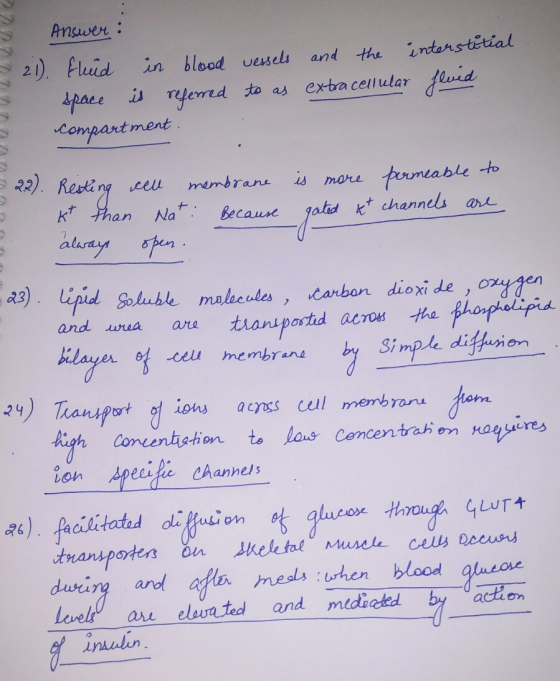
21. The fluid in blood vessels and the Interstitial space is referred to as: a. The...
During the aerobic metabolism of glucose, glucose is ____________. Reduced to form water Oxidized to form...
During the aerobic metabolism of glucose, glucose is ____________. Reduced to form water Oxidized to form water Reduced to form CO2 Oxidized to form CO2 Which of the following describes the equation: FAD + XH2 à FADH2 + X. FAD is reduced to FADH2 It is a coupled reduction – oxidation reaction XH2 is oxidized to X All of the above Which of the following is FALSE about glycolysis? The initial steps of glycolysis requires energy derived from the splitting...
How does facilitated diffusion differ from simple diffusion? Facilitated diffusion requires ATP Facilitated diffusion requires a...
How does facilitated diffusion differ from simple diffusion? Facilitated diffusion requires ATP Facilitated diffusion requires a solute-specific protein carrier Facilitated diffusion transports solute against its’ concentration gradient Which of the following is TRUE about primary active cell membrane transport? It is a form of transport that requires a protein “pump” It is a form of transport that transports ions and/or solute against their concentration gradient It is a transport mechanism that requires energy released from the splitting of ATP by...
need help for questions 21, 23, and 24 21. For a eukaryotic cell (an animal), an...
 need help for questions 21, 23, and 24
21. For a eukaryotic cell (an animal), an excess of glucose would be stored as g glucose would be stored as glycogen by a) glycogen lysis enzymes in liposomes an enzyme that binds to cellulose, c) storage in the Golgi apparatus, d) glycogen stored in the mesosomes that contaln dehydration synthesis enzymes, e) by organelles that contain dehydration synthesis enzymes 22. The molecule ATP is important because it is the energy source...
need help for questions 21, 23, and 24
21. For a eukaryotic cell (an animal), an excess of glucose would be stored as g glucose would be stored as glycogen by a) glycogen lysis enzymes in liposomes an enzyme that binds to cellulose, c) storage in the Golgi apparatus, d) glycogen stored in the mesosomes that contaln dehydration synthesis enzymes, e) by organelles that contain dehydration synthesis enzymes 22. The molecule ATP is important because it is the energy source...
Please answer the following questions for numbers 7-9. If you are not sure please write it...
 Please answer the following questions for numbers 7-9. If you
are not sure please write it next to the problem number. I am a
little confused with these. I will rate good!
. If the membrane shown in the beakers below is only permeable to Na", and the beaker on the left epresents the initial state, which of the following will occur over time? Na A, a. Na will diffuse to the left side of the membrane, causing a net...
Please answer the following questions for numbers 7-9. If you
are not sure please write it next to the problem number. I am a
little confused with these. I will rate good!
. If the membrane shown in the beakers below is only permeable to Na", and the beaker on the left epresents the initial state, which of the following will occur over time? Na A, a. Na will diffuse to the left side of the membrane, causing a net...
For a substance crossing a cell membrane, the chemical driving force Select one: a. depends only...
For a substance crossing a cell membrane, the chemical driving force Select one: a. depends only on the concentration gradient if the substance is uncharged, but also depends on the electrical force if the substance is an ion. b. is the force that pushes molecules across the membrane, but only if the substance is actively transported. c. depends only on the concentration gradient, regardless of whether or not the substance is an ion d. is the total driving force on...
Why are biological membranes considered to be “fluid mosaics”? - Discuss two factors that may determine...
Why are biological membranes considered to be “fluid mosaics”? - Discuss two factors that may determine membrane fluidity. - Draw labeled diagrams to illustrate: the Fluid-mosaic model of biological membranes three types of transport proteins - How does ATP provide chemical energy for active transport? - Discuss similarities and differences between any of the following pairs: soluble (globular) proteins vs. integral membrane proteins ,channel proteins vs. carrier proteins, active transport vs. facilitated diffusion ion pumps vs. ion channels and endocytosis...
33) Which of the following is most likely true of a protein that cotransports glucose and...
 33) Which of the following is most likely true of a protein that cotransports glucose and sodium ions into the intestinal cells of an animal? A) Sodium and glucose bind to the same site on the cotransporter. B) Transport of glucose against its concentration gradient provides energy for uptake of sodium ions against the electrochemical gradient. C) Sodium ions can be transported whether or not glucose is present outside the cell, but glucose transport requires cotransport of sodium ions. D)...
MEMBRANE STRUCTURE AND TRANSPORT ACROSS CELL MEMBRANES 1. An organelle that is characterized by extensive, folded...
 MEMBRANE STRUCTURE AND TRANSPORT ACROSS CELL MEMBRANES 1. An organelle that is characterized by extensive, folded membranes and is often associated with ribosomes 2. Label the following diagram Qutsde of cel LE nside of cell 3. List 4 functions of the plasma membrane c. d. 4. Complete the table below with the role cach component of the plasma membrane plays Plasma membrane components Role in the membrane Phospholipid Bilayer Cholesterol Glycopeoteins Glycolipids Protein Receptor Site Protein channel Protein Carrier 5....
When glucose moves across a phospholipid bilayer by passive transport, which factor determines the direction of...
 When glucose moves across a phospholipid bilayer by passive transport, which factor determines the direction of its transport? Choose one: A. the charge difference across the membrane B. whether the cell is metabolically active or not C. the amount of energy available to fuel the transport process D. the concentrations of glucose on either side of the membrane
A correct distinction between facilitated diffusion and active transport of a substance across a biological membrane...
A correct distinction between facilitated diffusion and active transport of a substance across a biological membrane is that . . . A. active transport requires conformational changes in the transport protein associated with the transport process, and facillitated diffusion does not. B. active transport requires integral membrane protein to carry out the transport, and facillitated diffusion does not. C. facilitated diffusion depends on an existing energy gradient acting on the transported substance, while active transport makes such a gradient. D....
 need help for questions 21, 23, and 24
21. For a eukaryotic cell (an animal), an excess of glucose would be stored as g glucose would be stored as glycogen by a) glycogen lysis enzymes in liposomes an enzyme that binds to cellulose, c) storage in the Golgi apparatus, d) glycogen stored in the mesosomes that contaln dehydration synthesis enzymes, e) by organelles that contain dehydration synthesis enzymes 22. The molecule ATP is important because it is the energy source...
need help for questions 21, 23, and 24
21. For a eukaryotic cell (an animal), an excess of glucose would be stored as g glucose would be stored as glycogen by a) glycogen lysis enzymes in liposomes an enzyme that binds to cellulose, c) storage in the Golgi apparatus, d) glycogen stored in the mesosomes that contaln dehydration synthesis enzymes, e) by organelles that contain dehydration synthesis enzymes 22. The molecule ATP is important because it is the energy source...
 Please answer the following questions for numbers 7-9. If you
are not sure please write it next to the problem number. I am a
little confused with these. I will rate good!
. If the membrane shown in the beakers below is only permeable to Na", and the beaker on the left epresents the initial state, which of the following will occur over time? Na A, a. Na will diffuse to the left side of the membrane, causing a net...
Please answer the following questions for numbers 7-9. If you
are not sure please write it next to the problem number. I am a
little confused with these. I will rate good!
. If the membrane shown in the beakers below is only permeable to Na", and the beaker on the left epresents the initial state, which of the following will occur over time? Na A, a. Na will diffuse to the left side of the membrane, causing a net...
 33) Which of the following is most likely true of a protein that cotransports glucose and sodium ions into the intestinal cells of an animal? A) Sodium and glucose bind to the same site on the cotransporter. B) Transport of glucose against its concentration gradient provides energy for uptake of sodium ions against the electrochemical gradient. C) Sodium ions can be transported whether or not glucose is present outside the cell, but glucose transport requires cotransport of sodium ions. D)...
 MEMBRANE STRUCTURE AND TRANSPORT ACROSS CELL MEMBRANES 1. An organelle that is characterized by extensive, folded membranes and is often associated with ribosomes 2. Label the following diagram Qutsde of cel LE nside of cell 3. List 4 functions of the plasma membrane c. d. 4. Complete the table below with the role cach component of the plasma membrane plays Plasma membrane components Role in the membrane Phospholipid Bilayer Cholesterol Glycopeoteins Glycolipids Protein Receptor Site Protein channel Protein Carrier 5....
 When glucose moves across a phospholipid bilayer by passive transport, which factor determines the direction of its transport? Choose one: A. the charge difference across the membrane B. whether the cell is metabolically active or not C. the amount of energy available to fuel the transport process D. the concentrations of glucose on either side of the membrane
Most questions answered within 3 hours.
-
Where is the error in this code sequence?
String s1 = "Hello";
String s2 = "ello";...
asked 11 months ago -
Financial data for Joel de Paris, Inc., for last year
follow:
Joel de Paris, Inc.
Balance...
asked 11 months ago -
Consider this reaction:
Al2(SO4)3 (aq)+ BaCl3
(aq) Al2Cl6 (aq)- +
3BaSO4(s) . What is the...
asked 11 months ago -
Suppose that Savneet is considering increasing her
recent random sample from 20 car rentals to 40...
asked 11 months ago -
Trucks arrive at an unloading terminal at an average rate of 120
per hour.
Trucks arrive...
asked 11 months ago -
Why are methanol and ethanol completely soluble in water while
octanol is not very little soluble....
asked 11 months ago -
A facilities manager at a university reads in a research report
that the mean amount of...
asked 11 months ago -
When the CuSO4 is rehydrated by adding water to the anhydrous
compound, is this an endothermic...
asked 11 months ago -
A ray of sunlight is passing from diamond into crown glass; the
angle of incidence is...
asked 11 months ago -
A block of mass 0.249 kg is placed on top of a light, vertical
spring of...
asked 11 months ago -
how do the kidneys compensate in the presences of acidosis
a) trigger hyperventilate
b) reserve acid...
asked 11 months ago -
Question 501 pts
The rental rate of capital to the firm increases. Which of the
following...
asked 11 months ago