
Homework Answers
A) By Newtons law of Gravitation,
F = Gm1m2/r^2
= 6.67e-11*0.25*0.25/r^2
= 4.17*10^-12/r^2
Here r is distance between the masses whoch would have been given in the experiment.
Here F is so small with any r, that we can ignore them.
So the only significant forces will be Tension and weight mg.
Weight mg =0.25*9.8 = 2.45N acts downwards always.
Add Answer to:
Calculations: Experiment 1: For a mass of 250 grams hung at 0 degrees and another 250...
a 5kg mass is hung from ceiling with two wires. the wires make a 45 degrees...
a 5kg mass is hung from ceiling with two wires. the wires make a 45 degrees angle with ceiling. the angle between the wires is 90. what is the magnitude of the net force on ceiling due to mass hanging on the two wires ?
A sign with a mass of 1 kg is hung by two ropes and hangs in...
A sign with a mass of 1 kg is hung by two ropes and hangs in equilibrium. Rope 1 (on the right in the sketch) is at an angle of 28 degrees from the horizontal. Rope 2 is hung vertically, goes through the ceiling, and by pulleys, is also connected horizontally to the side of the sign. In addition, a force of 22 Newtons is applied vertically downwards to the sign. What is the tension in rope 2 in Newtons?
1) Two masses are suspended on a force table. One is 250 g and is hung...
 1) Two masses are suspended on a force table. One is 250 g and is hung at the 30" mark. A second is 300 g and is hung at the 75" mark. What force must be applied to balance the table and where should it be applied?
140 grams = 1.372 N at 0 degrees. 200 grams = 1.96 N at 160 degrees....
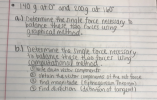 140 grams = 1.372 N at 0 degrees. 200 grams = 1.96 N at 160
degrees. For part a use a scale of 1N=3cm
a.) Determine the single force necessany to grahcl mtod. fites unng b. Determine he ngle force necessary balance o balance these Kwo forcer unng computationalnehod : Write doon vecc Compments 2 obtain the v 3 ind m ector components ot the net focce ude tyhagurean Thtoe Find diréchon (dehnirthon of tangent)
140 grams = 1.372 N at 0 degrees. 200 grams = 1.96 N at 160
degrees. For part a use a scale of 1N=3cm
a.) Determine the single force necessany to grahcl mtod. fites unng b. Determine he ngle force necessary balance o balance these Kwo forcer unng computationalnehod : Write doon vecc Compments 2 obtain the v 3 ind m ector components ot the net focce ude tyhagurean Thtoe Find diréchon (dehnirthon of tangent)
Recall the experiment activities. In the experiment, you have a meterstick of mass 64.9 grams. You...
 Recall the experiment activities. In the experiment, you have a meterstick of mass 64.9 grams. You found its center of mass is at 49.6cm. If the meterstick is pivoted at the 10cm mark, What is the torque magnitude (in unit of Nm) by the weight of the meterstick?
(ex) A point charge q,3.0nC is located on the x-axis at (-0.40 m, 0) and another...
 (ex) A point charge q,3.0nC is located on the x-axis at (-0.40 m, 0) and another point charge 42-+3.0nC is located at (+0.40 m, 0). (a) What are the magnitude and direction of the net electric field (caused by these two charges) on the y-axis at (0, +0.30 m)? (b) A third point charge q, =-60 nC is placed on the y-axis at (0, +0.30 m). What are the magnitude and direction of the net electric force (caused by the...
When a 2 kg mass is hung on a vertical spring, it extends the spring by...
When a 2 kg mass is hung on a vertical spring, it extends the spring by 2.00 m. A) What is the magnitude of the force on the mass due to the spring? N Tries 0/2 B) What is the spring constant of the spring? (Assume g = 10m/s2). N/m Tries 0/2 C) What is the angular velocity ω of the mass when it oscillates back and forth on this spring? s-1
What is the X-component of a force 27 N acting at an angle of 58 degrees....
 What is the X-component of a force 27 N acting at an angle of 58 degrees. Question 6 2 pts If a resultant of two forces in the experiment comes to 300 g at 30 degrees, what is the magnitude and direction of the Equilibrant? (give answer in grams, and the angle as counterclockwise from the X-axis)
A mass of 484 grams is sitting on a hill with an angle of incline of...
A mass of 484 grams is sitting on a hill with an angle of incline of 24.2 degrees. What is the magnitude of the gravity force into the hill? If there is only gravity and friction, this is also the magnitude of the normal force. The unit in newtons. Only give me the number here, not the unit.
A block with mass m =7.5 kg is hung from a vertical spring. When the mass...
 A block with mass m =7.5 kg is hung from a vertical spring. When
the mass hangs in equilibrium, the spring stretches x = 0.27 m.
While at this equilibrium position, the mass is then given an
initial push downward at v = 4.2 m/s. The block oscillates on the
spring without friction.
3) After t = 0.32 s what is the speed of the block?
5) At t = 0.32 s what is the magnitude of the net force...
A block with mass m =7.5 kg is hung from a vertical spring. When
the mass hangs in equilibrium, the spring stretches x = 0.27 m.
While at this equilibrium position, the mass is then given an
initial push downward at v = 4.2 m/s. The block oscillates on the
spring without friction.
3) After t = 0.32 s what is the speed of the block?
5) At t = 0.32 s what is the magnitude of the net force...
 1) Two masses are suspended on a force table. One is 250 g and is hung at the 30" mark. A second is 300 g and is hung at the 75" mark. What force must be applied to balance the table and where should it be applied?
 140 grams = 1.372 N at 0 degrees. 200 grams = 1.96 N at 160
degrees. For part a use a scale of 1N=3cm
a.) Determine the single force necessany to grahcl mtod. fites unng b. Determine he ngle force necessary balance o balance these Kwo forcer unng computationalnehod : Write doon vecc Compments 2 obtain the v 3 ind m ector components ot the net focce ude tyhagurean Thtoe Find diréchon (dehnirthon of tangent)
140 grams = 1.372 N at 0 degrees. 200 grams = 1.96 N at 160
degrees. For part a use a scale of 1N=3cm
a.) Determine the single force necessany to grahcl mtod. fites unng b. Determine he ngle force necessary balance o balance these Kwo forcer unng computationalnehod : Write doon vecc Compments 2 obtain the v 3 ind m ector components ot the net focce ude tyhagurean Thtoe Find diréchon (dehnirthon of tangent)
 Recall the experiment activities. In the experiment, you have a meterstick of mass 64.9 grams. You found its center of mass is at 49.6cm. If the meterstick is pivoted at the 10cm mark, What is the torque magnitude (in unit of Nm) by the weight of the meterstick?
 (ex) A point charge q,3.0nC is located on the x-axis at (-0.40 m, 0) and another point charge 42-+3.0nC is located at (+0.40 m, 0). (a) What are the magnitude and direction of the net electric field (caused by these two charges) on the y-axis at (0, +0.30 m)? (b) A third point charge q, =-60 nC is placed on the y-axis at (0, +0.30 m). What are the magnitude and direction of the net electric force (caused by the...
 What is the X-component of a force 27 N acting at an angle of 58 degrees. Question 6 2 pts If a resultant of two forces in the experiment comes to 300 g at 30 degrees, what is the magnitude and direction of the Equilibrant? (give answer in grams, and the angle as counterclockwise from the X-axis)
 A block with mass m =7.5 kg is hung from a vertical spring. When
the mass hangs in equilibrium, the spring stretches x = 0.27 m.
While at this equilibrium position, the mass is then given an
initial push downward at v = 4.2 m/s. The block oscillates on the
spring without friction.
3) After t = 0.32 s what is the speed of the block?
5) At t = 0.32 s what is the magnitude of the net force...
A block with mass m =7.5 kg is hung from a vertical spring. When
the mass hangs in equilibrium, the spring stretches x = 0.27 m.
While at this equilibrium position, the mass is then given an
initial push downward at v = 4.2 m/s. The block oscillates on the
spring without friction.
3) After t = 0.32 s what is the speed of the block?
5) At t = 0.32 s what is the magnitude of the net force...
Most questions answered within 3 hours.
-
Where is the error in this code sequence?
String s1 = "Hello";
String s2 = "ello";...
asked 11 months ago -
Financial data for Joel de Paris, Inc., for last year
follow:
Joel de Paris, Inc.
Balance...
asked 11 months ago -
Consider this reaction:
Al2(SO4)3 (aq)+ BaCl3
(aq) Al2Cl6 (aq)- +
3BaSO4(s) . What is the...
asked 11 months ago -
Suppose that Savneet is considering increasing her
recent random sample from 20 car rentals to 40...
asked 11 months ago -
Trucks arrive at an unloading terminal at an average rate of 120
per hour.
Trucks arrive...
asked 11 months ago -
Why are methanol and ethanol completely soluble in water while
octanol is not very little soluble....
asked 11 months ago -
A facilities manager at a university reads in a research report
that the mean amount of...
asked 11 months ago -
When the CuSO4 is rehydrated by adding water to the anhydrous
compound, is this an endothermic...
asked 11 months ago -
A ray of sunlight is passing from diamond into crown glass; the
angle of incidence is...
asked 11 months ago -
A block of mass 0.249 kg is placed on top of a light, vertical
spring of...
asked 11 months ago -
how do the kidneys compensate in the presences of acidosis
a) trigger hyperventilate
b) reserve acid...
asked 11 months ago -
Question 501 pts
The rental rate of capital to the firm increases. Which of the
following...
asked 11 months ago